If you’re planning your trip to Japan and wondering things to do in Nara, you’ve come to the right place. Nara was our day trip from Osaka, and we admit that at first, we weren’t sure about it. We almost skipped it. That would have been a huge mistake! Because Nara stole our hearts in a way we never expected.
The city was Japan’s first permanent capital back in the 8th century, and today it coexists between ancient history and something absolutely unique: hundreds of wild deer walking the streets alongside tourists, as if they were the true owners of the place. Spoiler: in a way, they are.
We arrived from Osaka by train and had a full day to explore it. It was enough for the main highlights, but honestly… you enjoy it much more with more time. In this guide, we’ll tell you everything we saw, what surprised us, and what you can’t miss if you go to Nara, Japan.
🌍 Travel Insurance: 5% Off with IATI Seguros! 🌟
Take advantage of this offer and travel safe.
Resumen: Qué ver en Nara - Japón
| Lugar de interés | Descripción principal | Entrada aprox. |
|---|---|---|
| Templo Tōdai-ji | El edificio de madera más grande del mundo y hogar del Gran Buda. | ¥800 |
| Parque de Nara | El centro neurálgico donde conviven más de 1.200 ciervos en libertad. | Gratis |
| Santuario Kasuga Taisha | Famoso por sus miles de linternas de piedra y bronce. | Gratis (exterior) / ¥500 (interior) |
| Nigatsudō | Sub-templo ideal para obtener vistas panorámicas de la ciudad. | Gratis |
| Kōfuku-ji | Destaca por su icónica pagoda de cinco pisos. | Gratis (recinto) |
| Barrio de Naramachi | Zona histórica con casas tradicionales (machiya) y tiendas locales. | Gratis |
| Jardín Yoshiki-en | Jardín japonés tradicional (gratis para extranjeros con pasaporte). | Gratis (extranjeros) |
| Jardín Isuien | Jardín con diseño de "paisaje prestado" y vistas al Tōdai-ji. | ¥1.200 |
| Puerta Nandaimon | Gran puerta de entrada con estatuas de madera de 8 metros. | Gratis |
| Museo Nacional de Nara | Colección destacada de arte budista y esculturas. | ¥700 |
How to get to Nara from Osaka and Kyoto
The first thing you want to know when planning your visit is how to get around. Nara is very well connected and incredibly easy to reach by public transport, which is exactly what we did.
From Osaka, the Kintetsu Nara Line train leaves from Namba Station and arrives directly at Kintetsu Nara Station in about 40 minutes. You can also take the JR Loop to Tsuruhashi and change there, but the Kintetsu is clearly more convenient. If you are using a JR Pass, the JR Yamatoji line from Osaka–JR Namba will take you to JR Nara Station in approximately 45 minutes.
From Kyoto, the fastest option is also the Kintetsu Limited Express from Kintetsu Kyoto Station: it arrives in about 35 minutes. A marvel of Japanese efficiency. Keep in mind that Kintetsu Nara Station is closer to the park than JR Nara Station, so if you can choose, take the Kintetsu.
- From Osaka (Kintetsu): ~40 minutes, around ¥680
- From Osaka (JR Pass): ~45 minutes, covered by the pass
- From Kyoto (Kintetsu): ~35 minutes, around ¥760
The Nara deer: Japan’s most unique experience
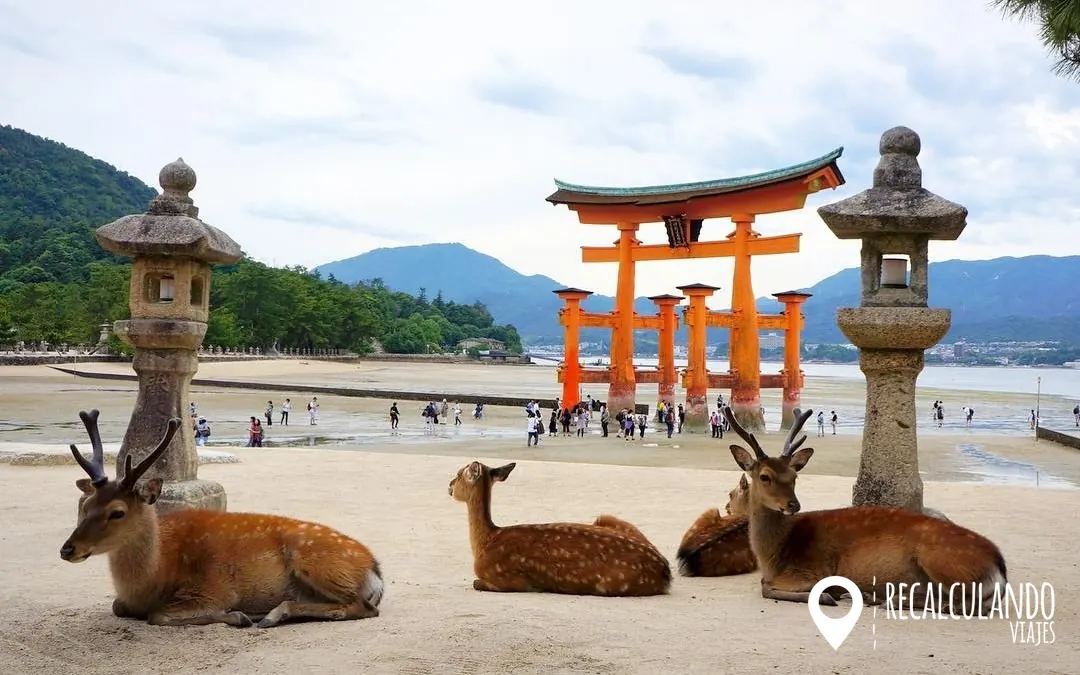
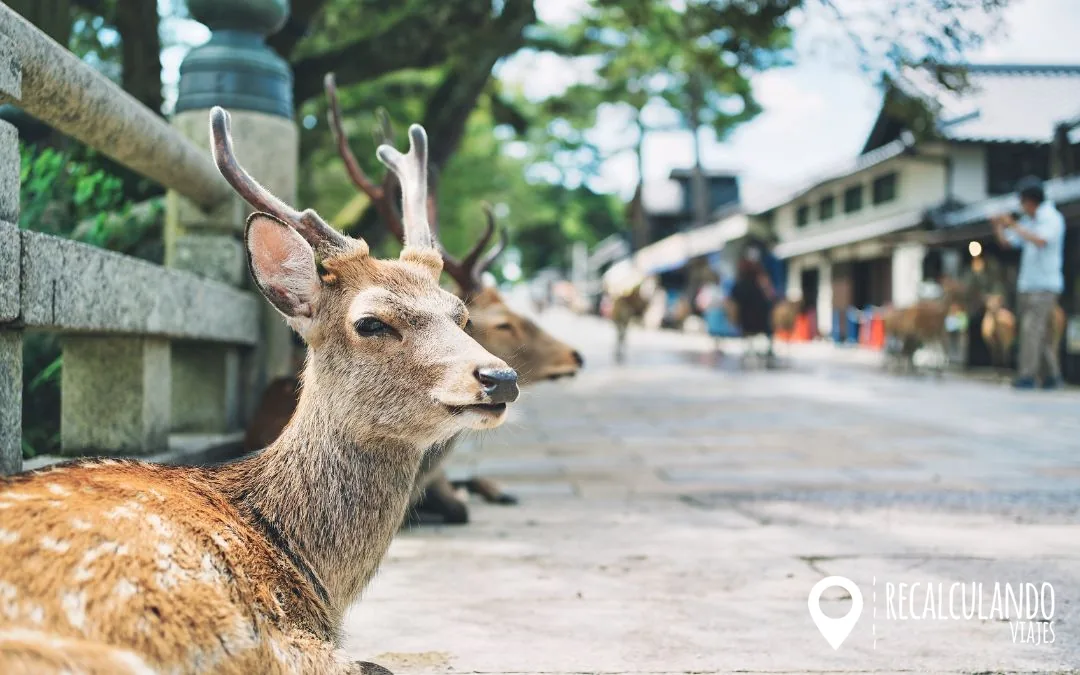
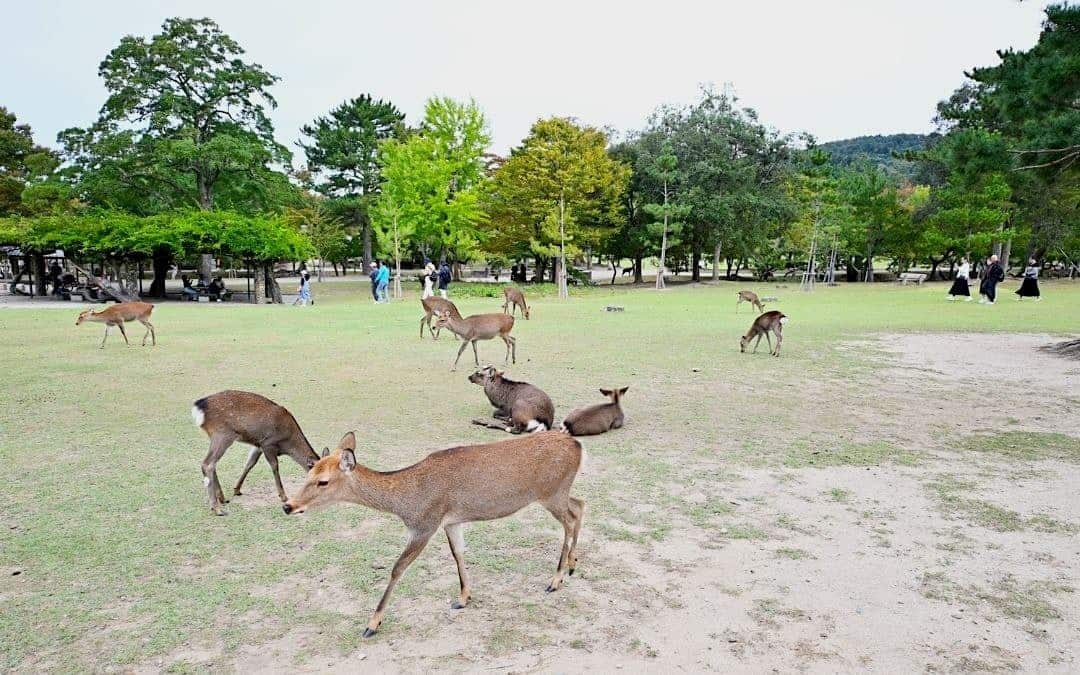
Before talking about temples and shrines, we must talk about the deer. Because in Nara, the shika (deer in Japanese) are the absolute protagonists. They are considered messengers of the gods in the Shinto religion and have been living freely throughout the park and city for centuries. Today, there are around 1,200 of them.
The experience of walking among them is… OMG. There is no other way to describe it. They come up to you, look into your eyes, and sniff your backpack. If you buy the special crackers called shika senbei (rice crackers sold for ¥200 a pack at stalls throughout the park), you will have a full entourage following you everywhere. Just be careful! When they see the crackers, they get insistent. They nudge you with their noses and tug at your clothes. It doesn’t hurt, but it’s hilarious. We were surrounded in a matter of seconds.
One important fact: the deer in Nara are wild animals protected by law. That is why it is forbidden to feed them anything other than the official shika senbei, and it is also forbidden to harm them. They even have their own social code: some will bow before asking for a cracker. It’s no joke! If you bow to them first, they will return the gesture. We tried it and it worked. It was one of the sweetest things we saw on the entire trip.
Things to do in Nara Japan: the 10 must-visit places
Nara has a concentration of historical sites that is impressive for its size. Most are located inside or near Nara Park, so getting around on foot is perfectly possible and very pleasant.
1. Tōdai-ji: the world’s largest wooden temple
This is undoubtedly the absolute star of Nara. The Tōdai-ji is a Buddhist temple declared a UNESCO World Heritage site, and its Great Buddha Hall (Daibutsuden) is the largest wooden building in the world. We knew that before we walked in, but it still left us speechless when we saw it in person.
Inside the Daibutsuden lives the Daibutsu, a bronze Buddha almost 15 meters tall. The scale is simply incomprehensible until you are standing in front of it. One of those moments where photos just don’t capture the feeling. The entrance fee is ¥800 and it’s worth every yen.
A fun detail we loved: there is a wooden column with a hole in its base the same size as the Buddha’s nostril (approximately 37 cm wide). Legend has it that whoever manages to squeeze through it will receive wisdom and enlightenment in their next life. We saw many people trying, including adults who got stuck halfway. We tried it… and only one of us made it through. We’re not saying who.
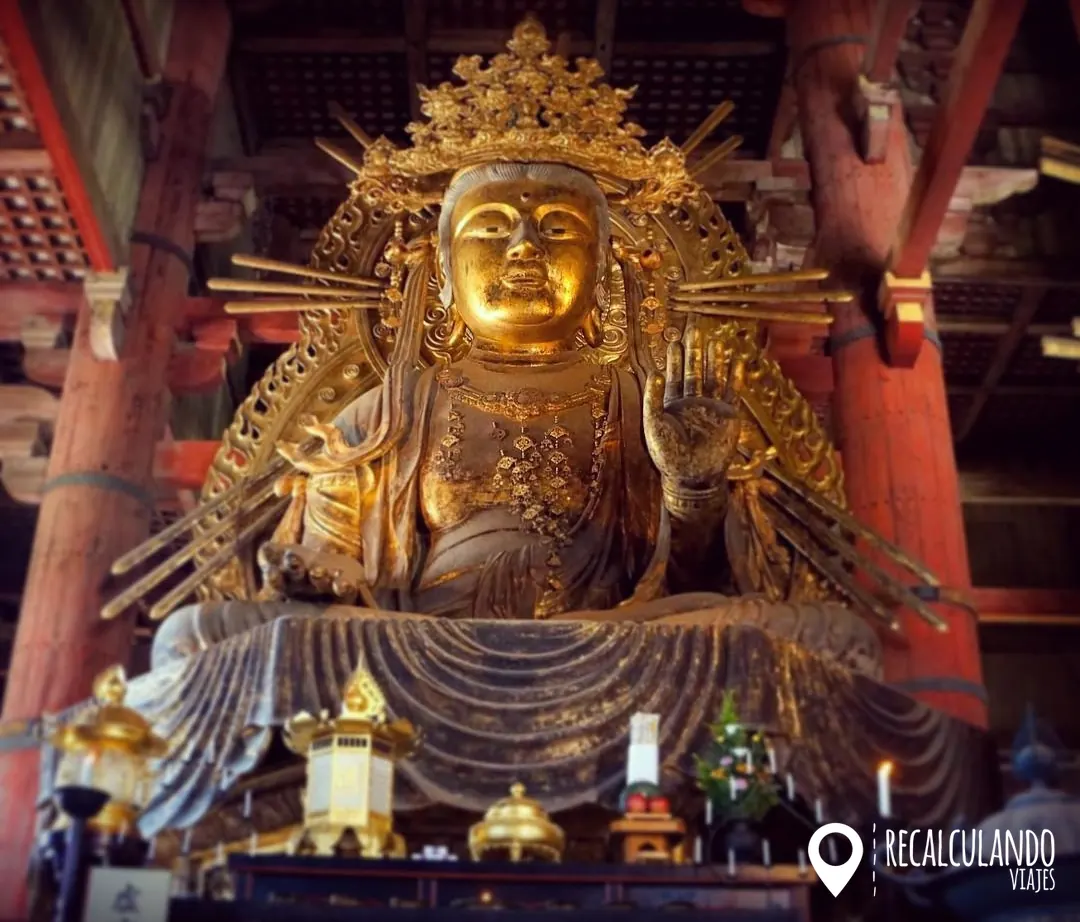
Todaiji Temple in Nara
2. The Tōdai-ji Great South Gate (Nandaimon)
Before reaching the main temple, you will pass through the Nandaimon, or Great South Gate. It is an impressive 13th-century structure with two huge guardian statues (niō) on each side, standing about 8 meters tall. The detail in the wood and the carvings is incredible. Stop here for at least five minutes to observe them closely: the expression on the guardians is fierce and magnetic at the same time.
3. Kasuga Taisha Shrine
If Tōdai-ji is the Buddhist symbol of Nara, Kasuga Taisha is the Shinto heart of the city. It is also a World Heritage site and dates back to the year 768. What makes it visually unique are the thousands of bronze and stone lanterns hanging along all the pathways of the shrine. Many travelers recommend seeing it during the Mantoro festivals, when all the lanterns are lit simultaneously. There was no festival on the day we went, but the atmosphere was still magical… especially with the deer wandering among the stone lanterns on the entrance path.
Entry to the exterior is free; entering the inner grounds costs ¥500.
4. Nara Park (Nara Kōen)
More than just a destination in itself, Nara Park is the stage where everything happens. It covers over 500 hectares and connects all the major historical sites in the city. Walking its tree-lined paths, with deer as constant companions and temples appearing among the trees, is an experience that is priceless. Literally: the park is FREE.
If you go in spring, the cherry blossoms make it one of the most photogenic places in all of Japan. In autumn, the color of the leaves is just as spectacular. We visited in the shoulder season and still found it beautiful.
5. Tōdai-ji Nigatsudō
Walking up from Tōdai-ji along a path through the forest, you reach Nigatsudō, a sub-hall of the temple complex with a wooden terrace that offers a beautiful panoramic view over the roofs of Nara and the surrounding landscape. It is much less visited than the Daibutsuden, giving it a quieter, more contemplative atmosphere. Many travelers overlook it… we say it is well worth the detour.



6. Kōfuku-ji and its five-story pagoda
Kōfuku-ji is another Buddhist temple from the Nara era that visually dominates the park’s landscape with its iconic five-story pagoda. At 50 meters tall, it is the second-tallest pagoda in Japan. Its silhouette appears in countless photos of the park with the deer in the foreground, and it is one of the most recognizable images of the city. Many travelers also recommend visiting the Nara National Museum, which is right next door and houses an important collection of Buddhist sculptures. Museum admission is ¥700.
7. The Naramachi historic district
Moving a little further away from the park to the south, the Naramachi neighborhood is a world apart. Its narrow streets preserve traditional Edo-period merchant houses (machiya), many now converted into craft shops, specialty cafes, and restaurants. It is the perfect place to get lost without a set destination, explore without a map, and grab a coffee or try some local sweets.
This is where we found one of the details that surprised us most about all of Nara: the manhole covers. We are not exaggerating when we say they are a work of art. They are engraved with the park’s deer and designs representing the city’s history. We spent a while looking ridiculous, crouching down to take photos of manholes. No regrets.
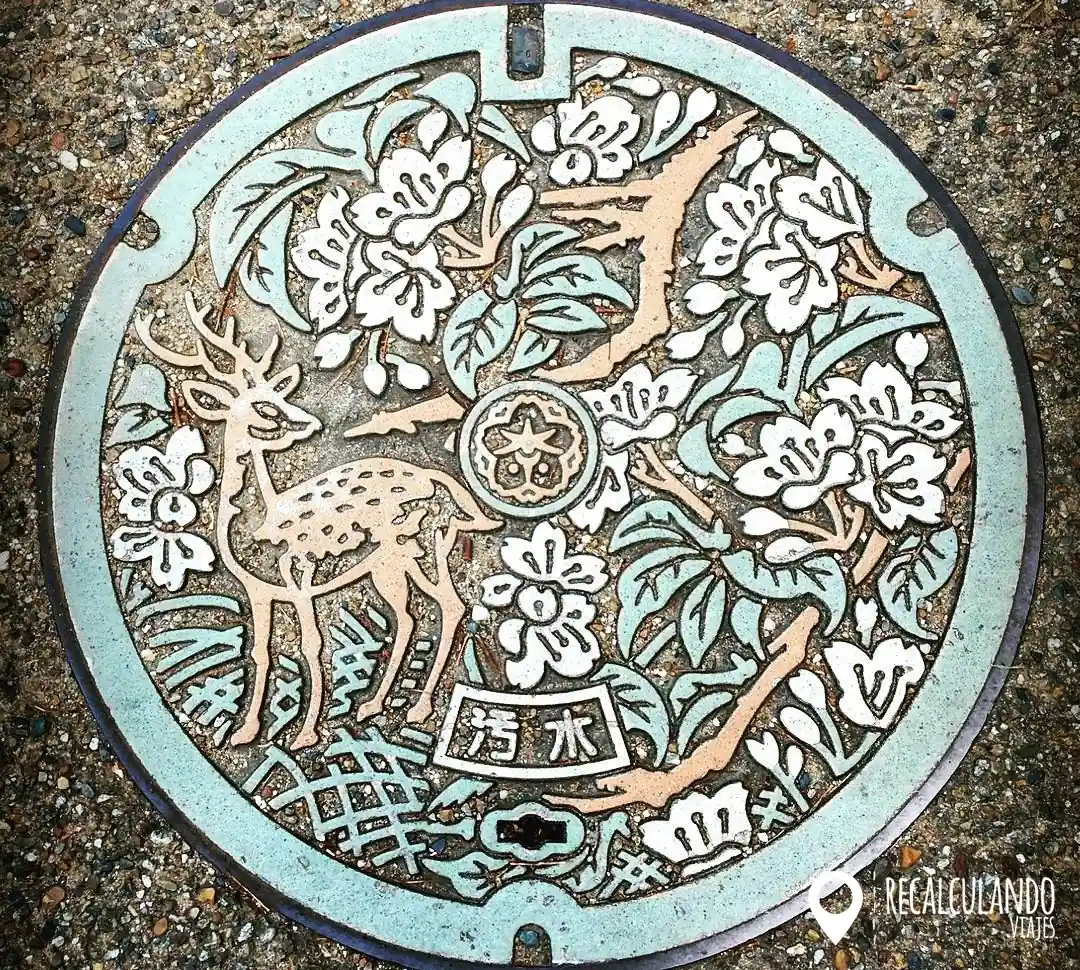
The manhole covers in Nara are 😍! 🦌 🦌!
👩⚕️👨⚕️ A must-have for stress-free travel! 🌎✈️ ➜ Get a Quote, Compare & Buy
8. Yoshiki-en and the Japanese gardens
For those looking for a moment of peace away from the noise of tour groups, the Yoshiki-en garden is a hidden gem. It is a traditional Japanese garden with ponds, tea pavilions, and impeccable greenery. The best part: admission is FREE for foreign visitors (you just need to show your passport). A very welcome rarity in Japan, where almost everything has an entrance fee.
9. Kasuga Wakamiya Shrine and its ancestral rites
Within the Kasuga Taisha complex, the secondary Kasuga Wakamiya shrine deserves special mention. It is the site of the Wakamiya On-Matsuri festival, one of the oldest in the country, which has been held every December since 1136 without interruption. If your visit coincides with those dates, you will witness something truly timeless.
10. Isuien Garden: the garden with a view of Tōdai-ji
The Isuien garden is probably the most visually spectacular in Nara. It has two sections with ponds and is designed to use the surrounding landscape—including Tōdai-ji in the background—as part of the composition. It is a gardening technique called shakkei (borrowed scenery). Admission is ¥1,200 but includes access to the art gallery. Many travelers recommend it as the most beautiful of the city’s gardens.

What to eat in Nara: flavors you can’t miss
The cuisine in Nara is incredible and quite unique! The city has its own specialties that you won’t find in Tokyo or Osaka. If you want to better understand Japanese food and its regional variations, this is also a perfect excursion from a culinary point of view. To learn more about the country’s cuisine, we recommend our complete guide to Japanese food.
Dishes and products you must try in Nara:
- Kakinoha-zushi: sushi wrapped in persimmon leaves. It is the typical dish of the region and has a completely different flavor from the sushi you know. The leaf gives it a unique aroma. You can find it in restaurants and shops all over the center.
- Miwa sōmen: thin wheat noodles served cold with a light dipping sauce. Nara is the birthplace of sōmen in Japan, and they have been crafted here artisanally for centuries.
- Nara Mochi: glutinous rice cakes with various fillings. The street stalls in the park make them fresh, and they are eaten warm.
- Sake from the Nara region: sake originated in this region, and there are several historic breweries on the outskirts. If you like sake, Nara is practically holy ground.
How much time to spend in Nara: day trip or overnight stay?
This is the question we get asked most about Nara. And the answer is: it depends on your travel style.
A day trip from Osaka or Kyoto is perfectly viable and sufficient to see the main attractions: Tōdai-ji, the deer, the park, and Kasuga Taisha. That is exactly what we did. We arrived at 9 AM and stayed until 6 PM. We left tired but very satisfied.
However, if you are the type who enjoys exploring thoroughly, staying for one night makes a lot of sense. Early in the morning and at sunset, the park has a different magic: there are fewer tourists, the light is spectacular, and the deer are more active. Furthermore, the Naramachi neighborhood deserves to be explored at a relaxed pace. If you stay over, you can also take the opportunity to visit the mountain temples of Yoshino or Hōryū-ji, which is 15 minutes away by train and has the oldest wooden buildings in the world still in use.
Practical tips for visiting Nara
After years of traveling Japan from end to end, we’ve gathered some tips that will make your visit much smoother:
- Arrive early. Tōdai-ji and Kasuga Taisha fill up with tour groups and school excursions from 10 AM. If you arrive at 8 or 9, you have the park almost to yourself.
- Be careful with food in the park. The deer are smart. If you have visible food—even snack bags or packaging—they will try to take it from you. Keep everything inside your backpack.
- Females with fawns are unpredictable. In spring and summer, there are fawns and mothers protect them actively. Do not get too close to the young.
- Wear comfortable shoes. The park is explored on foot, and there is quite a bit of ground between the different sites. Expect to walk between 8 and 12 km during the day.
- Carry cash. Many stalls and small shops in Naramachi do not accept cards.
- IC Card or Suica: Load your transport card before leaving Osaka or Kyoto so you don’t waste time at the ticket machines in Nara.
For more logistical preparation and travel planning, check out our guide to planning your trip, where we explain how to organize a trip to Japan from scratch.
Nara in the context of a trip to Japan
We visited Nara during our month-long trip through Japan, based in Osaka for four nights. The Osaka–Kyoto–Nara triangle is one of the most classic combinations in the country, and for good reason: the three destinations complement each other perfectly. Osaka for the food and urban energy, Kyoto for the temples, geisha districts, and Zen gardens, and Nara for the deer, ancestral history, and a completely different pace.
If your trip includes only one week in Japan, Nara fits perfectly as a day trip from Osaka or Kyoto. If you have more time, the experience of staying overnight and living in the city from dawn to dusk is something you will hardly forget. For those on a longer circuit—like the one we did, passing through Tokyo, Kanazawa, and Takayama—Nara rounds off the Kansai region in a way that is hard to beat.
Things to do in Nara – Map with Main Points

Frequently asked questions about things to do in Nara Japan
How much time should I spend in Nara?
A full day is enough to see the main attractions: Tōdai-ji, the park, the deer, and Kasuga Taisha. If you want to explore Naramachi at a relaxed pace and visit some gardens, two days are ideal.
Are the Nara deer dangerous?
In general, they are very docile, but they are wild animals. If you have visible food or shika senbei crackers, they may nudge you or nibble on your clothes. You need to be extra careful with females with fawns. In any case, never attempt to harm them or feed them food other than the official crackers.
What is the cheapest and what has an entrance fee in Nara?
Nara Park is completely free. Yoshiki-en garden is also free for foreigners with a passport. Tōdai-ji costs ¥800, Kasuga Taisha (inner grounds) ¥500, Isuien garden ¥1,200, and the Kōfuku-ji Museum ¥700.
Is it better to visit Nara in spring or autumn?
Both seasons are spectacular. In spring (March–April), the cherry blossoms are impressive. In autumn (November), the reddish and yellow foliage transforms the park into something magical. Summer is hot and humid; winter is cold but with fewer people and sometimes a little snow, which gives it a unique atmosphere.
Can I visit Nara without speaking Japanese?
No problem at all. The main sites have signage in English, trains have announcements in English, and temple ticket offices have staff accustomed to international tourists. With Google Translate and some friendly gesturing, you can get anywhere.
What is the best time to see the deer in Nara?
The deer are there year-round. In spring, fawns are born, which is very sweet but requires more caution. In October, adult males have full antlers and are in rut, which makes them somewhat more active and unpredictable. For a quiet and photogenic experience, autumn and winter are ideal.
Is it worth getting travel insurance for Japan?
Absolutely. Japan is a wonderful country, but medical care can be expensive for foreigners. We always travel with IATI Insurance. If you want to see options, you can check our comparison of the best travel insurance to choose the one that best fits your trip.
Nara, a city that stays in your heart
Honestly, Nara was one of the biggest surprises of our trip to Japan. We arrived with moderate expectations—”let’s see the deer and the big temple and go back”—and left completely in love with its pace, its history, and that absurd and wonderful mix of sacred deer walking among UNESCO-listed sites.
If you are putting together your itinerary and doubting whether to include Nara in things to do in Japan in 7 days or more, we say without hesitation: include it. Whether as a day trip or an overnight stay, Nara has something you won’t find anywhere else in the world. And that, for two travelers who have been roaming the planet for more than eight years, is saying a lot.
Have you visited Nara yet? Do you have any questions about the trip? Leave us a comment below, we love to hear how it went for you!
ℹ️ **Total Transparency**
This article contains affiliate links. If you book through these links, we may receive a small commission at no extra cost to you. We only recommend services we use on our travels and trust. This helps us keep this blog free and continue creating useful content for you. Thank you for your support!
🔗 Resources & Useful Links for your trip to Nara
Do you have any questions or want to add your own recommendations on things to do in Nara?
💬 Leave a comment or write to us, we love reading other travelers’ experiences.
Thank you so much for being part of this adventure!— Nanu & Facu 🌎 | Recalculando Viajes 💜