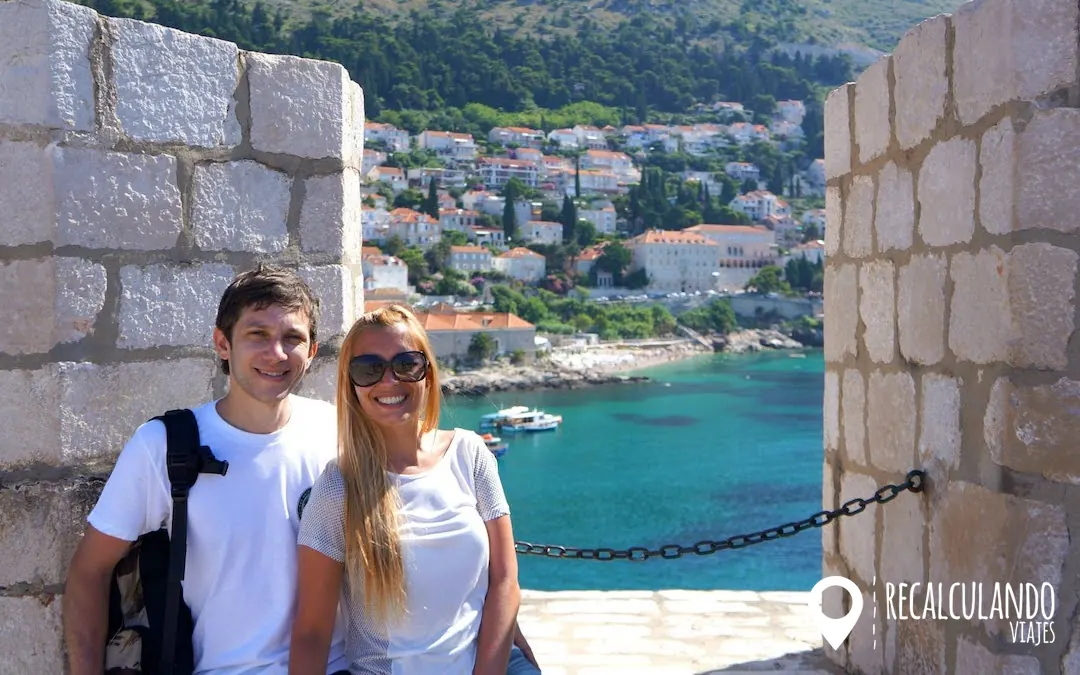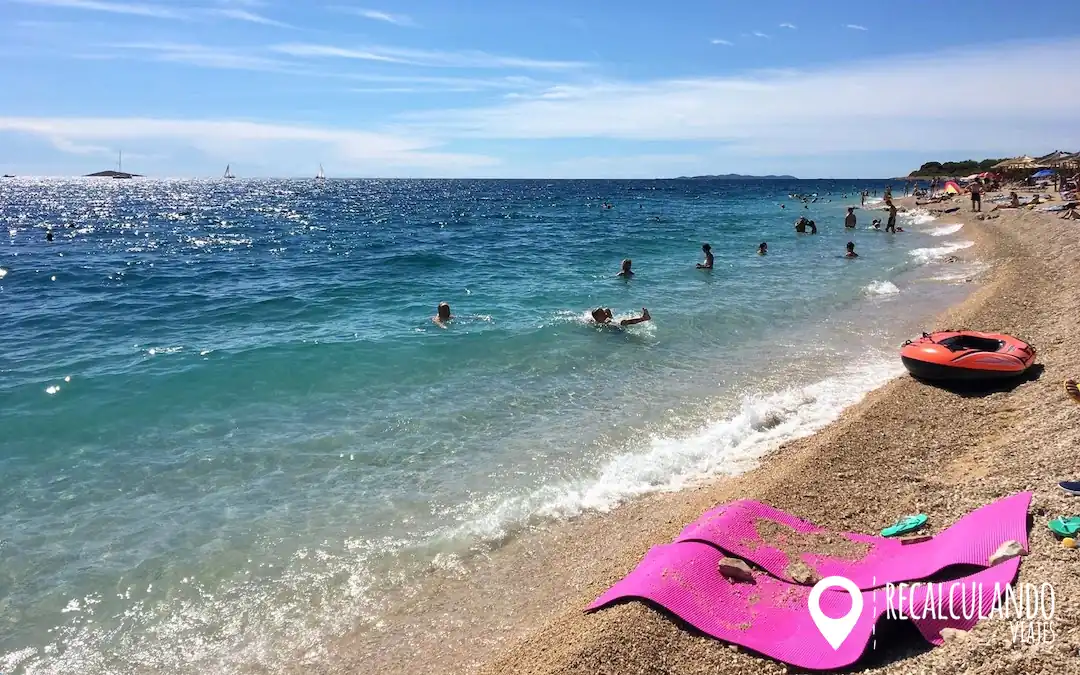
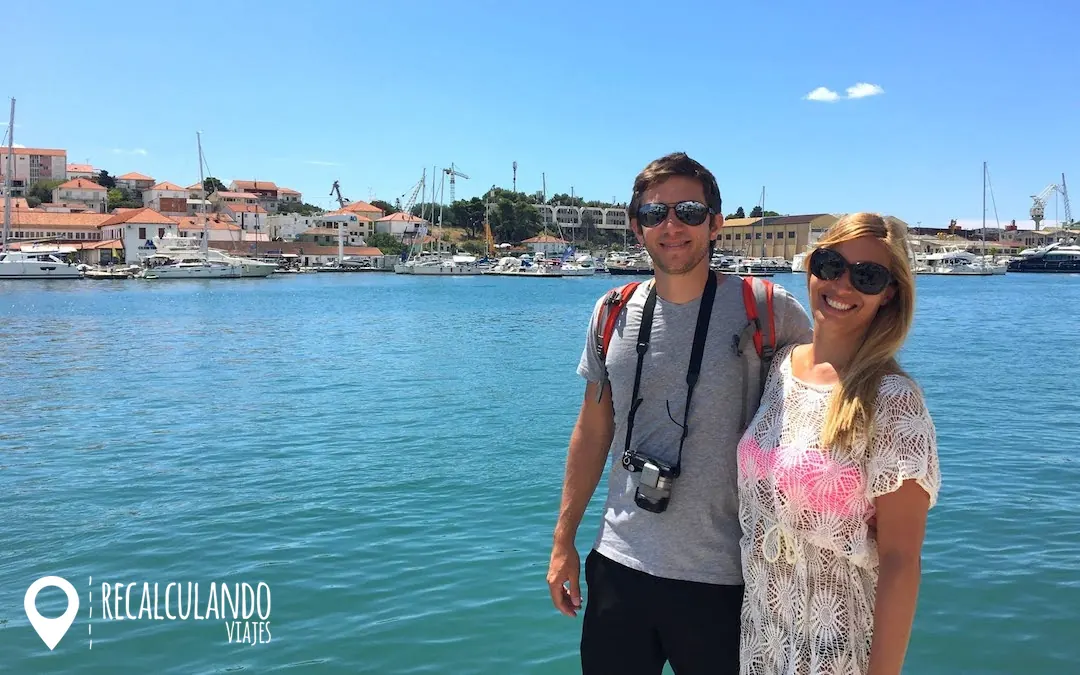
If you have to choose just one place among the things to do in Trogir, you’re going to fall short. This small city on the Dalmatian coast of Croatia is, without exaggeration, one of those places that leaves you speechless from the very first moment. We stayed for four nights in late July and walked it from end to end several times… and every time we found something new. In this guide, we share the 15 essential spots so you don’t miss anything, with a map, where to stay, and everything you need to know before you arrive.
🌍 Travel Insurance: 5% Off with IATI Seguros! 🌟
Take advantage of this offer and travel safe.
Summary: Things to do in Trogir
| Category | Key details |
|---|---|
| Destination | Trogir, Croatia (UNESCO World Heritage Site). |
| Best time | From May to October (September is the ideal month to avoid crowds). |
| Recommended time | From half a day to 1 full day. |
| Gastronomy | Dalmatian cuisine: fresh fish, seafood, pašticada, and local bread. |
| Essentials | St. Lawrence Cathedral, Kamerlengo Castle, and John Paul II Square. |
| Transport | 27 km from Split (car, bus, or ferry). Historic center is 100% pedestrian. |
| PRO Tip | The marble floors in the center are very slippery; wear rubber-soled shoes. |
| Budget | Affordable; many churches are free or have low-cost entry (3-5 €). |
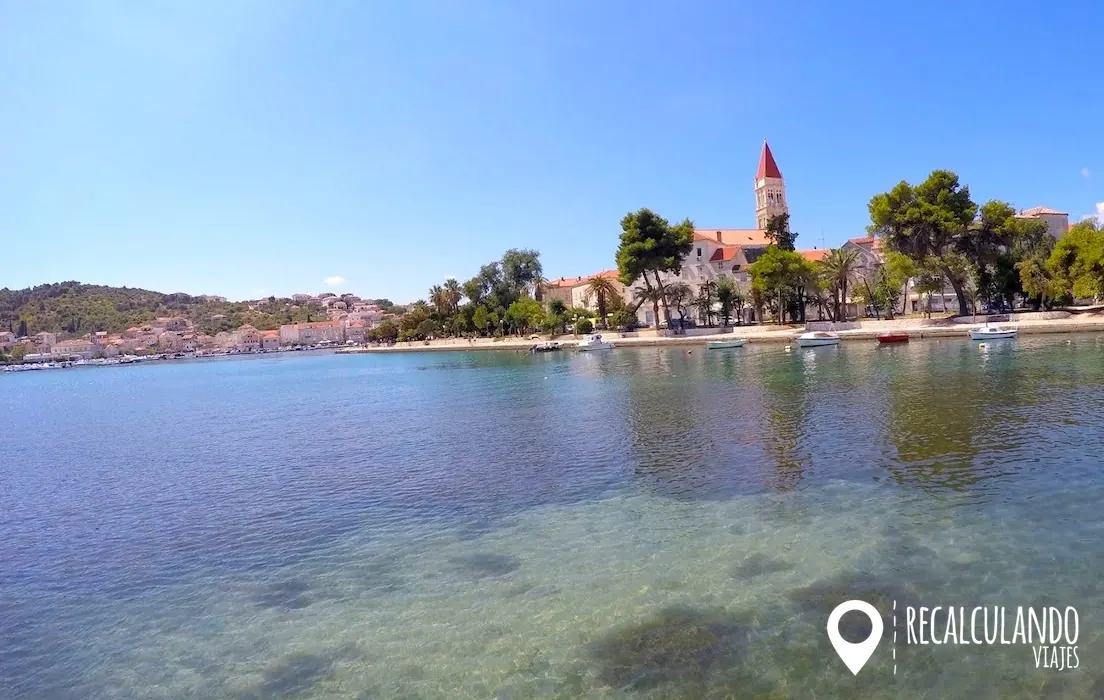
What is Trogir and why is it so worth it?
Trogir is a city built on an island of barely 1 km², connected to the mainland by one bridge and to the island of Čiovo by another. Its old town was declared a UNESCO World Heritage Site in 1997, and the reason is evident the moment you cross the bridge and enter through the North Gate: every street, every palace, every church reminds you that you are stepping on more than two thousand years of history.
It was founded by the Greeks in the 3rd century B.C., then came the Romans, the Saracens, the Venetians… and each one left their mark. The Venetians, in particular, transformed it profoundly during their nearly 400 years of rule: the architecture you see today has that unmistakable air of the Republic of Venice mixed with the Romanesque and Gothic styles of the Middle Ages. The result is a medieval center that looks like it was plucked from a movie.
And if you still need another reason to visit: some scenes from the second season of Game of Thrones were filmed here. The city port served as a setting for the merchant port of Qarth. But beyond television tourism, what will catch you is walking on the polished marble cobblestones of the historic center — a detail you don’t expect and that gives the city a completely different light depending on the time of day.
We used Trogir as a base for almost a week: we took excursions to Krka National Park, Mostar, and Primosten with our rental car, and then returned to walk the stone streets at night. We recommend it like this: as a base, not just as a one-day stop.
1. St. Lawrence Cathedral — Trogir’s essential
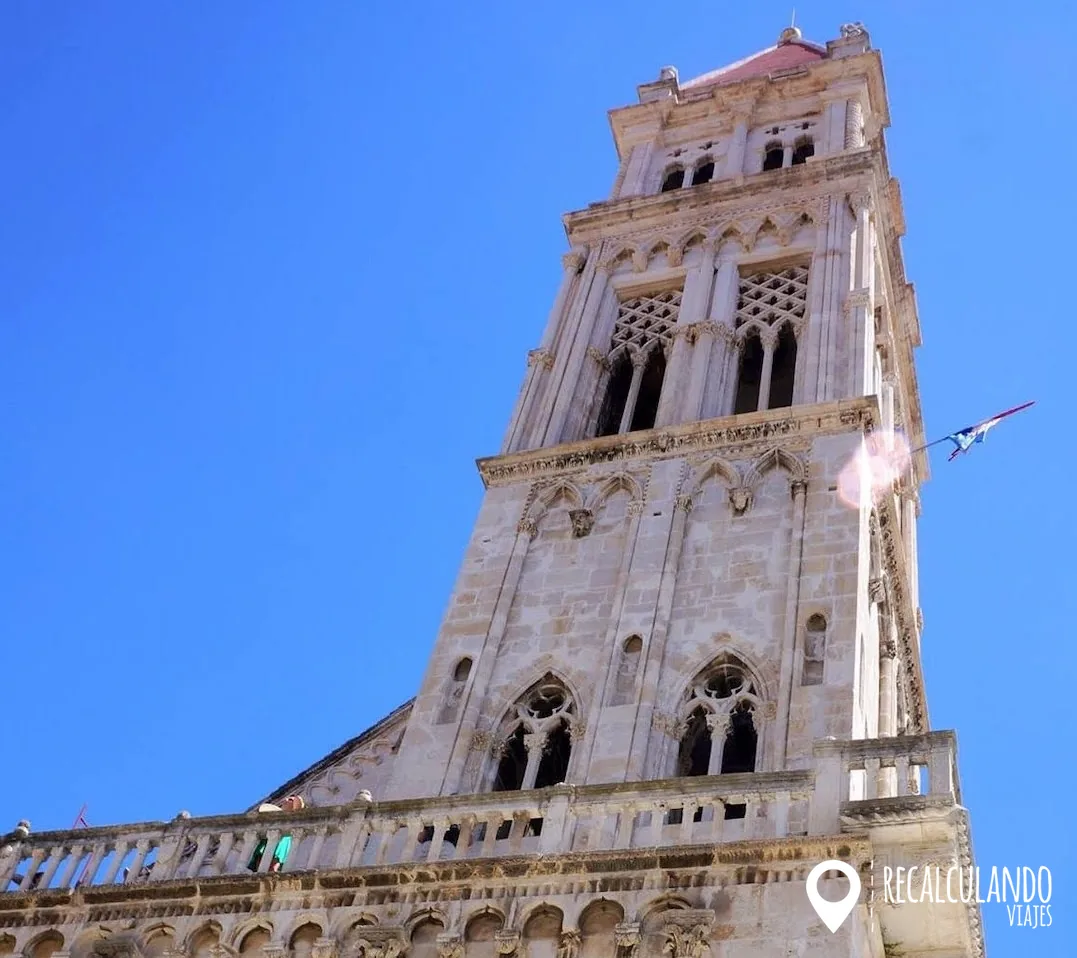
Impossible not to start here. St. Lawrence Cathedral (Katedrala Svetog Lovre) is the most iconic building in Trogir and probably one of the most impressive in all of Croatia. It can be seen from practically anywhere in the city, and the 47-meter bell tower that blends three different architectural styles in three floors — Romanesque, Gothic, and Renaissance — is one of those details that shows you how long it took to build: from the year 1200 until 1589.
What caught our attention most was the western portal, the work of Master Radovan (1240). It is covered in reliefs with figures of Adam and Eve, the apostles, scenes of the birth of Christ, and mythological creatures, all carved with a precision that gives you chills if you think it’s over 780 years old. Entry to the interior of the cathedral is free; if you want to see the complete cathedral plus the bell tower, the ticket is around 5 euros. We recommend it: the views from the top are spectacular. Hours vary by season — in summer it opens approximately from 9:00 a.m. to 9:00 p.m., with adjustments for the rest of the year.
Inside, don’t miss the Chapel of Blessed John of Trogir, another masterpiece of 15th-century Croatian sculpture.
2. John Paul II Square (Trg Ivana Pavla II) — the heart of the city
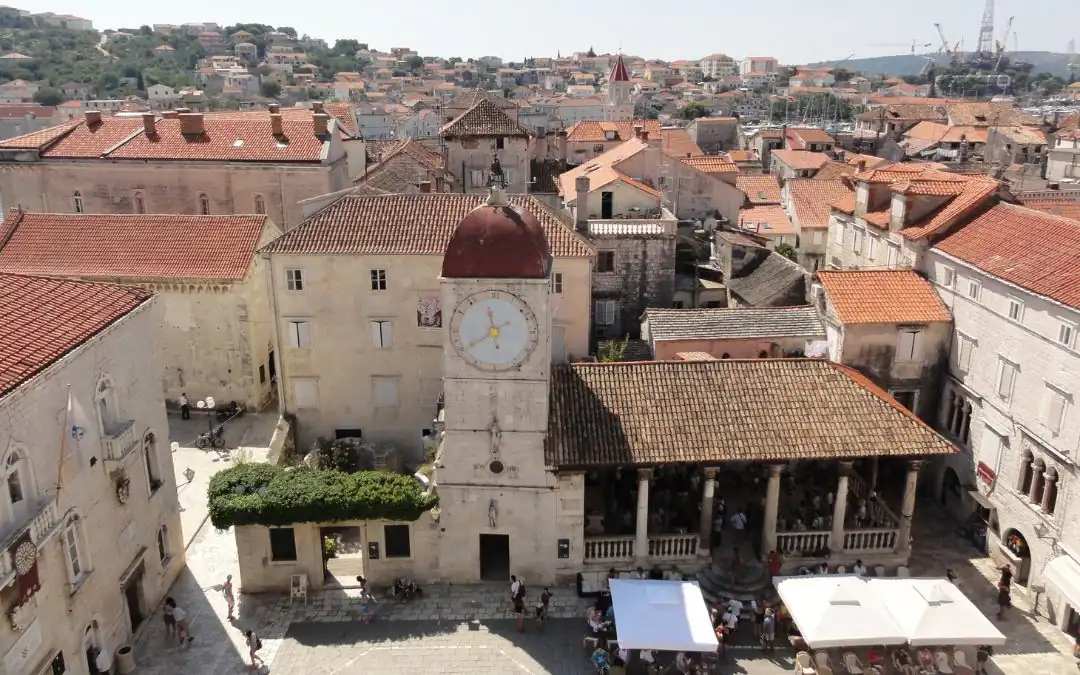
If St. Lawrence Cathedral is the jewel of Trogir, John Paul II Square is the chest that guards it. It is the heart of the city and the point where everything is concentrated: from here you can see the cathedral, the Cipiko Palace, the Church of St. Sebastian with its Clock Tower, the Rector’s Palace, and the Venetian Loggia. Practically all the major monuments to see in Trogir are within sight from this single space.
The Rector’s Palace (Knežev dvor), which today functions as the Town Hall, deserves a separate mention. Although its origin is from the 13th century, it was restored in the 19th in a Renaissance style. What many travelers don’t know is that you can enter the inner courtyard: it has a Gothic staircase and a well decorated with the Venetian winged lion that is pure history condensed into stone. Don’t just look at the facade.
We spent a lot of time here, especially at sunset, when the locals go out for a drink at the terrace bars and the atmosphere becomes very pleasant. It is the perfect place to sit, order a cold drink, and soak up all that heritage that surrounds you without haste.
3. Cipiko Palace — pure Venetian architecture
Just in front of the cathedral, the Cipiko Palace (or Palazzo Ćipiko) is one of the most elegant buildings you will see on the entire Dalmatian coast. It was built in the 15th century as a residence for the powerful Cipiko family, one of the most influential in Trogir’s history. The facade stands out for its Gothic trifora — that triple window with arches — the work of sculptor Andrija Aleši, and for the typically Venetian balconies and reliefs.
Many travelers agree that, although the interior is not permanently open to the public, it is worth stopping to look at the facade closely. Every detail tells a story.
4. The Church of St. Sebastian and the Clock Tower
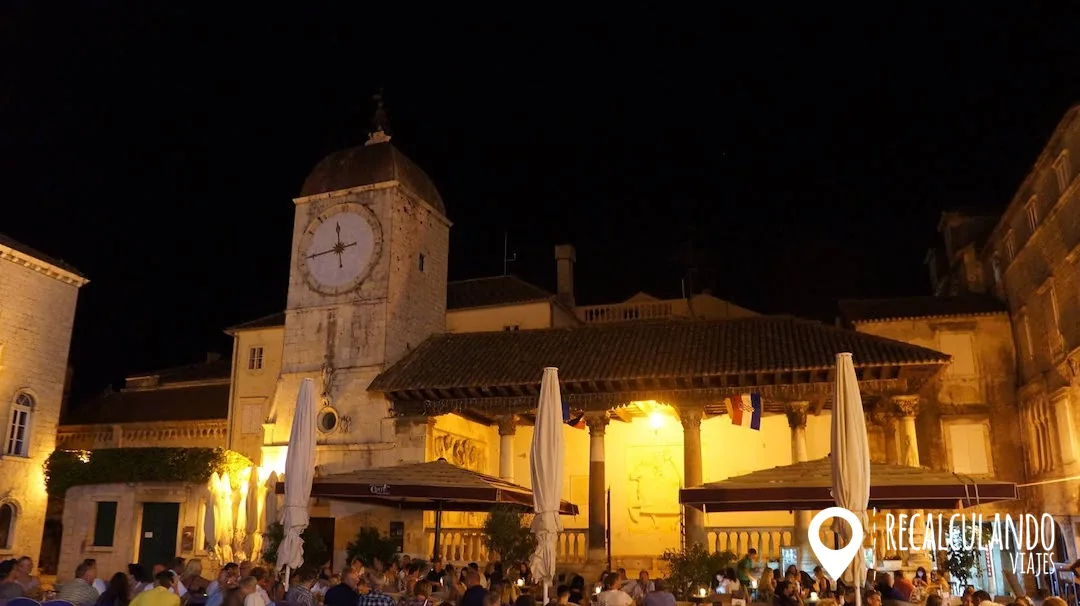
One of the most photogenic images of Trogir is the Church of St. Sebastian with its striking Clock Tower of almost 50 meters, topped by a red dome that gives it a very particular character. It was built on the remains of an old 11th-century church and became one of the visual symbols of the city. It is very similar to the one in Dubrovnik and, once you see it, it stays with you.
Above the entrance door, you can see the statue of St. Sebastian, patron saint of soldiers. The image of the tower with the cathedral in the background is one of the most repeated in Trogir photos, and with good reason.
5. The Venetian Loggia — six columns with centuries of history
Attached to the Church of St. Sebastian and also on John Paul II Square, the Loggia is that open portico supported by six Roman columns with carved capitals and a beautiful wooden ceiling. It was built at the beginning of the 14th century and reformed later. Today it functions as a public space where people sit, chat, and find shelter from the sun. There is a relief with Latin inscriptions about justice that many travelers overlook and which deserves a closer look.
6. Kamerlengo Castle — Venetian fortress by the sea
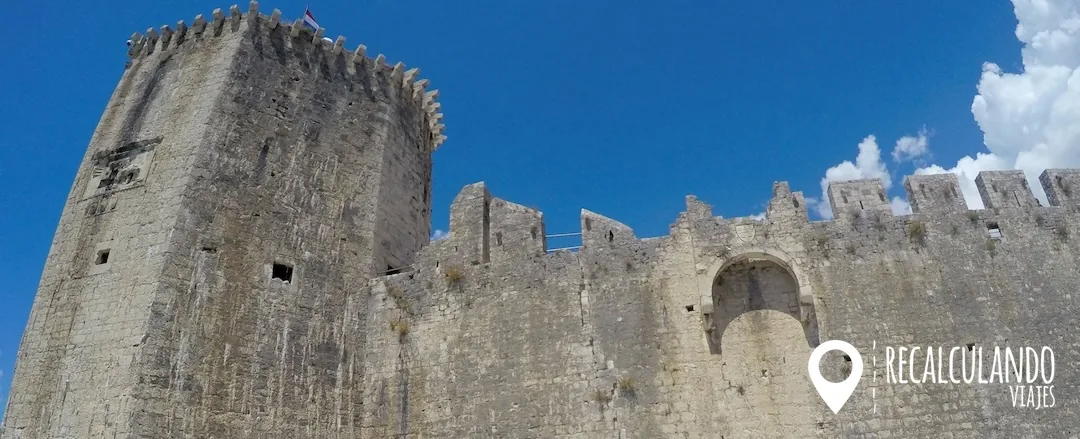
Kamerlengo Castle (Kaštel Kamerlengo) is the other great monument of Trogir next to the cathedral. The Venetians built it in 1430 as a military watchpost and residence for the governor, at the southwest corner of the historic center where the sea surrounds the walls. The scene of this fortress with the Adriatic in the background is one of the most beautiful in Trogir.
When we visited, you could explore the interior and climb the walls to get panoramic views of the sea and the historic center. In summer it is also usually used as a stage for concerts and cultural events. Although it is more impressive from the outside than from the inside, it is worth going in and climbing up. Entrance is around 3-5 euros.
7. St. Mark’s Tower — the end of the promenade
If you keep walking past Kamerlengo Castle along the seashore, you will reach St. Mark’s Tower (Kula Sv. Marka), a circular tower that was once connected to the castle by a wall that has since disappeared. What’s curious is that now, nothing separates it from the castle but a soccer field that the neighborhood residents use with total naturalness. A scene you don’t expect to find in a medieval city.
It cannot be visited from the inside, but the walk there along the sea side of the wall is very beautiful.
8. St. Nicholas Monastery — the only preserved female Benedictine monastery
Next to the South Gate of the wall, in the direction of Kamerlengo Castle, is the Monastery of St. Nicholas (Samostan Sveti Nikole). It was founded in 1064 and is the only female Benedictine monastery preserved in all of Trogir. The detail that caught our attention most: inside, it houses the marble relief of Kairos, the Greek god of opportunity and favorable moments, a piece of great value that most visitors don’t specifically look for. Many travelers recommend entering the church and the small collection of ecclesiastical art by paying a modest entrance fee. It is a very quiet space, away from the bustle of the main square.



9. The North Gate (Land Gate) — the entrance to the medieval world
Everything starts here. The North Gate, also called the Land Gate, is where you enter the historic center of Trogir when crossing the bridge from the mainland. It dates back to the 17th century and above it, you can see the statue of Blessed Giovanni Orsini, patron saint and protector of the city. It is the only remnant still standing of the old medieval wall on the north side, and crossing it gives you the feeling that you are literally leaving the present to enter another era.
Just after crossing the gate, on the right, is the Trogir Museum (Muzej Grada Trogira), located in the Garagnin-Fanfogna Palace. If you are interested in the city’s history from the Greek period to the present, stop by: it has archaeological objects, a library, and works of art. It opens approximately from 10:00 a.m. to 1:00 p.m. and from 6:00 p.m. to 9:00 p.m. in high season, with an entrance fee of about 4 euros. We didn’t go in, but many travelers recommend it as an introduction to the tour.
When we arrived by car, we parked just before the bridge and walked through here. It is the natural start of any tour of Trogir.
10. The South Gate — the other exit to the sea
The South Gate is the counterpart to the North Gate: it faces directly onto the promenade and serves as a connection point between the inner streets of the historic center and the waterfront. It is smaller and more discreet than the north one, but it holds a detail that few notice: it still preserves the huge original wooden doors from the 16th century. Many travelers discover it almost by chance while touring the promenade, but if you arrive looking for it, you now know what to look at.
11. The Promenade — the best place for an afternoon ice cream
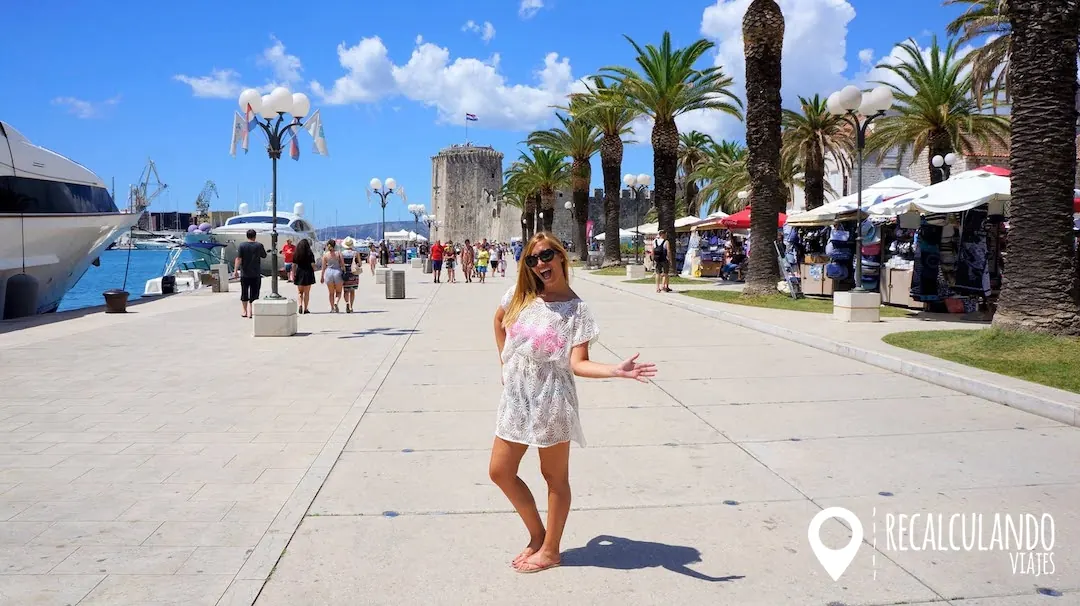
The Trogir promenade is short — it doesn’t even reach 400 meters — but it is one of the most pleasant we walked along our entire route through Croatia. It has bars, restaurants with terraces over the water, craft shops, and a lot of local life mixed with tourists. At sunset, the atmosphere is especially lovely: the light over the water, the moored boats, and that Mediterranean rhythm that invites you to stay without doing anything in particular.
We sat here more than one afternoon with an ice cream or a cold drink to watch time go by. We especially recommend it as the sun goes down.
12. The Church of St. John the Baptist — the most forgotten Romanesque jewel
South of the cathedral, among alleys that most visitors don’t traverse, is the Church of St. John the Baptist (Sveti Ivan Krstitelj). It is a small 13th-century church, built by the Benedictine order over an old 6th-century early Christian church. Inside, you can see remains of medieval frescoes and the tomb of the Cipiko family — the same one that built the palace in front of the cathedral. It doesn’t have the fame of the cathedral, but it is one of those findings that one remembers with more affection precisely for that reason.
👩⚕️👨⚕️ A must-have for stress-free travel! 🌎✈️ ➜ Get a Quote, Compare & Buy
13. The Church and Monastery of St. Dominic
Half hidden between the promenade and the interior alleys, the Monastery of St. Dominic has its origins in the second half of the 13th century, although the church dates back to the 14th century. It is one of those buildings that one almost misses if one doesn’t look for it specifically, because access from the promenade is not immediate. It is worth searching for: the cloister was restored after its destruction in the Second World War and has a lot of charm, as does the main altar. A detail for Game of Thrones fans: some scenes from the series were filmed in this space.
14. The streets and alleys of the historic center — getting lost is the plan
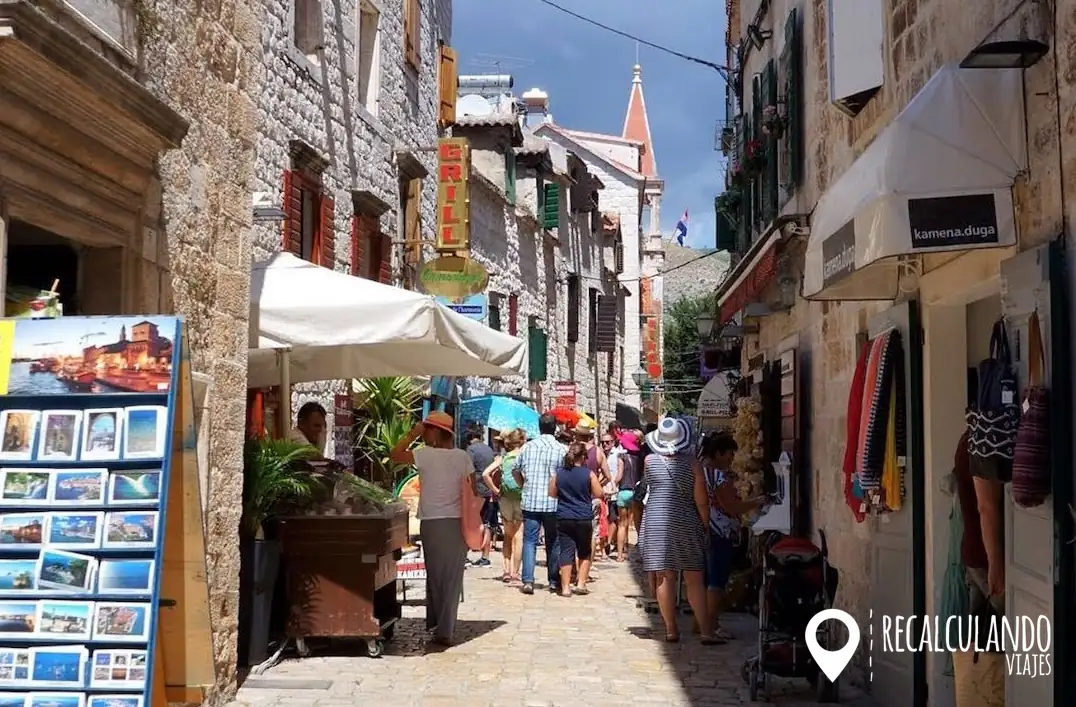
One of the best things to do in Trogir is not on any official list: just head out and get lost. The historic center has a network of medieval stone alleys so narrow that two people barely fit in some of them. The Šubićeva and Mornaska streets are especially beautiful to wander through without haste. And there is something very few guides mention: the floor of many streets in the old town is made of polished marble cobblestones, which gives it a very particular luminosity depending on the time of day. A beautiful detail… although beware: if it rains, that marble becomes quite slippery. Wear rubber-soled footwear and forget about heels.
The facades of the buildings are perfectly preserved, flower pots peek out of the windows, and from time to time a small hidden square appears where someone has a table and two chairs in the sun. It is those moments that make a visit to Trogir memorable.
We decided not to look at the map for an hour and just walk. It was one of the best decisions of the trip.
15. The beaches of Trogir and the island of Čiovo
One of the things to do in Trogir that many underestimate is crossing the Čiovski bridge to the island of Čiovo, which is just across the canal. In a few minutes on foot, you can reach some coves and beaches with clear water where you can swim. The most well-known are Okrug Gornji, Médena, and Panta Beach — turquoise waters, white pebbles, and lots of life in summer. In July, with the heat, we ended up in the water more than one afternoon.
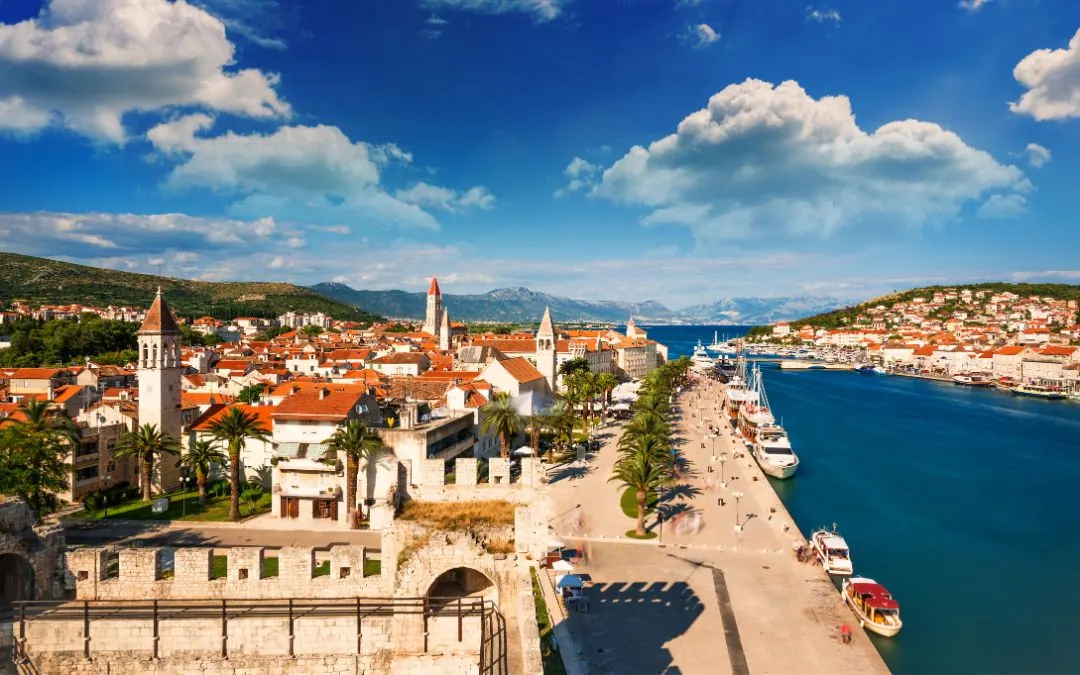
Another option that is worth it is to cross the Čiovski bridge to the marina on the other side: from here you have one of the best panoramic views of the entire historic center of Trogir, with the medieval rooftops silhouetted against the Adriatic. And catamarans and sailboats leave from the marina for cruises through the Croatian islands for several days. If you stay a few days in Trogir, it can be the perfect starting point to explore the archipelago.
Itinerary to see Trogir in 1 day
If you only have one day, this is the order we would recommend after having thoroughly toured it:
Morning: Enter through the North Gate and walk to John Paul II Square. Visit St. Lawrence Cathedral (climb the bell tower) and then take time to observe Cipiko Palace, the Clock Tower, and the Loggia. Turn into the interior alleys towards the south, look for the Church of St. John the Baptist and St. Nicholas Monastery next to the South Gate.
Midday: Lunch at one of the restaurants on the promenade with a sea view. They aren’t cheap in high season, but the experience is worth it. If you want something more economical, there are options in the interior streets.
Afternoon: Walk along the promenade to Kamerlengo Castle and climb the walls. Continue to St. Mark’s Tower. On the way back, cross to Čiovo for a swim. Finish with an ice cream or a drink in the square at sunset. It is the perfect finishing touch.
| 🗓️ Best time | May – October (September ideal for less tourism) |
|---|---|
| ⏱️ Recommended time | Half a day to 1 day (or more if you take excursions) |
| 💰 Indicative budget | Complete cathedral + tower: ~5 €. Kamerlengo Castle: ~3-5 €. Cathedral interior: free |
| 🎬 Curiosity | Scenes from Game of Thrones (season 2) were filmed in Trogir |
| 🗺️ How to get there | 27 km from Split by car or bus (every 30 min) |
| 💬 Language / Currency | Croatian / Euro (€) |
Map of things to do in Trogir
Below you will find an interactive map with all the points of interest mentioned in this guide so you can plan your route before you arrive:
Where to stay in Trogir
Trogir has options for all budgets, from apartments in the historic center to hotels with sea views on the outskirts. We stayed in the center and recommend it if you want to enjoy the city at night, when the day-trippers leave and the atmosphere is much quieter.
Search for accommodation at this link to see the best options available in Trogir. In high season, book well in advance, especially if you want to be inside the historic center.
How to get to Trogir
Trogir is located just 27 km northwest of Split and barely 5 km from Split International Airport, which makes it an almost mandatory stop if you are arriving by plane.
By car: It is the option we chose and the one we recommend most if you are touring Croatia. The road is comfortable and you are 30-40 minutes from Split. Mind you, the historic center is pedestrian, so you have to park before the bridge in authorized parking lots. The closest to the entrance costs around 4 €/hour; there are cheaper options 10 minutes away on foot.
By bus: There are frequent services from Split with departures approximately every 30 minutes. The journey takes about 45 minutes and the bus stop is right in front of the access bridge to the historic center, which is very convenient.
By ferry: The Bura Line connects Split with Trogir by sea, a very pleasant option in summer.
From Zagreb: There are direct long-distance buses that take about 5-6 hours. You can also fly to Split from Zagreb in less than 1 hour.
How to get around Trogir
On foot, directly. The historic center is less than 1 km² and can be traversed from side to side in about 15 minutes without stopping. You don’t need any means of transport inside the walled city. To get to the beaches of Čiovo or explore the surroundings, a rental car is ideal.
IMPORTANT TIP: the marble floor of the historic center is very slippery when it rains or is humid. Wear footwear with non-slip soles and avoid shoes with smooth soles or heels. It is a detail that makes a difference as soon as some drizzle appears.
What to eat in Trogir
Trogir’s gastronomy follows the line of Dalmatian cuisine: lots of fresh fish, seafood, pašticada (meat stew with wine), fried calamari, and famous Dalmatian bread. The restaurants on the promenade have high-season prices, so if you want to eat well without paying more, look for one of the taverns hidden in the interior alleys where locals go for lunch.
An ice cream in one of the small ice cream parlors in the historic center is a must: in July, with the Mediterranean heat, you appreciate it a lot.
Travel insurance for Croatia
Before traveling to Croatia, and in particular if you are touring the coast by car as we did, consider taking out good travel insurance. We always travel with IATI Insurance and we recommend it especially for trips around Europe: they have very complete coverage, 24-hour service in Spanish, and, with our link, you have a 5% discount.

Excursions from Trogir
One of the great advantages of staying in Trogir is the privileged location for excursions. We did three in the four nights we were there, and all three were well worth it.
Krka National Park: About 60 km from Trogir, this national park with its Krka river waterfalls was one of the most impressive moments of our entire trip through Croatia. We went by car, but you can also book an organized excursion if you prefer not to drive. If you go in August, arrive early to avoid the crowds.
➜ Book the excursion to Krka National Park from Trogir (in English)
Primosten: Another place we loved. It is a tiny town built on a peninsula (almost an island), with cobblestone streets, houses with red roofs, and incredible coves around it. It is only 35 km from Trogir and is perfect to combine with Krka in the same day, as we did.
Blue Lagoon and boat trips: Several boats leave from the Trogir promenade to the Blue Lagoon and the islands of Solta and Drvenik. An ideal way to spend the day in the Adriatic Sea.
➜ Excursion to the Blue Lagoon and Solta from Trogir (in Spanish)
Mostar (Bosnia-Herzegovina): We did Mostar in one day from Trogir by car. It is about a 2-hour drive, but it is absolutely worth it: the Old Bridge and the old town of Mostar are a completely different experience from everything you see in Croatia.
If you want to explore more of the best of Croatia, keep in mind that from Trogir you can also easily reach Split, the islands of Brač or Hvar, or continue towards Dubrovnik along the coastal route.
Frequently asked questions about Trogir
Is Trogir worth visiting?
Absolutely. Trogir is one of the visits you cannot skip if you are touring Croatia, especially if you are passing through Split. In just half a day you have access to one of the best-preserved medieval centers in the Mediterranean, a World Heritage Site. If you can also stay the night, the experience is completely different: when the day-trippers leave, the city regains a calm and magic that are priceless.
Which travel insurance should I get for Croatia?
For traveling to Croatia, it is best to have insurance with complete medical coverage, 24-hour travel assistance, and cancellation. We have been traveling as nomads for over 9 years and have learned that it is not worth taking risks. In our guide to the best travel insurance for Europe you will find our detailed recommendation with a discount included for blog readers.
How much time do I need to see Trogir?
With half a day you have enough time to tour the entire historic center of Trogir. If you want to enjoy it calmly, swim at a nearby beach, or take an excursion to Krka National Park, plan at least one night of accommodation in the city.
Is Trogir near Split?
Yes. Trogir is located just 27 km northwest of Split, which equates to about 30-40 minutes by car. There are also frequent buses between both cities with departures approximately every 30 minutes.
Is Trogir a World Heritage Site?
Yes. The historic center of Trogir was declared a World Heritage Site by UNESCO in 1997, thanks to its extraordinary preservation of medieval, Romanesque, Gothic, and Renaissance architecture in just 1 km² of island.
Where to park in Trogir?
The historic center of Trogir is pedestrian, so you have to leave the car in one of the outside parking lots. The most convenient is next to the access bridge to the walled city. There are also cheaper options about 10 minutes away on foot.
What excursions can I take from Trogir?
From Trogir you can organize excursions to Krka National Park and its waterfalls, visit the town of Primosten, reach Split, take a boat trip to the Blue Lagoon and the island of Solta, or go to the Plitvice Lakes on a long day trip.
What is the best time to visit Trogir?
The best time to visit Trogir is from May to October, taking advantage of the Mediterranean climate. July and August are the busiest and hottest months. If you want fewer people and more pleasant temperatures for walking, September and October are an excellent choice.
Conclusion: Trogir, a jewel of Dalmatia you can’t miss
Things to do in Trogir is not a question with a single answer: here every street has something to show. St. Lawrence Cathedral, Kamerlengo Castle, the promenade at sunset, the stone alleys where time seems to have stopped… Trogir is the type of city that surprises you with its size and conquers you with its character.
We loved using it as a base to explore the central coast of Croatia. Four nights flew by. If you have the opportunity, don’t just visit it in passing: stay the night, go out at night when the day-trippers are gone and you discover another city entirely.
Do you have any questions about Trogir or the route through Croatia? Leave us your question in the comments and we will answer you from our experience.
Do you want to continue discovering Croatia? Don’t miss our guides on what to see on the Amalfi Coast or explore more destinations in our Croatia section.
Other articles for your trip to Croatia
- 22 must-see things to do in Dubrovnik (with map)
- 18 Must-See Things to Do in Primosten (with Map)
- 21 must-see things to do in Split (with map)
- 18 essential things to do in Rab (with map)
- Plitvice Lakes, Croatia: Complete guide to visiting the National Park [2026]
- Krka Waterfalls: Guide to visiting the park (2026) + Map
- 15 Best things to do in Croatia (with map)
- 16 essential things to do in Brac (with map)
ℹ️ **Full Transparency**
This article contains affiliate links. If you book through these links, we may receive a small commission at no additional cost to you. We only recommend services we use on our travels and trust. This helps us keep this blog free and continue creating useful content for you. Thank you for your support!
🔗 Resources & Useful Links for your trip to Trogir
Do you have questions or want to add your own recommendations on things to do in Trogir?
💬 Leave your comment or write to us, we love reading the experiences of other travelers.
Thank you so much for being part of this adventure!— Nanu & Facu 🌎 | Recalculando Viajes 💜