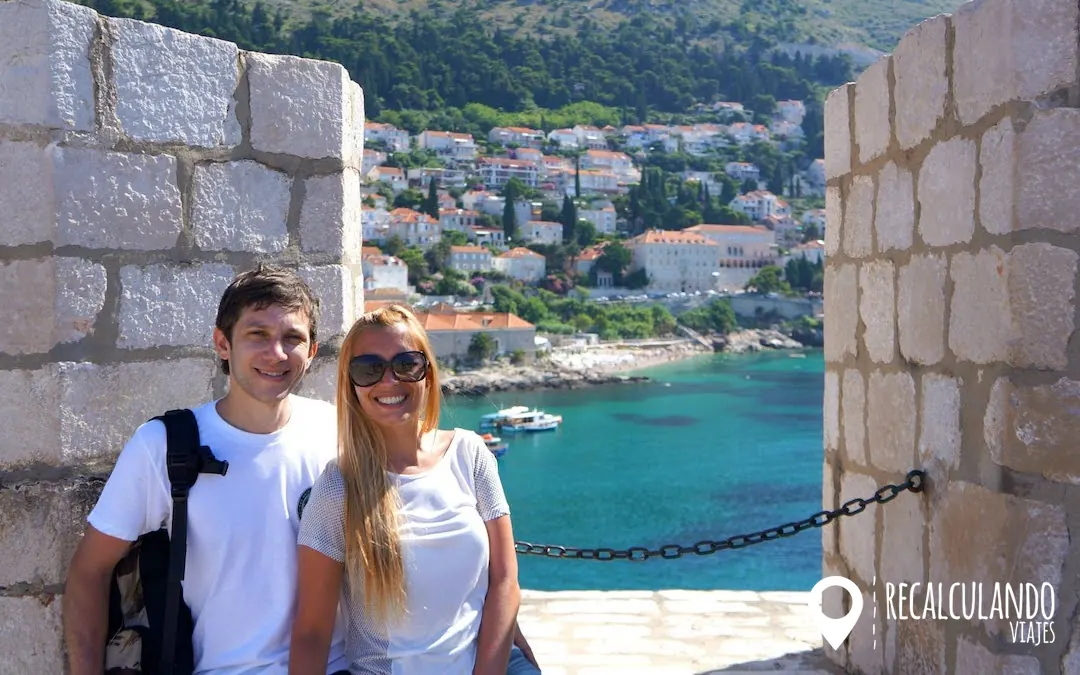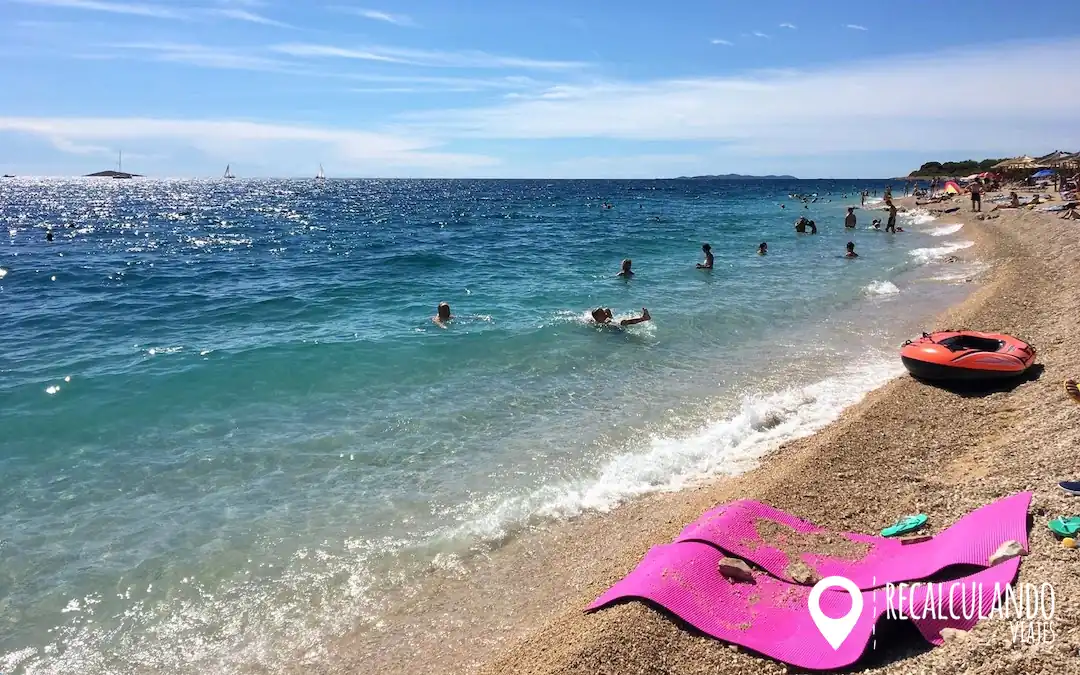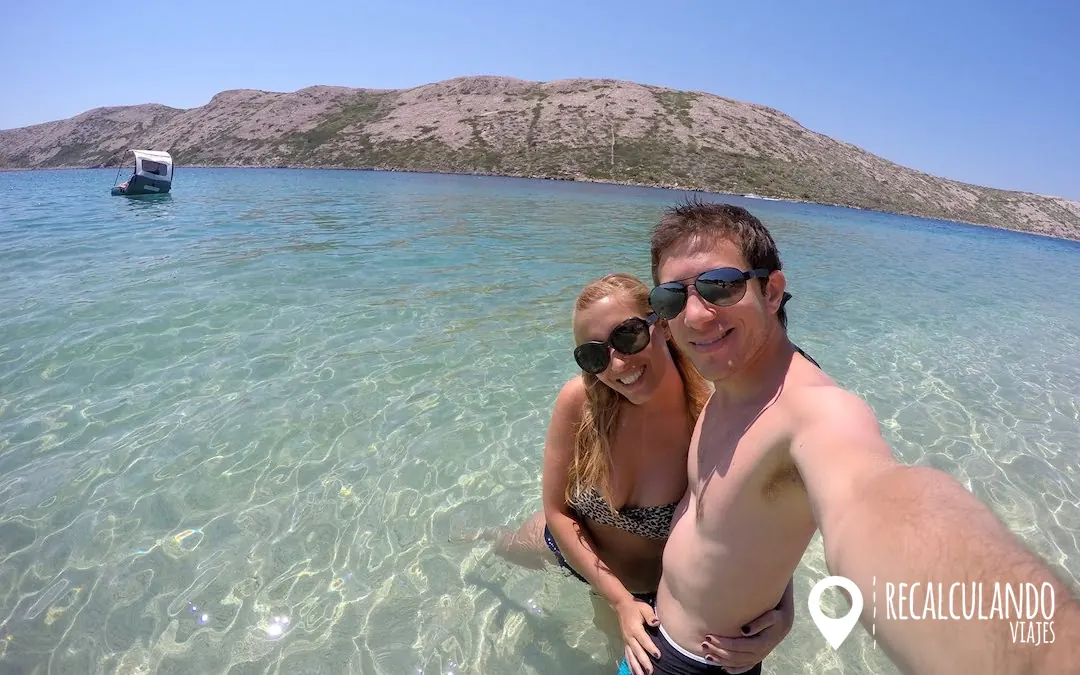
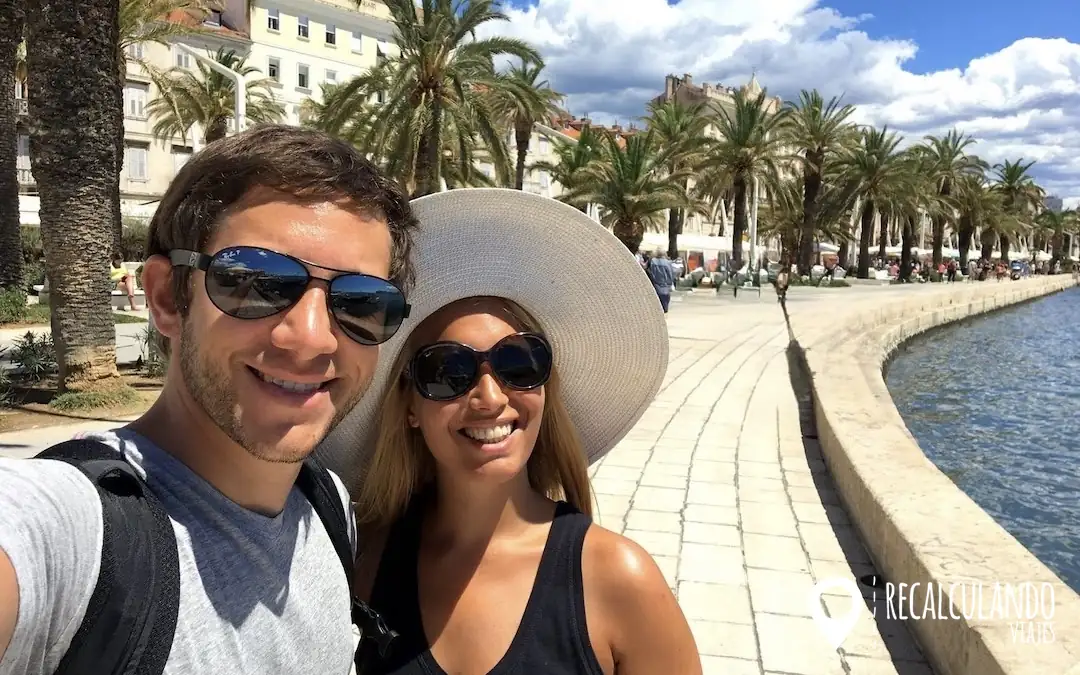
Deciding things to do in Split is simpler than it seems: almost everything essential is within the walls of a 1,700-year-old Roman palace where people still live. We stayed for three nights at the end of June with a rental car, after spending almost two months touring Croatia and its islands. Here we leave you the 21 places we liked the most, the walking tour we would plan today, real ticket prices, a map with everything marked, where to sleep and even where to park for free.
And something almost no one tells you when you look for things to do in Split: Croatia has much more here than just Diocletian’s Palace. It is also a beach city with a hill full of pine trees fifteen minutes from the center. We discovered that on the second day and it changed our trip.
🌍 Travel Insurance: 5% Off with IATI Seguros! 🌟
Take advantage of this offer and travel safe.
Things to do in Split – Croatia Summary
| Concept | Key details |
|---|---|
| Best time | May, June and September (avoid July and August due to heat and crowds). |
| Recommended duration | 2 days for the city; 3 days if including beaches or excursions. |
| Daily budget | From €90-120 per couple in mid-season. |
| Palace accessibility | Free access to the entire complex; paid entry only for cathedral, bell tower, cellars and temple. |
| Language | Croatian (fluent English in all tourist areas). |
| Transport | Old town is 100% pedestrian; car is unnecessary within the city. |
| Must-sees | Diocletian’s Palace, Peristyle, Cellars (Game of Thrones), Marjan hill and Kašjuni beaches. |
| Key tip | Stay near Varoš to combine proximity to the center and a peaceful rest. |
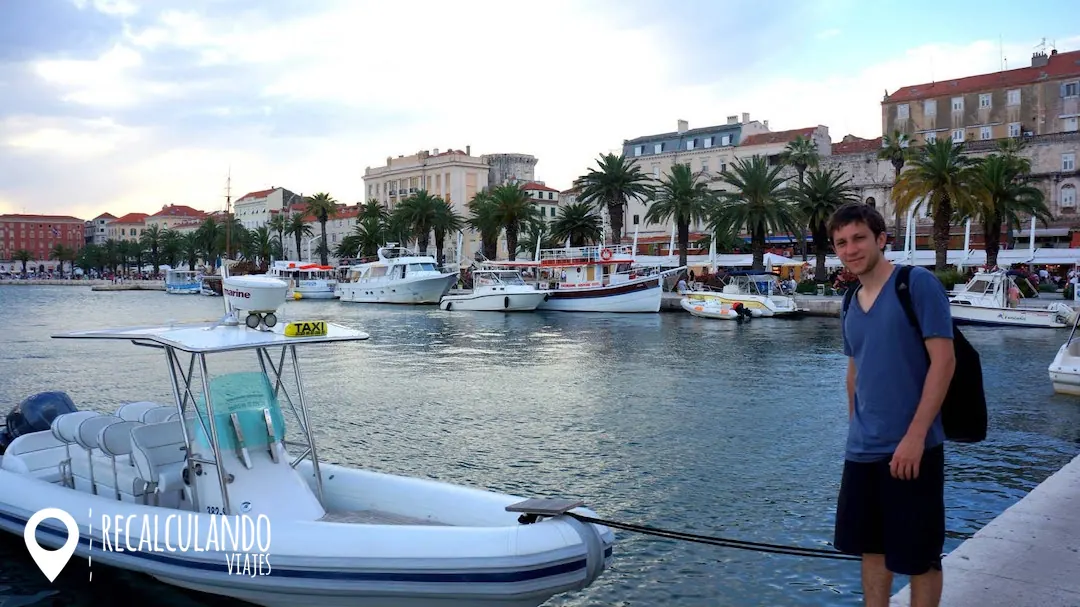
1. Diocletian’s Palace, the heart of Split
If we had to choose just one thing to do in Split, Croatia, this would be it. As they say, Emperor Diocletian ordered his retirement residence to be built between the late 3rd and early 4th centuries, covering about 30,000 square meters, half imperial villa and half fortress. The incredible thing is what happened next: the city did not turn it into a museum; it moved inside. Today there are apartments, bars, shoe stores and opticians (lots of opticians, it’s curious) within the Roman walls, and about 3,000 people live between those walls.
Here is the clarification that confuses everyone the most: Diocletian’s Palace is not a building with a door and a ticket booth. It is an entire neighborhood surrounded by a wall, with four access gates, and entry is free at any time. What you pay for are four specific things inside: the cathedral, the bell tower, the side rooms of the cellars and the Temple of Jupiter.
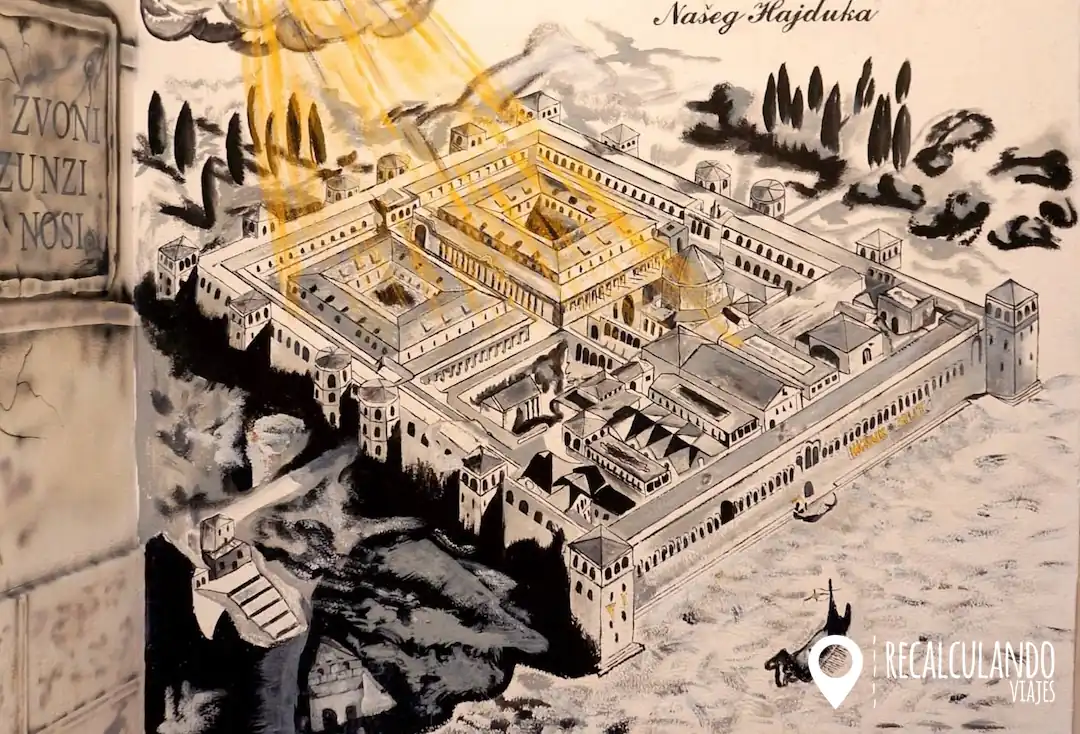
We got lost on purpose through its narrow streets more than once and something always appeared: a courtyard with a grapevine, a guy singing under an arch, a little stone door we hadn’t seen the day before. It was declared a World Heritage Site by UNESCO in 1979.
TIP: walk through the palace at least twice, early in the morning and after 8 pm. After 10 am, when the cruise ship groups arrive, the Peristyle and the main streets get crowded and it is a different place, not for the better. At night, with the stone illuminated and without the crowds, is when we liked it most.
2. The Palace Cellars: the Split of Game of Thrones
Under the palace, there is a network of vaulted rooms that remained buried for centuries and for that reason, they are the best-preserved part of the original 4th-century building. The central nave, which connects the Riva with the Peristyle, is free to walk through and is full of souvenir stalls. The side rooms are the ones with paid admission, costing around €5-6 (2025 price, it is worth confirming at the box office).
This is where one of the must-sees in Split appears for fans of the show: in these cellars, the dungeon scenes where Daenerys locks up her dragons in Meereen were filmed. Even if you haven’t seen a single episode in your life, the place is impressive: it’s cool in the middle of summer, the acoustics are tremendous and it gives a very clear idea of how everything above was built, because the layout of the cellars replicates that of the imperial quarters that were above them.
If you go in July or August and the heat is killing you, this is the best refuge in the center. It takes about 30 or 40 minutes to visit.
3. The Peristyle, the central square of the palace
The Peristyle is the porticoed courtyard where Diocletian received his subjects, and it remains the center of gravity of the city. It is surrounded by granite columns brought from Egypt and has an original sphinx over 3,500 years old, also Egyptian, which the emperor brought as decoration. Today it functions as an open-air living room: there is a bar that puts cushions directly on the steps and everyone sits there to have a drink.
It is the most photographed point in Split and also the one that gets crowded the fastest. If you want the photo without people, you have to be there before 9 am or after 9 pm. In summer, by mid-morning, it is simply impossible.
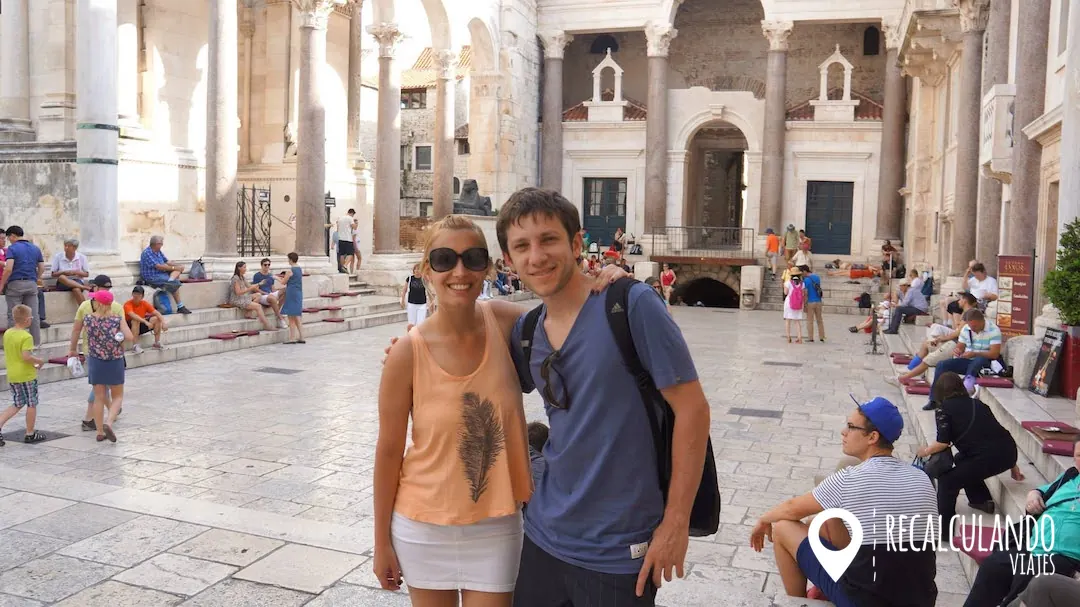
4. The Vestibule, a must-see in Split and it’s free
A few meters from the Peristyle, crossing an arch, is the Vestibule: a circular room with the dome open to the sky and absolutely empty. It was the anteroom to the emperor’s private quarters and was originally covered by a polychrome mosaic of which nothing remains today.
It is free and many people walk by without entering, which is a mistake. The acoustics inside are perfect and with luck you can come across a klapa, the traditional Dalmatian male singing groups that go to sing there because the sound bounces in a unique way. It happened to us one afternoon without planning it and it was one of those moments that stay with you. It lasts five minutes and costs nothing: it is one of the things to do in Split that we recommend the most.
5. The Cathedral of Saint Domnius and its bell tower
The cathedral of Split has one of the most ironic histories we encountered while traveling: it was the mausoleum of Diocletian, the emperor who persecuted Christians, and in the 7th century they transformed it into a cathedral dedicated precisely to Saint Domnius (San Duje), the bishop executed by his order. It is considered the oldest cathedral in the world still in use, maintaining its original structure.
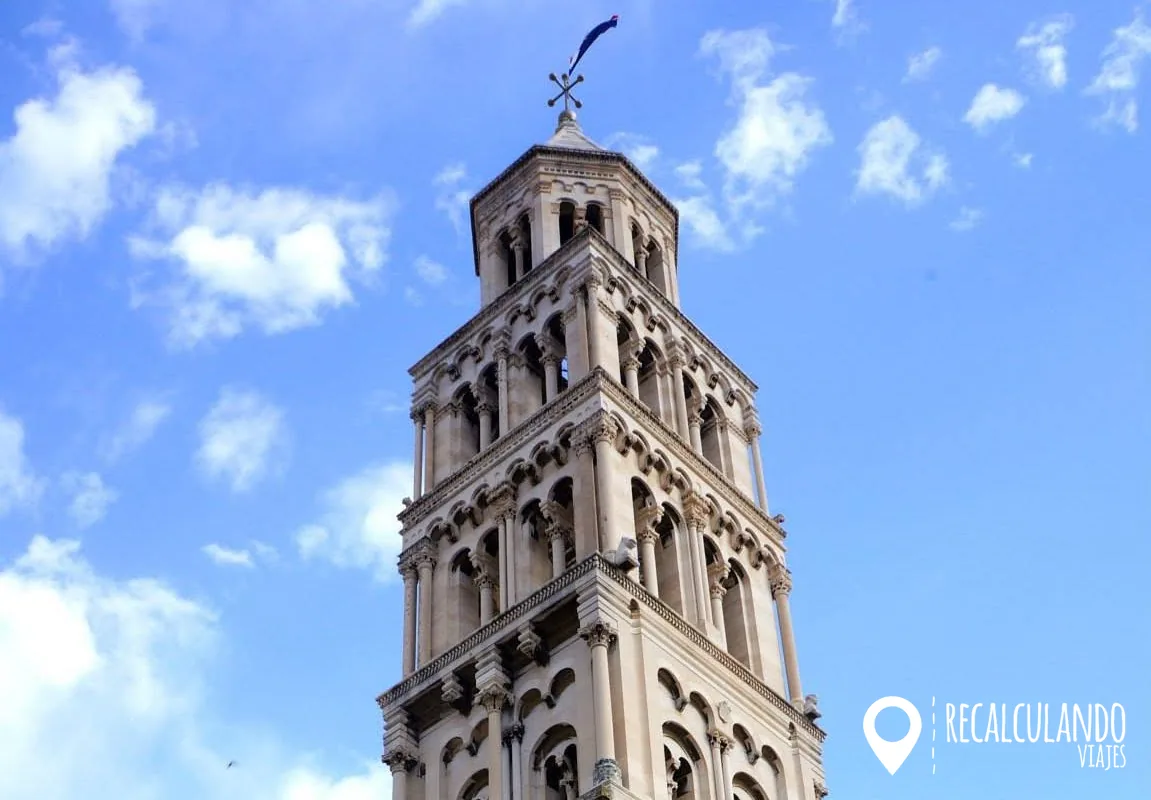
From the outside it is worth the detour: the walnut wood door carved in 1214 by Andrija Buvina, with 28 panels telling the life of Christ, is one of the images most repeated in the city. The 57-meter Romanesque-Gothic bell tower is the other symbol of Split and remains the tallest in Dalmatia.
How much does it cost to enter the Split Cathedral?
The ticket system is color-coded according to how many points you want to see, and it is one of the things worst explained on the internet. These are the reference prices (2025 season, to be confirmed at the box office when you travel):
| Ticket | What it includes | Approx. Price |
|---|---|---|
| Blue | Cathedral, crypt and baptistery (Temple of Jupiter) | €7 |
| Red | Cathedral, crypt, baptistery and treasury | €8 |
| Green | Cathedral, bell tower and treasury | €10 |
| Purple | All five points, including bell tower | €11 |
| Bell tower only | Climb to the tower | €5 |
Hours are around 7:30 am – 6 pm from Monday to Saturday, with breaks on Sundays for mass, so if you go on a Sunday, check before. The line between 10 am and 2 pm in summer can take you 20 minutes, better to go first thing in the morning or at the end of the day. You can check updated data on the official Split tourism website.
The treasury, the crypt and the climb to the bell tower
The treasury holds one of the most important sacred art collections in Croatia, with gold and silver reliquaries and a gospel book from the 6th or 7th century that is among the oldest liturgical books in Europe. The crypt, on the other hand, is honestly the most dispensable of the combo: you enter from the outside, it is practically empty and can be seen in five minutes. If you are short on time or budget, that’s the one you can skip.
Climbing the bell tower is what almost every traveler points to as the best part of the visit, with the complete view of the palace from above. Now, a warning: the stairs are narrow, steep and quite open in one section. If you have vertigo or knee problems, better skip it. We stuck with the views of Marjan, which are free and also spectacular.
👩⚕️👨⚕️ A must-have for stress-free travel! 🌎✈️ ➜ Get a Quote, Compare & Buy
6. The Temple of Jupiter, the hidden gem
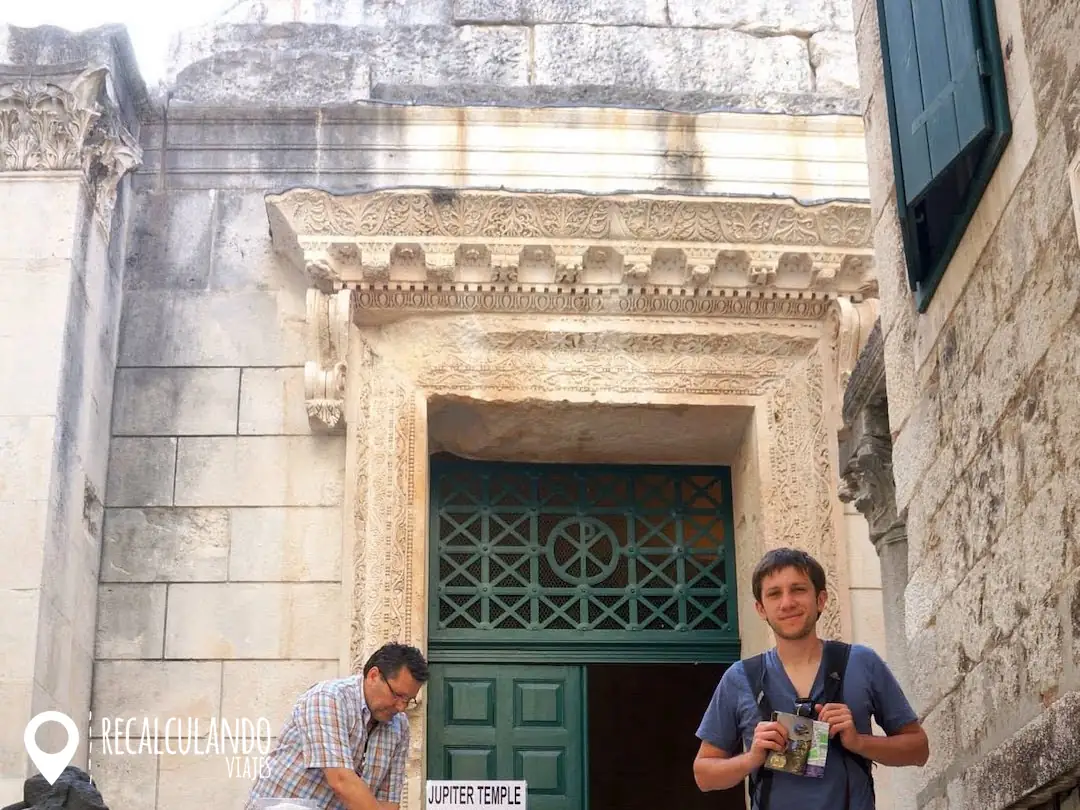
This is one of the places to see in Split that surprised us the most, and it’s less than a minute from the Peristyle through an alley that most people pass by. It’s a small Roman temple, but incredibly well-preserved, with a stone-vaulted coffered ceiling that is among the best preserved in the entire Adriatic. At the entrance, you are greeted by a headless black granite sphinx.
Later it became a baptistery and inside is the medieval baptismal font, with the relief of a Croatian king which is one of the oldest depictions of a European monarch. A single entry ticket costs around €3-4 and is included in several of the cathedral combo tickets, so if you buy the blue, red or purple one, you already have it paid for.
7. The Golden Gate and the finger of Gregory of Nin
The Golden Gate (Porta Aurea) is the northern entrance and the most monumental of the four: it is actually a double gate with a central courtyard in the middle, a defensive system designed to trap anyone who entered without permission. Diocletian crossed this gate for the first time into his palace on June 1, 305 AD.
Just outside is the statue of Gregory of Nin (Grgur Ninski), a work by Ivan Meštrović. It stands over eight meters tall and it is impossible to miss.
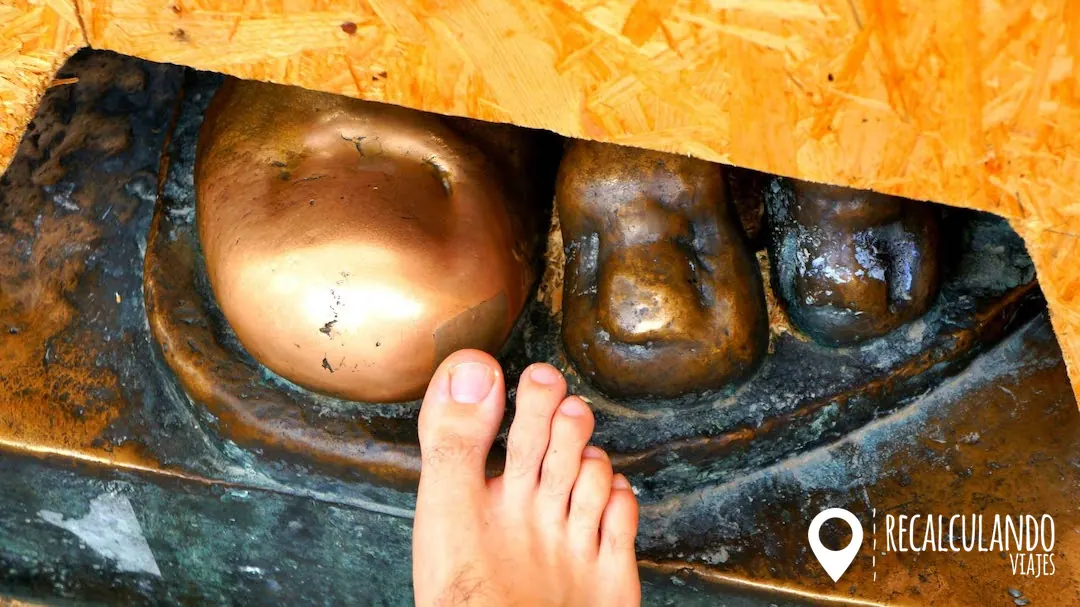
Tradition says that touching his big left toe brings luck and ensures you return to Split, so the bronze there is polished and shiny while the rest of the statue is dark. Obviously we touched it, and that’s where one of our favorite photos from the trip came from.
It is free, it is always full of people waiting for their turn for the photo and, if you want to take it without anyone around, go before 9 am. A few meters away, in the building that was the city’s first hospital, is the Gallery of Fine Arts (Galerija Umjetnina), with about a thousand years of Croatian art. We didn’t go in, but many travelers recommend it if you have extra time and like art.
8. The palace’s other three gates
The palace has four gates, one for each cardinal point and each with a metal name. Seeing them all is one of the simplest things to do in Split and a perfect excuse to go around the wall and understand how the complex was organized:
- Silver Gate (Argentea, east): connected the palace to the road that led to Salona, the Roman capital of Dalmatia. It was walled up from the Middle Ages until 1952, when they reopened it. Today it is the natural entrance if you come from the market.
- Iron Gate (Ferrea, west): the one used by the military and the only one through which life hasn’t stopped passing for 1,700 years in a row. It faces the People’s Square. Look at the clock of the Church of Our Lady of the Bell Tower, built over the gate: it has 24 numbers instead of 12, a rarity that almost no one looks at.
- Bronze Gate (Aenea, south): the smallest and different from all of them, because it faced the sea directly. From the cellars, you would exit from there to board ships. Today it is the access from the Riva.
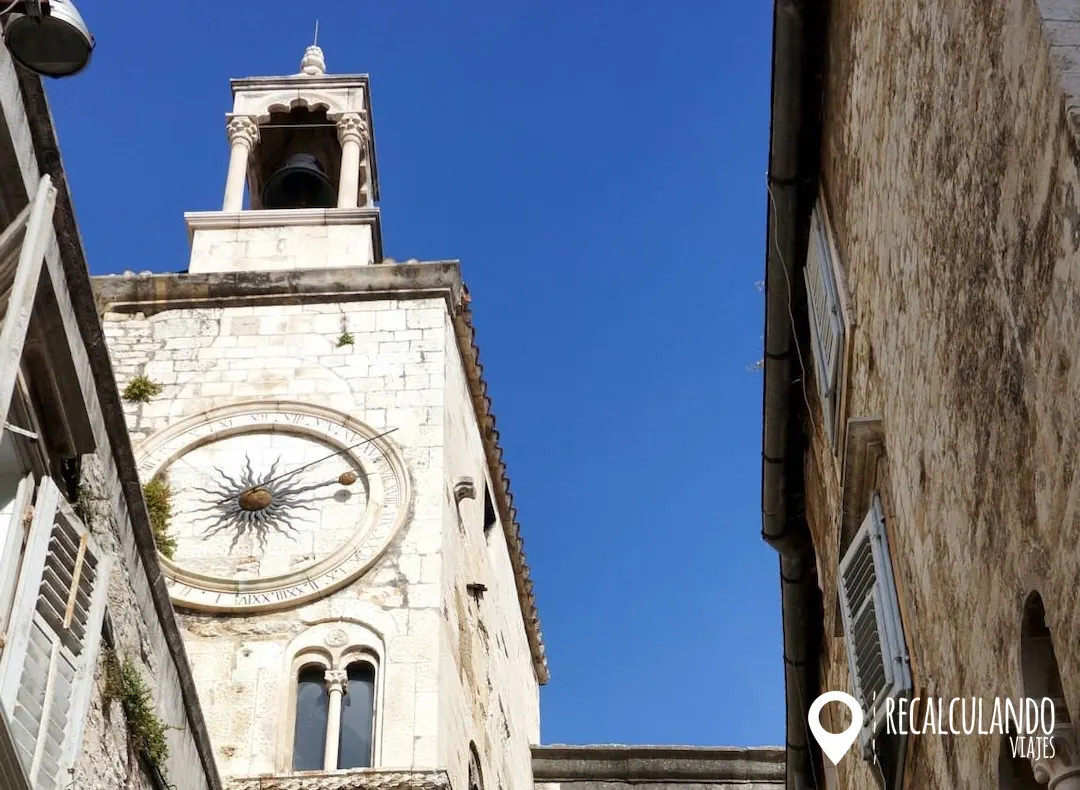
Clock Tower – Located near the Iron Gate
9. Pusti me proć street, one of the narrowest in the world
It is called Pusti me proć, which literally means “let me pass,” and the name is fitting: if someone comes from the opposite direction, one of the two must turn sideways. It is considered one of the narrowest streets in the world and connects the Peristyle with the Temple of Jupiter.
It is one of those things to do in Split that takes thirty seconds and is worth it anyway. We crossed it several times just for the pleasure of doing it and there was always someone laughing on the other side waiting for their turn. Look for it next to the cathedral, because it is not signposted and it is very easy to walk right past it.
10. Papalić Palace and Papalićeva Street
Tucked away among the narrow streets of the old town is Papalićeva, one of the prettiest medieval streets in the palace and another one used to film urban scenes of Meereen in Game of Thrones, including the slave rebellion.
On that same street is the Papalić Palace, a 15th-century Gothic mansion with a beautiful interior courtyard that you can peek into without paying an entrance fee. Inside is the Split City Museum. We stuck with the courtyard, which for our taste is the best part of the set: carved stone, an exterior staircase and total silence fifty meters from the hustle and bustle of the Peristyle. It is one of the corners that surprised us the most and where there was almost never anyone.
11. Game of Thrones Museum
Near the Golden Gate, a museum dedicated entirely to the series opened a few years ago, with themed rooms for Meereen, King’s Landing, Winterfell and Beyond the Wall, character sculptures, models, dragon eggs, costumes used in filming and the classic photo on the Iron Throne.
We didn’t go in, so we tell you this based on what we read and what we were told: travelers agree that it is small and only worth it if you are a big fan of the series. If your thing is to see the real locations, you have the palace cellars, Papalićeva street and Klis fortress, which are free or much cheaper and worth it in their own right even if you haven’t seen the series.



12. The Pjaca and the Fruit Square
The Pjaca (Narodni trg, People’s Square) is the main square outside the palace, just past the Iron Gate. It has the old Venetian Gothic town hall, a 15th-century sundial and many outdoor tables. It is the place where the people of Split gather to have coffee, which is a national sport here: they can sit for two hours with just one cup and no one rushes them.
A hundred meters away is the Fruit Square (Trg Braće Radić), much smaller and with an octagonal 15th-century Venetian tower that is somewhat hidden. It’s called that because it used to be the fruit market, although today there is no fruit left: it is a quiet little square with a couple of cafes and a statue of Marko Marulić, the Croatian Renaissance writer. It is one of those corners that are in the middle of everything and always have fewer people. Ideal for a ten-minute stop between visits.
13. The green market and the fish market, the Split of everyday life
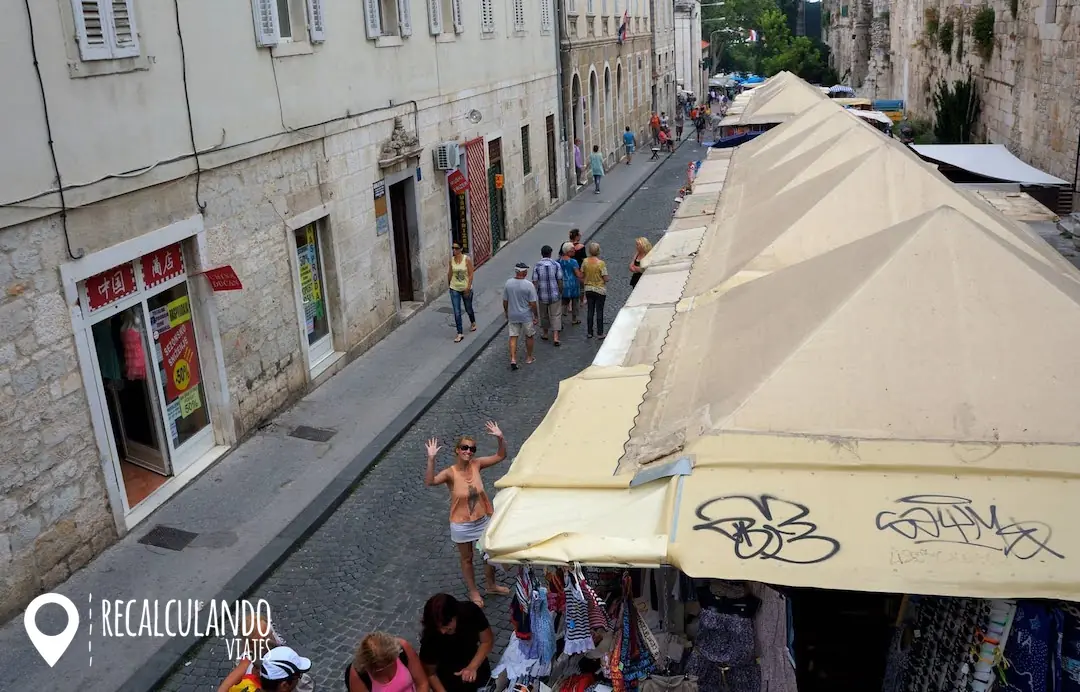
Attached to the Silver Gate is the Pazar, the open-air market of Split: fruits, vegetables, figs, local olive oil, lavender, cheeses and all the noise of a real city. We went to buy fruit two mornings and it ended up being one of our favorite places, because it is one of the few things in the center that is not designed for tourists. And if you are watching your budget, having breakfast with fruit from the market lowers your daily spending quite a bit.
On the other side of the old town, near Marmontova, is the Peškarija, the covered fish market from 1890, where the morning’s Adriatic fish is sold. It has a somewhat bizarre feature: it is the only fish market we have ever visited that doesn’t smell bad. It is built right next to a sulfurous spring and, they say, the smell of sulfur keeps the flies away.
TIP: both operate in the morning. After noon, almost everything is closed up, so if you want to see them in action, go early.
14. Marmontova and the National Theatre
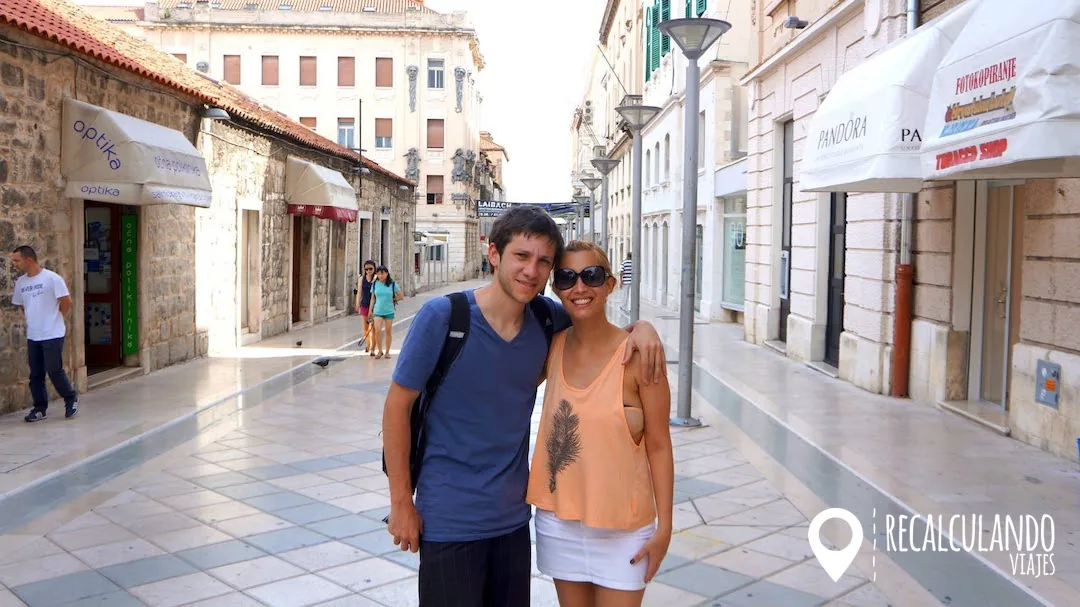
Marmontova is the wide pedestrian street with white flooring that separates the old town from the newer part. It is the shopping street of Split: brand-name stores, ice cream parlors, an occasional flower stall and street musicians in the afternoon. We walked it almost every day because it connects the Riva with the market and the Republic Square.
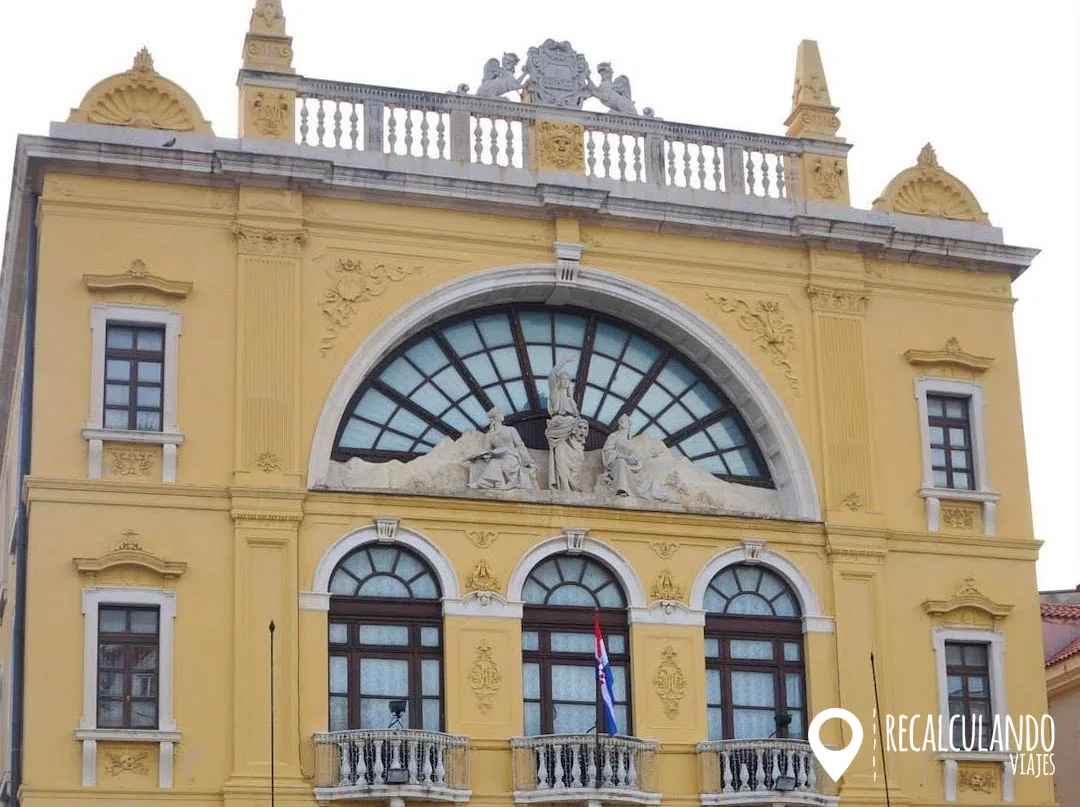
At the north end, a couple of blocks away, appears the yellow facade of the Croatian National Theatre (HNK), an 1893 building that was one of the first theaters with electric light in southern Europe. Even if you don’t go in to see anything, the illuminated facade at night is worth the walk.
TIP: the polished marble floor of Marmontova and the palace becomes slippery when it rains. With flip-flops with smooth soles, it is a slide, we checked.
15. The Republic Square (Prokurative)
At the end of Marmontova, towards the sea, opens the Republic Square, which everyone in Split calls Prokurative. It is a set of reddish neoclassical buildings with arcades on three of its sides, open to the sea on the fourth, and is clearly inspired by St. Mark’s Square in Venice.
For us, it is the prettiest square in the city and the most underrated: it is meters away from everything, many people don’t even know it exists and in the afternoon there is usually live music. It is the stage for the Dalmatian song festival and a good part of the summer concerts.
Keep in mind: the terraces in the square are among the most expensive in the center. Look at the menu before sitting down, or have a drink two streets in and come back to the square to listen to the music.
16. Walk along the Riva
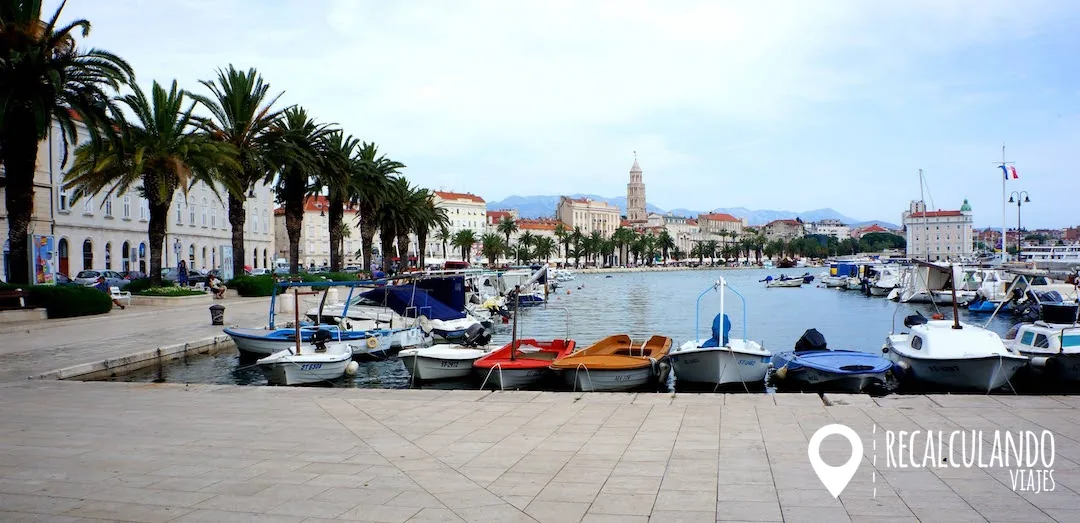
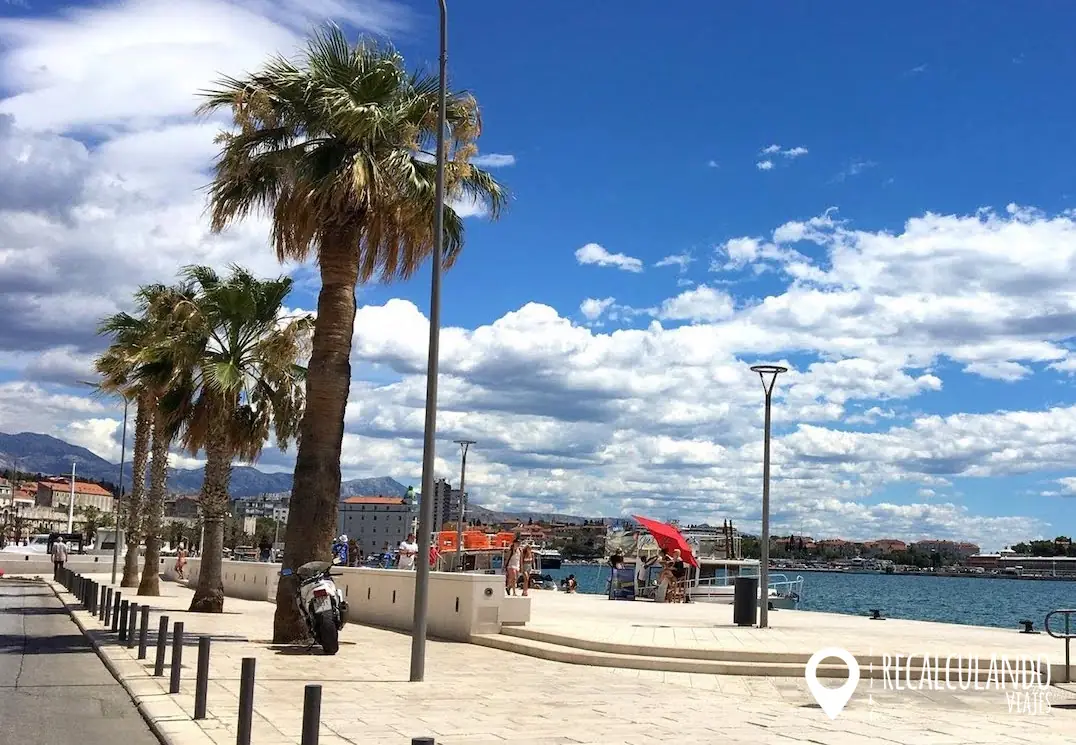
The Riva is the waterfront promenade that runs along the southern facade of the palace, with palm trees, white marble flooring and a row of bars with terraces overlooking the Adriatic. It has nothing monumental and yet it is one of the things to do in Split that we repeated the most: we would sit down to have a coffee at sunset, when the palace stone turns golden and the heat subsides, and time would pass us by watching people go by.
It is also the point where you understand how the city works: on one side you have the old town, on the other the port with the ferries leaving for the islands, and everyone passes through there. On Saturday nights it is full and in summer there are usually stalls and music.
Keep in mind: the prices of the Riva terraces are the highest in the center. If you want the same thing for much less, go two streets into the palace or cross to the Varoš neighborhood.
17. Marjan Hill, the city’s lungs
Marjan is the pine-covered hill that closes the Split peninsula to the west, and for us, it is the city’s best surprise. From the center, it is a 15 to 30-minute walk, depending on where you start. You go up the stairs of the Varoš neighborhood to the first terrace, where there is a bar with the most famous view of Split: the old town, the port and the islands in the background.
You can continue climbing to the highest point, where the flag is, and from there you can see both sides of the peninsula at once. The path is all in the shade of pine trees, with trails that open up to viewpoints and medieval chapels tucked into the rock. It is free, you do it on your own and you don’t need any transport.
On the way to Marjan, on the coastal promenade, is the Meštrović Gallery, the house-workshop of Croatia’s most important sculptor, now turned into a museum. We aren’t really museum people, so we just saw it from the outside, but many travelers put it among the best in Split, both for the sculptures and for the villa and its gardens overlooking the sea.
TIP: bring water and go up early or at sunset. At noon in summer the climb is tough, although later the shade of the pine trees helps quite a bit.
18. Kašjuni, one of the best beaches in Split
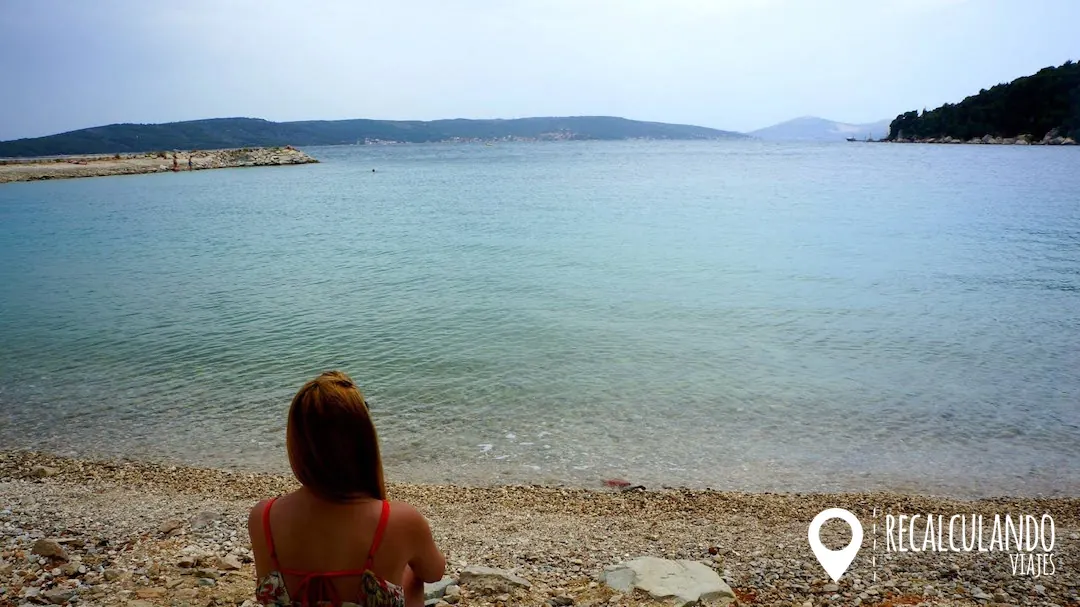
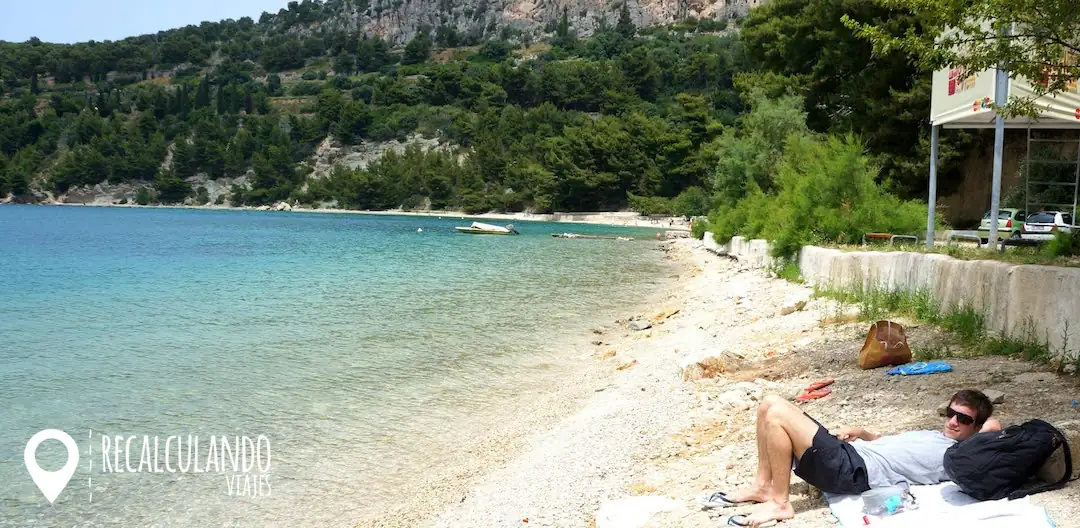
Kašjuni is on the west side of Marjan, about 4 km from the center, and it was our favorite beach in Split. It is pebble, with the water that turquoise blue transparent color that the entire Adriatic has and the pine trees going down almost to the shore. Compared to the beaches in the center, it feels like another world: it still has people, but the natural environment completely changes the experience.
It has services (a well-known beach bar, sunbed rentals, bathrooms), so it’s not a wild cove, but it’s not the urban beach full of bars either. We went by car and parked nearby without drama mid-morning; in high season you have to arrive early or resign yourself to walking a bit. You can also reach it walking along the sea from the center, or by bus, although the frequency drops a lot on weekends.
Keep in mind: it’s stones, not sand. Some water shoes or rubber sandals to get into the water change your day, especially if you go with kids.
19. Bene beach
Bene is on the other side of Marjan, at the northern tip, and is the quietest of the three. Surrounded by pine forests, with trees that reach almost to the water and a sports area with tennis courts. It is a very family-friendly beach and much less touristy than the others, partly because you have to go a little further.
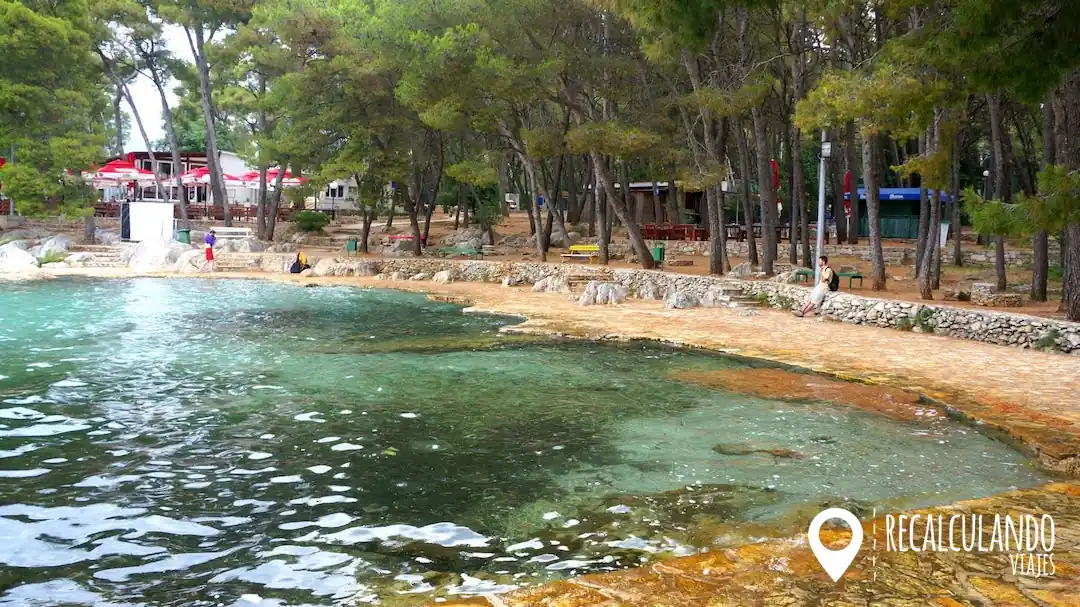
What we liked most is that it is not “remodeled”: it maintains the feel of a lifelong neighborhood beach, with natural shade which in Croatia is a scarce luxury. If you have very hot days and don’t want to suffer, this is the place.
You can get there by car along the route that borders Marjan (there is a parking lot), by bike, or walking from the center if you can handle about 40-50 minutes of uphill. Between Kašjuni and Bene is also Kaštelet, smaller and with fewer services.
20. Bačvice, Firule and picigin
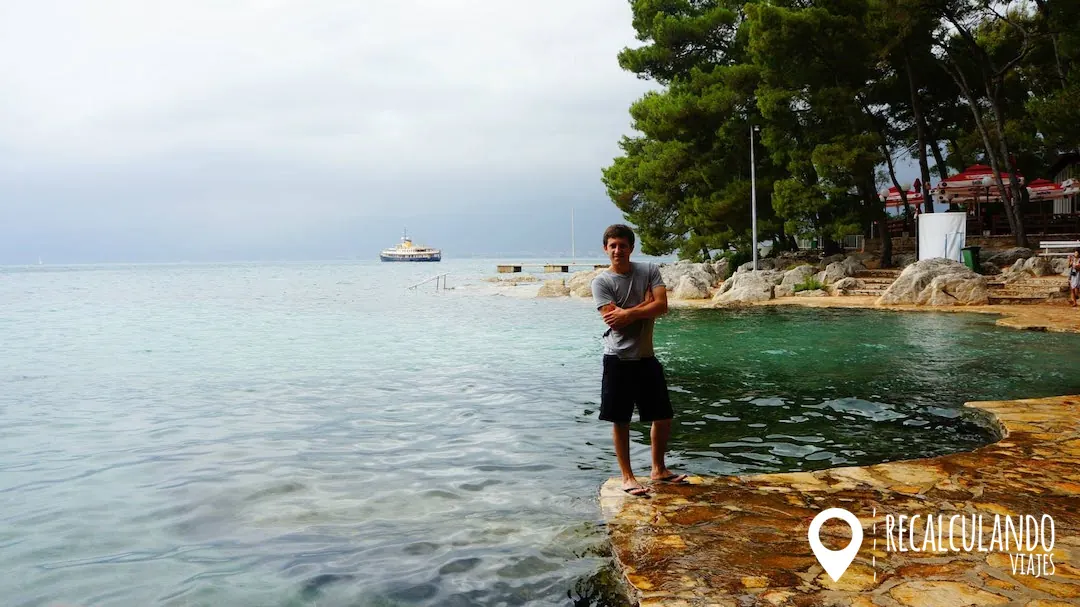
Bačvice is the urban beach of Split, a ten-minute walk from the center behind the station. It is the most popular and the most crowded: if you go in July or August, expect to find it packed. Its great peculiarity is that it is extremely shallow; you can walk more than a hundred meters out to sea without the water getting deep.
And that’s precisely why picigin was born there, the traditional game of Split: a group of people in a circle with water up to their knees passing a small ball back and forth, without letting it touch the water, diving in if necessary. It is declared an intangible cultural asset of Croatia and the locals play it all year round, even on January 1st. Watching them play is a spectacle in itself.
Following the coast to the east appear Ovčice and Firule, two smaller beaches, with fewer tourists and the same water. Firule is the lifelong neighborhood beach of the locals and is usually quite a bit quieter than Bačvice, so if you walk and find the first one impossible, continue fifteen more minutes.
To be honest, as a beach we prefer the Marjan ones a thousand times: Bačvice is comfortable and functional, but there is nothing romantic about it. Now, if you want to see a local custom that you won’t find anywhere else, it’s worth coming at sunset.
21. Klis Fortress and Salona ruins
The last of the places of interest in Split is on the outskirts and can be done in half a day. Klis Fortress is about 13 km away, perched on a gorge between the Mosor and Kozjak mountains, and has over 2,000 years of history: it was an Illyrian fort, the seat of Croatian kings and a key bastion against the Ottoman advance. It was also the main setting for Meereen in Game of Thrones, including the exterior scenes of the crucifixions and the taking of the city by Daenerys.
Entry costs around €12, includes the interpretation center and the olive museum, and opens every day early; just in case, always check updated data on the official website. There is free parking below and from there a short but steep climb, so wear closed shoes.
Halfway there are the ruins of Salona (Solin), the capital of the Roman province of Dalmatia and the largest archaeological site in Croatia: amphitheater, early Christian basilicas, walls and necropolis. It grew to be three times larger than Pompeii.
We didn’t get to do this outing: with three nights we prioritized the city and the beaches, so we tell you this based on what other travelers told us and what we had noted down. What we do know is that by car it is a convenient half-day plan and that both stops combine well in the same morning. By bus, lines 22 and 35 of Promet reach Klis from the bus station for just over €2.
Walking tour: things to do in Split in one day
If you have only one day, this is the order to see Split without zig-zagging. It’s about 5 or 6 kilometers, very relaxed, and you can walk everything:
- Enter through the Bronze Gate from the Riva and cross the central nave of the cellars.
- Go up to the Peristyle (early, before the cruise ships arrive).
- Cathedral of Saint Domnius and climb the bell tower.
- Vestibule, two steps away and free.
- Pusti me proć and Temple of Jupiter.
- Papalić Palace and Papalićeva street.
- Exit through the Golden Gate and touch the finger of Gregory of Nin.
- Border the wall to the market and the Silver Gate.
- Pjaca and Fruit Square, with a stop for lunch.
- Marmontova, Prokurative and the fish market.
- Climb to the Marjan viewpoint in the mid-afternoon.
- Close at the Riva at sunset and return to the palace already illuminated.
If you arrive by cruise ship, 5 or 6 hours is enough to do points 1 to 10 without rushing, because the terminal is meters from the old town.
When to go to Split: the best time for the trip
The things to do in Split can be visited all year round, but the difference between seasons is huge:
- May and early June: our recommendation. Warm weather, sea already pleasant starting in June, lower prices and the palace without the avalanche of cruise ships.
- July and August: the city in full swing, with all the nightlife and all the ferries running, but also with strong heat, high prices and accommodation that sells out months in advance.
- September: for us the other great option. The sea is at its best and the crowds drop quite a bit after the 15th.
- From November to March: very quiet and cheap, but with many ferries to the islands reduced to a minimum and several restaurants closed.
We were there at the end of June and it seemed like the right balance: the water was already good for swimming, but the August peak hadn’t arrived yet.
What to visit in Split in 1, 2 and 3 days: itineraries
Split in one day (or on a cruise ship stopover)
Follow the walking tour above and it’s enough for the essential. If you arrive on a cruise ship, start with the inside of the palace as soon as you get off, which is when it’s least crowded, and leave the Riva for the end.
Split in two days
The first day, the whole old town calmly, adding the palace cellars, the market and the squares. The second, a morning at the beach in Kašjuni or Bene and an afternoon exploring Marjan completely up to the flag.
Split in three days
With the third day you can choose: half a day to Klis and Salona, an excursion to the Krka waterfalls, or a whole day on an island. We used that day for the coast and we didn’t regret it even a little bit.

Where to sleep in Split
The area where you sleep changes the experience a lot, especially due to the noise and how close you are to the things to do in Split. These are the options depending on what type of trip you are taking:
- Inside Diocletian’s Palace: sleeping between Roman walls is an experience hard to beat and you have everything on foot. On the downside: it’s the most expensive area, you can’t enter by car and in summer there is noise from bars until late. If you are a light sleeper, this is not for you.
- Varoš and around Marjan: our favorite. Five minutes walking from the center, quiet stone streets and direct path to the beaches. The best balance between location and rest.
- Bačvice and Firule: close to the urban beach and the bus and ferry station. Practical if you arrive or leave early to the islands, and with more nightlife.
- Station area / Manuš: the most economical within the urban area, a ten or fifteen-minute walk from the palace.
- Podstrana or Trogir: if you travel by car and are looking for lower prices, they are 15-30 minutes away and usually have parking included, which in Split is gold.
TIP: in July and August, old town accommodations fly off months in advance and prices skyrocket. If you can move the trip to June or September, the difference is huge. And if you come by car, always confirm if the accommodation has its own parking before booking: you can’t drive inside the palace and private parking saves you the city’s biggest problem.
Accommodation Map in Split
On this map you can see accommodations with real prices according to your dates, which is the fastest way to compare area and price simply:
How to get to Split
By plane. Split airport (SPU), also called Resnik, is about 24 km from the center, next to Kaštela and only 5 km from Trogir. In summer it receives direct flights from several European cities, and is the natural gateway to all of Dalmatia.
From the airport to the center. Watch out for this, because many guides are outdated: since 2026 the Pleso Prijevoz shuttle bus stopped operating and Promet line 37 became the only public transport option. The ticket costs about €3 paying cash to the driver, or around €1.50 buying it through the Promet Split app. The trip to the Sukoišan urban terminal takes between 50 and 60 minutes because it stops along the way. The alternative is a taxi or private transfer, much more expensive but direct to the door.
By car. That’s how we arrived and how we recommend touring Croatia if you have several days: the A1 highway connects Zagreb with Split in about 4 hours and from there all the Dalmatian coast opens up.
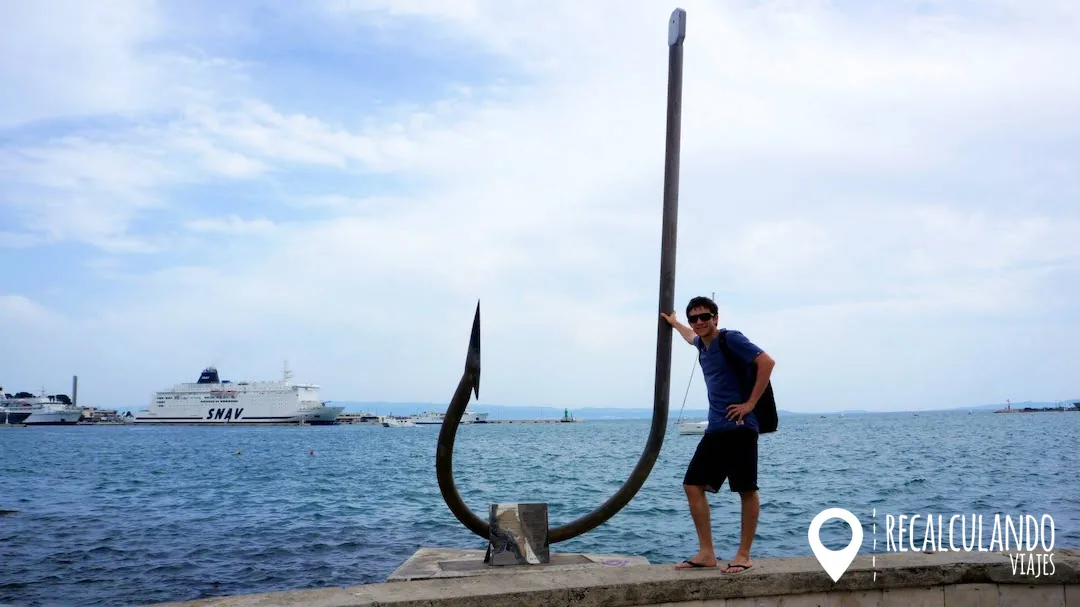
By ferry. The port of Split is the most important in the Croatian Adriatic and is meters from the Riva, so if you arrive without a car you walk to the old town. From there, ferries and catamarans leave for Brač, Hvar, Korčula, Vis and Šolta, in addition to international lines to Ancona and Bari. For reference, the trip to Hvar takes about an hour by passenger catamaran and about two hours by car ferry to Stari Grad. You can see updated schedules and prices on the Jadrolinija website.
How to get around Split
Good news: almost everything there is to do in Split can be done on foot. Inside the old town everything is pedestrian and distances are short, and you can even reach the Marjan viewpoint on foot without needing transport. For the beaches to the west you can walk, bike or take a local Promet bus.
Where to park in Split (and where it is free)
This is the most annoying part of arriving by car, so here are the details. The historic center and the entire palace area are closed to traffic, and nearby parking lots are paid, expensive and limited by the hour. In high season, driving around looking for a spot is a waste of a morning.
- The best option: book accommodation with private parking included. Even if it costs a few euros more per night, it saves you the whole problem.
- Free, 1 or 1.5 km away: on the residential streets that branch off Ulica Slobode there is usually free space, and also in the area of the Joker shopping center, about a 10-15 minute walk from the old town. Always check that there is no paid zone sign before leaving the car.
- Distant parking lots: this is what we ended up doing. We left the car far away and walked, which was cheaper and much less stressful than looking for a spot near the palace.
TIP: if you come from outside the European Union, check your cell phone data before traveling. We use an eSIM from Holafly and with the code RECALCULANDOVIAJES you get a discount; it activates in five minutes and you forget about looking for wifi. And when you pay with a card, always choose to be charged in euros and not in your currency: the exchange rate offered by the terminals is quite a bit worse.
What to eat in Split
After checking off the things to do in Split comes the other half of the trip. Dalmatian cuisine is pure Mediterranean, with a lot of Italian influence: fresh Adriatic fish, local olive oil, pasta and vegetables. The best and cheapest is in the konobas, the traditional lifelong taverns, which usually have homemade dishes at prices well below the restaurants on the Riva.
- Peka: meat or octopus cooked slowly under an iron bell covered in hot coals. It is the Dalmatian dish par excellence and in many places, it must be ordered hours in advance.
- Črni rižot: black cuttlefish risotto, ink included. It leaves your teeth black and that doesn’t matter.
- Ćevapi: some grilled minced meat rolls, Balkan heritage, served with bread and onion. The cheapest option for lunch and it’s everywhere.
- Blitva: chard with potato, garlic and olive oil. The side dish that accompanies every fish in Dalmatia.
- Grilled fish: ordered by weight and paid by the kilo, so ask the price and how much the piece weighs before they cook it, so you don’t get a surprise on the bill.
- Soparnik and fritule: the region’s typical flat chard pie and the sweet fritters with lemon zest.
And a note that surprised us: ice cream in Croatia is excellent and quite cheap compared to Italy. In Marmontova and around the Riva there are ice cream parlors everywhere and it was our ritual every afternoon.
Our practical recommendation: stay two or three streets away from the Riva and the Peristyle. There the prices drop quite a bit and the food is usually better.
Travel insurance for Croatia
Before heading out to explore the things to do in Split, a boring but necessary topic. Croatia is in the European Union, so with the European Health Insurance Card you have basic public attention covered if you travel from Spain. Now, that does not cover repatriation, cancellations, lost luggage, or private assistance, which is exactly where the big expenses appear. And on a coast and island trip, where you move by ferry, rent a car and go into the sea every day, the chance of an unforeseen event is not that low.
We always travel insured with IATI, which we have used for years on all our trips around Europe. You can see the coverage and calculate the price of your trip here:
The discount applies only by entering from that link, or loading the code RECALCULANDO. If you want to compare coverages before deciding, we leave you our comparison of insurance for Europe.

Excursions from Split
When you have already checked off the things to do in Split, the city becomes the best base in Dalmatia: many full-day excursions depart from here. These are the ones we like the most:
- Nearby islands: Brač with the famous Zlatni Rat beach, Hvar with its old town and fortress, and Šolta, quieter and very close. All are done in one day by catamaran.
- Blue Cave and Vis: the star excursion of the summer, with the Biševo cave and its fluorescent waters. It leaves very early and depends on the state of the sea, so book with a margin in case they cancel it.
- Pakleni Islands: the archipelago in front of Hvar, with transparent water, which is usually combined with the island on the same outing.
- Krka Waterfalls: just over an hour away, it is the most accessible national park from Split. We tell you everything in our guide to Krka waterfalls.
- Plitvice Lakes: further away (about 3 hours), but it is the most impressive park in Croatia. Check how to visit the Plitvice lakes before going, because the entrance logistics have their quirks.
- Trogir: 30 minutes away, a walled medieval old town, a World Heritage Site. We leave you the things to do in Trogir.
- Makarska Riviera: to the south, with the best beaches on the continent. The one in Brela is less than an hour away by car and was one of the ones we liked the most in all of Croatia.
If you prefer to be told the history of the palace in English instead of reading it on your own, there are walking tours and guided visits that leave from the Peristyle almost every day, in addition to themed Game of Thrones routes that combine the cellars with Klis.
Map of the things to do in Split
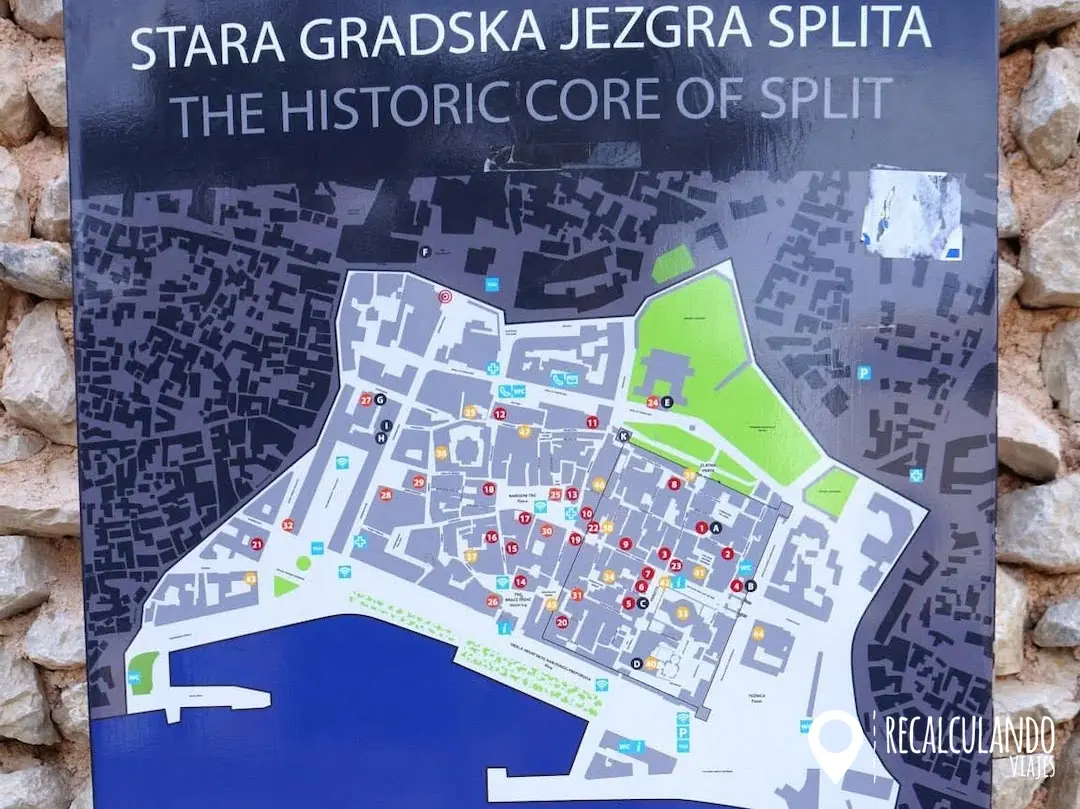
We leave you the map of things to do in Split with the 21 marked places, plus the beaches and the surrounding excursions. You can save it to your Google Maps and take it on your phone while you explore.
Frequently Asked Questions about Split
Is it worth visiting Split?
Very much so, and for us it is an obligatory stop on any route through Croatia. The things to do in Split combine Roman heritage, beach and mountain in very little space. It is not just a pretty historic center: it is an inhabited Roman palace where people go about their normal lives, with beaches and a hill with pine trees fifteen minutes away walking. It surprised us much more than we expected.
How many days are needed to see Split?
With two full days you can see the city in a relaxed way: one for Diocletian’s Palace and the old town, and another for Marjan and the beaches. If you want to add an excursion to Klis, Krka or an island, count on three days. For us, three nights was the right amount.
Things to do in Split in one day?
Diocletian’s Palace, cellars, Peristyle, Cathedral of Saint Domnius, Vestibule, Temple of Jupiter, the statue of Gregory of Nin, the squares, Marmontova and the Riva. If you have time in the afternoon, climb up to the Marjan viewpoint to see the city from above. All that can be done on foot in a single day without rushing.
Is a cruise ship stopover enough to see Split?
Yes, because the cruise port is meters from the old town. With 5 or 6 hours you have enough for the entire palace tour, the cathedral and the Riva without hurry. Our advice is to start with the inside of the palace as soon as you get off, which is when it’s least crowded.
How much does it cost to enter the Cathedral of Saint Domnius?
It depends on the combination you choose: the blue ticket is around €7 and includes the cathedral, crypt and baptistery; the purple one is around €11 and also includes the treasury and the bell tower. Climbing only to the tower costs around €5. These are reference prices for 2025 and it is worth confirming them at the box office.
Is there an entrance fee to see Diocletian’s Palace?
No. The palace is the city center, it is an inhabited public space and can be explored for free at any time. Only specific parts are paid separately: the cathedral, the bell tower, the Temple of Jupiter and the side rooms of the cellars.
Where was Game of Thrones filmed in Split?
The cellars of Diocletian’s Palace were the dungeons for Daenerys’ dragons, Papalićeva street was used for urban scenes of Meereen, and Klis fortress, 13 km from the city, was the city of Meereen itself. All three can be visited on your own, without the need to hire a tour.
What are the best beaches in Split?
The best ones are at the foot of Marjan hill: Kašjuni for the environment and the water, and Bene for the pine shade and tranquility. Bačvice is the most popular and closest to the center, with Firule and Ovčice next to it if you find it too crowded. If you have a car, the beaches of the Makarska Riviera, such as Brela, are less than an hour away and are on another level.
Where can you park for free in Split?
The historic center is closed to traffic and everything nearby is paid. Free options are 1 or 1.5 km away: the residential streets that branch off Ulica Slobode and the Joker shopping center area, about 10-15 minutes walking from the old town. Always check that there is no paid zone sign before leaving the car.
Is it worth renting a car in Split?
For the city, it is not necessary and even annoying, because the center is pedestrianized and parking is expensive and complicated in summer. It is worth it if you are going to tour Dalmatia, the Makarska beaches or the national parks. We had it for the entire trip through Croatia and it was the best decision, but during the days in Split we left it parked almost always.
How to get from Split to Hvar or Brač?
From the port, which is meters from the Riva. To Hvar, the passenger catamaran takes about an hour and the car ferry arrives at Stari Grad in about two. To Brač, the ferry to Supetar crosses in about 50 minutes. In July and August it is advisable to get tickets in advance, especially if you are taking the car across.
Is travel insurance necessary for Croatia?
It is not mandatory if you come from the European Union, but the European Health Insurance Card only covers basic public care: it does not include repatriation, cancellations or lost luggage. We use IATI on all our trips around Europe and you can see the coverages in our insurance guide.
Is Split expensive?
It is one of the most expensive destinations in Croatia in high season, especially accommodation in the old town and the terraces on the Riva. But it is handled easily: by eating in konobas two streets inside the center, buying fruit at the market and going to the Marjan beaches instead of the paid ones, the daily expense drops quite a bit.
Our conclusion on things to do in Split, Croatia
Split won us over for something we didn’t expect. We went thinking of a Roman palace and found a city that lives inside its ruins, with a pine-covered hill and turquoise water beaches fifteen minutes from the center, and with people who take a coffee for two hours as if time didn’t exist.
If you are planning a route through Dalmatia, you can use Split as a base: ferries to all the islands leave from here, the two southern national parks are here and the best beaches on the continent. And if you only have one day, don’t worry: the must-see things to do in Split can be done walking in one day, following the route we left above.
Are you still planning the trip? We leave you our entire Croatia guide with the islands and towns we visited, and if you are in the planning stage, see how we organize each trip step by step. Have a great trip!
ℹ️ **Total Transparency**
This article contains affiliate links. If you book through these links, we may receive a small commission at no additional cost to you. We only recommend services we use on our travels and trust. This helps us keep this blog free and continue creating useful content for you. Thank you for your support!
🔗 Resources & Useful Links for your trip to Split
Do you have questions or want to add your own recommendations on things to do in Split?
💬 Leave your comment or write to us, we love reading the experiences of other travelers.
Thank you very much for being part of this adventure!— Nanu & Facu 🌎 | Recalculando Viajes 💜