If you are looking for things to do in Primošten, we can tell you that this little stone town hanging over the Adriatic was one of the best surprises on our route through Dalmatia. We visited it for a day in July, driving from Trogir, and we ended up staying many more hours than we had planned. In this guide, we leave you the 18 must-see places, a map with all the points, which beach to choose, where to park, where to stay, how to get there, and the advice we wish we had read before going.
🌍 Travel Insurance: 5% Off with IATI Seguros! 🌟
Take advantage of this offer and travel safe.
Things to do in Primosten: Summary
| Category | Key Details of Primošten |
|---|---|
| What is it? | Former island turned into a peninsula, famous for its cobbled streets and maritime architecture. |
| Ideal time | 2-3 hours for the essentials; half a day to enjoy its beaches and vineyards. |
| Must-sees | Old town, Church of Saint George, cemetery viewpoint, and Bucavac vineyards. |
| Notable beaches | Velika Raduča (amenities and pines), Mala Raduča (central), and Lokvice (best views). |
| Gastronomy | Fresh fish, black risotto, peka, and the local red wine Babić. |
| Logistics | Paid parking in the center; water shoes are essential for the pebble beaches. |
| Best time | June and September (avoid crowds and enjoy ideal temperatures). |
| Location | Dalmatian coast, between Šibenik and Trogir (accessible by car or bus). |
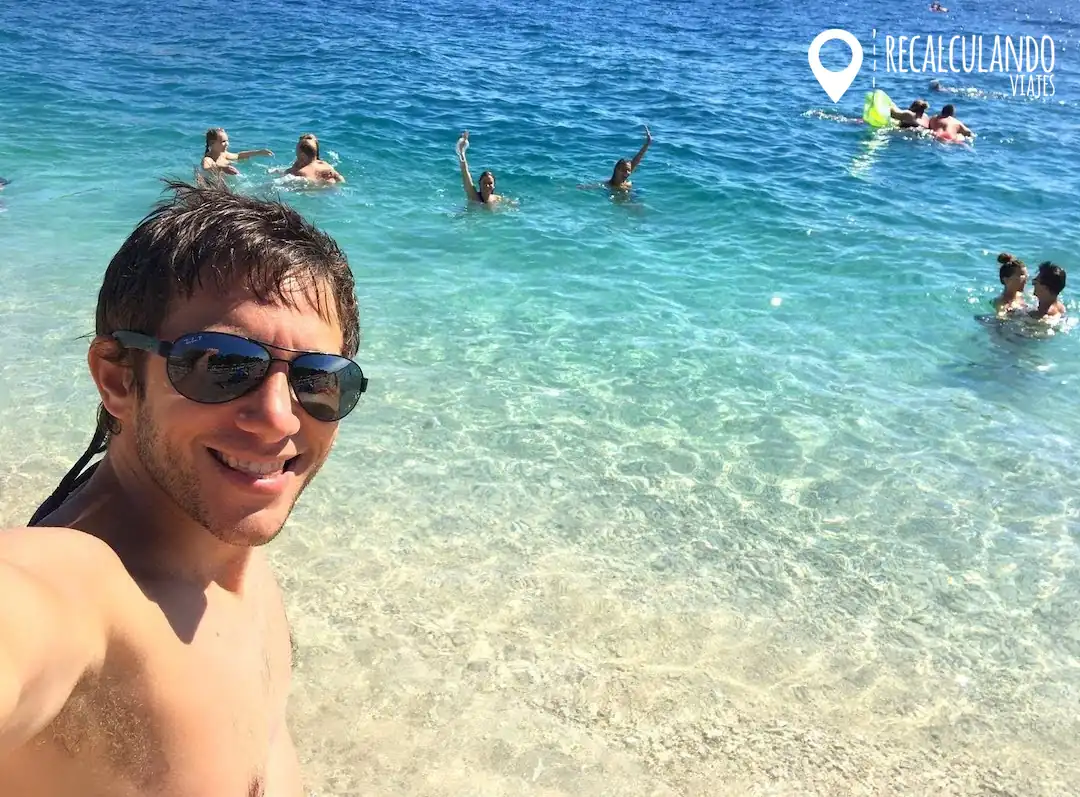
Primošten: the island that stopped being one
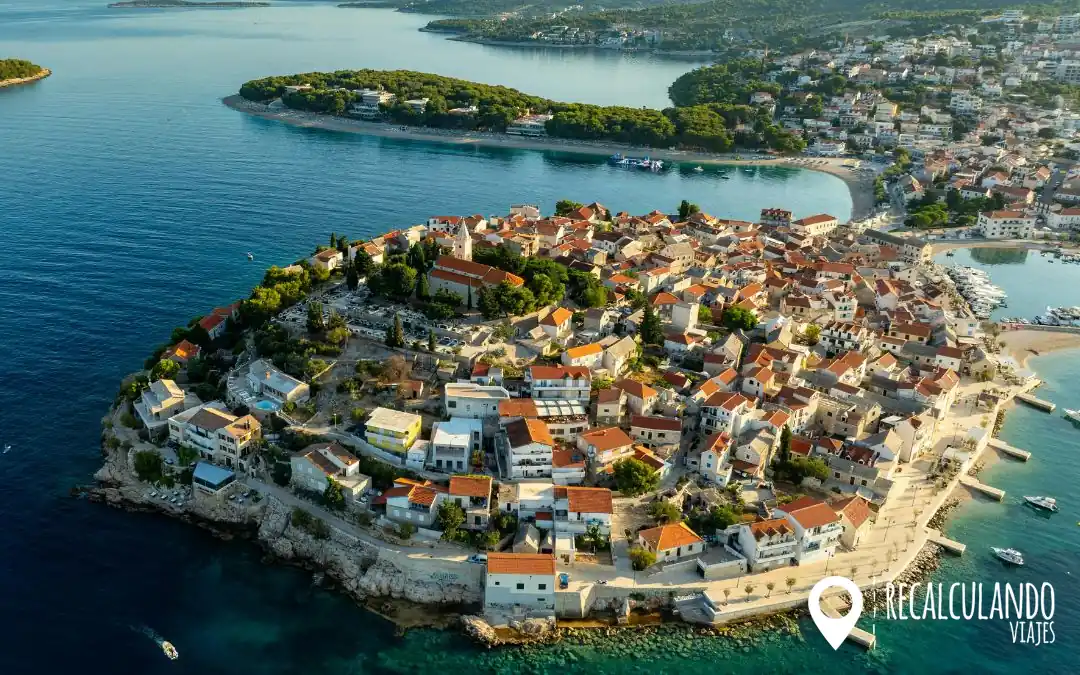
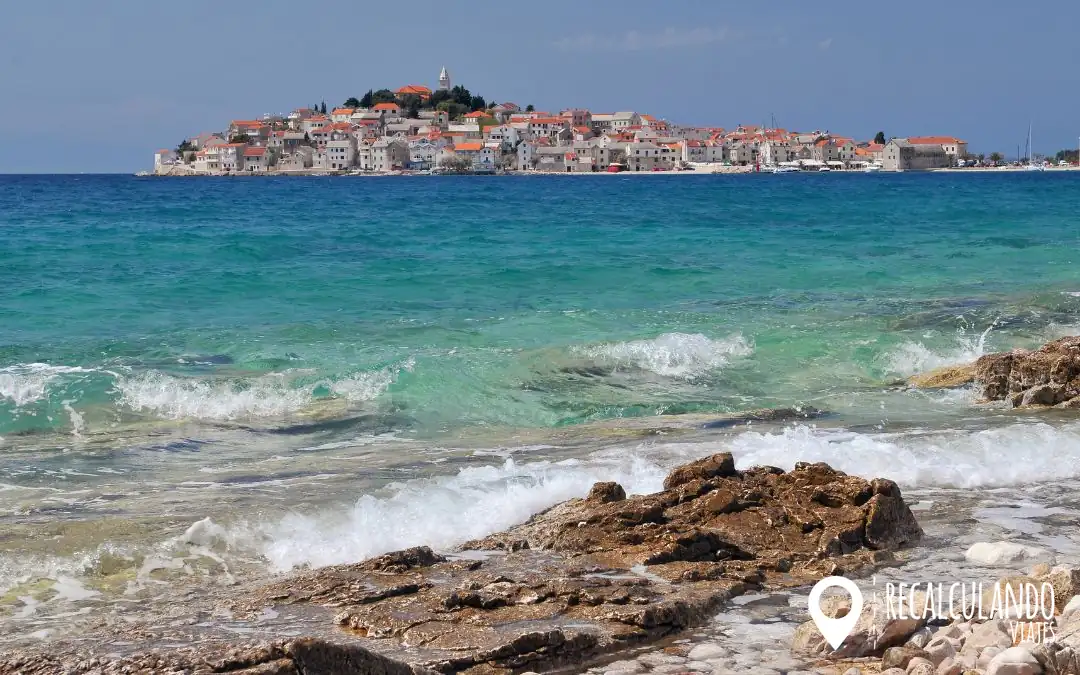
Primošten has fewer than 3,000 inhabitants and a history that explains its unusual shape: it was an island and, during the Ottoman attacks of the 16th century, it served as a refuge for the coastal population. Under Venetian rule, walls were built and a wooden drawbridge was constructed that could be retracted at night or in case of danger. That is where the name comes from, premošten, something like “joined by a bridge”.
Over time, the locals replaced the bridge with a dirt path and later with the stone isthmus you see today, and the island was attached to the mainland forever. That detail is what makes the town seem to float when viewed from the road. If you are coming from Trogir, which has the exact same origin, the comparison is inevitable: Trogir is more monumental, Primošten is more maritime and much smaller.
1. The wall and the stone gate, the entrance to the old town
The journey through the things to do in Primosten starts, without a doubt, at the old stone gate, the best-preserved section of the Venetian wall that protected the island. It is the only “official” entrance to the old town and acts as a threshold: on one side, the bustle of the coast and cars, on the other, a stone town where no vehicles can enter.
The original wall is no longer fully preserved, but the entrance arch is impeccable and is one of the most photographed spots. We walked underneath, and the change was immediate: the narrow streets are in the shade, and the temperature drops by several degrees. Just before crossing, on one side, is the chapel of Saint Roch, which we talk about below.
2. The old town, the heart of everything to do in Primosten
The old town is, without question, the reason why people stop here. It is a tiny labyrinth of cobbled streets that climb in a spiral toward the church, with light stone houses, green wooden shutters, flower pots, and very few signs. We went in without looking at the map, and it worked perfectly: in 15 minutes, we were already lost, and that was exactly what we wanted.
You can walk through the whole thing in a long hour, without rushing. There are no great monuments, and that is its charm: it is a fishing village that remains almost intact, with laundry lines, cats in the sun, and some grandmother sitting in her doorway. Look at the roofs, because some houses still retain the stone slabs instead of tiles, mixed with newer concrete constructions which, let’s be honest, take a bit of charm away from the whole.
Our advice is to walk through it twice, once upon arriving and once at sunset, because the stone changes color and the town empties suddenly when groups return to the buses.
TIP: the ground is made of stone polished by centuries of footsteps, and there are short but steep slopes. Comfortable footwear is a must. You will slip in flip-flops.
3. Rudina Square, the town’s meeting point
As soon as you cross the gate, you find yourself in the main square, on Svetog Jurja street: terraces, souvenir shops, the tourist office, and a disproportionate number of ice cream parlors for the size of the town. It is the only place in the old town where there is anything like commercial movement, and it acts as a meeting point for everyone.
We stopped there to have a drink after the first walk, and it was the best place for people-watching: Croatian families returning from the beach, travelers with maps in their hands, and locals greeting each other from table to table. If you need to ask about schedules, boat rentals, or excursions, the tourist office is right there.
4. The Church of Saint George (Sv. Juraj), the highest point of the town
All the narrow streets end in the same place: the parish church of Saint George, built in the 15th century at the top of the peninsula and thoroughly renovated in 1760. Admission is free, and the interior is sober, tiny, and very “village-like”. Inside, there is an icon of the Virgin with silver ornaments and a painting by the master Cusi from 1719, as well as the altar of Our Lady of Loreto, the town’s patron saint.
But what is really worth it is the view from outside. Standing up there, with the Adriatic surrounding you on all four sides and the red roofs cascading toward the sea, is one of those things that justify the detour on its own. It is the best natural viewpoint in the whole town and, moreover, it’s free. The bell tower is the one you see peeking out in all the photos of Primošten taken from the water.
👩⚕️👨⚕️ A must-have for stress-free travel! 🌎✈️ ➜ Get a Quote, Compare & Buy
5. The cemetery: one of the things to do in Primosten with the best views
It sounds strange to recommend a cemetery, we know. But the one in Primošten surrounds the Church of Saint George, it sits about 100 meters above the sea and has, without exaggeration, the best views of the town. Cypress trees, pines, white stone tombstones with detailed sculptures, and the Adriatic in the background. A quiet place even in the middle of July, when it was packed everywhere else.
It is the favorite spot for many people to watch the sunset, and we understand why: the sun goes down right behind the islets and the sea turns orange. We stayed there for a long while, almost alone, while the bars on the promenade could be heard in the distance. Mind you: it is an active cemetery, so it is appropriate to walk through it with respect and in silence.
6. The šetnica, the promenade that surrounds the entire peninsula
One of the things to do in Primošten that we liked the most was the coastal promenade that goes all the way around the old island. It is called šetnica, and it won’t take you more than 20 or 25 minutes if you walk straight through, although it took us twice as long because we stopped every two minutes.
The circuit discovers tiny coves between the rocks—like Rosi or Popožo—iron stairs to get into the water, benches in the shade of the pines, cafes with terraces facing the sea, and viewpoints toward the islets in front. There are stretches where the water is so transparent that you can see sea urchins from above. If you are short on time and have to choose just one thing, choose this: it is the best photo of Primošten and the nicest way to understand how the town is built.
7. The fishing port and the promenade
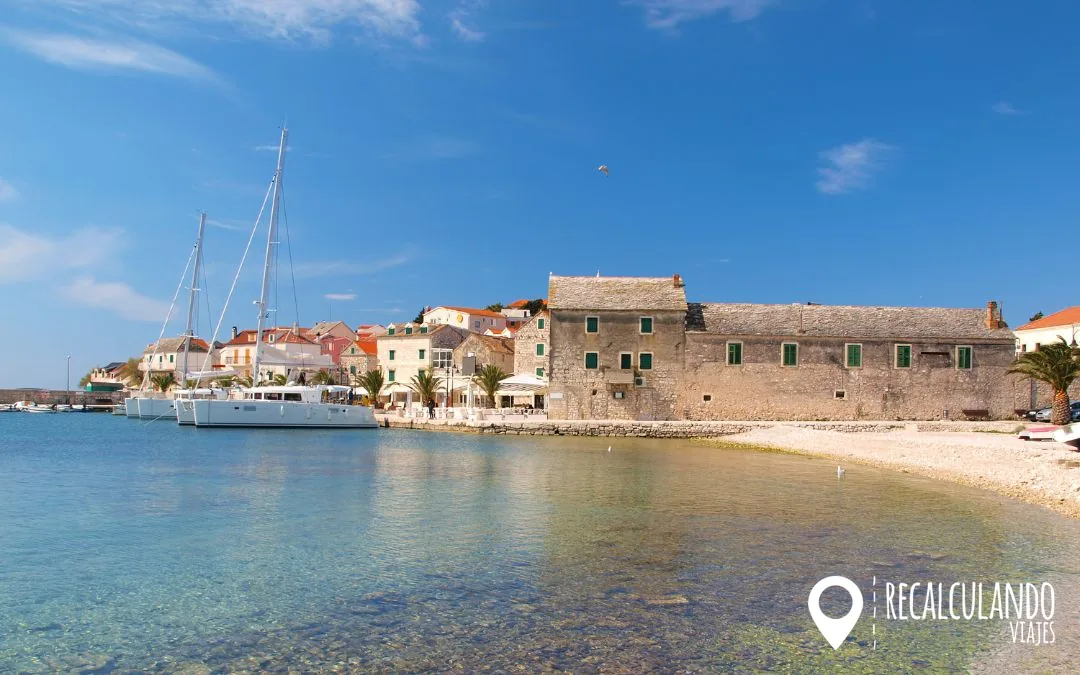
The port is the classic postcard: wooden boats, nets, the fisherman statue, little stone houses behind, and the bell tower peeking out above everything. It is on the isthmus, right where the old town joins the mainland, and it acts as an improvised central square. Early in the morning, you can see the fishermen returning, and in the afternoon, it fills with people having a drink with their feet almost in the water.
The promenade continues toward the Mala Raduča area and is where the bars, ice cream parlors, and nightlife are concentrated. We walked the whole thing before dinner, and it was a perfect way to cool down from the afternoon heat. In summer, there are little craft stalls, local olive oil, and lavender.
8. Lokvice Beach, the view that made Primošten famous
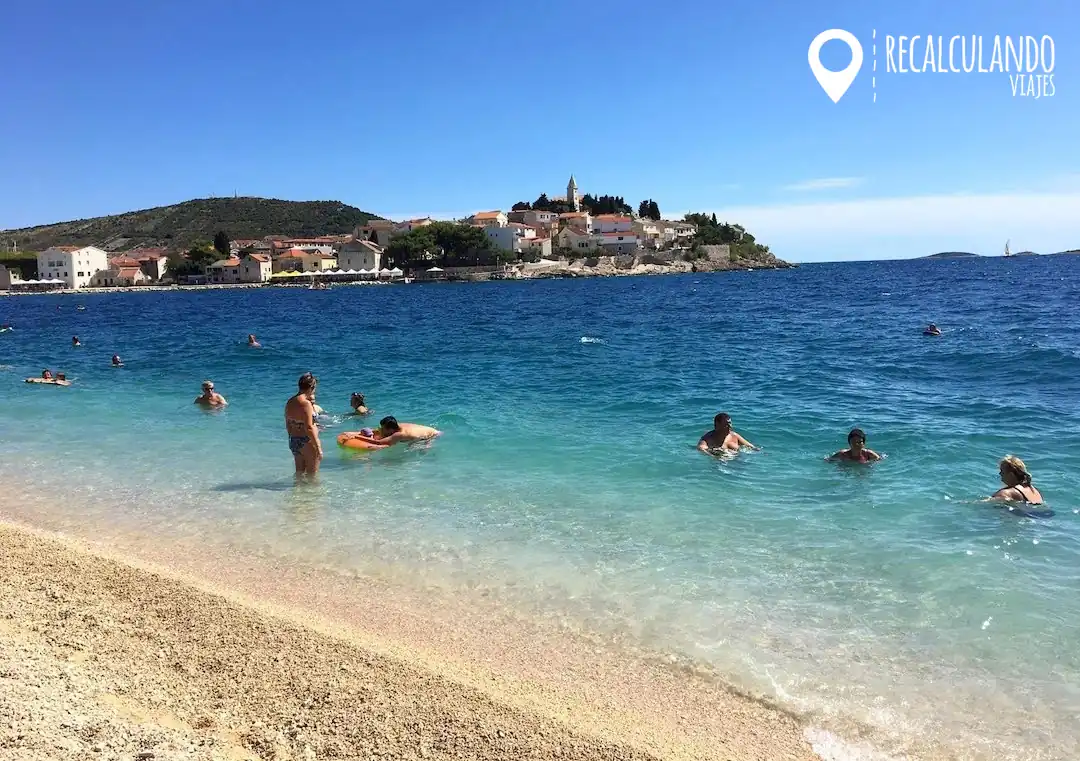
If you saw a photo of Primošten and got hooked, it was almost certainly taken from here. Lokvice is the beach on the mainland, on the parking lot side, and from its shore, you can see the whole town resting on the hill, with the houses stacked up and the bell tower standing out. It is THE view.
As a beach, it is fine—nothing more: coarse stone, crystal-clear water, and little shade. But as a viewpoint, it is unbeatable, and on top of that, it is the first natural stop if you arrive by car. We used it just like that, to take the first photos before entering the town.
Photography TIP: we happened to arrive near noon and the light was very harsh. Photographers who know the area recommend coming in the morning, because in the afternoon the town is backlit from this side. If you want the perfect photo, wake up early.
9. Mala Raduča Beach, the most central
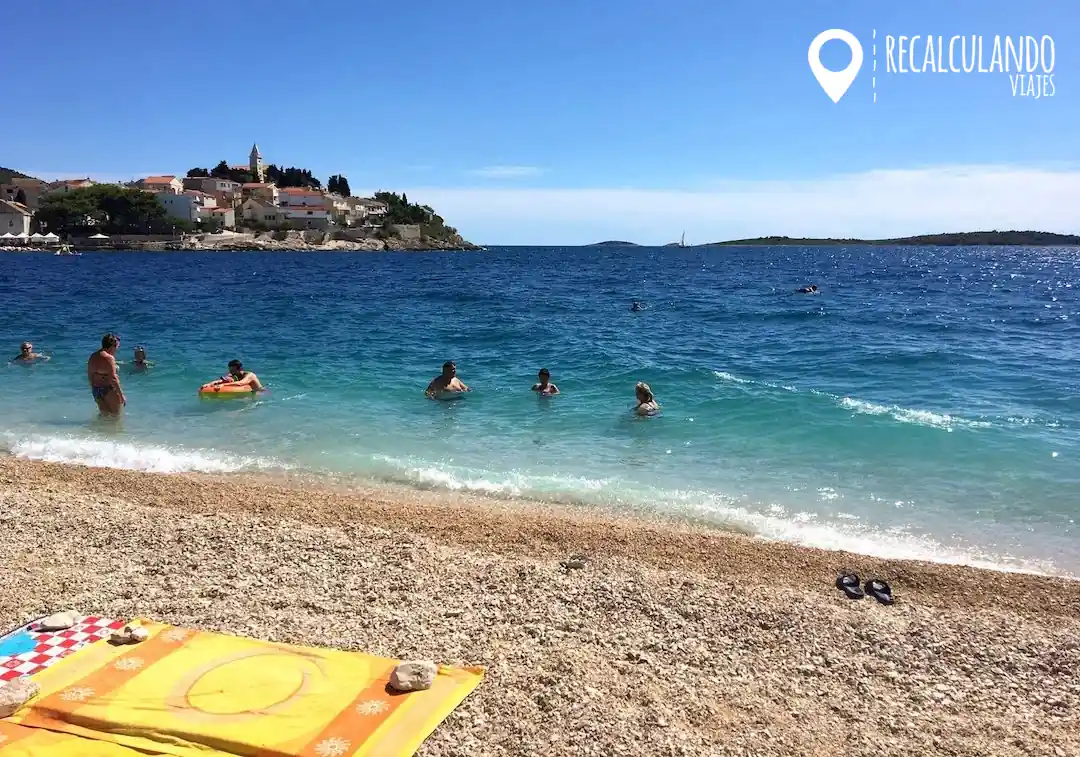
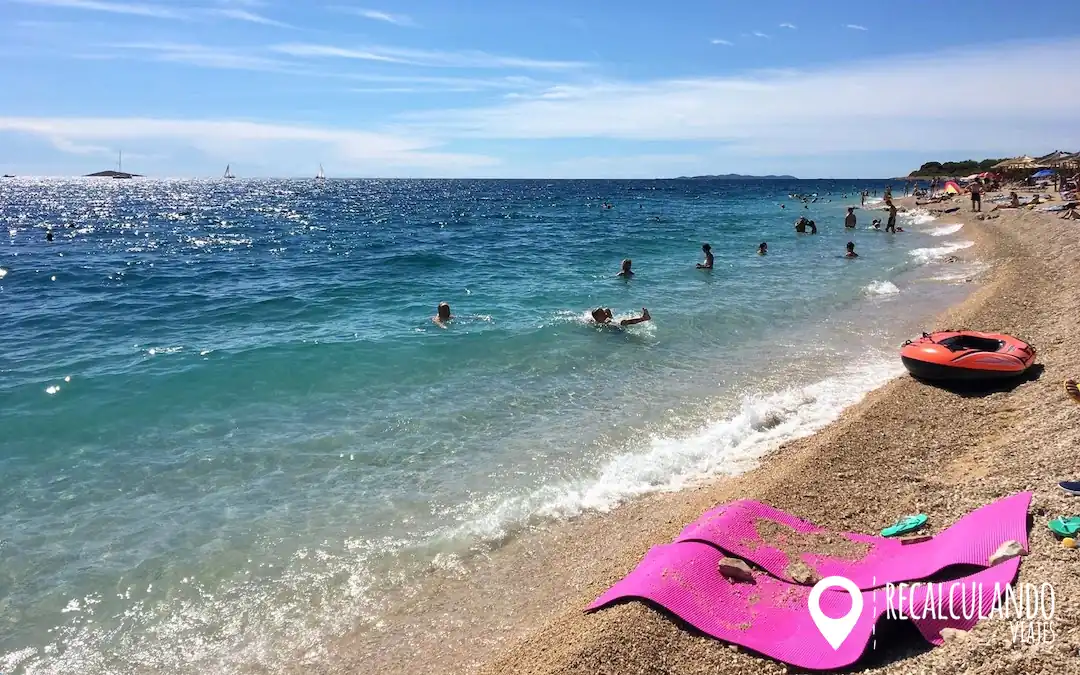
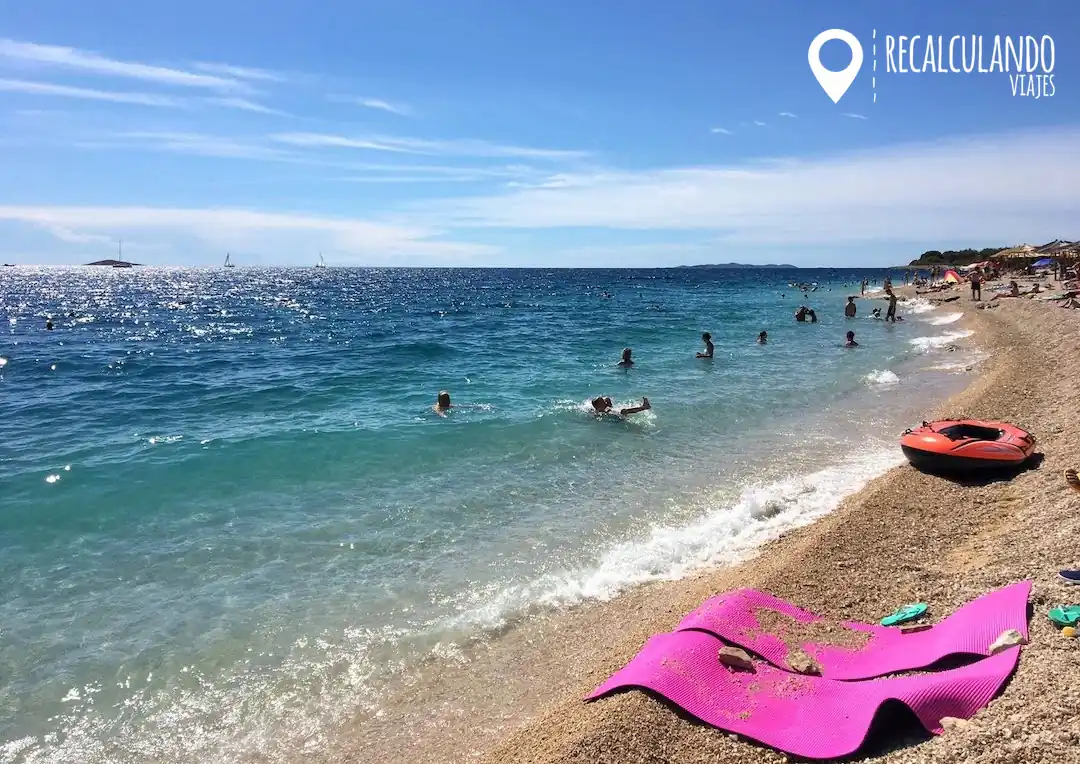
If we are talking about beaches, this is the first on the list of things to do in Primošten. Mala Raduča is right next to the center, just as you cross the isthmus, and it is the beach that appears in all the photos because it has the peninsula with the entire old town in the background. It consists of fine pebbles, has a gentle entry into the water, and a turquoise color that in July looked retouched.
Since it is in the very center, it gets quite crowded between 11 am and 5 pm, especially in August. It has bars next to it, rental umbrellas, and toilets, so it is the most convenient option if you are traveling with children or just passing through. We took a dip there for a while at noon and the water was incredible, although we had to walk a few meters to the end to find a quiet spot.
10. Velika Raduča Beach, the best for spending the day
Velika Raduča is the big, crescent-shaped beach located on the opposite peninsula (the one full of pines, north of the center). It often appears on lists of the best beaches in Croatia, and the truth is that it deserves it: crystal-clear water, gentle slope, and pine trees that reach the shore, which means free natural shade—something that isn’t very common in Dalmatia.
It is about a 10-minute walk from the center and is quite a bit larger than Mala Raduča, so it handles the high season better. It is also the best-equipped of all: rental loungers and umbrellas, beach bars, showers, toilets, kayaks, and even inflatable water games for kids in the summer. If you are coming to Primošten for some real beach time, this is the one for you.



11. The hidden coves of the Raduča peninsula
One of the must-sees in Primosten that almost no one mentions: keep walking along the Raduča peninsula beyond the main beach. It is a pine forest with dirt trails and, every so often, a little path down to a pebble cove where there is absolutely no one.
We reached a tiny cove with two people and a twisted pine tree providing shade, and we stayed there until the sun went down. There are no services, so bring water, something to eat, and sunscreen. Many travelers also recommend the islet of Smokvica, off the coast, where there is a naturist beach for those looking for total privacy.
TIP: the bottom is rocky and there are sea urchins in the rocky areas. A cheap pair of water shoes will save your vacation.
12. The viewpoint of the Virgin of Loreto, on Gaj hill
This is one of the must-see things to do in Primošten if you are coming by car. On Gaj hill, 170 meters high and about 3 km from the old town, stands a 17-meter statue of the Virgin of Loreto, patron saint of the town, inaugurated in 2017. It is one of the tallest statues of its kind in the world, and it can be seen from the road long before reaching Primošten.
We saw it from the car on the way and we really wanted to go up, but we were tight on time. Those who go up agree that it is the best viewpoint in the area: from there you can see the entire peninsula, the islets, and a good part of the vineyards. You can reach it by car via a paved road or by walking from the town (one hour, uphill and with no shade, so better not to do it at noon in summer). At the top, there is a bar with a terrace for a drink while looking at the coast.
13. The Bucavac vineyards, the famous “stone lace”
Of all the things to do in Primosten, this is the great secret of the town and what impressed us most about the landscape. About 3 km south is Bucavac Veliki, an 18-hectare hillside divided into dozens of tiny plots separated by dry-stone walls, built by hand, without machines, over centuries. From afar, it looks like white lace thrown over the hill.
The site is on the UNESCO World Heritage tentative list, and an aerial photo of these vineyards was exhibited at the United Nations headquarters in New York as a symbol of human labor over nature. When you see the size of each plot up close and the amount of stone moved, you understand perfectly why.
They are private property, so you don’t go in to walk among the vines. You can see them from the road (there is space to stop), from the Loreto viewpoint, or from the sea.
14. Tasting Babić wine, another thing to do in Primošten
From those impossible plots comes Babić, the native red grape of the area. It is a powerful wine, full-bodied with mineral notes, very different from the light whites one associates with the Croatian coast. It has international fame and goes great with grilled meats and Dalmatian ham.
There are several family wineries in Primošten and in the inland villages that offer guided tastings; many travelers recommend them as one of the best experiences in the area, with prices that usually range from 30 to 60 € per person depending on what is included. If you don’t want to spend that much, any bar on the promenade will serve you a glass of local Babić for a few euros. We tried it that way, sitting in front of the port, and it was a perfect end to the day.
15. The Chapel of Saint Roch and the story of Don Ivan Šarić
Just before the wall gate, outside the old town, is the Chapel of Saint Roch. It was first mentioned in the mid-16th century and finished in 1680, when it was dedicated to the saint to whom the town attributes having saved it from the plague that devastated Europe. It is tiny and can be visited in five minutes, but it has the strongest history in the town.
In front of it is a monument to Don Ivan Šarić, the local priest who, during World War II, saved dozens of women and children from reprisals. The residents declared November 16, 1942, as the Day of Salvation. Šarić was murdered in 1944, and in 1991, the town raised this monument in gratitude. We think those are the kinds of details that completely change how you look at a place.
The other small church is that of Our Lady of Charity (Gospa od Porta), simple and with a beautiful location near the water. Here every chapel has to do with the sea, the plague, or the war.
16. The Kremik marina and the protected bay
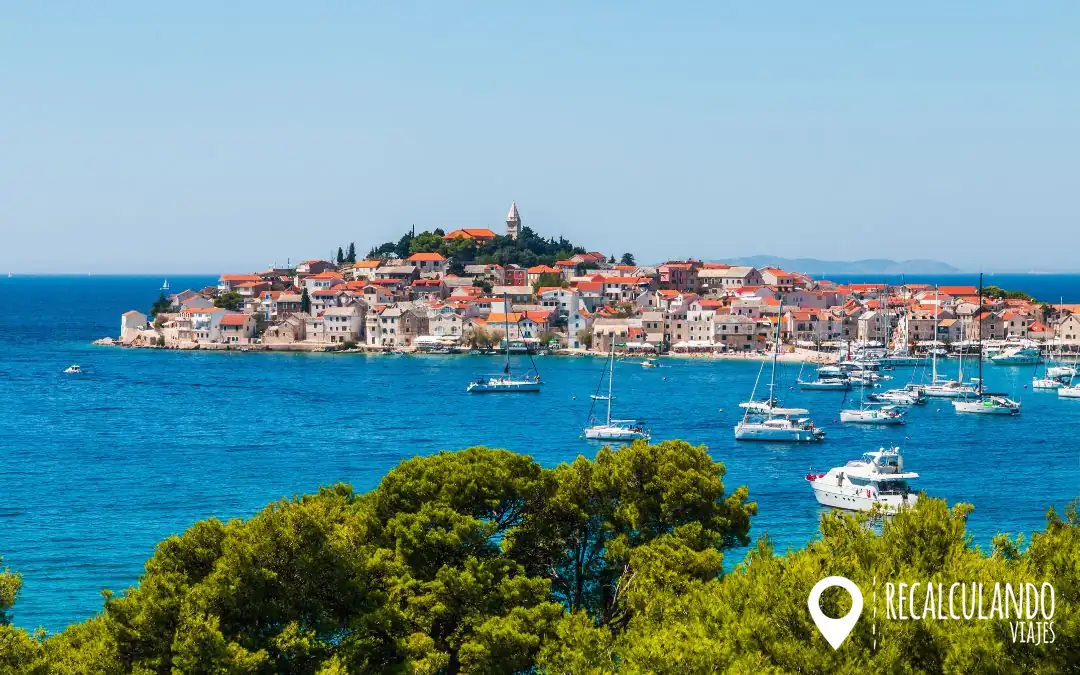
South of the town, just below the vineyard hillsides, is the Kremik marina, considered one of the most picturesque and protected in Croatia thanks to how deep its bay is. It is a common stop for those sailing the Dalmatian coast, and in summer it fills up with sailboats.
Even if you don’t sail, the view from above is worth it: the contrast between the white masts, the dark water of the bay, and the stone walls of Bucavac behind is very photogenic. We passed by there in the car on our way to Primošten and stopped for a minute to look. If you are interested in the nautical scene, there are bars and restaurants with terraces at the marina.
17. Rent a boat and go out to the islets
Off the coast of Primošten, there are seven small islets, and one of the things most people do here in summer is rent a motorboat (with or without a skipper) to explore them. You don’t need a license for the smaller boats and there are several agencies in the port and the marina; in high season, it is best to book one or two days in advance.
Excursions by boat also depart toward the Šibenik archipelago, and for those with more time, you can sail along the Krka river to Skradin, the gateway to the national park. We didn’t manage to do it on this trip—we went by land to the Krka waterfalls—but it is one of those activities we noted for next time. From the water, moreover, is the best way to see the stone vineyards in their full dimension.
18. Aurora Club, the most famous nightlife in Dalmatia
We close the list of things to do in Primosten with something that isn’t for everyone but is part of the town’s identity. 2 km from the center is Aurora, open since 1991 and considered the largest club in Dalmatia: several dance floors, an outdoor section, a pool, and huge capacity. It opens from June to September, and in the peak of summer, it runs every night.
We visited Primošten for the day, so we didn’t experience it, but it is impossible not to notice: in July, half the signs in the town point toward it. If you are traveling looking to go out, it is a huge plus for such a small town. And if you are looking for absolute tranquility, keep it in mind when choosing where to stay, because the buzz of the promenade also lasts until late.
The best beaches in Primošten: which one to choose for your plan
Beaches are, along with the old town, what most people looking for things to do in Primošten are after. The town and its surroundings have many for such a small place, and not all are for the same thing. All are pebble or stone, none are sand, and the water is absolutely transparent in all of them. This table saves you the trial-and-error trip:
| Beach | What it’s like | Ideal for |
|---|---|---|
| Mala Raduča | Central, fine pebbles, busy, with services next door | A quick swim if you are just passing through |
| Velika Raduča | Large, crescent-shaped, with pines and all services | Families and a full day at the beach |
| Lokvice | On the mainland, coarse stone, little shade | The best view and photo of the town |
| Dolac | Small, near the center, very clear water | Snorkeling without going too far |
| Rosi and Popožo | Coves between rocks, on the promenade surrounding the peninsula | A quiet dip without people |
| Smokvica Islet | Off the coast, reachable by boat | Naturist area and total isolation |
Our advice after traveling through half of Dalmatia: bring water shoes (the bottom pricks), a towel you don’t mind ruining, and an umbrella if you go to Lokvice. And watch out for the wind, as some days it kicks up little waves on the beaches most exposed to the open sea.
How much time to spend in Primošten: half-day itinerary
Let’s be honest: the things to do in Primošten fit in a handkerchief. With two hours, you see the essentials, and with half a day, you do it without rushing, including a swim and coffee. If you come from Split or Trogir, it fits perfectly as a stop on a longer route. This is how we would do it again:
- 10:00 AM — Arrival and parking in the Lokvice area. First photos of the town from the beach, with good light.
- 10:30 AM — Saint Roch Chapel, wall gate, and Rudina Square.
- 11:00 AM — Old town without a specific route up to the Church of Saint George and the cemetery-viewpoint.
- 12:00 PM — Full walk around the peninsula via the šetnica, with a stop at the port.
- 1:00 PM — Lunch with a sea view and a glass of Babić.
- 2:30 PM — Swim at Mala or Velika Raduča and a nap in the shade of the pine trees.
- 5:00 PM — By car: stop at the Bucavac vineyards and climb to the Virgin of Loreto viewpoint.
- 7:30 PM — Sunset from the cemetery or from the viewpoint terrace.
If you stay overnight, the ideal order is the opposite: beach in the morning and town at sunset. In July, between 12 pm and 4 pm, the old town is an oven and is full of excursions arriving by bus.
What to eat in Primošten
The food here is pure Dalmatian and quite a bit tastier than one expects in a tourist town. In the konobas (family taverns), you will find fresh grilled fish and seafood, squid, crni rižot (black ink risotto), škampi na buzaru—prawns in a white wine, garlic, and parsley sauce—and octopus salad. Lobster “a la buzara” is the most famous local specialty.
On the meat side, the star is the peka: meat or octopus cooked for hours under an iron bell with embers on top. You almost always have to order it several hours in advance, so if you are tempted, ask as soon as you arrive. To accompany, Dalmatian ham, sheep’s cheese in olive oil, and the indispensable Babić.
We are not accustomed to recommending restaurants by name if we haven’t tested them thoroughly, so we leave you with the criteria that works for us all over Croatia: get a block or two away from the main promenade, look if locals are eating there, and be wary of menus with photos and in five languages. High-season prices hover around 15-25 € per fish dish and 12-18 € per meat dish.
Where to stay in Primošten
Primošten is small and is basically divided into three zones. The old town and the isthmus, with apartments and stone guesthouses and lots of charm, ideal if you want to walk around at night (although you have to climb stairs and you can’t reach the door by car). The Raduča peninsula, where the large hotels facing the beach are, perfect for families looking for services and shade. And the upper area and the way out toward the road, more economical and quiet, designed for those traveling by car who want their own parking.
➜ Search for accommodation in Primošten on the map
Our advice: if you come in July or August, book several months in advance, because the supply is limited and flies off the shelves. And if you sleep inside the old town, always ask where you leave the car and how many steps there are to the door: those are details that matter more in Primošten than in other destinations.
How to get to Primošten
Primošten is right on the Dalmatian coast, on the D8 road, halfway between Šibenik and Trogir. Getting there is simple at any time of year, and these are the options with indicative prices:
| From | Means | Duration | Indicative Price |
|---|---|---|---|
| Split | Bus (Arriva, FlixBus, Nomago) | 1 hour | 8-12 € |
| Split | Car (60 km via D8 or A1) | 55 minutes | 5-10 € fuel |
| Split | Taxi or private transfer | 55 minutes | About 100 € |
| Šibenik | Bus | 30 minutes | 4-7 € |
| Trogir | Car (33 km) | 40 minutes | 3-6 € fuel |
By car
It is the best option and the one we used. From Trogir, it took us just over 40 minutes on the coastal D8 road, which also offers viewpoints to stop at. From Split, you can go via the same D8 (slower and nicer) or via the A1 motorway, exiting at Šibenik. The car is the only thing that allows you to stop at the vineyards, climb to the viewpoint, and link Krka or Rogoznica on the same day.
If you haven’t rented one yet, you can Compare Car Rental prices (➜ CLICK HERE).
Where to park in Primošten
This is the point that causes the most headaches in summer, so here are the details: parking is paid practically in the entire central area (blue zone), it is charged by the hour, and in high season it fills up very early. The most convenient spaces are those in the Lokvice beach area, a few minutes’ walk from the wall gate, and there are several parking lots further away as an alternative.
You pay at a parking meter or by an application from your phone (check the signs in each zone to see which applies). You cannot enter the old town by car, so one way or another you will walk a bit. We arrived near noon and ended up quite far: if you can, arrive before 10 am or after 5 pm.
By bus
There are daily buses that connect Primošten with Split (about 1 hour) and with Šibenik and Trogir (half an hour), operated by companies like Arriva, FlixBus, Nomago, or Autotransport Šibenik. The stop is on the main road, a few minutes’ walk from the center. It is totally viable to do Primošten in a day without a car, although you miss the vineyards and the Loreto viewpoint.
By plane
The nearest airports are Split (about 45 minutes away) and Zadar (a little over an hour away). Buses run to the coast from both, although the most practical thing is still to rent a car directly at the airport.
Useful tip: so you don’t run out of mobile data looking for the map on the road or paying for parking by app, we always travel with an eSIM. You can see the Holafly eSIM with a discount using the code RECALCULANDOVIAJES.
Travel insurance for Croatia
Croatia is a quiet destination, but a lot of sea activity happens here: snorkeling, kayaking, motorboating, walking on slippery rocks, and sea urchins everywhere. A cut on your foot or a sprain can ruin your trip, and in high season private medical consultations are not cheap. That’s why we never leave without coverage.
We have been traveling with IATI Insurance for years and they have always responded well. With the code RECALCULANDO you have a permanent 5% discount on any IATI policy, whether for a weekend in Dalmatia or a long trip through Europe.
| What to look for before hiring | Why it matters in Croatia |
|---|---|
| Medical and emergency coverage | Private consultations on the coast are expensive in high season |
| Water sports included | Kayaking, snorkeling, and motorboating are common activities in Primošten |
| Theft of luggage and objects | Crowded beaches and cars parked in the street |
| Trip cancellation | Accommodation in July and August is booked well in advance |

Excursions from Primošten
Due to its location, Primošten is an ideal base for moving around central Dalmatia. These are the trips we are most convinced by:
- Krka National Park: about 45 minutes by car. Waterfalls, wooden walkways, and the small town of Skradin. We tell you everything in our guide to the Krka waterfalls.
- Šibenik: half an hour and 28 km away. Its Saint James Cathedral is a World Heritage Site, and the pedestrian historic center, surrounded by fortresses, is beautiful.
- Trogir: 40 minutes and 33 km away, another walled old town on an island, also a World Heritage Site. See what to do in Trogir.
- Rogoznica: 15 minutes away, another fishing village with a huge marina and significantly fewer tourists.
- Dalmatian Islands: ferries leave from Split to Hvar and Brač, two of our favorites.
- Plitvice Lakes: about two and a half hours away, doable in a day if you leave early. Here is our guide to the Plitvice lakes.
If you prefer not to drive, there are organized excursions with a guide in Spanish from Split and Šibenik. You can see available excursions in Croatia here.
And if you are putting together the complete route, in our Croatia guide you will find all the destinations we visited, from Brela to Korčula.
Map of things to do in Primošten
So you can organize the route without wasting time, we made a map with all the things to do in Primošten that we mentioned: the wall gate, the old town, the Church of Saint George, all the beaches, the Bucavac vineyards, the Loreto viewpoint, the marina, and the parking areas. Save it on your phone before you leave, because in some inland areas the signal is very weak.
Frequently Asked Questions about Primošten
How long does it take to see Primošten?
Two hours is enough to walk through the old town, climb to the Church of Saint George, and walk around the peninsula on the coastal promenade. If you want to add a swim and a quiet meal, allow half a day. To also do the Bucavac vineyards and the Virgin of Loreto viewpoint, a full day is ideal.
Is it worth visiting Primošten on a day trip from Split or Trogir?
Yes, it is a perfect day excursion. From Split, it is about 60 km and from Trogir 33 km, just over 40 minutes by car. We did it that way, from Trogir, and it was enough to see the essentials without rushing too much.
Where can you park in Primošten?
Parking is paid in almost the entire central area and is charged by the hour, with a parking meter or via an app. The most practical places are those in the Lokvice beach area, a few minutes’ walk from the wall gate. You cannot enter the old town by car, and in July and August, it is advisable to arrive before 10 am.
Which is the best beach in Primošten?
Velika Raduča is the best for spending the day because it is large, has pine trees that provide shade, and offers all services. Mala Raduča is the most central and convenient if you are passing through. And Lokvice has the best view of the town, ideal for photos. All are pebble, so it is advisable to bring water shoes.
What is the best time to visit Primošten?
June and September are the best months because the sea is already warm and there are significantly fewer people than in July and August. We went in July and the town was very crowded at noon, although in the afternoon it emptied out quite a bit.
Can you get to Primošten without a car?
Yes. There are daily buses from Split, which take about an hour, and from Šibenik and Trogir, which take half an hour. The stop is on the main road, a few minutes’ walk from the center. Without a car, you will still be able to see the town and beaches, but you will miss the Bucavac vineyards and the Gaj hill viewpoint.
What is eaten and drunk in Primošten?
The cuisine is classic Dalmatian: grilled fish and seafood, squid, black ink risotto, lobster “a la buzara”, and peka, which is meat or octopus cooked under an iron bell with embers. The star drink is the red wine Babić, made from the native grape that grows in the area’s dry-stone vineyards.
Is Primošten an island?
It was for centuries. The town was built on a small islet that was connected to the mainland by a wooden drawbridge, intended to protect against Ottoman attacks. Later, the inhabitants themselves replaced it with an isthmus of land and stone, so today Primošten is a peninsula connected to the continent.
What is the best time to take photos of Primošten?
The morning. The classic view of the town is taken from the coast, at the height of Lokvice beach, and at that time the sun illuminates the houses from the front. In the afternoon, the town is backlit from that point. For sunset, on the other hand, the best thing to do is go up to the cemetery next to the Church of Saint George.
Is Primošten worth it?
After traveling through a good part of the Croatian coast, we tell you yes: Primošten is one of those places you don’t expect and end up loving. It doesn’t have imposing monuments or famous museums, and that is precisely why it works. What it has is an intact old town over the sea, beaches with impossible water, a landscape of vineyards unique in the world, and a much quieter pace than Split or Dubrovnik.
Mind you, let’s be clear: if you are looking for a monumental medieval city, Trogir or Šibenik will impress you more. Primošten is enjoyed differently, without rushing, looking at the sea from above and having a drink at the port. That is why it works so well as a stop on a route through Dalmatia.
If you are planning your trip and were doubting about what to do in Primošten or if it was worth the detour, our recommendation is clear: reserve at least half a day. We thought about spending two hours and stayed until sunset, looking at the town from above with the orange sea in the background. Don’t miss it!
Have you already been to Primošten? Tell us in the comments what you liked most so we can add it to the guide. And if you have doubts about planning your trip to Croatia, write to us and we will help you.
Articles for your trip to Croatia
- 22 must-see things to do in Dubrovnik (with map)
- 21 must-see things to do in Split (with map)
- 18 essential things to do in Rab (with map)
- Plitvice Lakes, Croatia: Complete guide to visiting the National Park [2026]
- Krka Waterfalls: Guide to visiting the park (2026) + Map
- 15 Best things to do in Croatia (with map)
- 16 essential things to do in Brac (with map)
- 15 essential things to do in Dugi Otok, Croatia (with map)
ℹ️ **Total Transparency**
This article contains affiliate links. If you book through these links, we may receive a small commission at no additional cost to you. We only recommend services we use on our travels and trust. This helps us keep this blog free and continue creating useful content for you. Thank you for your support!
🔗 Resources & Useful Links for your trip to Primosten
Do you have questions or want to add your own recommendations on things to do in Primosten?
💬 Leave your comment or write to us, we love reading about other travelers’ experiences.
Thank you very much for being part of this adventure!— Nanu & Facu 🌎 | Recalculando Viajes 💜