
| 13 min read | by Nanu y Facu | Asia, Blog, Japan
Kamakura was the political capital of Japan during the period that bears its name (1185-1333), and it still has that old samurai capital feel you no longer find in enormous Tokyo. Temples everywhere, trails through the mountains, a beach popular with surfers and, of course, its bronze giant. Let’s get started!
🌍 Travel Insurance: 5% Off with IATI Seguros! 🌟
Take advantage of this offer and travel safe.
Summary: What to See in Kamakura
| Place / Aspect | Key description | Approx. price |
|---|---|---|
| Great Buddha (Daibutsu) | The symbol of the city; a bronze statue 11.3 meters tall (13.35 m with the pedestal) in the open air. | 300-350 JPY |
| Hasedera Temple | Gardens, Jizo statues and spectacular sea views. | 400 JPY |
| Tsurugaoka Hachimangū Shrine | Spiritual and cultural center, dedicated to the deity of the samurai. | Free |
| Komachi-dori Street | Shopping street, ideal for trying local food and buying crafts. | Varies |
| Hokokuji Temple | Known as the "bamboo temple", a very peaceful Zen setting. | 200-400 JPY |
| Enoden Train | A must-ride little coastal train connecting the tourist areas. | 200-260 JPY |
| Kita-Kamakura | Area of traditional Zen temples (Kenchoji, Engaku-ji). | 300-500 JPY |
| Enoshima Island | Island connected by a bridge, famous for its views of Mount Fuji. | Free (access) |
| Kamakura Beach | Coastal area very popular with surfers and for watching the sunset. | Free |
📑 In this guide · 10 sections
- Where is Kamakura and why visit it?
- How to get to Kamakura from Tokyo
- The Great Buddha Daibutsu
- Hasedera Temple
- Tsurugaoka Hachimangū Shrine
- Komachi-dori Street
- Hokokuji Temple
- Other things to see in Kamakura if you stay more than a day
- Travel insurance for Kamakura
- Frequently asked questions about what to see in Kamakura
Where is Kamakura and why visit it?
Kamakura is in Kanagawa Prefecture, south of Tokyo, a little over an hour away by train. It’s one of those destinations where you can feel the history on every street. It has 65 Buddhist temples and 19 Shinto shrines, so it’s impossible to see them all in a single visit. And honestly… you don’t need to.
What we liked most is that, unlike Kyoto, tourism here isn’t as crowded. You can walk calmly, take photos without dodging half of humanity and enjoy a much more relaxed pace. In our case, we arrived early and that was key. Something to keep in mind: in Japan almost everything closes around 5:00 pm, so getting up early completely changes your day.
How to get to Kamakura from Tokyo
Getting there is super easy, and that’s part of its charm. There are two main options by train:
- JR Yokosuka Line: goes directly from Tokyo Station to Kamakura in about 55-60 minutes. No transfers and covered by the JR Pass.
- JR Shonan-Shinjuku Line: departs from Shinjuku and also gets there directly in a little over an hour. It’s also covered by the JR Pass.
Once in Kamakura, to get to the Great Buddha and Hasedera you’ll use the Enoden train (江ノ島電鉄), a beautiful little coastal train that is NOT included in the JR Pass, but costs just about 200-260 yen per ride. Something to keep in mind: we recommend sitting at the front, right behind the driver, to see the route between little houses and the sea. A small detail that makes the ride much nicer.
If you’ve never put together an itinerary for Japan and don’t know where to start, here’s our step-by-step guide on how to plan your trip (in Spanish). And before you leave, don’t forget travel insurance: healthcare in Japan is very expensive, and traveling with peace of mind is priceless.
The Great Buddha Daibutsu: the number one must-see in Kamakura
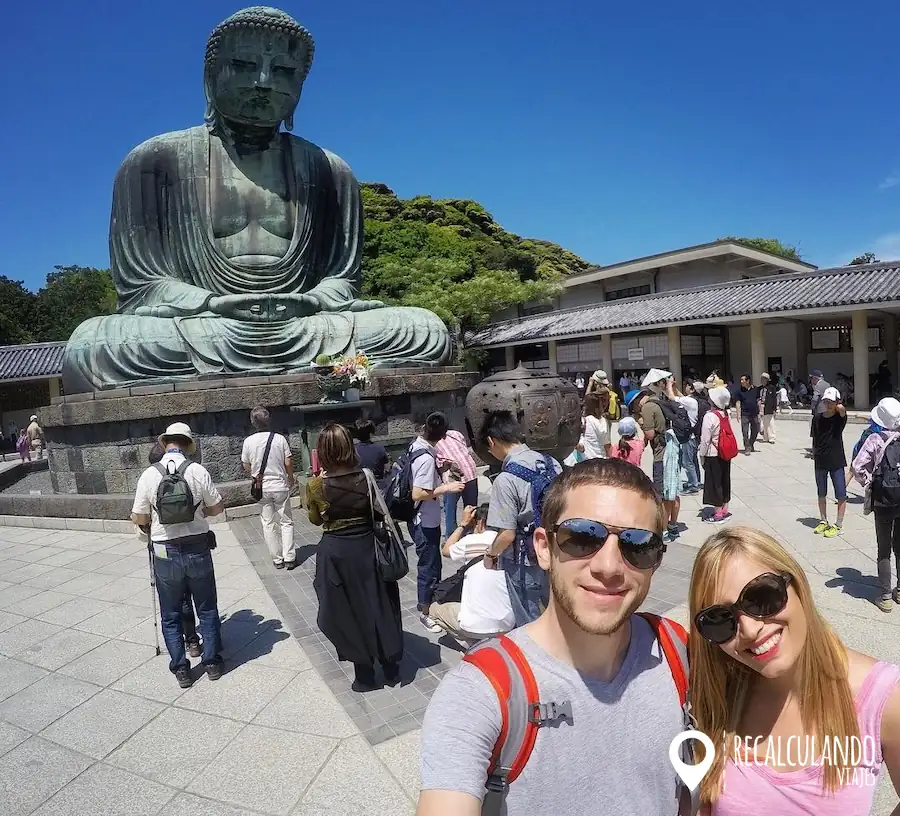
If there’s one place that defines Kamakura, this is it. The Great Buddha Daibutsu (大仏) is the city’s absolute symbol and, for us, one of those images you’ll never forget. It’s located inside the Buddhist temple Kōtoku-in (高徳院), of the Pure Land school.
It’s a bronze statue 11.3 meters tall (13.35 m including the pedestal) and weighing 121 tons. It’s the second largest seated Buddha in Japan, surpassed only by the one at Todai-ji Temple in Nara. But what makes it so special is that it’s outdoors. It used to be protected inside a huge wooden hall… until a tsunami in 1495 destroyed the building and left the Buddha facing the sky. And there it still sits, imposing, surrounded by nature.
It fascinated us. Walking around it gives you a sense of calm that’s hard to explain. And a great tip: for an extra 50 yen you can go inside the Buddha, which is completely hollow, and see how it was assembled centuries ago. Don’t miss it!
- Admission: 300 yen (plus 50 yen to go inside).
- Hours: 8:00 am to 5:30 pm (until 5:00 pm in winter).
- How to get there: get off at Hase Enoden station and walk about 10-12 minutes.
A detail that touched us: when we went, the temple was full of schoolchildren in colorful caps taking photos in front of the Buddha. You’ll see that image of Japanese kids on school trips again and again all over the country, and there’s something endearing about it.
Hasedera Temple: gardens, sea views and emotion
Just a 10-minute walk from the Daibutsu is Hasedera Temple (長谷寺), and it was, without a doubt, one of our favorite places of the day. It’s one of those spots where you go for a temple and come away with gardens, viewpoints and a peace you didn’t expect.
Here you’ll find one of the most important representations of Kannon, the goddess of compassion. But what struck us most were the hundreds of small Jizo statues, the protector of children. Mothers who have lost their children place them there as an offering, and walking among them is a very moving moment, even if you’re traveling without kids. It touches your heart when you least expect it.
Head up to the temple’s viewpoints: on clear days you can see the sea of Kamakura and the view is gorgeous. In our case, we had a wonderful time exploring every corner at a relaxed pace. It’s absolutely worth it.
Good to know:
- Admission: 400 yen.
- Hours: 8:00 am to 5:00 pm (from October to February until 4:30 pm).
👩⚕️👨⚕️ A must-have for stress-free travel! 🌎✈️ ➜ Get a Quote, Compare & Buy

Tsurugaoka Hachimangū Shrine: the spiritual heart of the city
The Tsurugaoka Hachimangū shrine is the most important Shinto shrine in Kamakura and the cultural center of the city. It’s dedicated to Hachiman, the protective deity of the samurai, which makes total sense in a city with so much warrior history.
To get there you walk up a long avenue and then a grand staircase that leads to the main building. From the top you get a really nice panoramic view. If you want to do as the locals do, look for a 5-yen coin (the one with the hole, which brings good luck), toss it into the offering box and bow before making a wish. We did it, why not? hehehe.
It’s surrounded by lotus ponds that look splendid in summer, and by red torii gates that stand out against the green. It’s a stop we absolutely recommend.
Komachi-dori Street: eat, shop and let yourself go
It’s impossible to talk about what to see in Kamakura without mentioning Komachi-dori Street. As you leave the station, this shopping street (which connects directly with the Hachimangū shrine) is pure life. It’s packed with cafés, souvenir shops, local crafts and, above all, delicious food stalls.
Here you can try specialties like senbei rice crackers, sweets made from azuki beans, shirasu whitebait and, the classic of classics, the dove-shaped butter cookies (Hato Sablé), which have been sold in Kamakura since the late 19th century. We took the chance to nibble on something sweet and recharge.
Good to know: an important point of local etiquette. On Komachi-dori they ask you not to walk while eating. You buy your snack, eat it near the stall, throw away the trash right there and only then continue. A custom worth respecting. If you like Japanese food as much as we do, don’t miss our complete article on Japanese food and everything we tried during the trip.



Hokokuji Temple: Kamakura’s secret bamboo forest
If you have a bit more time, Hokokuji Temple, known as “the bamboo temple,” is a little gem. Many travelers recommend it as the quieter alternative to the famous (and crowded) Arashiyama bamboo forest in Kyoto.
The bamboo forest is behind the temple, and although it isn’t huge, the concentration of tall, dense stalks creates a beautiful visual effect. Since it’s less well known, you can be patient, wait a while and take photos almost without people. It also has some very nice traditional gardens.
Good to know: entry to the bamboo forest costs about 200-400 yen and the hours are usually 9:00 am to 4:00 pm. It’s a bit far from the center, so it’s best to get there by bus (Google Maps sorts it out easily).
Other things to see in Kamakura if you stay more than a day
If you decide to spend the night in Kamakura instead of doing the typical day trip, there’s even more to discover:
- The great Zen temples of Kita-Kamakura: such as Kenchoji and Engaku-ji. From Kenchoji the views of the city are fabulous. Good to know: some only accept cash.
- Mountain trails: routes like the Daibutsu Kiridoshi connect temples along old paths. If you’re going to hike, bring comfortable shoes because the trails are dirt.
- Kamakura beach: very popular with surfers, ideal for a relaxed sunset.
- Enoshima: a small island connected by a bridge, 20 minutes away on the Enoden train. It has caves, gardens with views of Mount Fuji on clear days and a quieter atmosphere. That said, it adds 2-3 hours to the day, so only if you leave Tokyo really early.
Japan stole our hearts from end to end. If you’re putting together your route, our guides on what to see in Tokyo (in Spanish) and what to see in Takayama (in Spanish) will come in handy, two places that also fascinated us.


Travel insurance for Kamakura
Kamakura is usually a day trip from Tokyo, with trains, steep temple steps and a lot of walking. Even on a short trip, insurance that covers medical assistance, luggage and cancellation lets a small mishap stay small.
We always travel insured with IATI Seguros: booking through our link gives you a permanent 5% discount, with no code needed.
Frequently asked questions about what to see in Kamakura
Can you see Kamakura in one day from Tokyo?
Yes, absolutely. If you leave Tokyo before 9:00 am, you’ll have enough time to see the Great Buddha, Hasedera, the Hachimangū shrine and stroll down Komachi-dori, getting back to Tokyo before dinner. That’s how we did it and it felt very complete.
How much does it cost to enter the temples in Kamakura?
Most admission fees are between 200 and 500 yen each. The Great Buddha costs 300 yen and Hasedera 400 yen. Bring cash, because several temples don’t accept cards.
Is the train to Kamakura included in the JR Pass?
Yes. Both the JR Yokosuka Line and the JR Shonan-Shinjuku Line are covered by the JR Pass. The Enoden train, which you use within Kamakura, is private and NOT included, but it costs very little.
What is the best time of year to visit Kamakura?
Spring (sakura, in late March and April) and autumn (momiji, in November) are the prettiest, although also the most crowded. At any time of year, getting up early is the key.
Can you go inside the Great Buddha?
Yes, and we recommend it. For an extra 50 yen you can access the hollow interior of the statue and see how it was built. It’s a curious experience that not everyone knows about.
What should you bring to visit Kamakura?
Cash in yen for admission fees, comfortable shoes (especially if you plan to walk between temples or do the trails) and your Suica or Pasmo card for short Enoden rides. Good to know: the station lockers fill up fast on weekends.
Conclusion: why Kamakura deserves a place on your trip to Japan
If you’re deciding what to see in Kamakura, we tell you from the heart: it’s absolutely worth it. In a single day you combine the imposing Great Buddha Daibutsu, the moving peace of Hasedera, the spirituality of the Hachimangū shrine and the flavors of Komachi-dori. It’s history, nature and Japanese culture in its purest form, just an hour from Tokyo.
For us it was one of the best excursions of our whole month in Japan, and it left us wanting to go back. So you know the drill: get up early, bring cash, hop on the little Enoden train and let yourself be surprised. You won’t regret it! And if this guide was useful, tell us in the comments what you liked most about Kamakura.
This article contains affiliate links. If you book through these links, we may receive a small commission at no additional cost to you. We only recommend services that we use on our trips and that we trust. This helps us keep this blog free and continue creating useful content for you. Thank you for your support!
🔗 Resources & Useful Links for your trip to Kamakura
Do you have questions or want to add your own recommendations on Kamakura?
💬 Leave a comment or write to us, we love reading about the experiences of other travelers.
Thank you very much for being part of this adventure!— Nanu & Facu 🌎 | Recalculando Viajes 💜