Searching for things to do in Estoril and finding only “the casino and the beach” was what happened to us before we went, and the reality is much nicer than that. We went for a day trip from Lisbon, by train, at the end of January, and we came back with the feeling that this town on the Portuguese Riviera is highly underrated. In this guide, we tell you the 18 things to do in Estoril that we liked the most, with a map, where to eat, where to stay, how to get there, and all the updated 2026 data.
Estoril is less than 30 minutes from Lisbon by train and shares a promenade with Cascais, so it can be perfectly combined in the same day. We did it that way and we tell you about it from our experience, including what surprised us, what isn’t worth as much, and some prices that many guides keep publishing outdated.
🌍 Travel Insurance: 5% Off with IATI Seguros! 🌟
Take advantage of this offer and travel safe.
Things to do in Estoril Summary
| Category | Key information |
|---|---|
| Destination | Estoril, Portugal (Portuguese Riviera). |
| Recommended time | Half a day (only Estoril) or 1 full day (combining with Cascais). |
| How to get there | Train from Cais do Sodré (Lisbon), approx. 30-35 minutes. |
| Best time | May to October (beach); January and February (walks without crowds). |
| Daily budget | 30-45 € per person (includes train, food, and some entrance fees). |
| Must-sees | Casino Estoril, Praia do Tamariz, Paredão, Hotel Palácio, and Monte Estoril. |
| Gastronomy | Fresh fish, bacalhau, and pastéis de nata (budget: 10-35 €/meal). |
| Language / Currency | Portuguese / Euro (€). |
A bit of Estoril’s history: from thermal spa to Costa dos Reis
Before starting with the list of things to do in Estoril, it is worth understanding where this town comes from, because it explains everything you are going to see.
Estoril existed as a thermal spa village for centuries, but only became an international tourist resort in the 20th century, with the project promoted by Fausto Cardoso de Figueiredo starting in 1914. Hotels, a casino, a golf course, gardens, and even the operation of the Lisbon-Cascais railway were all part of the same plan. In 1930, the Hotel Palácio opened, the most important hotel in the country at the time.
The second chapter is the one that gave it worldwide fame. During World War II, Portugal remained neutral, and Estoril became a refuge for exiled European royal families (Spanish, Italian, Bulgarian, Romanian) and, at the same time, a nest of British, German, and French spies who crossed paths in the same bars. Hence the nickname “Costa dos Reis” (Coast of Kings) and the Ian Fleming stories, which we will look at in detail below.
And the name? There isn’t just one version. The most repeated explanation links it to roots that refer to sterile or sparsely inhabited land, which fits with the pine forest and the rocky coast that existed before urbanization. We give this as probable, not as a certainty: it is one of those etymologies that every guide states with too much certainty.
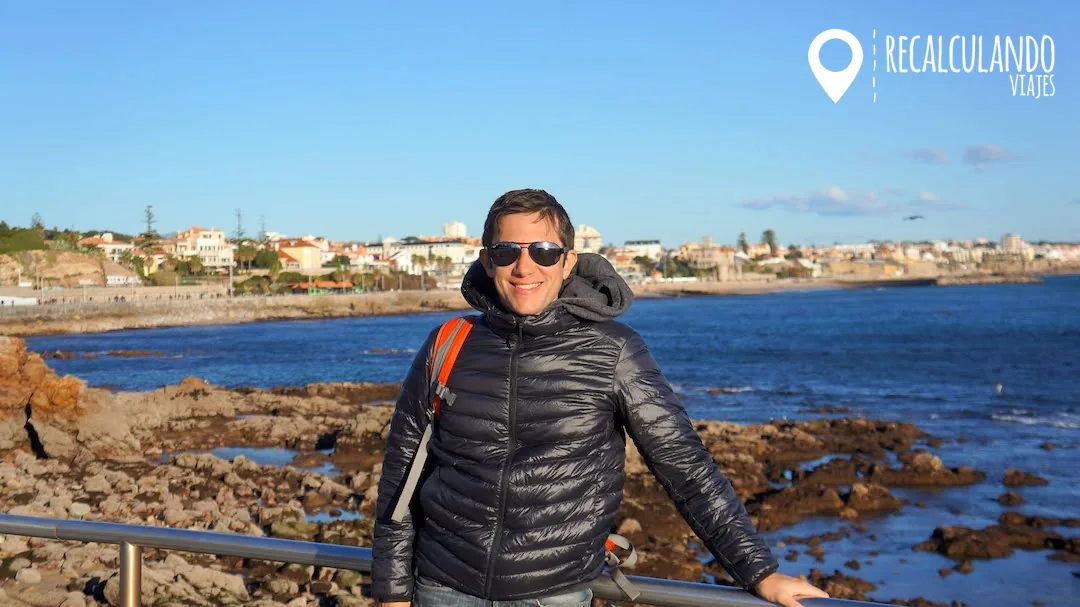
1. Casino Estoril, the largest in Europe
It is impossible to start any list of things to do in Estoril any other way. Casino Estoril opened in 1916 and is, according to its own website, the largest casino in Europe. It stands at the end of an avenue with gardens and fountains that runs straight down to the sea, and that perspective is one of the most beautiful postcards of the town.
We didn’t enter the gaming rooms (not our thing), but it’s worth knowing how it works: entry to the building is free, you must be over 18 and present a photo ID to access the gaming rooms, and the dress code is “smart casual.” Many travelers recommend taking advantage of the art gallery and the free concerts scheduled in the Lounge D, which can be enjoyed without betting a euro.
The fact we liked the most is historical: Ian Fleming used to come here to play in 1941 when he worked for British naval intelligence, and he met the Serbian double agent Dusko Popov here. From that mix, James Bond was born. Careful with an error that repeats itself all over the internet: the novel Casino Royale was inspired by Estoril, but it takes place in a fictional French resort. The movie that was filmed here was On Her Majesty’s Secret Service, from 1969.
2. Praia do Tamariz, the beach you must see in Estoril
Right in front of the casino, crossing the train tracks via a pedestrian tunnel, appears Praia do Tamariz. It is the main beach and one of the things to do in Estoril that you cannot miss, even if you go in winter like us.
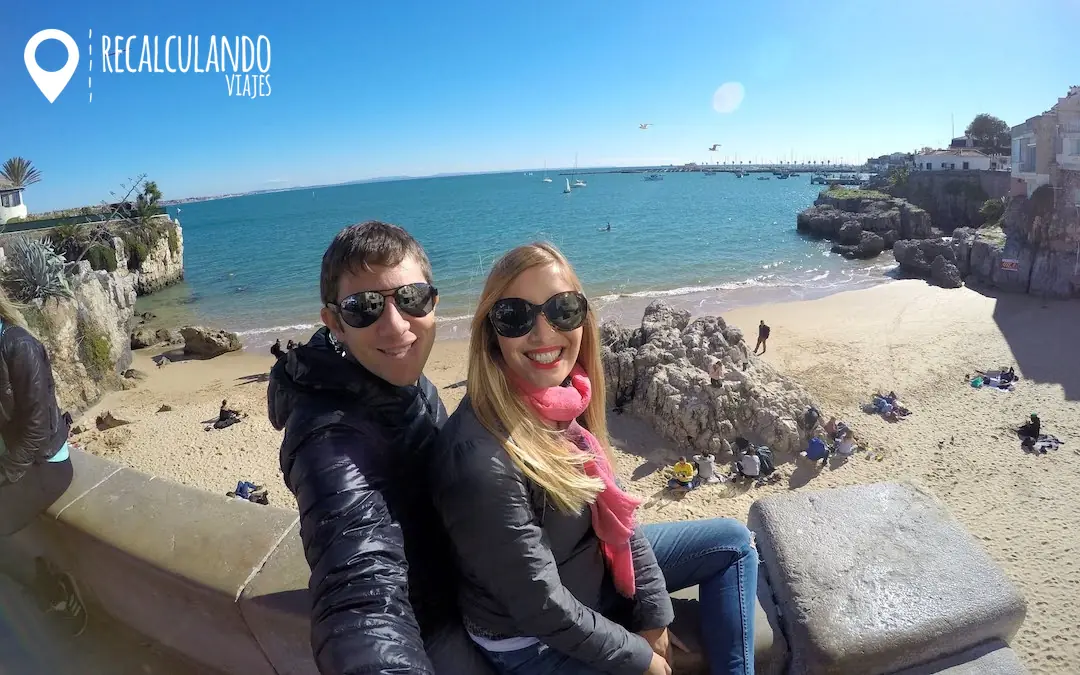
It is a golden sand beach, protected from the strong Atlantic swell, with the sea much calmer than on the northern beaches. That is why it is a favorite for families with children. Behind it is a promenade with bars, terraces, and kiosks, and on one side, the little castle that appears in all the photos. It doesn’t have the turquoise color of the beaches of the Algarve, but for being half an hour from a European capital, it is very good.
In January, it was empty and with a very nice warm sun, so we walked the whole thing with our sneakers in our hands. In summer, it’s a different story: it gets crowded, and renting an umbrella with lounge chairs is around 20 € for the day. The train station is about 50 meters away, literally.
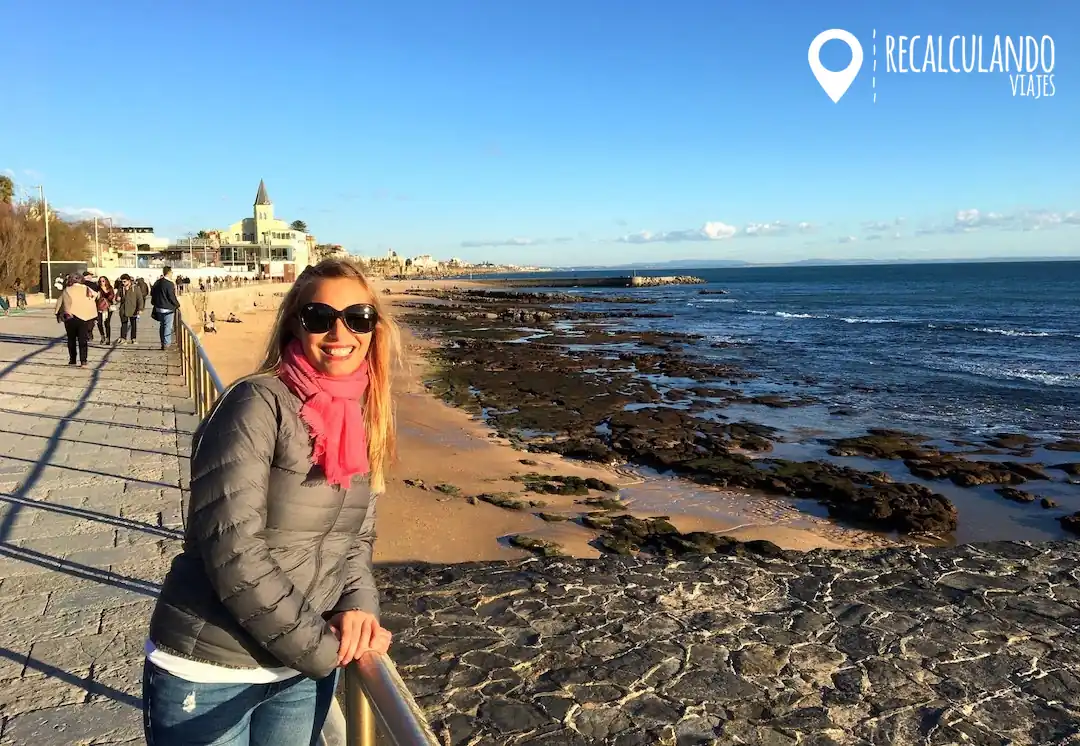
3. Forte da Cruz, the “castle” of Estoril
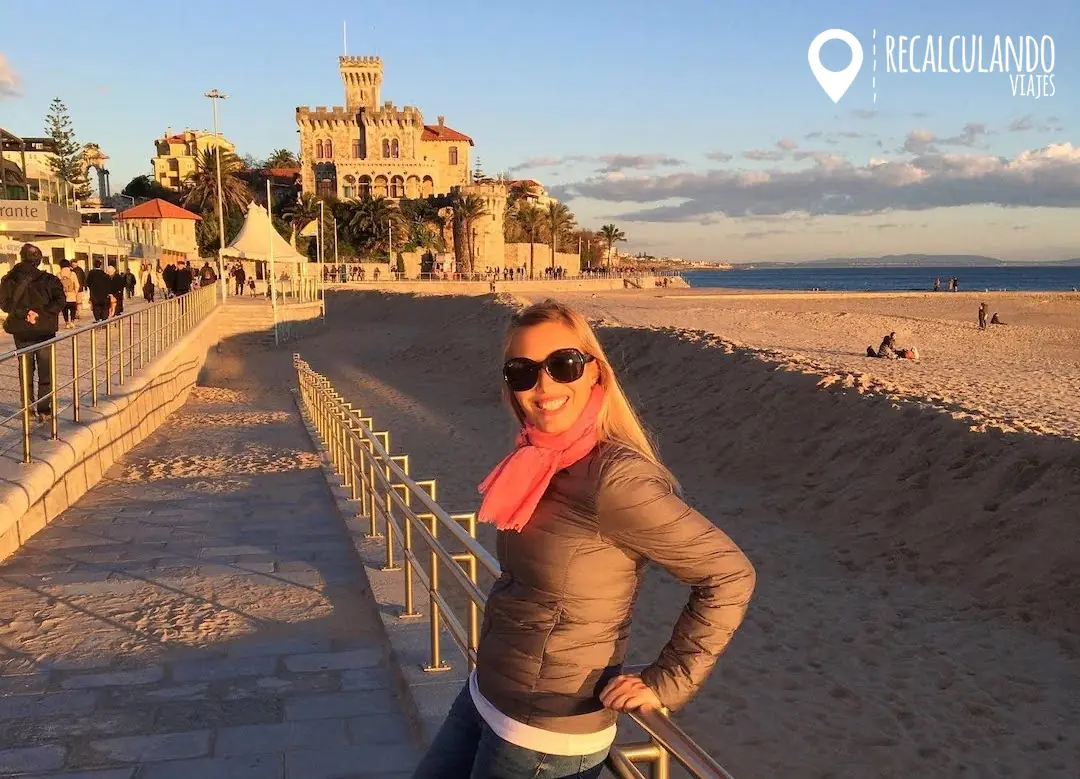
It is the building that makes many people say, “Is this a castle?” Forte da Cruz overlooks the end of Tamariz beach and is one of the essential visual sights in Estoril.
Here is a precision that almost no guide gets right. At that point, there was a 17th-century fort, designed to defend the entrance of the Tagus. But the romantic castle look you see today, with its towers and battlements, comes from a 19th-century remodeling commissioned by the Barros family, which is why it is also known as Chalet Barros. In other words: the stone is old, the “castle” not so much.
Today it operates as a private space for events and weddings, so you cannot visit inside. We walked around it from the outside, and from the promenade, you can get the best photo, especially at sunset when the stone turns orange.
4. The Casino Gardens and Estoril Park
The landscaped avenue that goes down from the casino to the sea is, for us, the heart of the town. It is called Estoril Park (or Jardim do Estoril) and is a green lung with palm trees, flower beds, fountains, and an artificial pond with ducks.
It is free, always open, and in a few blocks, it concentrates the spirit of the place: here you can see why this area was called the “Costa dos Reis.” On the sides are hotels from another era and stately mansions that survived the passage of mass tourism.
We sat on a bench for a while to eat a pastel de nata, and it was one of those simple moments you remember later. If you go with kids, there are playgrounds and plenty of space for them to run around.
5. The Paredão: walking from Estoril to Cascais
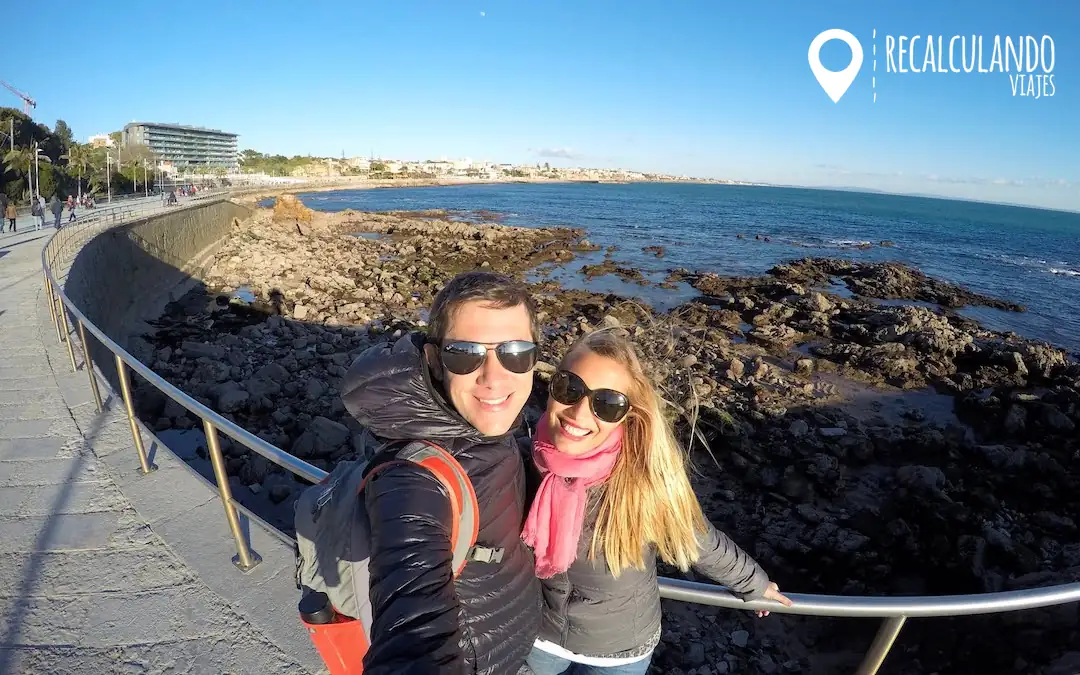
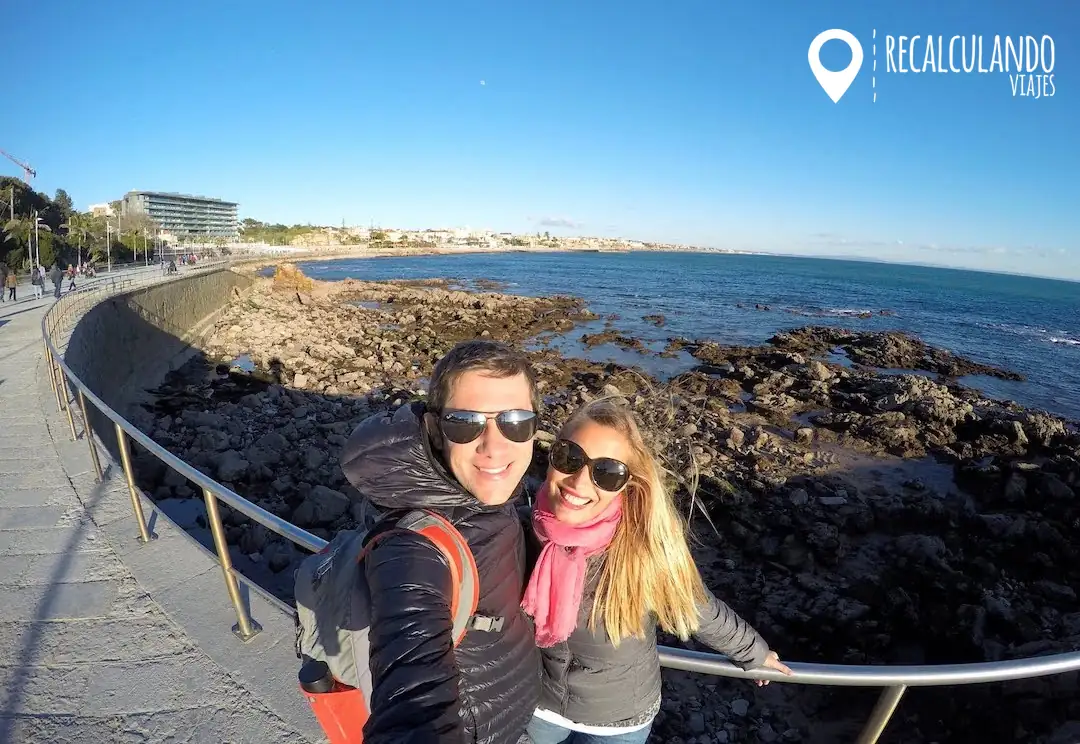
If you ask us which is the best of the things to do in Estoril, we answer without hesitation: walking the Paredão. It is the paved promenade that connects Praia do Tamariz with Cascais, bordering the ocean the whole way.
It is about 1.7 kilometers to the bay of Cascais (about 25-30 minutes at a leisurely pace), and on the way, you pass by Praia da Poça, Praia das Moitas, Praia da Duquesa, and Praia da Conceição.
We did it with a headwind, and on the way back, the sun was fully on us. One of the most beautiful coastal walks we did in Portugal! A practical trick: get off the train in Estoril, walk to Cascais, and return by train from there, because both stations are in the same fare zone and the same ticket works for you.
6. The Tamariz Ocean Pool
At the east end of Tamariz beach, there is a saltwater pool carved into the rock that fills up at high tide. It’s from the 50s, it’s free, and it’s one of the most charming points of interest in Estoril.
The charm is twofold: the water is much warmer than the open Atlantic, and without waves or currents, it is much safer for those who swim little or for kids. When the tide goes out, little crabs and small fish get trapped, and the kids spend hours watching them.
Let’s be honest: it is not a luxury hotel pool, the walls are worn, and the floor is quite slippery. But it is free and has a vintage charm that you can’t get anywhere else.
7. The Hotel Palácio and the spy route
A few meters from the casino is the Hotel Palácio, inaugurated in the 30s and nicknamed “the spy hotel” during World War II. Portugal was neutral, and British, German, and French agents passed through here, as well as entire royal families who were exiled in the area.
Framed on its walls are the registration cards of illustrious guests: Ian Fleming’s, who registered as a Foreign Office official; Antoine de Saint-Exupéry’s; and Dusko Popov’s. It was also a filming location for On Her Majesty’s Secret Service.
We didn’t stay there (the prices are well above our travel budget), but you can go in for a drink at the bar and look at the historical photo gallery. Many travelers recommend it as a short stop even if you aren’t staying overnight.
👩⚕️👨⚕️ A must-have for stress-free travel! 🌎✈️ ➜ Get a Quote, Compare & Buy
8. The center of Estoril and the Avenida de Nice
Competitors talk about the “historic center of Estoril,” and it’s worth clarifying: Estoril does not have a medieval old town like Óbidos or Guimarães. What it has is a resort center planned in the early 20th century, with wide avenues, buildings from the 20s and 30s, and street names that reveal its original audience: Avenida de Nice, Avenida Clotilde, Avenida de Sabóia.
We walked through it after leaving the casino, going up Avenida de Nice. That is where the real life of the town is: pastry shops with windows full of pastéis de nata, greengrocers, pharmacies, people greeting each other by name. In a couple of blocks, almost all the places where you will want to eat are concentrated.
It is one of those things to do in Estoril that takes no more than 20 minutes and gives context to everything else: you understand that this was a tourism project designed from scratch, not a fishing village that grew.
9. Igreja de Santo António do Estoril
Steps from the Avenida Marginal is the Igreja de Santo António do Estoril, and here we have to correct ourselves and, by the way, half the internet: it is not a modern church nor a minor construction. It has a very long history.
It all started with a small wooden hermitage dedicated to Saint Roch, mentioned as early as 1527. The Franciscans later built the 17th-century temple, which was very damaged by the 1755 earthquake and rebuilt in the 18th century: from there come the baroque stone façade and the altar with gilded carvings. In July 1927, a fire almost completely destroyed it, and it was rebuilt following the project of architect Tertuliano Marques, respecting the original layout. The ceiling frescoes are by Carlos Bonvalot, and the tile panels with scenes from the life of Saint Anthony are by master Victória Pereira. It has been a parish since 1929.
We saw it open mid-morning and went in for a moment: the side tiles are worth the stop, even if you are not into churches. The parish hours are broad (Monday to Friday, it usually opens in the morning and afternoon), so it is rare to find it closed.
A detail in favor of our guide: several blogs call it a “basilica” and place it incorrectly in time. It is not a basilica; it is the parish church of Estoril.



10. The old Estoril Thermal Baths
This is the fact you won’t find in any other guide of things to do in Estoril, and for us, it explains the whole town: Estoril was born as a thermal spa, not as a beach destination.
Already in the 18th century, there were thermal baths here, frequented even by King José I. In 1880, the spa was restored and had 15 marble bathtubs for immersion baths. But the big leap came with Fausto Cardoso de Figueiredo, who in 1914 commissioned the French architect Henry Martinet to create a complete urban development plan with hotels, golf courses, thermal baths, and gardens. From that project came the Casino, the Hotel Palácio (inaugurated in 1930), and the layout of the avenues you walk today.
The thermal building no longer works as it did in its golden age, but the legacy is everywhere: in Estoril Park, there is a statue of Fausto Figueiredo looking at his work. If you understand that, you understand why Estoril was called the Costa do Sol and why the streets have French names.
11. Monte Estoril and the Avenida de Sabóia
Between Estoril and Cascais, on the hill, is Monte Estoril, the most elegant residential neighborhood in the area and one of the things to do in Estoril that almost no tourist does. It has its own train station, so getting there is very easy.
We went up the internal streets to the Avenida de Sabóia and looked at mansions from the early 20th century, many with tiles, towers, and gardens that peer over the walls. There are makeshift viewpoints on the corners from which you can see the entire coast up to the Sintra mountains.
It is an uphill walk, so wear comfortable shoes. In return, you get a different Estoril, quiet, without bars or souvenirs. We loved it precisely for that reason.
12. Museu da Música Portuguesa – Casa Verdades de Faria
In the middle of Avenida de Sabóia is the Casa Verdades de Faria, a mansion from 1918 designed by Raul Lino and commissioned by the Irish-Portuguese aristocrat Jorge O’Neill. Today, the Museu da Música Portuguesa operates there, with the collection of folk instruments gathered by ethnomusicologist Michel Giacometti and the legacy of composer Fernando Lopes-Graça.
We are not into museums unless they are unmissable or free, so we didn’t go in. But many travelers recommend it both for the collection and for the building itself: stained glass windows with the shamrock and the red hand of Ireland, 18th-century tiles, and a chapel dedicated to Saint Patrick.
An important fact, outdated in almost all Spanish guides: it is part of the Cascais Museum District, whose regular ticket increased to 5 € and the 24-hour pass to 7.50 €. There is also an integrated ticket with the Cascais line train for 9 €. It is closed on Mondays and holidays.
13. Praia da Poça, the first one on the Paredão
As soon as you start walking east along the Paredão, you find Praia da Poça, on the border between Estoril and São João do Estoril. It is smaller than Tamariz and quite a bit rockier.
That feature is precisely its charm: when the tide goes out, natural pools form among the rocks, and you can get in to explore. We found it almost empty in January, with two people fishing and nothing else.
It has bars open in season and is steps away from the São João do Estoril train station, so you can also start the walk from here and do the route in reverse.
14. Praia da Azarujinha, the hidden cove
This is one of those things to do in Estoril if you like to get off the beaten path. Praia da Azarujinha is in São João do Estoril, wedged between low cliffs, and you go down a staircase from the promenade.
It is small, intimate, and fills up quickly in summer because the locals have it on their radar. At high tide, the sand practically disappears, so it is best to check the tide table before going down.
We liked the surprise effect: you come walking from above, look down, and this cove you didn’t expect appears.
15. São Pedro do Estoril and its beach
Continuing towards the Lisbon side is São Pedro do Estoril, a quiet neighborhood with one of the most beloved beaches by locals. It is somewhat separated from the center and outside the promenade, so it receives almost no tourists.
It was one of the first surf beaches in Portugal, although today surfers go more to Guincho or Carcavelos. At low tide, pools form among the rocks, and many people in the area will tell you it is the best beach in all of Estoril.
It has full services: restrooms, showers, lifeguards in season, and a beachfront restaurant.
16. Golfe do Estoril, one of the classic courses in Portugal
Surrounded by pine trees and a few minutes from the center is Golfe do Estoril, one of the historic courses in the country and another piece of Fausto Figueiredo’s original project. It is one of those points of interest in Estoril that average travelers miss but that are part of the town’s DNA.
We didn’t play (nor do we know how, let’s be honest), but we walked by the edge on our way to Monte Estoril, and the view of the greens with the sea in the background is truly beautiful. The main course has 18 holes, and there is a secondary 9-hole course, with prior reservation and club rentals for those who don’t travel with equipment.
If golf isn’t your thing, skip it. If it is, it is one of the few cities where you can play in the morning and be on the beach in the afternoon.
17. Autódromo do Estoril
About 6 kilometers from the center, in Alcabideche, is the Autódromo do Estoril (officially Autódromo Fernanda Pires da Silva), inaugurated in 1972. It hosted the Portuguese Formula 1 Grand Prix between 1984 and 1996, and Ayrton Senna’s winning debut took place there in 1985, under historic rain.
Today it remains active with the Superbike World Championship, motorcycle championships, and the Estoril Classics, the largest classic car event on the Iberian Peninsula. You cannot visit it freely: you have to go on a competition or track day.
We didn’t go because we were without a car and only for the day, but if you are a motorsport fan, it is a must-see stop. Important clarification: there are guides that say the circuit is “closed to the public,” and that is not the case. You don’t visit it freely on any given day, but it continues to have a calendar of competitions and open events with tickets.
18. Fiartil, the Estoril Handicraft Fair
If you come in summer, the Estoril Handicraft Fair is one of the most traditional things to do in Estoril: it is the oldest handicraft fair in Portugal and has been held at the Fiartil venue for over 60 editions.
It brings together more than 90 stalls of national and international artisans, traditional trade, and a gastronomic area with three restaurants. There is live music every night, with Mondays dedicated to Fado. The 2026 edition was from June 26 to August 23, from Sunday to Thursday from 5 pm to 11 pm and Fridays and Saturdays until midnight.
We went in January, so we missed it entirely. If your trip falls between late June and August, check the dates on the official Fiartil website and plan your visit to Estoril to arrive at night.
Where to stay in Estoril
Estoril works very well as a base to explore the Portuguese Riviera without paying Lisbon prices. It is 30 minutes from the city center by train, you have the beach steps away, and Cascais and Sintra nearby.
Our recommendation by areas:
- Estoril Center (around the casino): the most practical if you are coming without a car. Everything on foot and the station next door.
- Monte Estoril: quieter and with sea views, ideal if you want something residential and elegant.
- São João and São Pedro do Estoril: more economical and very local, with its own train station.
Regarding indicative seasonal prices, an apartment or simple accommodation in Estoril starts around 60-80 € per night in low season, a 3-4 star hotel moves between 90 and 150 €, and the classic historic ones in front of the casino easily exceed 250 €. In July and August, everything goes up, and it is better to book months in advance.

Where to Stay in Estoril? Map & Prices
On this map, you can see the hotels and apartments available in Estoril with real prices according to your dates:
How to get to Estoril from Lisbon
Estoril is about 25 kilometers from the center of Lisbon by road, and there are three reasonable ways to get there. The train is, for us, the winner by far.
By train (the best option)
The Cascais line leaves from Cais do Sodré station (connected to the green metro line) and stops in São Pedro do Estoril, São João do Estoril, Estoril, and Monte Estoril, among others.
- Duration: about 30-35 minutes to Estoril.
- Frequency: approximately every 20-30 minutes, from 5:30 am to 1:30 am.
- Price: around 2.45 € per trip (4-zone fare), plus 0.50 € for the Navegante Ocasional rechargeable card, which is bought once and works for the entire Lisbon network.
- Watch out: fares are updated every January 1st. Verify the daily rates on the CP – Comboios de Portugal website.
The final stretch goes right by the sea and is a show in itself, so sit on the left side going towards Estoril. We did it round-trip on the same day, and it worked perfectly.
Two clarifications that correct data that circulates a lot: the old Viva Viagem card is now called Navegante Ocasional (same support price, 0.50 €), and the possibility of loading two trips or using the “zapping” mode does exist, so you are not forced to buy each ticket separately at the window.
By car
There are two roads, and they are different experiences:
- A5 motorway: the fast one. Half an hour without traffic, with tolls.
- Marginal Road (EN6): the scenic one. It borders the coast the whole time, takes much longer, and can have traffic jams at rush hour, but the views are spectacular. If you have time, go via the Marginal and return via the A5.
Renting a car makes sense if you want to combine Estoril with Sintra, Cabo da Roca, and Guincho. You can compare prices between agencies in this car rental search engine, which is what we use in Europe. That said: parking in the center of Estoril in summer is a headache, and surface parking is paid in most of the municipality.
From Lisbon airport
With luggage, the most practical thing is Uber or Bolt direct: between 25 and 35 € and about 30-40 minutes. By public transport, you have to cross the whole city by metro to Cais do Sodré and only then take the train, so it is cheap but takes double the time.
If you are planning a longer route, also check out our Europe guides.
Is the Lisboa Card worth it?
The Lisboa Card includes the Cascais line trains, so if you already have it bought to visit museums in the capital, the trip to Estoril comes at no extra cost. If you are going only for the trip to Estoril, it is not worth buying it: it does not pay off with a couple of train rides.
How much time to dedicate to it and our one-day itinerary
For us, half a day is enough to visit the main things to do in Estoril calmly. If you add Cascais, you have a well-rounded day. This was our route:
- Early departure from Cais do Sodré and arrival in Estoril.
- Estoril Park and casino facade.
- Tunnel to Praia do Tamariz and Forte da Cruz.
- Up to Monte Estoril and Avenida de Sabóia.
- Lunch in the center.
- Full Paredão to Cascais, stopping at Praia da Poça.
- Afternoon in Cascais and return by train from there.
If you go in beach season, reverse the order: beach in the morning and walk at sunset, which is when the Paredão becomes magical.
Things to do near Estoril: one-day excursions
Estoril is very well located to use as a base: in less than half an hour, you have some of the most impressive places in Portugal. These are the getaways that make the most sense.
Cascais, 1.7 km away walking
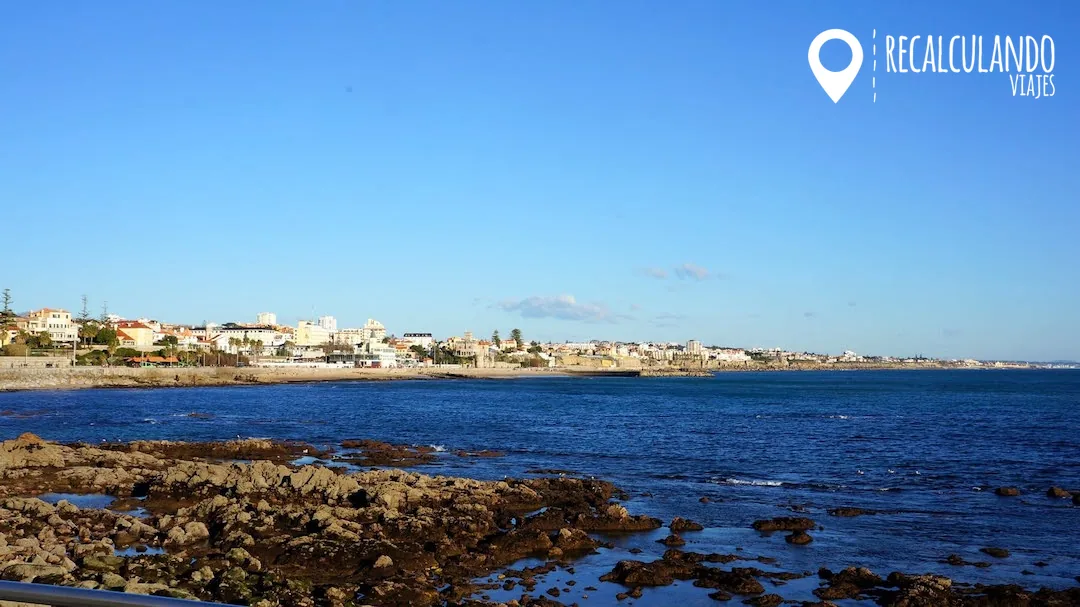
The most obvious getaway and the one we did. You arrive on foot along the Paredão in 25-30 minutes, by train in 3 minutes, or by bike. Cascais has a real historic center, the Boca do Inferno, the Casa de Santa Maria, the Santa Marta lighthouse museum, and much more nightlife than Estoril. Our recommendation: walk there and come back by train so you don’t repeat the same landscape tired.
Sintra: Pena Palace and Quinta da Regaleira
About 25-30 minutes by car or by combining train and bus. The Pena Palace, with its yellow and red towers on the mountain range, is a World Heritage Site and one of the Seven Wonders of Portugal. Quinta da Regaleira adds gardens, Masonic symbols, and the famous Initiation Well. Key fact that is not always clarified: at Pena, tickets have an assigned time, and in high season they sell out days in advance, so buy them online before traveling.
Cabo da Roca, the westernmost point of continental Europe
About 20-25 minutes by car. It is the westernmost end of the European continent (several guides get confused and write “oriental,” watch out) and has cliffs of more than 100 meters over the Atlantic. Entry is free; there is a lighthouse and a viewpoint with the stone cross where everyone takes a photo. Bring a jacket even if it’s hot: the wind there is something else.
Praia do Guincho and Carcavelos
Two opposite beaches, and both are worth it. Guincho is wild, windy, and a paradise for surfers and kitesurfers, with the dunes and the Sintra mountains in the background. Carcavelos, in the opposite direction and on the same train line, is huge, urban, and one of the best for spending the day if you travel without a car.
Lisbon in half an hour
You arrive in 30-35 minutes by train and get off directly at Cais do Sodré, steps from the Time Out Market and Barrio Alto. The train also stops in Belém, so you can get off on the way to see the Tower and the Jerónimos Monastery without returning to the center.
Organized excursions in Spanish
If you prefer to be taken and told everything, there are full-day excursions that combine Sintra, Cabo da Roca, and Cascais departing from Lisbon, with a guide in Spanish. Prices start around 55-60 € per person without tickets and go up to 95-100 € for those that already include the Pena Palace and Quinta da Regaleira. It is the most comfortable option if you don’t want to deal with Sintra parking, which is a chaos in summer.
And if you are going to continue traveling the country, we leave you other guides of ours of things to do in Portugal, including the Figueirinha beach, near Setúbal, which was one of the ones that surprised us the most.
Where to eat in Estoril: areas, prices, and what to order
Here we are going to be transparent: we toured the things to do in Estoril in one day and ate in only one place, so we are not going to throw out a list of ten restaurants that we didn’t try, like almost all the guides you will read do. What we can give you is the mental map of where to look and how much to expect to pay.
The three gastronomic zones of Estoril
- Avenida de Nice and center streets: the most economical and local. Bakeries for breakfast or snacks, taverns with a daily menu. It is where those who live here eat.
- Seafront (Paredão and Praia do Tamariz): terraces with views of the Atlantic, fresh fish, and clearly higher prices. You pay for the view, and sometimes it’s worth it anyway.
- Avenida Marginal and Monte Estoril: medium-high range restaurants, several with Italian or signature cuisine, designed for quiet dinners.
How much does it cost to eat in Estoril
- Coffee with pastel de nata: between 2 and 3.50 €. In the center, cheaper than on the coast.
- Daily menu or prato do dia in a tavern: around 10-14 € with drink.
- Lunch or dinner in a beachfront restaurant: from 20 to 35 € per person.
- Beer (imperial) on a terrace: 2-3.50 €.
What to order no matter what
You are on the coast, so grilled fish is the safe bet: sea bream, sea bass, or sardines in the summer season. Bacalhau appears in a thousand versions (à brás, com natas, à lagareiro) and is always good. As a starter, order queijo da serra or presunto. And for dessert, in addition to the pastel de nata, look for the travesseiro if you come from Sintra.
A practical tip that we learned in Portugal the hard way: what they bring to the table without you asking (bread, olives, pâtés, cheeses) is called “couvert” and is charged separately. If you are not going to eat it, return it as soon as they leave it, and they won’t charge you for it.
In low season, watch out for the hours: several beach places close or shrink their menu. In January, we found much less movement than we expected.
Best time to visit Estoril
The best time to visit the things to do in Estoril depends on what you are looking for, and we say this having gone in the middle of winter:
- June to September: beach, handicraft fair, full terraces, and everything open. Also the most expensive time and with more people.
- April, May, and October: our recommendation. Pleasant weather, lower prices, and the Paredão without crowds.
- November to March: cool and windy, but sunny many days. We walked in long sleeves in late January and it was beautiful. That said: ice-cold water and several beach bars closed.
A detail that surprised us: even in the middle of winter, there were people swimming.
Travel insurance for Estoril
Although Portugal is safe and has good healthcare, traveling without insurance is a lottery that isn’t worth playing. A sprain on the Paredão, gastroenteritis, or lost luggage can ruin your trip and your wallet. And if you travel from Argentina, medical coverage in Europe is not optional in practice.
We have used IATI Insurance for years on all our trips around Europe and never had problems managing anything. By booking through our link, you get a 5% discount.
If you want to compare coverage before deciding, we leave you our guide on the best travel insurance for Europe, where we explain what to look for in the fine print.

Practical tips for your visit to Estoril
- Comfortable shoes: between the Paredão and the climbs in Monte Estoril, you are going to walk more than you think.
- Bicycles: watch out for guides that say there are free bikes next to the station. Free bikes are only for residents, students, and workers with the Viver Cascais card. Visitors rent from the MobiCascais kiosks (there is one in Estoril, on Avenida Clotilde) and it is paid.
- Tide: several small beaches almost disappear at high tide. Check it before going down.
- Internet: we always travel with eSIM to not depend on Wi-Fi. If you want to try it, with the code RECALCULANDOVIAJES you get 5% off your eSIM.
- Cash: you can pay with a card almost everywhere, but some beach kiosks ask for a minimum or cash only.
- Luggage: if you are packing for Portugal, our luggage checklist will save you from forgetting things.
Map of things to do in Estoril
We put together this map with the 18 things to do in Estoril from the guide, plus the train stations and the route of the Paredão to Cascais. It will help you see how close everything is: the center can be covered on foot without any problem.
Frequently asked questions about things to do in Estoril
How many days are needed to see Estoril?
Half a day is enough to visit the main things to do in Estoril on foot: the casino, the park, Praia do Tamariz, and Forte da Cruz. If you add the Paredão to Cascais and the beaches of São João and São Pedro, you can use a full day without rushing.
Is it worth visiting Estoril or is it better to go straight to Cascais?
It is worth it, and you don’t have to choose. They are 1.7 km apart, connected by a flat promenade, and the same train ticket allows you to get off at one and return from the other. Estoril has the casino, gardens, and quieter beaches; Cascais has more historic center and nightlife.
Can you enter Casino Estoril for free?
Yes, entry to the building is free. To access the gaming rooms, you must be over 18 and present a photo ID, as well as respect the smart casual dress code. There are also scheduled free concerts and an art gallery.
How much does the train from Lisbon to Estoril cost?
It is around 2.45 € per trip from Cais do Sodré, plus 0.50 € for the Navegante Ocasional rechargeable card, which is bought once. The trip lasts between 30 and 35 minutes and there are trains approximately every 20-30 minutes.
What are the beaches in Estoril like?
They are urban beaches, with golden sand and quite protected from the strong Atlantic swell, which is why they are good for families. Praia do Tamariz is the main and busiest one; Praia da Poça and Praia da Azarujinha are rockier and quieter, and São Pedro do Estoril is the locals’ favorite.
What is the best time to visit Estoril?
From June to September for beach and summer vibes, although it is the most expensive and crowded time. April, May, and October are ideal for the pleasant weather and lack of crowds. In winter, the town is quiet and sunny many days, but the water is ice-cold and several beach bars close.
What is the distance between Lisbon and Estoril?
About 25 kilometers by road from the center of Lisbon. By train from Cais do Sodré, it’s 30-35 minutes; by car via the A5, about half an hour without traffic, and quite a bit more if you go via the Marginal road along the coast.
Can you walk from Estoril to Cascais?
Yes, and it is the best walk in the area. The Paredão connects Praia do Tamariz with the bay of Cascais in 1.7 kilometers of flat, paved paths, about 25-30 minutes at a leisurely pace. It is lit at night and accessible. Both stations are in the same fare zone, so you can walk and return by train with the same ticket.
What does the word Estoril mean?
There is no closed etymology. The most widespread explanation associates the name with roots that refer to sterile or sparsely populated land, something consistent with the pine forest and rocky coast that existed before the area was urbanized at the beginning of the 20th century. It is best to take it as probable, not as a certainty.
Where to eat in Estoril and how much does it cost?
The taverns and pastry shops in the center, around Avenida de Nice, are the most economical option: a daily menu is around 10-14 €, and a coffee with pastel de nata is between 2 and 3.50 €. The restaurants facing the sea, on the Paredão and Praia do Tamariz, go up to 20-35 € per person. Remember that the “couvert” they bring without you asking is charged separately.
Is it better to stay in Estoril or Lisbon?
It depends on the trip. Estoril is usually cheaper than Lisbon, you have the beach and promenade steps away, and you are 30 minutes from the center by train—ideal if you are looking for tranquility or traveling with children. Lisbon wins if your priority is museums, nightlife, and not wasting time on daily transfers.
Conclusion: is Estoril worth it?
After touring it, our answer is a resounding yes. The things to do in Estoril are not monumental, nor will they leave you breathless like Sintra, but the whole works: a casino with a spy history, stately gardens, family beaches, and a promenade that is among the most beautiful in Portugal.
If you have little time in Lisbon, dedicate half a day to it and combine it with Cascais. If you have more leeway, stay the night here and use it as a base for Sintra, Cabo da Roca, and Guincho: you will pay less than in the capital and will sleep listening to the sea.
And if you are organizing your trip from scratch, we leave you our step-by-step guide on how to plan your trip. Have a great trip and let us know how it went!
ℹ️ **Total Transparency**
This article contains affiliate links. If you book through these links, we may receive a small commission at no additional cost to you. We only recommend services that we use on our trips and that we trust. This helps us keep this blog free and continue creating useful content for you. Thank you for your support!
🔗 Resources & Useful Links for your trip to Estoril
Do you have questions or want to add your own recommendations about things to do in Estoril?
💬 Leave your comment or write to us; we love reading the experiences of other travelers.
Thank you very much for being part of this adventure!— Nanu & Facu 🌎 | Recalculando Viajes 💜