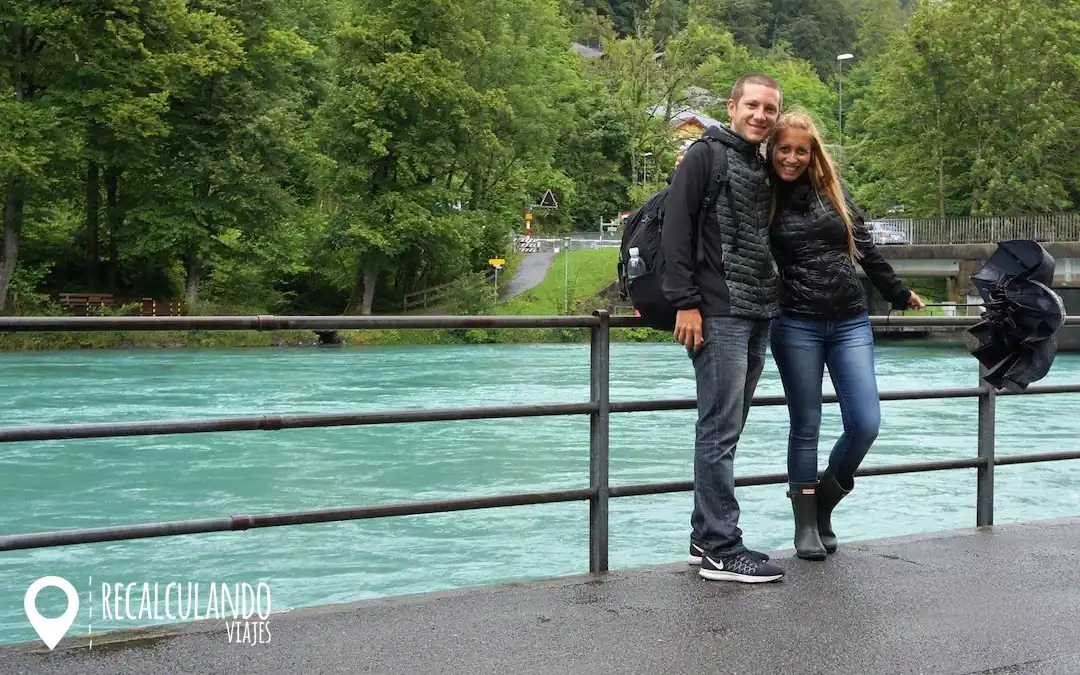
If you are planning your trip to Switzerland and looking for things to do in Interlaken, here are the 20 essential spots, with updated prices, a map, and tips on where to sleep and how to get there. We went by train from Zurich in early July and were hit with torrential rain… so we will tell you what we were able to visit and what we learned so you can have a better experience.
Interlaken is that Swiss town nestled between two lakes—Thun and Brienz—that serves as the base camp for the entire Bernese Oberland. Trains to Jungfraujoch, Lauterbrunnen, Grindelwald, and Schilthorn depart from here. The town itself can be explored in an afternoon, but the list of things to do in Interlaken and its surroundings could fill an entire week.
🌍 Travel Insurance: 5% Off with IATI Seguros! 🌟
Take advantage of this offer and travel safe.
Things to do in Interlaken Summary
| Category | Key Information |
|---|---|
| Destination | Interlaken, heart of the Bernese Oberland (Switzerland). |
| Best Time | June to September; May and October offer fewer crowds. |
| Recommended Days | Minimum 3 days; 4-5 days is ideal to see the area without rushing. |
| Daily Budget | Between 150 and 250 CHF per person (accommodation, food, and excursions). |
| Transport | Train, bus, and boat; cars are impractical due to mountain restrictions and parking costs. |
| Essentials | Höheweg, Harder Kulm, Jungfraujoch, Lauterbrunnen, and lakes Thun and Brienz. |
| Pro Tip | Always check live webcams before buying high mountain tickets. |
| Rainy Day Plan | St. Beatus Caves, Trümmelbach Falls, or visiting the town of Thun. |
1. The Höheweg, the essential promenade of things to do in Interlaken
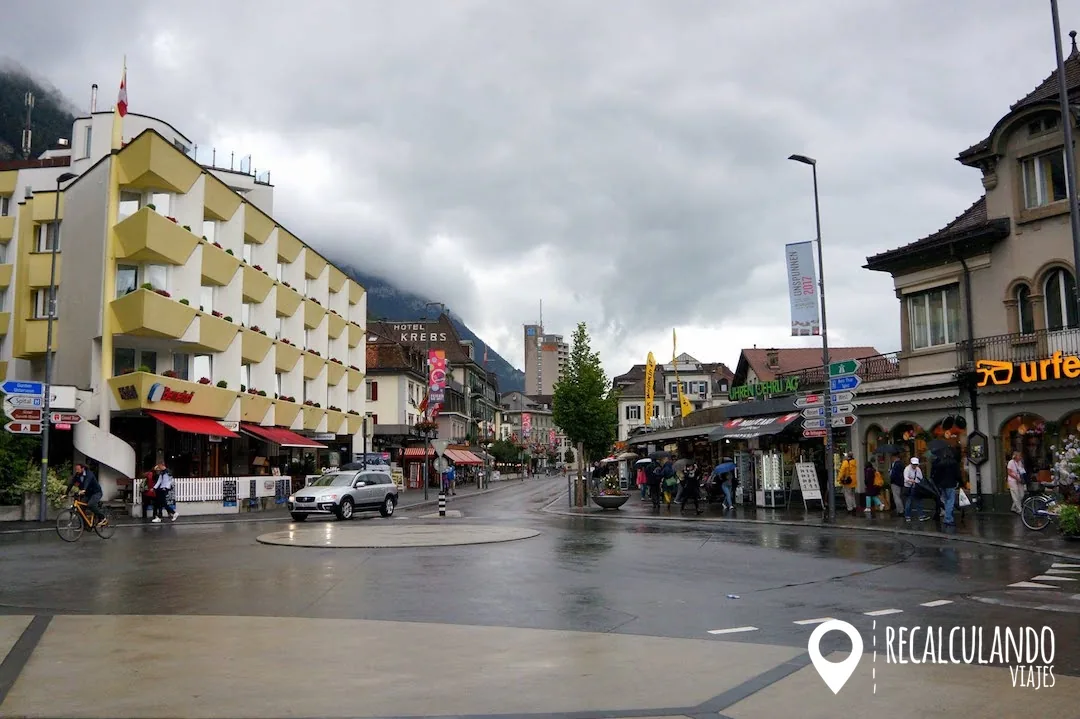
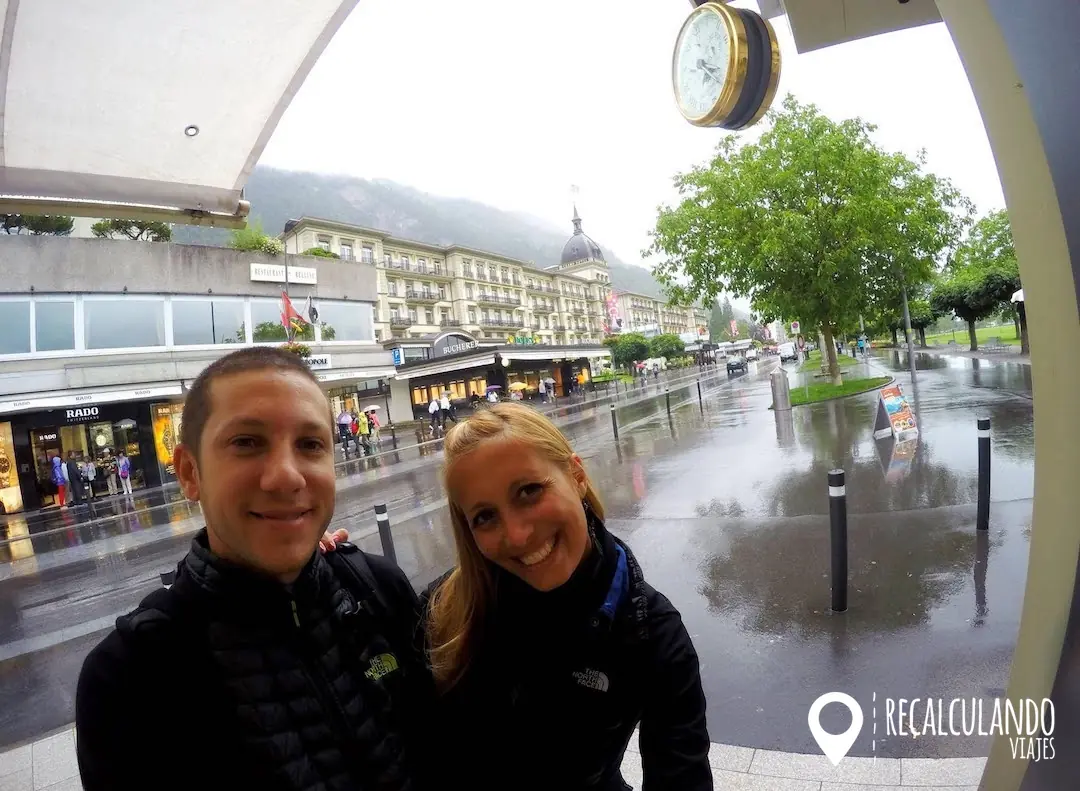
The Höheweg is the main street of Interlaken and the heart of the town. It connects the two stations—Interlaken West and Interlaken Ost (East)—and it’s where you will surely pass several times a day. On one side you have the huge meadow of the Höhematte; on the other, a row of 19th-century palatial hotels, confectioneries, watch shops, and souvenir stores.
We walked it from end to end under an umbrella that barely held up, and it still seemed beautiful to us. When the sky clears for a bit, you can see the white triangle of the Jungfrau peeking out at the end of the valley. One of those postcards you’ve seen a thousand times in photos, yet it’s still striking when you see it in person.
TIP: walking from West to Ost takes about 20 minutes at a leisurely pace. If you arrive by train and are short on time, get off at West, walk the Höheweg, and depart from Ost towards your chosen mountain. You get the best of the walk without losing a minute.
2. The Höhematte, the Kursaal, and the Japanese Gardens
The Höhematte is a 14-hectare meadow right in the center that was saved from real estate speculation in 1864 when a group of residents bought it to prevent construction. Thanks to that, today Interlaken has an unobstructed view of the Jungfrau massif right from the main street. A round of applause for them.
Paragliders land in the meadow all day long. Next to the Höhematte is the Kursaal, the casino and convention center, with meticulously cared-for gardens and the famous flower clock, a mandatory photo stop for everyone passing through.
In front of the Hotel Interlaken, there are also small Japanese gardens, a gift from the twin city of Ōtsu. They can be seen in five minutes, but it’s a quiet, unique corner compared to the rest of the town. We were soaking wet, but we couldn’t stop taking photos.
3. Unterseen, the old town almost nobody visits
Two steps from Interlaken West station, crossing the Aare river, is Unterseen: a historic district founded in 1279 that most tourists completely miss. It has a cobblestone square surrounded by wooden houses, a church with a stone bell tower, and a main street, the Untere Gasse, that looks like a movie set.
We’ll be honest: with the rain falling that day, we didn’t explore it as we would have liked, we just took a peek. But many travelers point to it as the most authentic corner of the area, and seeing the little we did, we believe them. If you come on a nice day, it is one of the things to do in Interlaken that costs the least and is enjoyed the most: it’s free and a ten-minute walk from the center.
Worth noting: from the bridge over the Aare in Unterseen, you can get one of the best photos of the town, with the turquoise water in front and the mountains behind.
4. The stroll along the Aare River
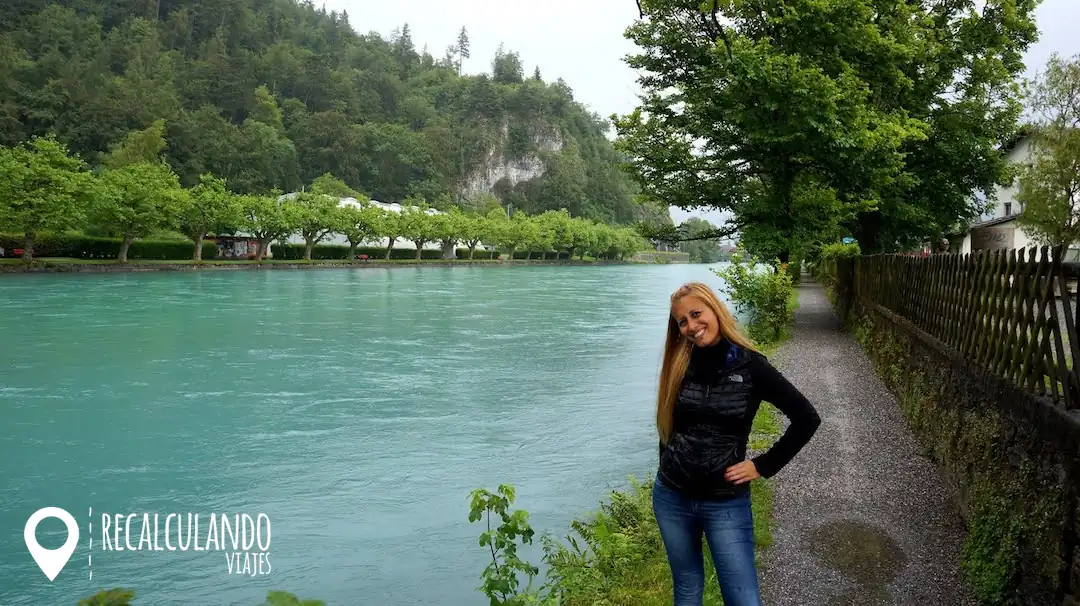
The Aare is the river that connects Lake Brienz with Lake Thun and cuts through the middle of Interlaken. Going around the back of the Kursaal, you reach the river promenade, and from there you can walk west through one of the least touristy parts of town.
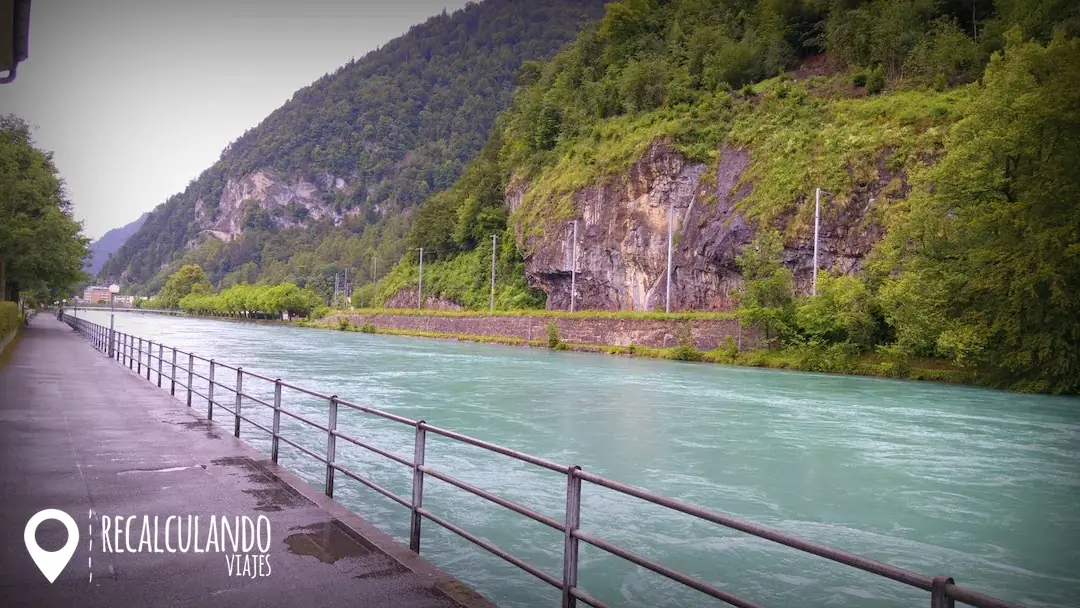
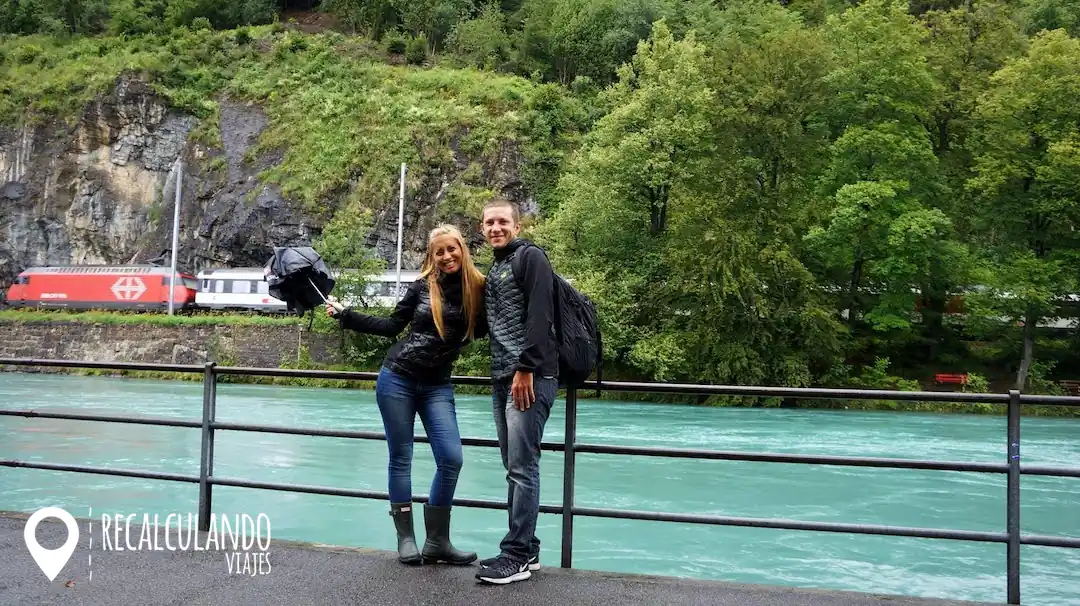
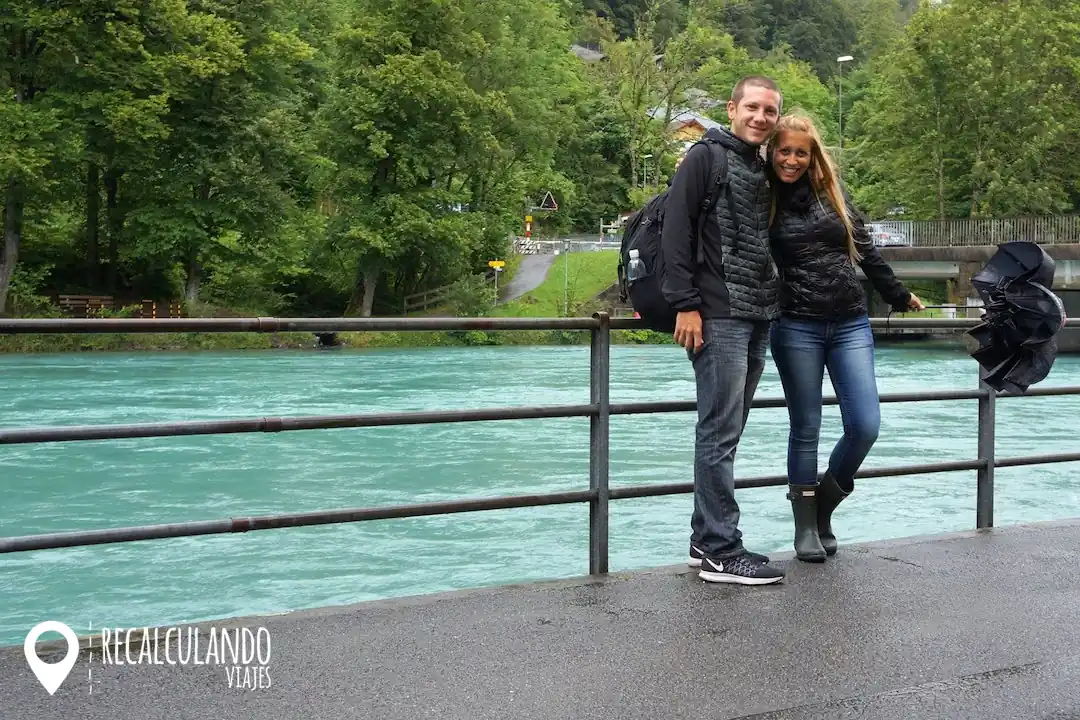
The color of the water is a very particular milky turquoise, typical of glacial melt. In summer, you will see people drifting down in boats or floating directly in the river, a local classic. We did a short stretch between showers, and it was one of the most beautiful parts of the day: no people, with the sound of the water and the mountains closing off the horizon.
It is one of the most peaceful things to do in Interlaken; it takes an hour and costs nothing. Perfect for the last afternoon or those moments when the weather doesn’t allow you to go anywhere else.
5. Harder Kulm, the best viewpoint for things to do in Interlaken in half a day
If you have to choose just one mountain and don’t want to spend a fortune, this is it. Harder Kulm is at 1,322 meters and is reached via a red funicular that leaves a few minutes’ walk from Interlaken Ost station, crossing the bridge over the Aare. The journey takes about 10 minutes with a gradient that reaches 64%, so the ascent is already part of the show.
At the top, there is a panoramic restaurant with turrets that looks like it’s out of a fairy tale and, above all, the Two Lakes Bridge: a suspended platform with a glass floor from where you can see both lakes, the town below, and the Eiger, Mönch, and Jungfrau in front. We couldn’t go up because it was all covered in clouds, and there’s no point in paying to see gray. But it is the first thing we would do if we returned.
| Round trip price | About 44 CHF per adult (50% discount with Swiss Travel Pass or Half Fare Card; free with the Jungfrau Travel Pass) |
|---|---|
| Funicular duration | 10 minutes, with departures every 30 minutes |
| 2026 Season | April 3rd to November 29th. Closed in winter |
| Recommended time | 2 to 3 hours in total |
TIP: the best time is sunset, when the sun hits the lakes from the side. If you are going to eat at the restaurant at the top, it is advisable to book a table.
6. Paragliding over Interlaken
Interlaken is one of the world capitals of adventure sports, and tandem paragliding is the star activity. Flights take off from Beatenberg or the Mürren area and land right on the Höhematte, in the center, after 10 to 20 minutes in the air depending on conditions.
No prior experience is needed: you are strapped to an instructor and the only thing you have to do is run a few meters during takeoff. Prices start at around 190 CHF, and flights are canceled for free if the weather doesn’t cooperate, something that happens often in this area.
We didn’t fly—nobody was flying that day, obviously—but we watched those who had done it earlier land, and they all came down with the same “I can’t believe it” expression. If paragliding is too much for you, the area offers rafting on the Lütschine, canyoning, ziplines, and jet boat rides. There are options for all levels of adrenaline.
7. Lake Thun by boat
Thunersee is the largest of the two lakes and one of the most beautiful walks you can take without going up any mountain. The boats depart from the Interlaken West pier and cruise along the shore, stopping in small towns like Spiez, Oberhofen, Merligen, or Beatenbucht, until reaching the city of Thun.
The full trip takes about two hours each way and is included in the Swiss Travel Pass, so if you have the pass, it’s practically free. There are dinner cruises and sunset departures that many travelers recommend as one of the most beautiful moments of the trip, with light falling over the castles on the shore.
Combined idea: take the boat to Beatenbucht, visit the St. Beatus Caves, and return by bus. You get two visits in one morning and don’t repeat the route.
👩⚕️👨⚕️ A must-have for stress-free travel! 🌎✈️ ➜ Get a Quote, Compare & Buy
8. St. Beatus Caves
On the north shore of Lake Thun, about 12 kilometers from Interlaken, are the St. Beatus Caves (St. Beatus-Höhlen). It is an underground system of which about 14 kilometers have been explored, although the visitable part is a route of about 1 kilometer with stalactites, internal waterfalls, and small lakes.
The access path is worth it alone: you go up a forest trail crossing several bridges over the waterfall that comes out of the cave itself, with the lake in the background. Adult admission costs 20 CHF and includes the cave museum; they are open all year round, with a constant temperature of 8 to 10 degrees inside (bring a jacket even if it’s hot outside).
You can get there on bus 21 from Interlaken in about 20 minutes, or by boat to Beatenbucht. If you go by car, parking costs 7 CHF for the day. It is also the best plan in the area for a rainy day: we didn’t plan for it, and in hindsight, it’s exactly what we should have done.
9. Oberhofen Castle
About 20 minutes by boat from Interlaken, on the shore of Lake Thun, stands Oberhofen Castle. It is a 13th-century fortress that once belonged to the Habsburgs and now functions as a museum, with a park of almost six hectares around it and a tower that literally extends into the water.
We didn’t go in—you already know how our day ended—and we aren’t museum people unless they are essential. But many travelers recommend it precisely for the park and the view of the lake from the gardens, which are free to access. It is one of those things to do in Interlaken and surroundings that are enjoyed just as much from the outside: just walking the park and taking the photo of the castle reflected in the water justifies the stop.
10. Lake Brienz, Iseltwald, and the Bönigen Lido
Brienzersee is the younger brother of Lake Thun, but it has a turquoise color that doesn’t seem real. On the south shore, about 6 kilometers from Interlaken, is Iseltwald: a small village of barely 400 inhabitants that became famous worldwide for a scene from the Korean series Crash Landing on You, filmed on its wooden pier.
The popularity was so sudden that the municipality had to put an access fee on the pier (about 5 CHF) and regulate parking to manage the number of people. Even so, the village remains beautiful and very quiet if you go early or late in the afternoon. You can get there on bus 103 from Interlaken Ost in about 20 minutes.
The lidos: where to swim in the lakes
Lidos are open-air swimming areas on the shores of the lakes, and in Switzerland, they are a real institution. Near Interlaken, the two best known are Lido Bönigen, on Lake Brienz and five minutes by bus from the center, and Burgseeli, in the Goldswil area, which is a small lake with much warmer water.
They have grass, changing rooms, and a cafeteria. In July and August, the water is cold but perfectly swimmable, and it is one of the few truly cheap plans in the area. A mate on the shore of Brienzersee looking at the mountains is hard to beat.



11. Jungfraujoch, the most famous excursion from Interlaken
Jungfraujoch, nicknamed Top of Europe, is the highest train station in Europe: 3,454 meters. You go up from Interlaken Ost via two routes, via Lauterbrunnen and Wengen or via Grindelwald with the Eiger Express cable car, and a good part of the final journey goes through a tunnel dug inside the Eiger.
At the top, the Ice Palace (a labyrinth of galleries carved into the glacier), the snowy plateau, the Alpine Sensation exhibition, and the Sphinx observatory await you at 3,571 meters: the highest building in Europe, reached by a dizzying elevator. From there you can see the Aletsch Glacier, the longest in the Alps.
Now, the uncomfortable part: it’s very expensive. In 2026, the round-trip ticket from Interlaken Ost costs 261.20 CHF between May and October, and 224.40 CHF the rest of the year. To that, you add the mandatory seat reservation in high season, which is 10 CHF more per person. With a Swiss Travel Pass or Half Fare Card, the price drops significantly, but it remains the most expensive excursion in Switzerland.
| Altitude | 3,454 m (Sphinx viewpoint at 3,571 m) |
|---|---|
| Round trip price 2026 | 261.20 CHF (May to October) / 224.40 CHF (rest of the year) |
| Seat reservation | Mandatory from May to October, 10 CHF per person |
| Minimum time | About 6 hours round trip from Interlaken |
The most important tip: book the seat first (it’s only 10 CHF) and buy the ticket only on the morning of the ascent, after checking the live webcam of the Jungfraujoch. If it’s cloudy, you won’t see anything at the top, and you’ll have spent more than 260 francs on a white wall.
12. Schynige Platte and its Alpine Botanical Garden
This is one of the things to do in Interlaken that we would love to do most if we return. From Wilderswil, a few minutes by train from Interlaken, a vintage cogwheel train departs, taking about 50 minutes to climb to almost 2,000 meters at Schynige Platte.
At the top, there is an alpine botanical garden of more than 8,000 square meters with about 500 varieties of mountain plants, a hotel-restaurant with a panoramic terrace, and several trails. The most famous one goes up to the Oberberghorn, but even the short circular walk (about one hour) offers views of the Eiger, Mönch, and Jungfrau, and both lakes at the same time.
The train runs only in season, more or less from late May to October, so confirm dates before planning. It is a much cheaper alternative to Jungfraujoch and a favorite among the Swiss.
13. Lauterbrunnen and the Staubbach Falls
20 minutes by train from Interlaken Ost is Lauterbrunnen, probably the most photographed valley in Switzerland. It is a U-shaped glacial valley with vertical walls of almost 500 meters down which 72 waterfalls fall. The most famous is Staubbach, which drops almost 300 meters right behind the town and, on windy days, turns into mist before touching the ground.
Behind the waterfall, there is a path carved into the rock that allows you to see it from the inside, and it is free. Five minutes away by bus are also the Trümmelbach Falls, ten glacial waterfalls inside the mountain accessed by an elevator dug into the rock (admission about 14 CHF).
Lauterbrunnen combines perfectly with Mürren or Wengen, two car-free towns hanging over the valley, reached by cable car or cogwheel train. It is, for us, the full-day plan with the best landscape-to-price ratio in the entire area.
14. Grindelwald-First and Lake Bachalpsee
Grindelwald is the other great base town in the region, half an hour by train from Interlaken, and it lies at the foot of the north face of the Eiger. From the town, a gondola goes up to First, at about 2,168 meters, where several of the most popular attractions of the Oberland are concentrated.
At the top is the First Cliff Walk, a metal walkway bolted to the cliff with a viewpoint that hangs over the void, and from there the trails start. The most famous one leads to Bachalpsee, an alpine lake that reflects the snowy peaks and appears on every postcard of Switzerland: an hour and a half walk round trip, without technical difficulty.
To go down, there are options for all tastes: the First Flyer (zipline), the First Glider, mountain carts, and trotti bikes. Watch the dates: in 2026 the gondola will be closed for maintenance from October 26th to November 27th.
15. Schilthorn – Piz Gloria, the James Bond mountain
We close the list with the Schilthorn, at 2,970 meters, crowned by the Piz Gloria revolving restaurant, where much of On Her Majesty’s Secret Service was filmed. You go up by cable car from Stechelberg or from Mürren, and the journey itself is an attraction.
At the Birg intermediate station is the Thrill Walk, a walkway hanging from the cliff with sections of glass and a net through which you can crawl over the void. At the top, in addition to the revolving restaurant, there is an interactive exhibition about the Bond films.
Many travelers point to it as the best alternative to Jungfraujoch: the view of the Eiger, Mönch, and Jungfrau is even more frontal, and the price is significantly lower.
Recommended route: go up through Stechelberg and down through Mürren and Grütschalp to Lauterbrunnen, so as not to repeat the path and see the valley from two different heights.
16. Thun, the medieval city of the lake
Thun is the gateway to the Bernese Oberland and, for many travelers, the most beautiful stop among all the things to do in Interlaken and its region. It is at the opposite end of the lake that bears its name, 20 minutes by train from Interlaken or about two hours by boat if you prefer to arrive by water.
Its great attraction is the old town with the Obere Hauptgasse, a street where the sidewalks of the shops are built above the roofs of the ground floor, something you won’t see anywhere else in Switzerland. At the top stands the 12th-century Thun Castle, with four towers, a historical museum inside, and a view of the lake and the Alps from the very top.
We didn’t get to Thun, so we’ll tell you about it with borrowed words: the three blogs that rank first on Google for this search include it, and many travelers point to it as the best half-day excursion from Interlaken. If you have a day of bad weather and the mountains are covered, this is the getaway that saves the day.
TIP: combine the train there with the boat back. You pay the same and do two different routes.
17. Spiez and the Sigriswil suspension bridge
Halfway between Interlaken and Thun is Spiez, a town with one of the most photogenic bays in the country: a medieval castle on a promontory, a sailboat harbor, and vineyards that descend to the water’s edge. It is reached in 20 minutes by train from Interlaken and is a short stop that is easily combined with Thun on the same day.
On the north shore of the lake, near Sigriswil, there is another essential that almost no guide mentions: the panoramic suspension bridge, about 340 meters long, which crosses the Gummi gorge at quite a height. It is walked in five minutes, has free access, and offers a frontal view of Lake Thun that is hard to beat. If you are afraid of heights, consider yourself warned.
Both are reached by public transport from Interlaken, although the bridge requires a combination of boat and bus, so it is advisable to check schedules before leaving.
18. Brienz and the Ballenberg open-air museum
Brienz is at the opposite end of the lake of the same name, 20 minutes by train from Interlaken Ost. It is a village of wooden houses known for artisan woodcarving and for being the base of the Brienzer Rothorn, the last steam cogwheel train still operating in Switzerland, which climbs to 2,244 meters.
A few minutes from the village is Ballenberg, the largest open-air museum in the country: 66 hectares with more than 100 historic buildings brought from all Swiss regions, traditional craft workshops in operation, and about 200 farm animals. Many travelers who go with children point to it as the best family plan in the entire area.
| Ballenberg 2026 Ticket | 32 CHF per adult (discount when buying online) |
|---|---|
| 2026 Season | April 9th to November 1st, 10 am to 5 pm |
| Recommended time | Half a day minimum; with children, the whole day |
| How to get there | Train to Brienz and bus to the museum entrance |
Near Brienz are also the Giessbach waterfalls, which fall in fourteen leaps to the edge of the lake and are reached by boat plus a historic funicular. We didn’t see them, but from what they say, it is one of the most beautiful postcards of the Brienzersee.
19. Lake Blausee and Oeschinensee
These two lakes are outside the immediate radius of Interlaken—you have to go towards the Kander valley, a long hour’s journey away—but they appear on almost every list of things to do in Interlaken and surroundings for one reason: the color of the water.
The Blausee is tiny, barely 0.64 hectares at 887 meters altitude, inside a private natural park with a trout farm. The water is so transparent that you can see the bottom at 12 meters deep. It has paid admission and is covered entirely in less than two hours, including a glass-bottom boat ride.
The Oeschinensee plays in another league: it is at 1,578 meters, surrounded by walls of more than 3,000 meters, and is one of the most impressive alpine lakes in Switzerland. You go up by cable car from Kandersteg and then walk between 20 and 30 minutes to the shore, on a path suitable even for strollers.
| Oeschinensee Cable Car (round trip) | 40 CHF in high season and 36 CHF the rest of the year (22.50 CHF with Swiss Travel Pass) |
|---|---|
| Mandatory reservation | Time slot for the ascent from June 20th to September 20th, 2026 |
| How to get there | Train from Interlaken to Kandersteg (change in Spiez), about 1 hour |
| Recommended time | Half a day for Blausee, full day if you add Oeschinensee |
Worth noting: since 2026, the Kandersteg–Oeschinensee section is no longer included in the Berner Oberland Pass, so check the fine print before buying a pass with this lake in mind.
20. The Aare Gorge and the Reichenbach Falls
We close with an excursion that almost nobody puts in the guides and that we think is one of the most original: the Haslital valley, passing Brienz, about 40 minutes by train from Interlaken.
The Aare Gorge (Aareschlucht) is a 1.4-kilometer gorge that the river carved into the rock, traversable by walkways bolted to the wall with the water roaring below. Admission costs 13 CHF for adults and 8 CHF for children aged 6 to 15, and the 2026 season runs from April 3rd to November 1st. Fridays and Saturdays between July 3rd and August 29th, they open at night with the gorge illuminated, which must be something else.
A step away are the Reichenbach Falls, famous because Arthur Conan Doyle made Sherlock Holmes fall there in his fight with Professor Moriarty. You go up in a historic funicular to a viewpoint, and in the town of Meiringen, there is a statue and a small museum dedicated to the detective. Meiringen, moreover, claims to be the cradle of the meringue: enough reason to stop for a snack.
It is a full-day plan, not crowded, and very cheap compared to the big mountains. If you’ve already been to Interlaken before or want to get off the classic circuit, this is the detour.
Recommended itinerary: things to do in Interlaken in 1, 2, and 3 days
This is the breakdown that seems most logical to us depending on the days you have:
| Days | Suggested plan |
|---|---|
| 1 day | Höheweg, Höhematte, and Kursaal in the morning, Unterseen and the Aare promenade at midday, and funicular to Harder Kulm in the afternoon for sunset. |
| 2 days | Day 1: the entire town + Harder Kulm. Day 2: Lauterbrunnen, Staubbach Falls, and ascent to Mürren or Schilthorn. |
| 3 days | Add a third day for Grindelwald-First and Bachalpsee, or for Lake Brienz with Iseltwald and a swim in the Bönigen Lido. |
| 4 or 5 days | With this margin, you can include Jungfraujoch (choosing the clearest day), Schynige Platte, and a boat trip on Lake Thun with a stop at the St. Beatus Caves. |
| 6 days or more | You can add Thun and Spiez, the day in Kandersteg with Blausee and Oeschinensee, and the Haslital getaway with the Aare Gorge and Reichenbach Falls. |
Our advice: don’t finalize the order of the days until you arrive. In the Bernese Oberland, the weather rules, and it is best to leave the ascents for the day the forecast is clearest.
Where to sleep in Interlaken
Interlaken is the most practical base in the Bernese Oberland: it has two stations, piers for both lakes, and direct connections to Lauterbrunnen, Grindelwald, and Wilderswil. Sleeping here puts almost all the things to do in Interlaken and its surroundings within reach. These are the areas worth looking at:
- Center (between West and Ost): the most convenient of all. You step out of the hotel and you are already on the Höheweg. It’s the most expensive area, but also the one that makes the best use of time.
- Unterseen: crossing the Aare, a ten-minute walk. Quieter and somewhat cheaper, with very good value for money.
- Bönigen and Wilderswil: a few minutes by bus or train, ideal if you are looking to save money or if you are traveling by car and want parking without dramas.
- Lauterbrunnen, Wengen, or Mürren: if you are coming primarily to hike in the mountains, sleeping directly in the valley saves you two trips per day.
On this map you can see availability and real prices of hotels and apartments in Interlaken, with all platforms compared at once:
Important: in July and August Interlaken gets full and prices skyrocket. If you are traveling in high season, book several months in advance. If you want more ideas to organize yourself before leaving, in our guide on how to plan your trip we tell you the step-by-step process we used.
How to get to Interlaken
Interlaken has two train stations: Interlaken West, closer to the town of Unterseen and Lake Thun, and Interlaken Ost (East), which is the important one because all mountain trains and Lake Brienz boats depart from there. Almost all trains stop at both.
- From Zurich: there are direct trains every hour, and the trip takes about 2 hours. It is exactly what we did, in one day, and it works perfectly. A ticket without discounts is around 60-70 CHF each way.
- From Bern: less than an hour by direct train. The fastest connection of all.
- From Lucerne: about 2 hours with the Luzern–Interlaken Express, one of the most beautiful panoramic routes in Switzerland. We also toured Lucerne and Bern by train: moving around Switzerland by rail is a pleasure.
- From Geneva or Zurich Airport: between 2h 30m and 3 hours with a connection.
- By car: from Zurich, about 2 hours by highway. Remember the mandatory vignette and that parking in Interlaken is expensive.
The piece of data that changes the trip: the Lucerne–Interlaken route is done with the Luzern–Interlaken Express, a panoramic train with giant windows that borders four lakes and crosses the Brünig Pass. It doesn’t cost more than a normal train, but it is advisable to book a seat in summer. If you can choose where to enter Interlaken from, enter here: the trip stops being a transfer and becomes part of the walk.
You can always check real schedules on the Swiss Railways website, SBB, which is infallible and works to the minute.
If you are planning to combine Interlaken with other corners of Europe, you can compare Car Rental prices before deciding. Honestly: here the train and boat take you everywhere and a car is almost always surplus.
How to get around Interlaken
The town can be explored entirely on foot: there is a 20-minute walk from one station to the other. To reach the rest of the things to do in Interlaken and its region, public transport is impeccable, and you have to decide one thing before traveling: which pass is worth it.
Which transport pass is best in 2026
This is probably the decision that will save (or lose) you the most money on the whole trip. These are the four passes and their 2026 prices:
| Pass | 2026 Price | What it covers | For whom |
|---|---|---|---|
| Swiss Half Fare Card | 150 CHF (1 month) | 50% discount on trains, buses, boats, and almost all mountains | The most flexible option. Pays for itself with two or three mountain ascents |
| Swiss Travel Pass | From 254 CHF (3 days) | Trains, buses, and boats in the whole country included, plus discounts on mountains | If you are also going to tour other regions of Switzerland |
| Berner Oberland Pass | From 240 CHF (3 days) | Free transport throughout the region. Does not include Jungfraujoch, Harder Kulm, or Schilthorn | If you are staying only in the Oberland and take many trips |
| Jungfrau Travel Pass | From 210 CHF (3 days) | The Jungfrau region, with Harder Kulm included. Jungfraujoch pays a supplement | If you are focusing on Interlaken, Grindelwald, and Lauterbrunnen |
Our honest recommendation: if you go for 3 or 4 days and plan to do two mountains at most, crunch the numbers with individual prices and the Half Fare Card before spending on a regional pass. Passes pay for themselves when you take many trips per day, not when you take one. And watch out for a change in 2026: the Kandersteg to Oeschinensee cable car is no longer included in the Berner Oberland Pass.
Interlaken by car, camper, or caravan
If you are coming by vehicle, keep in mind that Switzerland requires a highway vignette and that parking in Interlaken is expensive: downtown parking lots go for several francs per hour. The area does have very good camping infrastructure—Bönigen, Lauterbrunnen, and Interlaken have several on the river or lake—and overnight parking outside authorized areas is prohibited in Switzerland, so it’s best to book.
A car is also no use for going up the mountains: neither Mürren nor Wengen have road access and the rest of the summits are reached only by train or cable car. The most practical thing is to leave it parked at your accommodation and move around using public transport.
Another detail: if you sleep in an Interlaken hotel, they usually give you a guest card with local transport included. Ask at check-in, because they don’t always offer it to you.
And to have internet without fighting with roaming, an eSIM from Holafly solves it in five minutes (with the code RECALCULANDOVIAJES you have a discount). In an area where you will check the forecast and webcams all the time, it is appreciated.
Interlaken in winter
Most guides on things to do in Interlaken take for granted that it is a summer destination, and it’s a half-truth. In winter, the town sheds its skin: there are fewer people, accommodation prices drop significantly, and the snowy landscape with the Jungfrau in the background is another thing.
What works and what doesn’t between December and March:
- Remains open: Jungfraujoch (all year), Schilthorn, St. Beatus Caves, and trains to Lauterbrunnen and Grindelwald.
- Closed: the Harder Kulm funicular, the Schynige Platte train, and the lake boats significantly reduce their frequencies.
- Adds: ski slopes of Grindelwald, Wengen, and Mürren, with more than 200 skiable kilometers in the Jungfrau region, as well as sledding, snowshoes, and skating.
If your priority is hiking and lakes, come in summer. If you are looking for snow, friendlier prices, and mountains without queues, winter is a great option. In our travel tips you have more ideas for choosing dates.
Where to eat in Interlaken
The cuisine of the Bernese Oberland is hearty, mountain-style, and designed for the cold. These are the dishes you will see most:
- Rösti: the grated potato cake fried until golden in a pan. It is the national dish par excellence and is served with egg, cheese, bacon, or meat.
- Fondue and raclette: melted cheese, in the common pot or melted over potatoes. In winter, it’s what the body craves.
- Zürcher Geschnetzeltes: strips of veal in cream and white wine sauce with mushrooms, almost always accompanied by rösti.
- Bratwurst: grilled sausage in bread with mustard. It’s the cheap and fast option, and in Switzerland, “cheap” is a word that must be taken advantage of.
- Lake fish: perch or trout from Thunersee and Brienzersee, in restaurants on the shore.
- Chocolate: mandatory. Läderach and Sprüngli are the brands you will see in any showcase on the Höheweg.
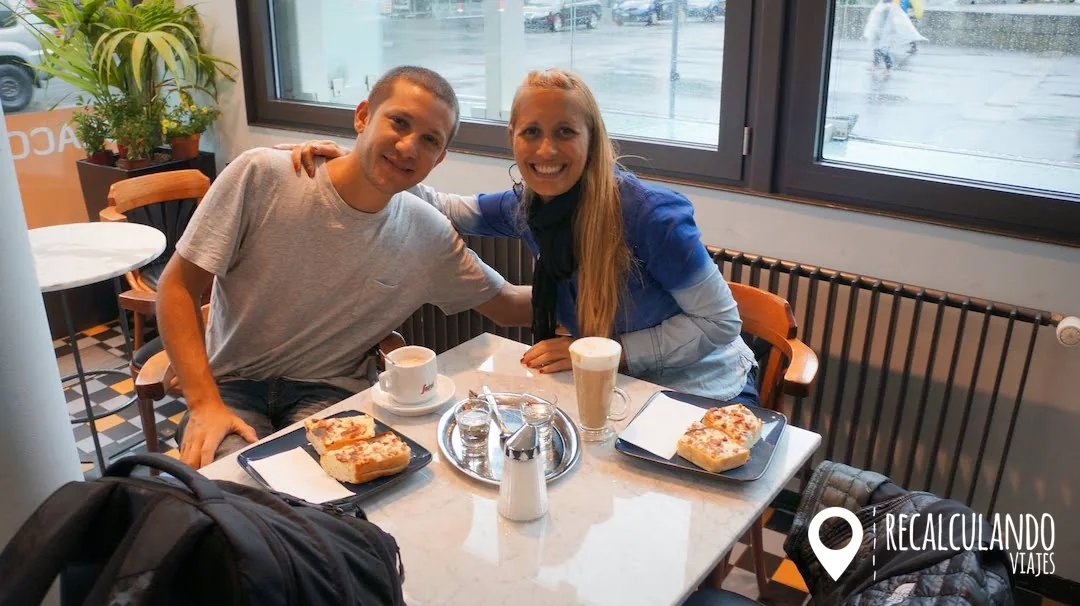
We are not going to recommend specific restaurants because, with the downpour we had, we ate where we could and it wouldn’t be honest to sell it to you as a selection. What we do tell you: a main course costs around 25-35 CHF, so many travelers combine one restaurant meal per day with shopping at the Coop or Migros in the center.
Travel insurance for Interlaken
Switzerland has one of the most expensive healthcare systems in the world. A simple doctor’s visit goes to several hundred francs, and a helicopter rescue in the Alps is counted directly in the thousands. Add to that that people come here to do paragliding, rafting, and high-altitude hiking: insurance stops being a luxury and becomes a necessity.
We always travel with IATI Insurance and have used it several times in these nine years of nomad life. What we value most is that they cover adventure sports in the appropriate modalities, they assist in Spanish, and you don’t have to pay out of pocket in most cases. If you want to see all the coverages in detail, we leave you our comparison of the best travel insurance for Europe.
With our link you have a 5% permanent discount on your IATI policy, and in campaign times the discount can reach up to 15%.
Worth noting: if you plan to go paragliding, canyoning, or hiking above 3,000 meters, confirm that the modality you contract includes those activities. Not all basic coverages contemplate them.

Excursions from Interlaken
Almost all the things to do in Interlaken in this guide can be done on your own by train, bus, or boat. But if you are short on time or prefer someone to solve the logistics of the mountains—which in high season implies reservations, combinations, and schedules—organized excursions save you several headaches.
The most sought-after are the ascent to Jungfraujoch with a guide, the tour through the Lauterbrunnen and Grindelwald valley, the boat trip on both lakes, and outings to Iseltwald for fans of Crash Landing on You. There are also full-day outings from Zurich and Lucerne.
If you are building a longer alpine route, our guides on things to do in Hallstatt, in Austria, and things to do in Bled, in Slovenia, might be useful. And if the French side of the Alps tempts you, Annecy is another beautiful stop.
Map of things to do in Interlaken
Here we leave you the map with the 20 things to do in Interlaken that we tell you about in this guide, plus the stations, piers, and departure points for each excursion. You can save it to your Google Maps and use it directly during the trip.
Frequently asked questions about things to do in Interlaken
How many days are needed to see Interlaken?
For the town itself, one day is enough: the Höheweg, the Höhematte, Unterseen, and Harder Kulm fit comfortably in one day. But if you want to take advantage of the Bernese Oberland region, 3 days minimum is ideal, and between 4 and 5 if you plan to go up to Jungfraujoch and do some hiking.
What is the best time to visit Interlaken?
June to September is the best season, because all cable cars and mountain trains are operational and the trails are open. May and October have fewer people and lower prices, although some facilities close for maintenance. In winter the town continues to operate, but the Harder Kulm funicular closes.
Is it worth going up to Jungfraujoch or is Harder Kulm better?
It depends on budget and time. Harder Kulm costs about 44 CHF round trip, is done in two or three hours, and gives the best panorama of the town between the two lakes. Jungfraujoch exceeds 260 CHF in high season and takes up half a day, but it is a high mountain experience that is not repeated anywhere else in Europe. If the budget is tight, the Schilthorn is an excellent middle ground.
Can you visit Interlaken in a day from Zurich?
Yes, and it is exactly what we did. There are direct trains every hour and the trip takes about 2 hours each way. With an early departure, you have time to tour the town and go up to Harder Kulm, although it is not enough for Jungfraujoch or a long hike.
What can you do in Interlaken if it rains?
The St. Beatus Caves are the best indoor plan in the area, along with the Trümmelbach Falls in Lauterbrunnen. You can also walk the Höheweg and Unterseen with an umbrella, tour the old town, or take a boat on Lake Thun, which is just as enjoyable from the inside. We endured a downpour and the day was still worth it.
Is Interlaken expensive?
Yes, Switzerland is one of the most expensive destinations in Europe. Count on between 150 and 250 CHF per day per person including accommodation, food, and a mountain excursion. To lower costs, it is convenient to shop at supermarkets like Coop or Migros, evaluate a transport pass according to the days, and prioritize free plans, of which there are many: the Höheweg, Unterseen, the Aare promenade, and the shores of the two lakes.
Do you need to rent a car to get around the area?
No. Swiss public transport is punctual and reaches everywhere: trains to Lauterbrunnen and Grindelwald, buses to Iseltwald and the St. Beatus Caves, and boats on the two lakes. Furthermore, the car does not go up to most mountains and parking in Interlaken is expensive, so the train is usually the best option.
Which transport pass is best for Interlaken?
It depends on how many trips you take per day. The Swiss Half Fare Card costs 150 CHF, is valid for one month, and gives a 50% discount on almost everything, so it pays for itself with two or three mountain ascents. The Jungfrau Travel Pass starts at 210 CHF for 3 days and includes Harder Kulm. The Berner Oberland Pass starts at 240 CHF for 3 days, but does not cover Jungfraujoch, Harder Kulm, or Schilthorn. If you do one big excursion, it is usually cheaper to pay individual tickets.
Can you visit Interlaken in winter?
Yes, and it is a very underutilized time. In winter, accommodation prices go down, there are fewer people, and you can add skiing in Grindelwald, Wengen, and Mürren, sledding, and snowshoes. Keep in mind that the Harder Kulm funicular and the Schynige Platte train close, and that lake boats reduce their frequencies. Jungfraujoch, Schilthorn, and the St. Beatus Caves operate all year round.
Is it better to sleep in Interlaken or Lauterbrunnen?
Interlaken is the best base if you are going to move around a lot: it has both stations, boats for both lakes, and direct connections to the entire Oberland. Lauterbrunnen, Wengen, or Mürren are convenient if you are coming primarily to hike in the mountains, because they save you two trips per day and you wake up inside the landscape. For a first visit of 3 or 4 days, Interlaken wins on logistics.
Conclusion: our experience with things to do in Interlaken
We left Interlaken soaked, with our sneakers in a mess and without having gone up any mountain. And even so, we would return tomorrow. That says a lot about the place.
These 20 things to do in Interlaken give you the complete list: the essentials of the town, free and on foot, and the great excursions of the Bernese Oberland, which take the budget but also the photos you will look at for years. The final advice is simple: choose the day to go up the mountain well, check the webcams before buying the ticket, and always leave a plan B indoors.
If you are building your complete route, in our Switzerland section you will find more destinations in the country, and don’t forget to review the luggage checklist before leaving: in the Alps, a waterproof jacket is worth more than any advice. And if you go, tell us how you did with the weather… it owes us a rematch!
ℹ️ **Total Transparency**
This article contains affiliate links. If you book through these links, we may receive a small commission at no additional cost to you. We only recommend services we use in our travels and trust. This helps us keep this blog free and continue creating useful content for you. Thank you for your support!
🔗 Resources & Useful Links for your trip to Interlaken
Do you have any questions or want to add your own recommendations about things to do in Interlaken?
💬 Leave your comment or write to us, we love reading about other travelers’ experiences.
Thank you very much for being part of this adventure!— Nanu & Facu 🌎 | Recalculando Viajes 💜