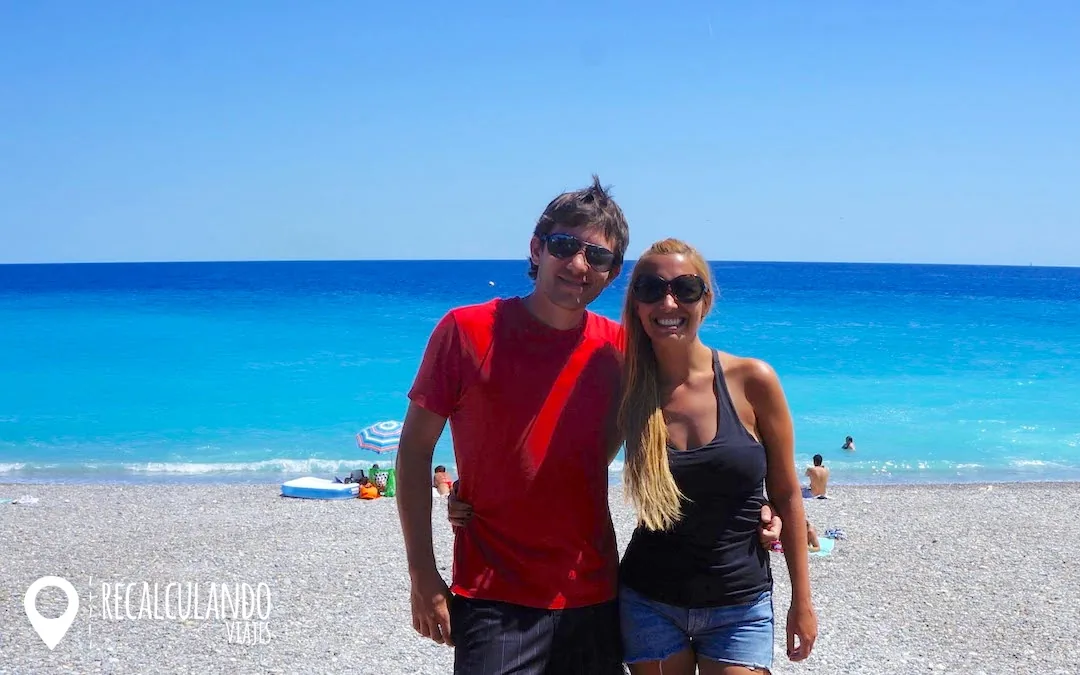
If you are looking for things to do in Nice, you’ve come to the right place: in this guide, we tell you the 20 must-see places in the capital of the Côte d’Azur, with verified hours and prices for 2026, 1, 2, and 3-day itineraries, a map, and our tips on where to sleep and how to get around. We have been to the area twice (once in summer and once in autumn), and Nice always ends up being the perfect base for touring the entire French Riviera.
The first time, we stayed for 3 nights in Nice and rented a car to tour the surroundings. The second time, we returned with our own car and stayed for 10 days in Menton, so we went back and forth to Nice several times. Everything you are about to read here is told from our experience, with data checked this year.
🌍 Travel Insurance: 5% Off with IATI Seguros! 🌟
Take advantage of this offer and travel safe.
Things to do in Nice Summary
| Concept | Detail |
|---|---|
| Best time | May, June, September, and October (mild weather and fewer crowds). |
| Recommended days | 2 days for the city; 4-5 days if including excursions along the Côte d’Azur. |
| Daily budget | Between €90 and €110 per person (accommodation, meals, and transport). |
| Urban transport | Tram and bus: single ticket €1.70; daily pass €7. |
| Museums | Municipal pass €15 (4 days). The Marc Chagall Museum and MAMAC (under renovation) operate under special conditions. |
| Must-sees | Promenade des Anglais, Vieux Nice, Cours Saleya, Castle Hill, and Place Masséna. |
| Typical gastronomy | Socca, pissaladière, pan bagnat, and Niçoise salad (no potatoes). |
| Airport connection | Tram line 2 direct to the port in 26 minutes (€3.70 using a rechargeable card). |
| Key tip | Bring water shoes, as the beaches are pebbly (rocks) and not sandy. |
Why Nice is unlike the rest of France
Before starting the list, it’s worth understanding something that explains everything you will see. Nice was founded by the Greeks in the 4th century B.C. with the name Nikaia, in honor of Nike, the goddess of victory. Later it was Roman, medieval, and for centuries it belonged to the House of Savoy and the Kingdom of Piedmont-Sardinia. It only became French in 1860, after a referendum.
That is why the old town looks like Genoa, the food is more Italian than French, and many signs are still written in Niçois. Add to that the 19th century, when the British and Russian aristocracy began spending their winters here and left behind palaces, villas, an Orthodox cathedral, and a 7-kilometer seaside promenade. That mixture is precisely what UNESCO recognized in 2021.
Having this in mind completely changes how you view the things to do in Nice. You are not in a French city with a beach: you are in an Italian city that became French and then turned into the winter resort for half of Europe.
1. The Promenade des Anglais, the most famous walk on the Côte d’Azur
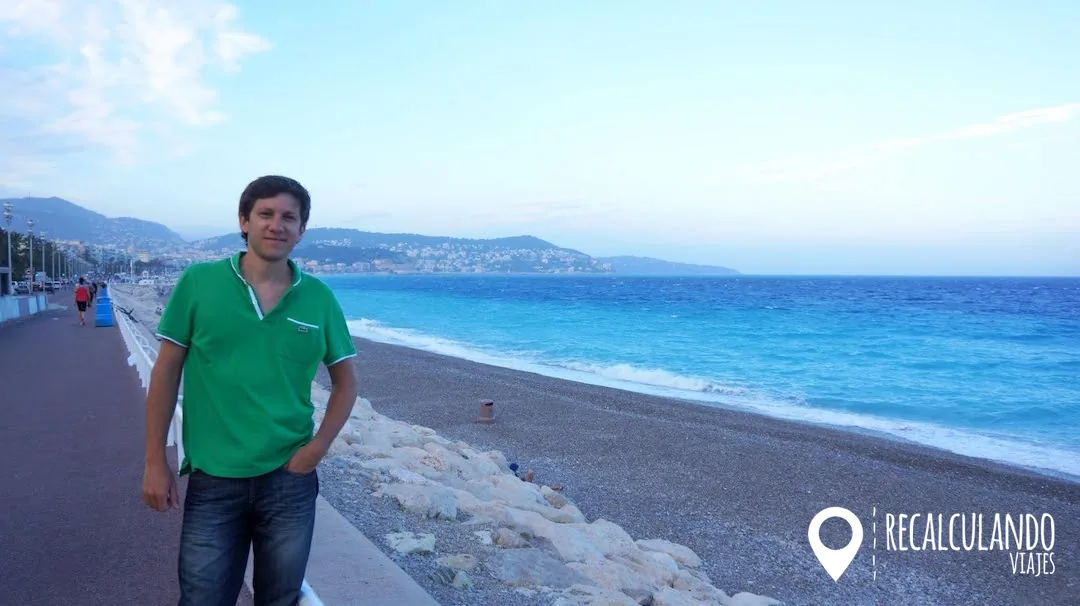
We start the list with the most iconic feature. The Promenade des Anglais is 7 kilometers of wide sidewalk facing the Mediterranean, with palm trees, the famous blue chairs looking out to sea, and people jogging, skating, and strolling at any time.
It is, without debate, the first of the things to do in Nice. It is named that way because it was promoted by British tourists who spent the winter here at the beginning of the 19th century: Reverend Lewis Way was the one who raised the money to build it. Precisely because of that history as the Riviera’s “winter capital,” the city made it onto the UNESCO list.
We walked it several times and we tell you with total honesty: the best moment is sunset. The light turns orange, the Bay of Angels looks spectacular, and the promenade comes to life without the midday heat. Sit for a while in a blue chair, even if it’s for ten minutes. It’s free and it’s one of the things to do in Nice that is most enjoyed.
Tip: if you don’t want to walk the 7 km, there are bicycle and electric scooter rentals along the entire promenade. With the bike, you can do it from end to end in less than half an hour.
2. The Vieux Nice, the old town that makes you fall in love
The Vieux Nice is a labyrinth of narrow streets, ochre, yellow, and reddish facades, clothes hanging on balconies, and wooden shutters. It looks like a little Italian village tucked inside a French city… and it makes perfect sense after what we told you above.
No itinerary is needed here. Just turn down any street and get lost. You will find small squares, Baroque churches, ice cream parlors, spice and olive oil shops, and those narrow passages where sunlight barely enters. The main streets to orient yourself are Rue Droite, Rue de la Préfecture, and Rue Pairolière.
Within the old town are several points on this list: the Cours Saleya, Place Rossetti, the Lascaris Palace, the Opera, and plenty of churches. Also Place du Palais de Justice, which hosts book and antique markets almost every Saturday, and Place Saint-François, with its small fish market in the morning.
Our TIP: explore it at least twice. In the morning, when the neighborhood is working and smells of bread and market flowers. And at night, when the warm lights turn on and everything completely changes. It looks like another place!
3. The Cours Saleya and its flower market
If we have to choose a favorite corner of the old town, it’s this one. The Cours Saleya is a long esplanade, enclosed by colorful buildings, where one of the most beautiful markets we have seen in France operates.
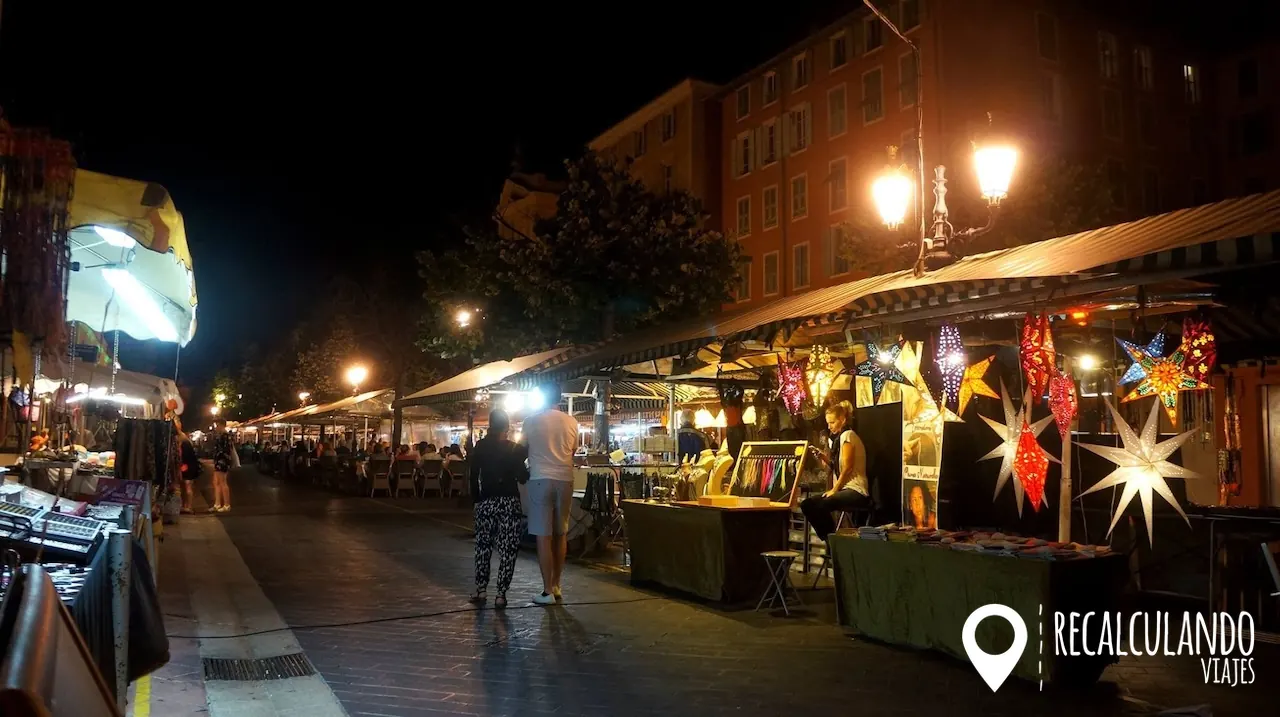
From Tuesday to Sunday morning, there is the market for flowers, fruit, and local products: mimosa bouquets, dried lavender, Nice olives, tapenade, cheeses, spices. It opens very early (from 6 in the morning) and starts to clear out around 1:30 PM. On Mondays, it changes completely and turns into an antiques and bric-a-brac fair, with about 150 stalls, from 7 AM to 6 PM.
In summer, there is also a night craft market from June to September, usually from 6 PM to midnight. We went in the morning and it was a hit: the colors of the flower stalls are the kind that make you take fifty photos without realizing it. Go early, between 8 and 11 AM, because it gets quite crowded afterward.
Tip: climb the stairs of the Ponchettes, facing Place Pierre Gautier, to have a view of the entire market from above. It completely changes the photo.
4. The Place Masséna, the heart of Nice
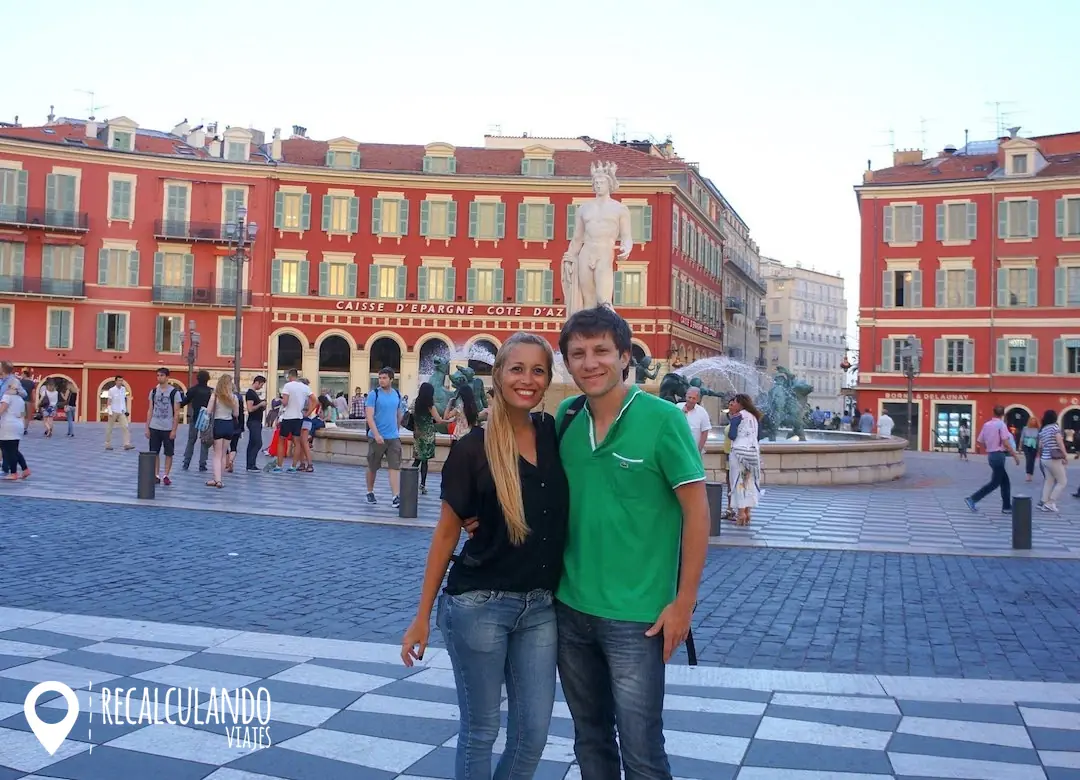
The Place Masséna is the point where the whole city intersects: the connection between the Vieux Nice, the modern area, and the Paillon park. And visually it is impressive, with its Pompeian red buildings with arcades and green shutters, the black and white checkerboard floor, and the Fontaine du Soleil with its enormous Apollo.
What we liked most are the seven illuminated statues that are on top of very tall poles, the work of the Catalan artist Jaume Plensa. They represent the seven continents and change color at night. It is one of those things that in photos aren’t fully understood… until you see them live.
The tram passes through here, and it is an excellent meeting point to start any route: in fact, it is where almost all the city’s tours and free tours depart. We ended up returning to this square almost every day without planning it.
5. The Place Rossetti and the Sainte-Réparate Cathedral
In the heart of Vieux Nice, this square suddenly opens up, and it is one of those lovely surprises the city gives you. Yellow and ochre facades, a fountain in the middle, café tables everywhere, and the Sainte-Réparate Cathedral dominating the scene with its colorful tiled dome.
The cathedral was built between 1650 and 1699 and is dedicated to Saint Reparata, the patron saint of Nice, a 3rd-century martyr whose relics are kept inside. It is Baroque with clear Italian influence and has ten side chapels, each dedicated to a different saint or brotherhood. Entrance is free, and it is worth popping in for at least five minutes: the contrast between the sober facade and the ornate interior, with marble and gold everywhere, is very striking.
The square is also famous for its artisanal ice cream parlors, with very strange flavors that you won’t find anywhere else. It is a good place to take a break in the mid-afternoon.
6. The Baroque churches of Vieux Nice
Here is one of the must-sees in Nice that almost no guide in Spanish expands on, and which we think is the best of the old town. In addition to the cathedral, the Vieux Nice concentrates a handful of spectacular Baroque churches, and entrance to all of them is free.
The most impressive is the church of Saint-Jacques-le-Majeur, known as Église du Gesù, on Rue Droite. The Jesuits built it between 1607 and 1650, imitating the Church of the Gesù in Rome, and inside it is pure theater: frescoes on the vault, colored marbles, side chapels loaded with decoration. It is one of those churches where you enter out of curiosity and stay for twenty minutes.
A few meters away is the church of Saint Rita (officially the Annunciation), the most beloved by the locals, dedicated to the patron saint of impossible causes. It is open every day from approximately 9 AM to 12 PM and 2 PM to 5 PM. And there are also the Mercy Chapel, on the Cours Saleya itself, and the church of Saint-François-de-Paule, next to the Opera.
In these years of traveling, we have visited many churches, and we tell you without exaggeration: the Niçois Baroque is different from the French and Italian, it has something all its own. If you like architecture, spend a morning on this.
7. The Lascaris Palace, one of the most surprising things to do in Nice
Continuing along Rue Droite, you arrive at the Lascaris Palace, and this is a rare case: from the outside, it is just another facade in the old town, with nothing that grabs your attention. Inside, it is a 17th-century Genoese palace with a monumental staircase, frescoes, gilded stuccoes, tapestries, and period furniture.
It was the residence of the Lascaris-Vintimille family, one of the most powerful in the region, and today it functions as a museum with one of the most important collections of musical instruments in France: harps, violins, harpsichords from the 18th century.
Practical data 2026: admission costs €5, it is free for children under 13, and it is included in the municipal museum pass. It is open every day except Tuesdays, from 10 AM to 6 PM. The Cathédrale-Vieille Ville tram stop is less than 100 meters away.
We did not enter (you know we aren’t big on museums unless they are essential or free), but it is the interior that travelers who have been there recommend the most, and for €5, it is one of the cheapest things in the city.
👩⚕️👨⚕️ A must-have for stress-free travel! 🌎✈️ ➜ Get a Quote, Compare & Buy
8. Castle Hill, the best viewpoint in Nice
The Colline du Château is the classic city viewpoint: a 19-hectare park at 93 meters high, between the Vieux Nice and the port, from where you can see the entire Bay of Angels with the orange roofs of the old town below. Almost nothing remains of the medieval castle because Louis XIV ordered it destroyed in 1706, but the views remained.
It is free to climb, and there are three options: the stairs from the Vieux Nice, the softer zigzag climb, or the free elevator which is at the end of the Quai des États-Unis and takes less than a minute. Watch out, the elevator doesn’t always work. The park is open every day, generally from 8:30 AM to 8 PM from April to September and until 6 PM the rest of the year.
Up there, in addition to the viewpoints, there is a 10-meter artificial waterfall fed by the old Vésubie canal, with a small bridge that passes behind it; ruins of the medieval Sainte-Marie cathedral; a historic cemetery and playgrounds for children. Budget an hour for the basic tour and two if you want to see everything.
We tell you this honestly: we didn’t climb it. Our itinerary was packed between the beaches and trips along the coast, and we left it for next time. But it is the spot most recommended by travelers who have been there. If you have to choose only one viewpoint, make it this one, and go first thing in the morning or near sunset: at noon the sun beats down hard and there is little shade on the balconies.
9. The beaches of Nice and the Bay of Angels
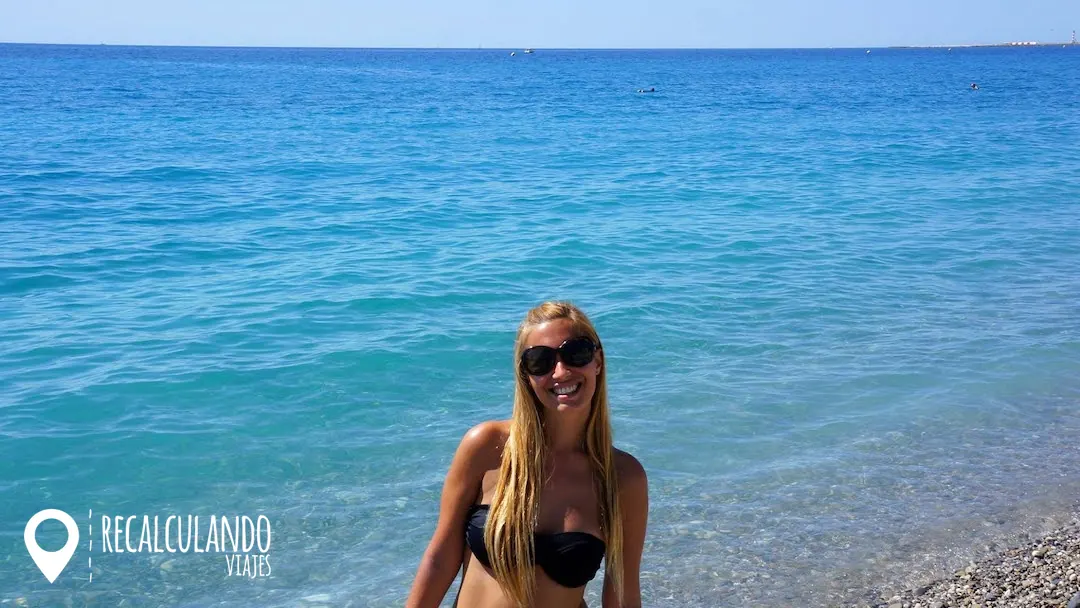
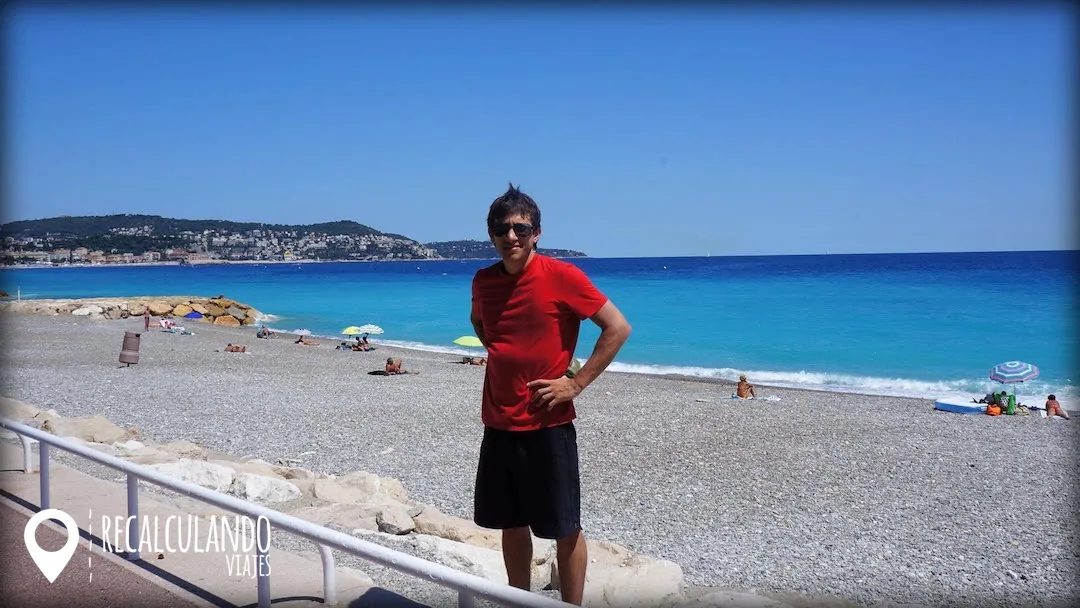
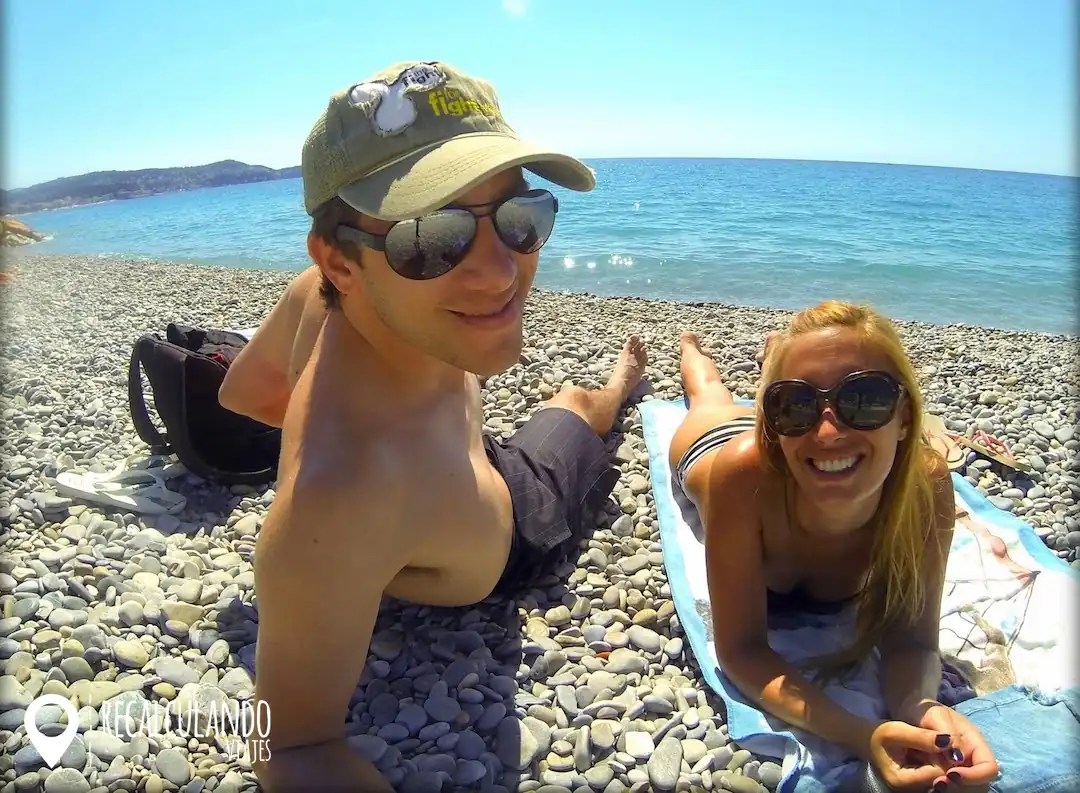
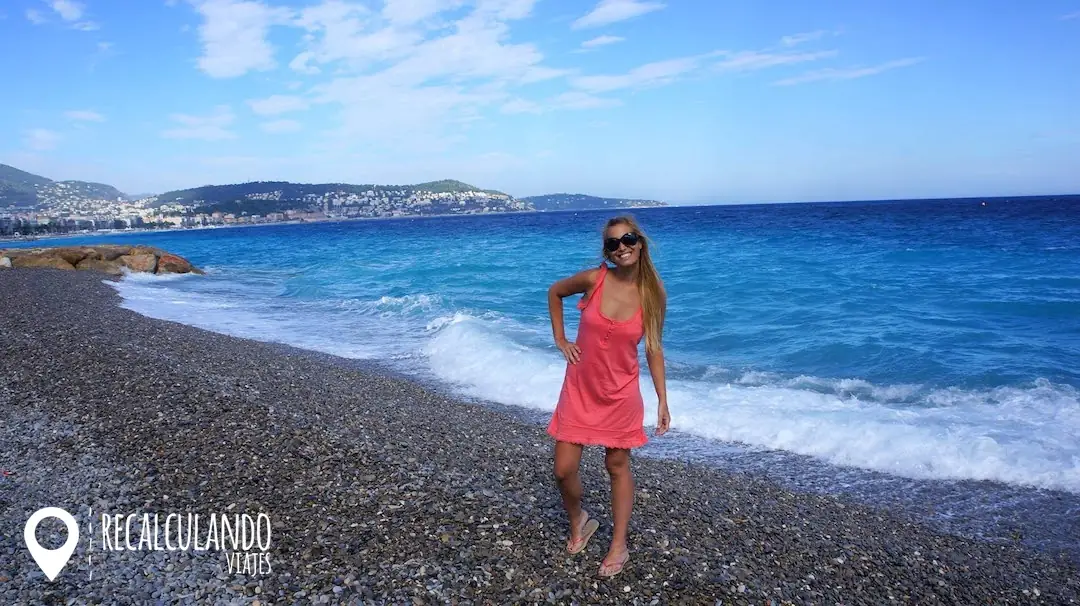
Watch out for this because it surprises many people: the beaches of Nice are not sandy, they are pebbly. Round, large stones that are great for the clear water they generate… but walking barefoot can be complicated if you are not used to it.
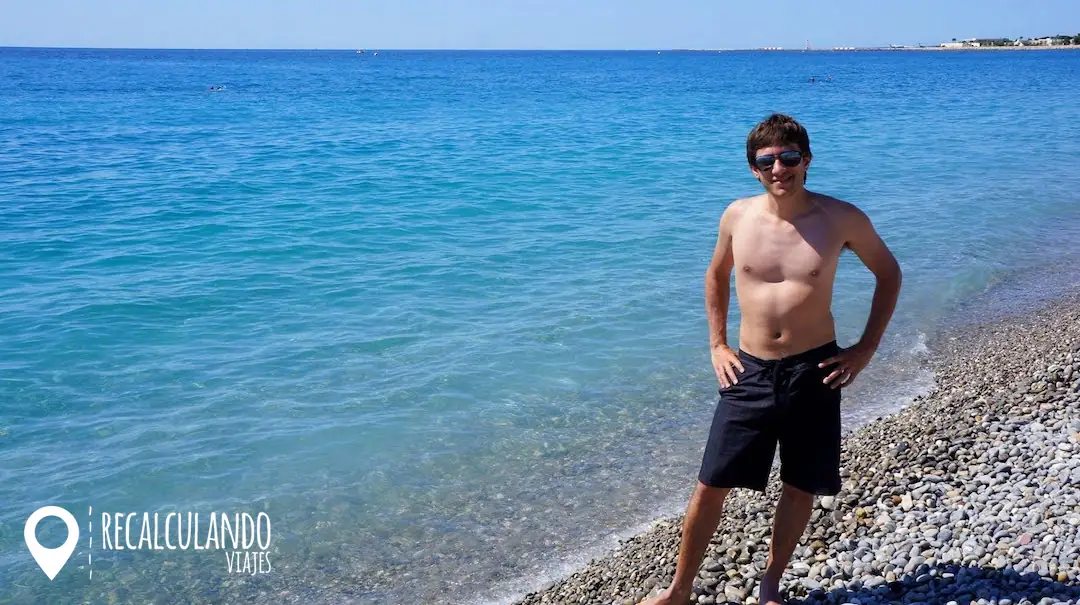
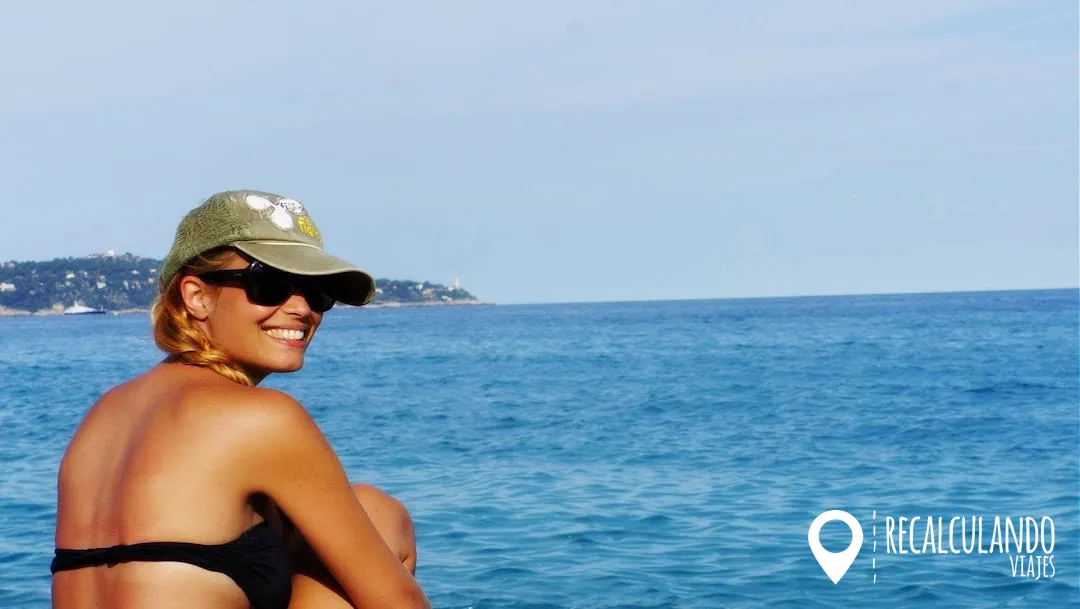
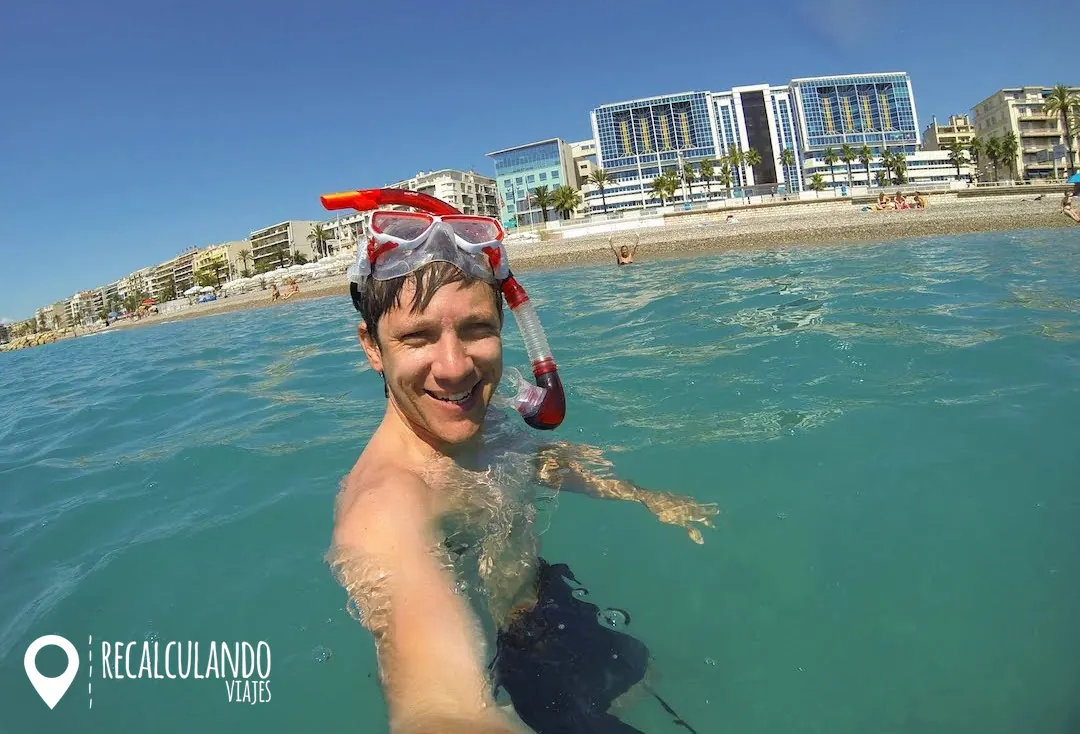
Practical TIP: bring water shoes or rubber sandals. If you can, add a foam mat or a thick towel, because the stone can be a bit uncomfortable. We spent several hours on the beach here and the water is an incredible blue, with that transparency that makes the Côte d’Azur famous.
Public and free beaches
Along the Promenade des Anglais, you have several with free access and showers: Plage des Ponchettes (the most central, next to the old town), Plage du Centenaire, Plage Magnan, and Plage de Carras, the latter two further west and much less crowded.
Private beaches
These are the ones that have lounge chairs, umbrellas, and restaurant service, and they are interspersed with the public ones. Expect to pay between €20 and €30 per day. For us, it is not necessary to pay: the public ones are perfect and the sea is exactly the same.
Tip: if you want something quieter, take the tram or bus and get off at Villefranche-sur-Mer or Beaulieu-sur-Mer. They are 10-15 minutes away and the coves are much nicer than those in the center of Nice.
10. The Promenade du Paillon, the city’s green lung
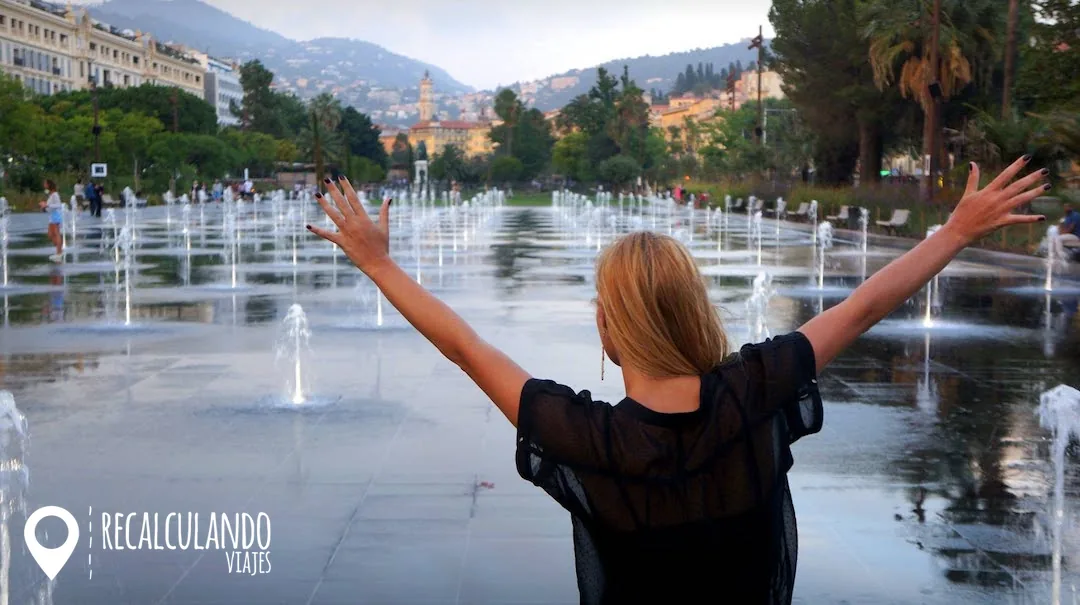
It is one of the things to do in Nice that almost nobody has on their radar and that we loved. The Coulée Verte is a linear park built over the covered bed of the Paillon river, which runs from the area of the old National Theater to the Jardin Albert Ier, next to the sea.
It has water mirrors with jets where children go to play, giant games shaped like sea animals, grass, palm trees, and plenty of shade. In summer, it is a lifesaver at noon.
Important novelty that still doesn’t appear in most guides: in October 2025, the extension (they call it “season 2”) was inaugurated on the land where the Acropolis and the National Theater stood, and the park went from 12 to about 20 hectares, with urban forest areas, new play areas, and sectors designed for rest. We haven’t toured that part yet, but if you go now, you will find it open.
11. The Albert I Garden, where the park meets the sea
It is the southern end of the Promenade du Paillon and deserves its own place among the sites to see in Nice because it is the oldest public park in Nice, from 1852. It is right between Place Masséna and the Promenade des Anglais, so you will pass through here no matter what.
It has huge palm trees, ornamental fountains, an open-air theater (the Théâtre de Verdure) that hosts concerts in summer, and the Venet Arch, that 30-meter curved steel sculpture that can be seen from the entire square. It is the place where the ice skating rink and a good part of the Christmas market are held in December.
We crossed it a bunch of times going from the center to the beach and it was always full of people sitting in the shade. It is a short stop, ten minutes, but it is a perfect breath of fresh air between walks.



12. The Hotel Negresco, an icon of the Belle Époque
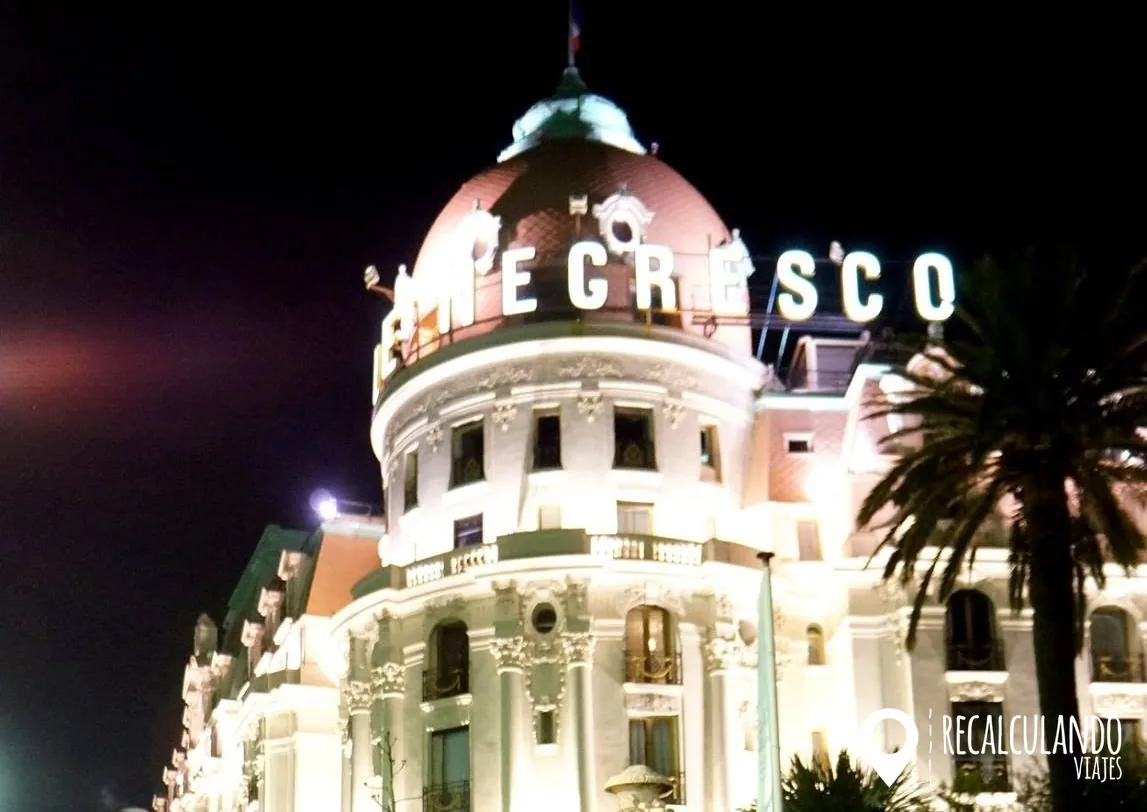
On the Promenade des Anglais is the most famous hotel in Nice: the pink dome of the Negresco is practically the city’s logo. It opened in 1912 and has been a historical monument since 1974.
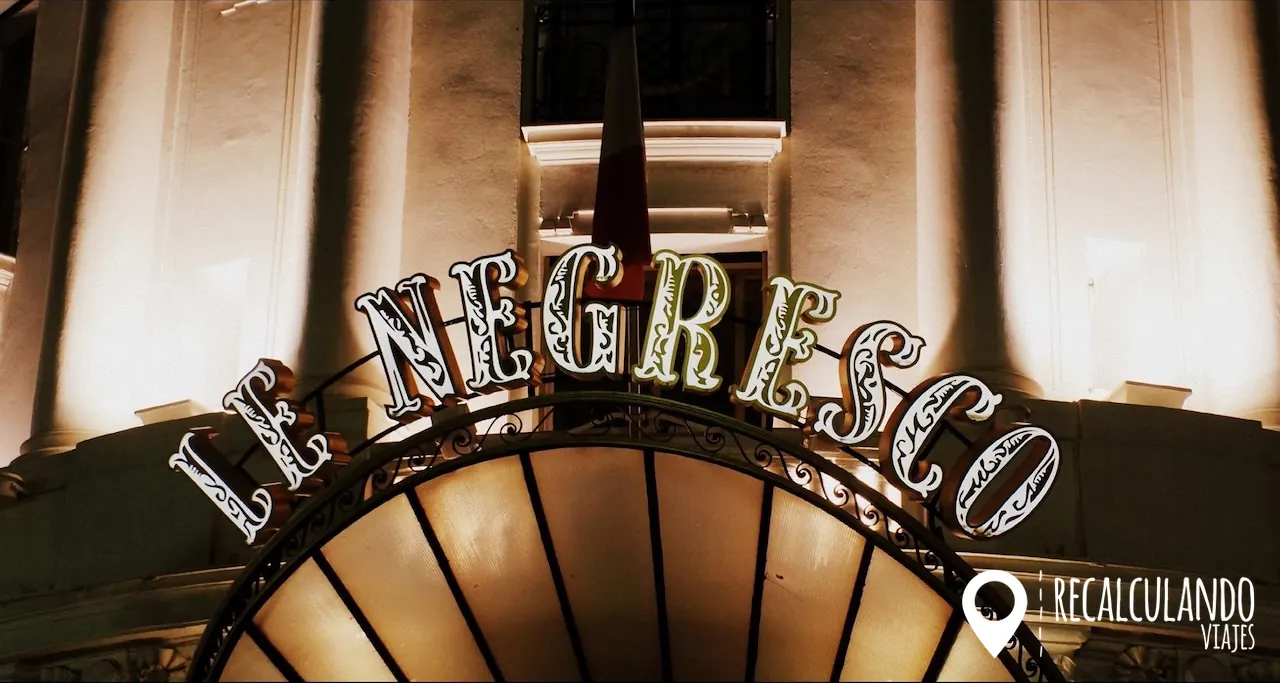
Inside, it has an impressive art collection and a hall with a giant Baccarat crystal chandelier, although we didn’t enter: it is a luxury hotel in operation and access to common areas is at the discretion of the staff, so we don’t promise anything.
What is 100% free and worth it is seeing it from the outside, paying attention to the doormen in period uniforms, and taking advantage of the fact that you are on the seaside promenade. It is one of the things to do in Nice that best tells the history of the city as a winter destination for the European aristocracy.
13. The Nice Opera and the Rue Saint-François-de-Paule
A few meters from the Cours Saleya is the Nice Opera, a beautiful 1885 building with an Italian-style facade, gold details, and more than 1,000 seats. It was inspired in part by the Opera Garnier in Paris and continues to operate with an opera, ballet, and concert season.
The street where it is, Rue Saint-François-de-Paule, is short but concentrates a lot: historical olive oil and jam shops that opened in the 19th century, the opera facade, and the constant coming and going between the old town and the sea.
We saw it from the outside, walking, and were left wanting to return to see a performance. If you like the subject, check the program before traveling because tickets for specific performances sell out quickly.
14. The Basilica of Notre-Dame de Nice
On Avenue Jean Médecin, the most important shopping street in the city, this neo-Gothic basilica suddenly appears, which seems to have been taken from northern France. It is the largest church in Nice, built starting in 1864 inspired by the great French Gothic cathedrals, and its two 65-meter twin towers can be seen from several blocks away.
We went in and really liked the contrast: from the outside, it is imposing and light-colored stone, and inside it has huge stained-glass windows that fill everything with color. It has something different because of how unexpected it is in the middle of a modern avenue full of businesses.
Admission is free and it usually opens from Tuesday to Sunday from 9:30 AM to 12 PM and 4 PM to 7 PM, and on Mondays only in the afternoon. It is a five-minute walk from Place Masséna, so you have no excuse not to pop in.
15. St. Nicholas Russian Orthodox Cathedral
This is another of the must-sees in Nice that we didn’t get to see, and we regret it: it is the largest Russian Orthodox cathedral outside of Russia, with colorful onion domes, pink brick, and tiles. Czar Nicholas II ordered its construction and it was inaugurated in 1912, in memory of Tsesarevich Nicholas Alexandrovich, who died in Nice in 1865.
It exists because since 1860, the Russian imperial family chose Nice to spend the winters, and behind them came a whole community of aristocrats, military personnel, and artists. Inside, it is decorated with icons, frescoes, and a repoussé metal iconostasis. Many travelers point to it as the most surprising building in the city.
Practical data 2026: admission is free (be careful, because several guides still say it is paid). Guided tours cost €10 per adult, although there is a free guided tour every day between 3 PM and 5 PM. It is open from 9 AM to 12 PM and 2 PM to 6 PM between April and October, and from 9:30 AM to 12 PM and 2 PM to 5:30 PM the rest of the year. There is a strict dress code: shoulders and knees must be covered. It is in the Tzarewitch neighborhood, about a 15-minute walk from the train station.
16. Lympia Port, another must-see in Nice
The port of Nice is one of those areas that completely changes the idea one has of the city. They excavated it into the rock in the 18th century, and it is one of the oldest on the Côte d’Azur. It is a real port, with sailboats, fishing boats, yachts, and ferries that leave for Corsica, surrounded by red and ochre buildings that give it a very different air from the tourist seaside promenade.
Nearby is Place Garibaldi, the oldest square in Nice, with white and yellow arcades and a statue of Giuseppe Garibaldi, who was born right here in 1807. The surrounding neighborhood is more local and less touristy, with bars where city residents have a drink.
It is a good plan for the end of the day, when the sun hits the facades of the port from the side. You can get there by tram without any problem (line 2 ends at Port Lympia).
17. A boat trip around the Bay of Angels
From Port Lympia, boat trips along the coast depart, and it is, for us, the best way to understand the geography of the Riviera. From the water, you see Castle Hill, the entire Promenade des Anglais, the villas of Saint-Jean-Cap-Ferrat, and the bay of Villefranche, which is one of the most beautiful in the Mediterranean.
There are basically three formats: the short one-hour cruise around the bay, the half-day excursion that reaches the coast of Monaco, and the sunset cruise with a glass of wine included, which is the one that sells out most in summer.
We toured the coast by land, by car, so this is one we have noted for next time. If you travel in July or August, book days in advance because the good times fly.
18. Cimiez, one of the quietest things to do in Nice
Above the city, about 15 minutes by bus from the center (lines 5, 16, 18, 33, 40, or 70), is Cimiez: the residential neighborhood where the rich who wintered in Nice settled, and where the ruins of Cemenelum remain, the Roman city that rivaled the Greek Nikaia.
An amphitheater, quite complete thermal baths, and remains of roads and dwellings are preserved. The visit to the ruins is free, something almost no one mentions. The Archaeological Museum, which houses the mosaics and sculptures found there, is paid separately and is included in the museum pass.
A few meters away is the Franciscan monastery of Cimiez, with a garden of olive trees and flowers and a very nice view of the Mediterranean. Matisse and Dufy are buried in its cemetery. Entrance to the garden is free and it is one of the quietest places in the whole city.
We did not go up to Cimiez and it is one of the things we left pending. If you are interested in the Roman part or the museums, dedicate half a day to it: between the bus, the ruins, and the monastery, the whole morning goes by.
19. The museums of Nice: Matisse, Chagall, and the pass that is worth it
Nice has one of the best museum offerings in France outside of Paris, so here is its own section with updated numbers, because this is where guides in Spanish are most outdated.
- Matisse Museum: in a 17th-century Renaissance villa in Cimiez. Matisse lived almost 40 years in Nice and died here. Admission €12, closed on Tuesdays, from 10 AM to 6 PM.
- Marc Chagall National Museum: the largest public collection of the artist, with the Biblical Message series. Admission about €12. It is a national museum, so it is not included in the municipal pass. Free the first Sunday of each month.
- Jules Chéret Museum of Fine Arts, Masséna Museum, Naïf Art Museum, and Charles Nègre Photography Museum: all municipal and all included in the pass.
- MAMAC (modern and contemporary art): attention here, because several guides continue to recommend it. It has been closed for renovations since January 2024 and won’t reopen until 2028. Meanwhile, it operates as “MAMAC nomad,” with exhibitions at other city venues.
The tip to save money: the Nice municipal museum pass costs €15 and is valid for 4 days for all municipal museums and galleries. It pays for itself with just two visits. And if you are a resident of the metropolis, it is free.
We already told you we aren’t big on museums unless they are essential or free, so we didn’t enter any. But if you travel during rainy days or like art, you have enough here for three quiet days.
20. Trying Niçoise cuisine, one of the things to do in Nice you must do
We end the list with something that isn’t a monument but is equally unmissable. Nice’s cuisine has its own identity, half French and half Italian, and it is eaten on the street.
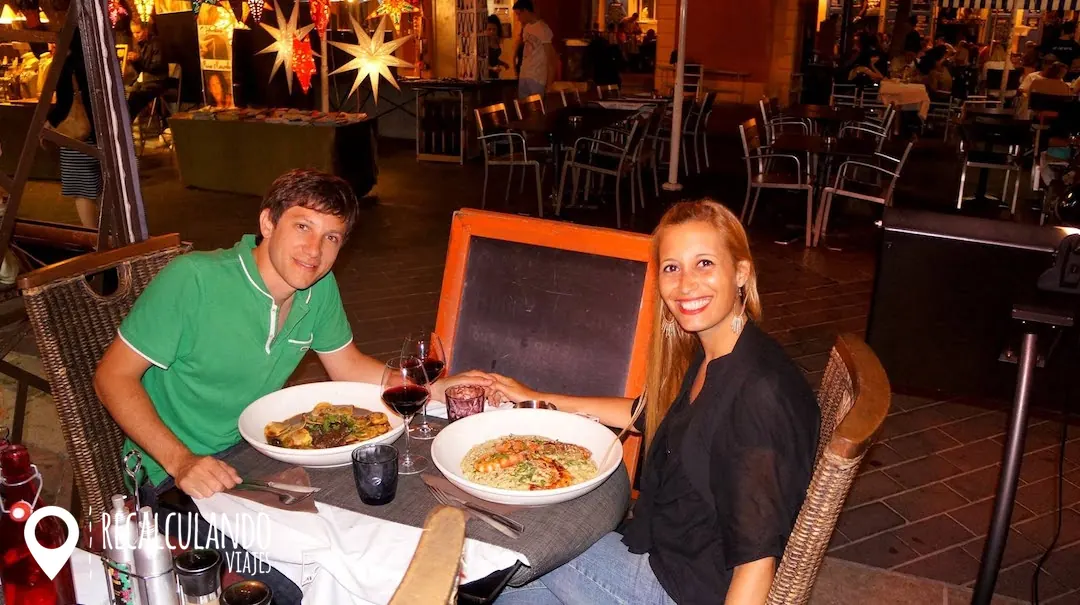
The classics you have to try are socca (a thin chickpea flour cake baked in a wood-fired oven, which is eaten hot, cut with your hands, and with plenty of pepper), pissaladière (a caramelized onion tart with anchovies and black olives), pan bagnat (a round sandwich with tuna, egg, olives, and olive oil, ideal to take to the beach), and petits farcis, vegetables stuffed with meat and breadcrumbs.
And watch out for the Niçoise salad: the real one doesn’t have potatoes or cooked vegetables, only raw ones, tuna or anchovies, and hard-boiled eggs. If they serve it to you with boiled potatoes, you are in a place for tourists.
The smell of freshly made socca in the small streets of Vieux Nice is impossible to ignore. And add an ice cream in Place Rossetti. It’s not expensive, it’s delicious, and it’s the most local thing you will eat on the Côte d’Azur.
Things to do in Nice in 1, 2, and 3 days: our itineraries
Things to do in Nice in one day
If you only have one day, this is the route we recommend, and it can be done entirely on foot:
- Morning: Cours Saleya market (arrive before 10 AM), walk around Vieux Nice, the church of Saint-Jacques, and Place Rossetti with the Sainte-Réparate cathedral.
- Midday: socca or pan bagnat in the old town and climb to Castle Hill using the free elevator.
- Afternoon: some beach time in the Bay of Angels and a walk along the Promenade des Anglais to the Hotel Negresco.
- Sunset and night: Albert I Garden, Place Masséna with the illuminated statues, and dinner in Vieux Nice.
Things to do in Nice in 2 days
With two days, everything you can do in Nice fits in with much more calm. The first day you do the route above, and the second you dedicate to:
- Morning: Notre-Dame basilica and Avenue Jean Médecin, followed by St. Nicholas Russian Orthodox Cathedral.
- Midday: Promenade du Paillon and a quiet lunch in the Place Garibaldi area.
- Afternoon: Lascaris Palace, Lympia Port, and a boat trip or sunset on the seaside promenade.
Things to do in Nice in 3 days
The third day can be organized in two ways depending on your profile:
- If you like museums: full morning in Cimiez (Roman ruins, Franciscan monastery, and Matisse Museum) and afternoon at the Chagall Museum, which is on the way back to the center.
- If you prefer landscapes: a one-day getaway along the coast. We would go to Villefranche-sur-Mer, Èze, and Monaco, which chain perfectly on the same bus line.
Free tours and guided visits in Nice
If it is your first time in the city, starting with a guided tour of the old town organizes your list of things to do in Nice and the rest of the trip. There are free tours in Spanish that depart almost every day from Place Masséna and last around two hours: they tour Vieux Nice, Cours Saleya, the cathedral, and the port area, and work on tips.
There are also night tours, private tours if there are several of you (sometimes it ends up being cheaper than the free tour per person), and themed Niçoise gastronomy visits, which combine the market with tastings.
We are more of the type to explore on our own with a map in hand, but when we want to understand the history of a city, we book with Civitatis, which has guides in Spanish and free cancellation until the last minute.
The tourist bus in Nice: is it worth it?
The hop-on hop-off tourist bus follows a circuit that passes by the seaside promenade, the port, Castle Hill, Cimiez, and the Russian cathedral, with an audio guide and several stops where you can hop on and off freely. The one-day pass usually costs around €25.
Our honest opinion: if you are going to be there for 2 or more days, you don’t need it. The whole center is walkable and the tram costs €1.70. However, it makes sense in three specific cases: if you arrive on a cruise and have just half a day, if you travel with people who walk little, or if you want to get to Cimiez and the Russian cathedral without fighting with the bus lines.
Where to eat in Nice
Eating well is part of what there is to do in Nice, but we don’t give names of restaurants we haven’t tried, so instead of a list, we leave you the areas and the logic, which is more useful:
- Vieux Nice: this is where the typical food is, but also where the tourist traps are. Simple rule: if it has a menu with photos and someone standing at the door inviting you in, keep walking.
- Cours Saleya: in the morning you buy market products and put together a great picnic for very little money. At night it fills up with terraces, more expensive and more touristy.
- Port area and Place Garibaldi: this is where the people of Nice eat. More reasonable prices and fewer people with cameras.
- Libération neighborhood: north of the center, with its own morning market. It is the most local option of all.
Lunch in France usually has a “formule” or set-price menu of the day, much cheaper than the a la carte menu. Take advantage of it: you eat just as well for half the price.
Excursions from Nice: the Côte d’Azur in one day
Beyond what there is to do in Nice within the city, here is its great advantage: it is the ideal base for getting to know the entire Riviera. We toured the area by car both times and these are the getaways we liked the most.
| Destination | Distance | How to get there | Recommended time |
|---|---|---|---|
| Villefranche-sur-Mer | 7 km | Train or bus 600 | Half day |
| Èze | 12 km | Bus 82 or 602 | Half day |
| Monaco and Monte Carlo | 20 km | Train (25 min) or bus 600 | Full day |
| Antibes and Juan-les-Pins | 22 km | Train (20 min) | Full day |
| Saint-Paul-de-Vence | 25 km | Bus 400 or car | Half day |
| Cannes | 33 km | Train (35 min) | Full day |
| Menton | 30 km | Train or bus 600 | Full day |
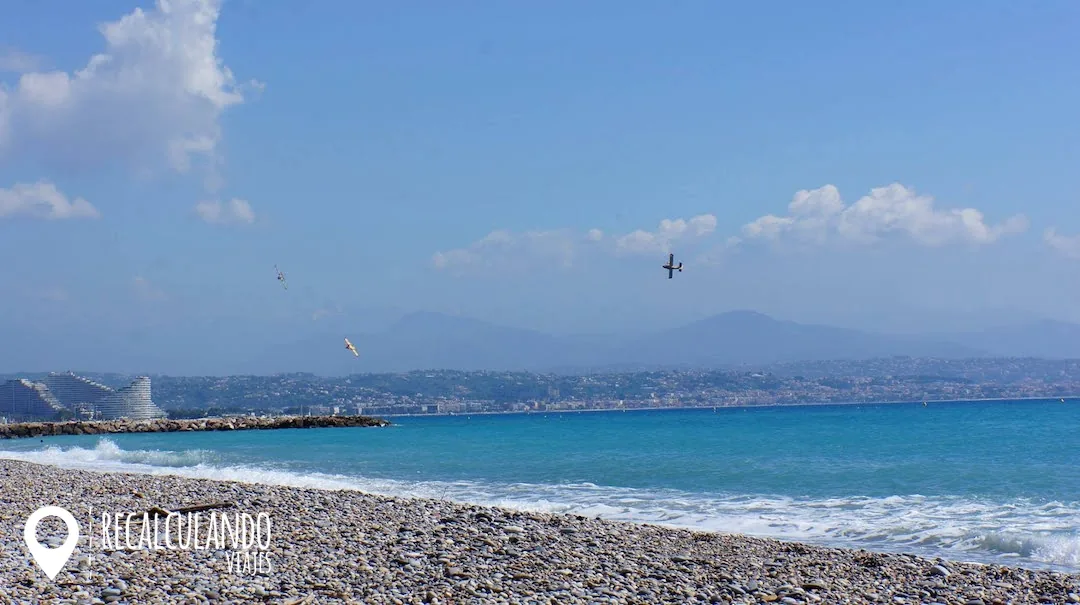
Antibes
Of all of them, our favorites were Antibes, with its walled old town and Provençal market, and Villefranche-sur-Mer, which has the most beautiful bay on the entire coast. Also, the beautiful medieval village of Èze.
We went to Monaco at sunset and stayed to see the illuminated casino at night: impressive!
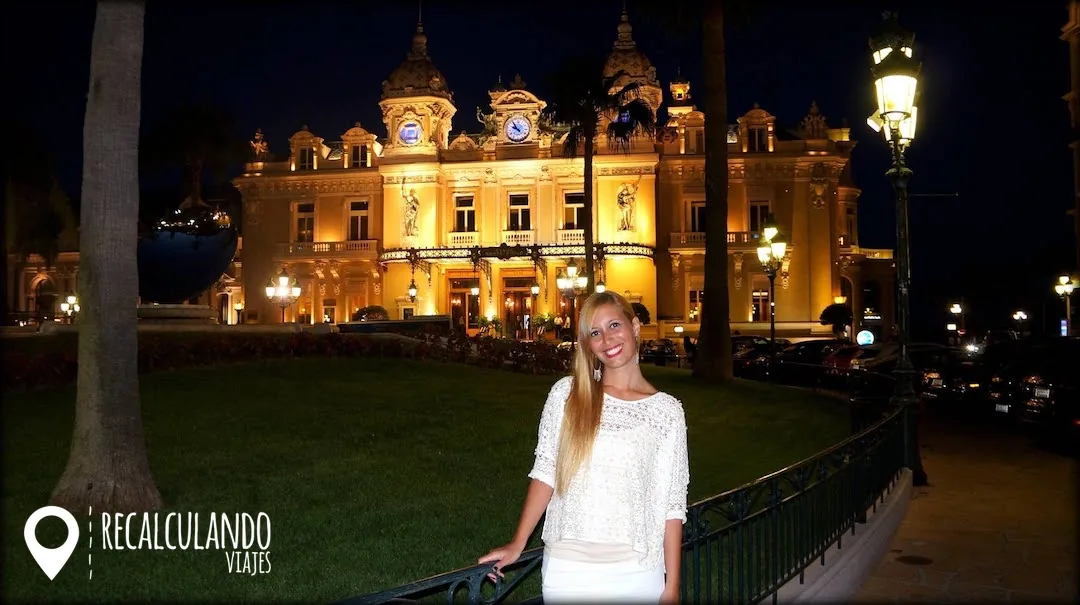
Monaco – Monte Carlo
In Cannes, we walked the Boulevard de la Croisette and the walk of fame with the actors’ handprints.
Menton was our base the second time and we highly recommend it: colorful, quiet, and right on the border with Italy.
If you don’t drive, there are organized one-day excursions that combine several of these towns and save you the problem of bus schedules. The most requested are the full-day tour of the Côte d’Azur and the half-day excursion to Monaco and Èze.
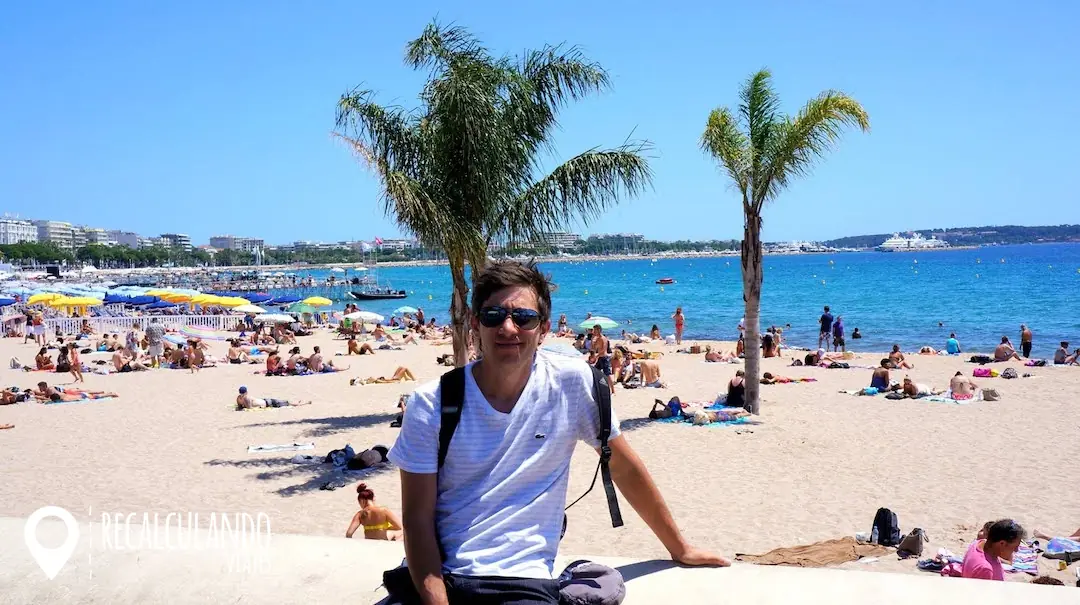
Cannes
Where to stay in Nice
The area where you stay quite changes the experience. These are the options that seem best to us:
- Vieux Nice: our recommendation if you are coming for a few days. You are in the middle of everything and go straight out to walk. Con: it can be noisy at night.
- Carré d’Or and Jean Médecin: the modern area, between Place Masséna and the sea. Very comfortable, with tram and businesses. The best comfort-price ratio.
- Near the station (Nice-Ville): the most economical option and perfect if you are going to take trips by train. The neighborhood is not the prettiest, but it is safe and well connected.
- Port Lympia: quieter and more local, a 15-minute walk from the old town and with tram line 2 at the door.
- Cimiez: residential and very quiet, with beautiful villas. We only recommend it if you come by car.
One thing to keep in mind: in July and August prices skyrocket and the good stuff flies. If you travel in high season, book months in advance.
On the map below, you can compare hotels, apartments, and hostels from all platforms at the same time:
How to get to Nice and how to get around
From the airport to the center
Nice Côte d’Azur Airport is the third largest in France and is only 7 kilometers from the center. It has two terminals connected by a free shuttle. The most practical way to reach the city is tram line 2, which departs from both terminals, runs every 7 to 9 minutes, and arrives at the port in about 26 minutes.
Here is a trick that seems key to us and that we didn’t see in any other guide in Spanish: the airport machines only sell the round-trip pass for €10. But the stretch between the terminals and the Grand Arénas stop is free, so you can get off there, buy “La Carte” rechargeable card for €2, and load it with a single trip of €1.70. You reach the center for €3.70 instead of €10, and you keep the card for the whole trip.
Other options: taxis have a flat rate of about €32 to the center (€85 to Cannes, €95 to Monaco), and Uber and Bolt also operate. If you arrive late at night, with heavy luggage, or there are four of you, a private transfer reserved in advance often costs about the same as a taxi and saves you the line.
Getting around the city
A single tram or bus trip costs €1.70 and is valid for 74 minutes including transfers. The 1-day pass is €7, the 2-day pass €13, and the 7-day pass €20. There are three tram lines: T1 crosses the center from north to south, T2 goes from the port to the airport, and T3 reaches the stadium. You can check the updated rates on the official Lignes d’Azur website.
An important detail: inspectors are very strict and you have to validate the card on every trip, even if you have a multi-day pass.
For the surrounding towns (Monaco, Èze, Menton, Villefranche), ZOU! regional buses are used at €2.50 per trip, regardless of distance; if you pay with a contactless card on board, it costs €2.20. And the TER coastal trains are very fast: Monaco in 25 minutes, Cannes in about 35.
Is it worth renting a car?
For the city, no. Parking in Nice is expensive and complicated, and you walk the whole center. However, if you want to tour inland villages like Saint-Paul-de-Vence, Grasse, Valbonne, or Èze with freedom, or Antibes, Cannes, Monaco, the car changes everything. We did it that way both times and don’t regret it. We usually compare prices on DiscoverCars, which brings together local and international agencies in a single search.
If you are coming from outside Europe and need data on your cell phone, we use the eSIM from Holafly with the code RECALCULANDOVIAJES, which gives you a 5% discount.
When to go to Nice: best time and climate
Nice has one of the best climates in France: mild winters, almost no frost, and more than 300 days of sunshine per year. Even so, there are times better than others.
- May, June, and September: our recommendation. Good weather, sea suitable for swimming, and fewer people than in midsummer.
- July and August: full and expensive, with temperatures of 28-30 °C. It is enjoyable just the same, but book everything in time.
- October: we went in autumn and it was lovely. Fewer people, spectacular light, and lower prices, although the water is already fresh.
- February: it is the month of the Nice Carnival, which in 2027 runs from February 9 to 28 with the theme “Vive l’Amour,” with night parades and the traditional Battle of the Flowers. 30 km away, the Menton Lemon Festival is held from February 13 to 28, 2027. You can check the program on the official Nice tourism website.
- December: if you are interested in Nice at Christmas, the city sets up its Christmas market and an ice skating rink in the Albert I Garden. We have more destinations in our Christmas travel section.
Travel insurance for Nice
France is part of the Schengen area, and if you are traveling with an Argentine passport, travel insurance is mandatory to enter. Beyond the requirement, private medical care in Europe is extremely expensive and a simple consultation can cost hundreds of euros.
We always travel insured with IATI Seguros, which has support in Spanish 24 hours a day and covers cancellation, luggage, and adventure sports depending on the modality. If you want to compare coverage before deciding, we wrote a complete guide on which is the best insurance for traveling to Europe.

Map with the 20 things to do in Nice
We created a map with the 20 things to do in Nice in this complete guide so you can organize your route and see what is close to what. The entire center is pedestrian or almost, so most points are connected by walking.
Frequently asked questions about things to do in Nice
How many days are needed to see Nice?
With 2 full days, you can calmly tour the city’s must-see places, including the old town, Castle Hill, and the seaside promenade. If you want to add the museums of Cimiez or excursions to Monaco, Cannes, Antibes, or Èze, 4 or 5 days using Nice as a base is ideal.
What is the best time to visit Nice?
May, June, September, and early October are the best months: the weather is good, the sea is pleasant, and there are significantly fewer people than in July and August. February is a good option if you want to see the Nice Carnival and the Menton Lemon Festival.
Can you get around Nice by walking?
Yes. The old town, Place Masséna, Cours Saleya, the Promenade des Anglais, and Castle Hill are all within walking distance of each other. You will only need transport to get to Cimiez hill, the Russian Orthodox cathedral, or from the airport.
How do you get from Nice airport to the center?
The most practical option is tram line 2, which connects the two terminals with the center and the port in about 26 minutes. At the airport, they only sell the €10 round-trip pass, but you can travel for free to the Grand Arénas stop and buy the card there for €2 plus a single trip for €1.70.
How much does it cost to enter Nice museums?
The Matisse Museum costs €12 and the Marc Chagall Museum about €12. The municipal museum pass costs €15 for 4 days and includes the Matisse, Masséna, and Lascaris Palace, among others, but not the Chagall, which is a national museum. MAMAC is closed for renovations until 2028.
Is it paid to enter Nice’s Russian Orthodox cathedral?
No, admission is free. Only guided tours are paid, which cost €10 per adult, although there is a free guided tour every day between 3 PM and 5 PM. You must go with shoulders and knees covered.
Are the beaches in Nice sandy?
No, they are pebbly. The water is transparent and very nice, but it is better to bring water shoes or rubber sandals and something thick to lie on, because the stones are uncomfortable. There are free public beaches like Plage des Ponchettes or Plage Magnan and private beaches with lounge chairs that cost between €20 and €30 per day.
Is the tourist bus in Nice worth it?
Only in specific cases. If you are going to be there for two days or more, you don’t need it, because the center is walkable and the tram costs €1.70. It makes sense if you arrive by cruise with few hours, if you travel with people who walk little, or if you want to get to Cimiez and the Russian cathedral comfortably.
Is it expensive to travel to Nice?
It is a more expensive destination than the French average, especially in July and August. Calculate from €90 to €110 per day per person with accommodation, meals, and transport. It gets much cheaper by eating Niçoise street food, using transport passes, and traveling outside of high season.
Is it necessary to rent a car to see Nice?
For the city, it is not necessary and it is even a problem, because parking is expensive and the center is walkable. The car is only useful if you want to tour inland villages like Saint-Paul-de-Vence, Grasse, or Valbonne, where public transport arrives less frequently.
Conclusion: our opinion on Nice
After two trips to the Côte d’Azur, we still think the same: Nice is one of those cities that work just as well for staying to enjoy it as for using it as a base camp. It has a beach, an old town, markets, museums, history, and a transport network that puts half the Riviera less than an hour away.
If we had to keep three things from everything there is to do in Nice, we would choose the Cours Saleya market in the morning, Place Masséna with the illuminated statues at night, and the sunset from the Promenade des Anglais. And next time, we promise, we will climb Castle Hill and take the boat around the bay.
Before you leave, we leave you our guide on how to plan your trip step by step, our luggage checklist, and all our articles on France, where you will find other beautiful destinations like Annecy, Colmar, or Strasbourg. Have a good trip!
Other articles for your trip to France
- 20 essential things to do in Corsica (with map and itineraries)
- Things to do in Strasbourg: The Ultimate 2026 Guide with Must-sees, Hidden…
- Things to do in Albi: the essential guide with the best places to visit in 2026
- Things to do in Eguisheim: The Guide to Discovering the Most Charming Village…
- Things to do in Annecy: Unmissable Guide with the Best Places 2026
- Things to do in Carcassonne: The 12 Must-See Guide
- Things to do in Turckheim: the must-see guide to the medieval village of Alsace…
- Things to do in Colmar: 15 Must-See Places (Definitive Guide 2026)
ℹ️ **Total Transparency**
This article contains affiliate links. If you book through these links, we may receive a small commission at no additional cost to you. We only recommend services that we use on our trips and that we trust. This helps us keep this blog free and continue creating useful content for you. Thank you for your support!
🔗 Resources & Useful Links for your trip to Nice
Do you have questions or want to add your own recommendations on things to do in Nice?
💬 Leave your comment or write to us, we love reading the experiences of other travelers.
Thank you very much for being part of this adventure!— Nanu & Facu 🌎 | Recalculando Viajes 💜