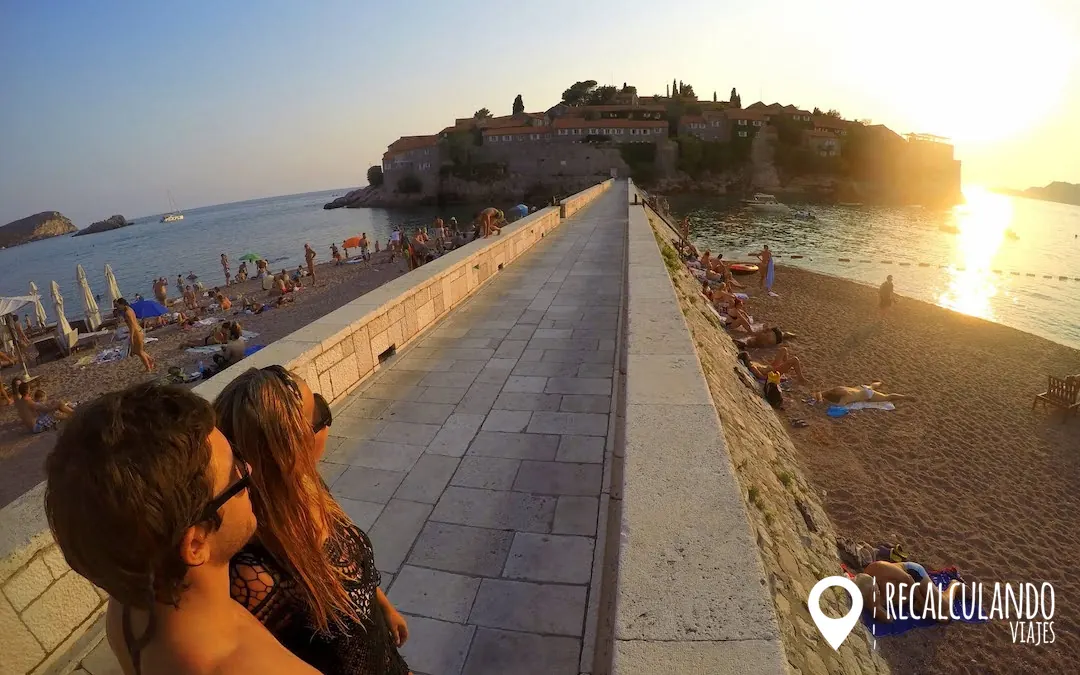
Sveti Stefan is that postcard you’ve seen a thousand times before setting foot in Montenegro: an islet of stone connected to the mainland by a strip of pink sand. We arrived one late August afternoon, after spending the day in Kotor, and understood why Sveti Stefan (Montenegro) is the image that sells the entire country. In this guide, we tell you about the 15 must-see places, including a map, beaches, updated prices, where to stay, and how to get there.
A note before we start: in 2026, the area changed quite a bit. The Aman hotel complex reopened Villa Miločer on May 22nd and the island on July 1st, after five years of being closed due to a legal conflict with the State. That changed the regulations for the beaches, so we’ll tell you how it is today below.
🌍 Travel Insurance: 5% Off with IATI Seguros! 🌟
Take advantage of this offer and travel safe.
Sveti Stefan Overview
| Category | Key details |
|---|---|
| Location | Adriatic coast of Montenegro, 8 km from Budva. |
| Best time | June and September (ideal weather, fewer crowds). |
| Access to the island | Only for hotel guests or via restaurant reservations. |
| Public beaches | Available east of the isthmus (free access without services). |
| Private beaches | Western area and the King’s beach; high prices (€220-240). |
| Budget | From €10 (budget beach day) to +€1,000 (accommodation). |
| Transport | Local bus from Budva (15-20 min), taxi, or rental car. |
| Top viewpoints | Church of Saint Sava (best panoramic view) and Adriatic highway. |
| Nearby visits | Miločer Park, the fishing village of Pržno, and Praskvica Monastery. |
| Essential tip | Arrive early to find parking and avoid peak hours. |
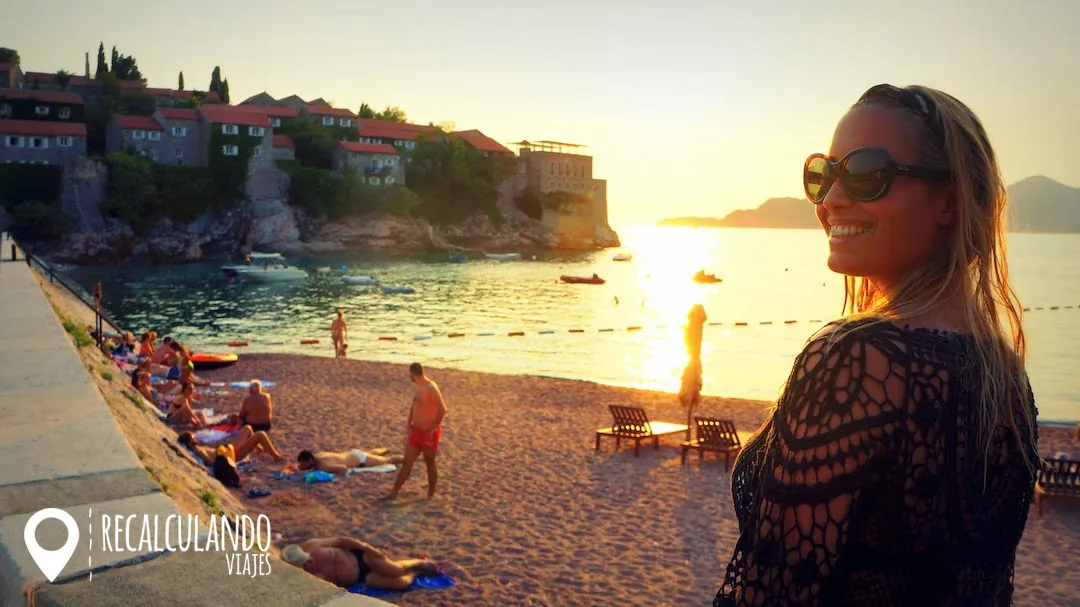
1. The island of Sveti Stefan: what it is and why it’s the postcard of Montenegro
Let’s start with the obvious: the reason you’re reading this. The islet is a 15th-century fortified village that the Paštrovići built to defend themselves against the Turks. Stone houses, orange tile roofs, narrow streets… all packed onto a rock of just two hectares. In English, you will also find it as Saint Stephen, which is the literal translation.
The origin story is great. The walls were built in 1442 and, according to local tradition, the Paštrovići defeated Turkish galleys that were heading towards Kotor. With the loot, they built twelve stone houses on the rock, one for each clan tribe. Disputes between families were resolved in front of the main entrance, which is why that gate was known for centuries as the place of justice.
Over time, the village grew to about a hundred houses and that was it, with no room for one more. But at the beginning of the 20th century, people started leaving due to a lack of work, and in 1955 the island was completely empty. That was when the State made the decision that changed everything.
On July 13, 1960, the Yugoslav government did something unusual: they converted the entire village into a hotel, respecting the streets, walls, roofs, and facades while bringing luxury behind the doors. And it worked. In the sixties and seventies, Sophia Loren, Elizabeth Taylor, Richard Burton, Orson Welles, and half of the European jet set visited. Later came the Aman chain, which restored it between 2007 and 2009 and turned it into one of the most exclusive hotels in the Mediterranean. In 2014, Novak Djokovic got married in the island’s church.
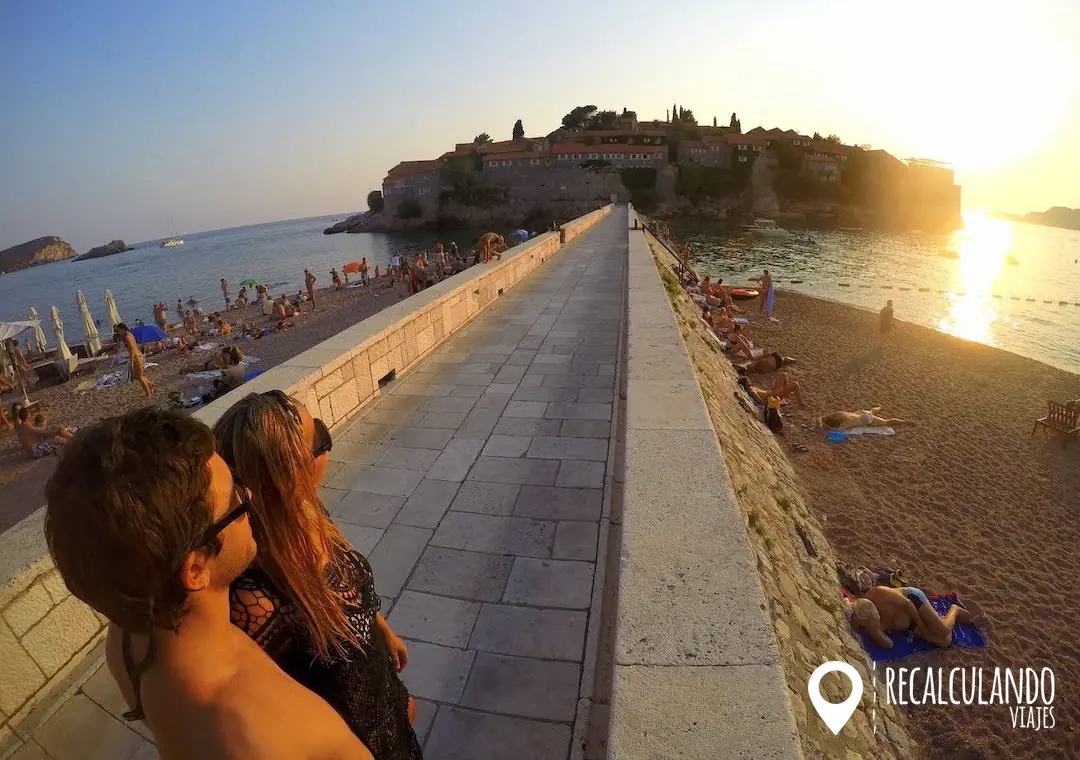
Now, the million-dollar question: can you enter? The short answer is no, unless you are a guest or have a reservation at one of its restaurants. When we went, the bridge was closed with security, and we watched from the outside, like everyone else. After the reopening of July 2026, the island remains hotel territory, with the possibility of organized visits at controlled times, but it is not an old town you can wander through freely. Know this from the start, and you won’t be disappointed like many people are.
So, is it worth it? Absolutely. Because the beauty of the islet is precisely seeing it from the outside.
2. The isthmus: the exact spot to take the photo
The strip of sand and pebbles that connects the island to the coast is the heart of everything. From there, the island looms over you: the walls, the cypress trees peeking out between the roofs, and the sea on both sides, with different colors depending on the time of day.
A fact that almost no one mentions: nature didn’t make that isthmus alone. It was the inhabitants themselves who widened it so they could come and go with a horse-drawn cart and bring food and materials. So, Sveti Stefan stopped being an island by the decision of its residents more than five hundred years ago.
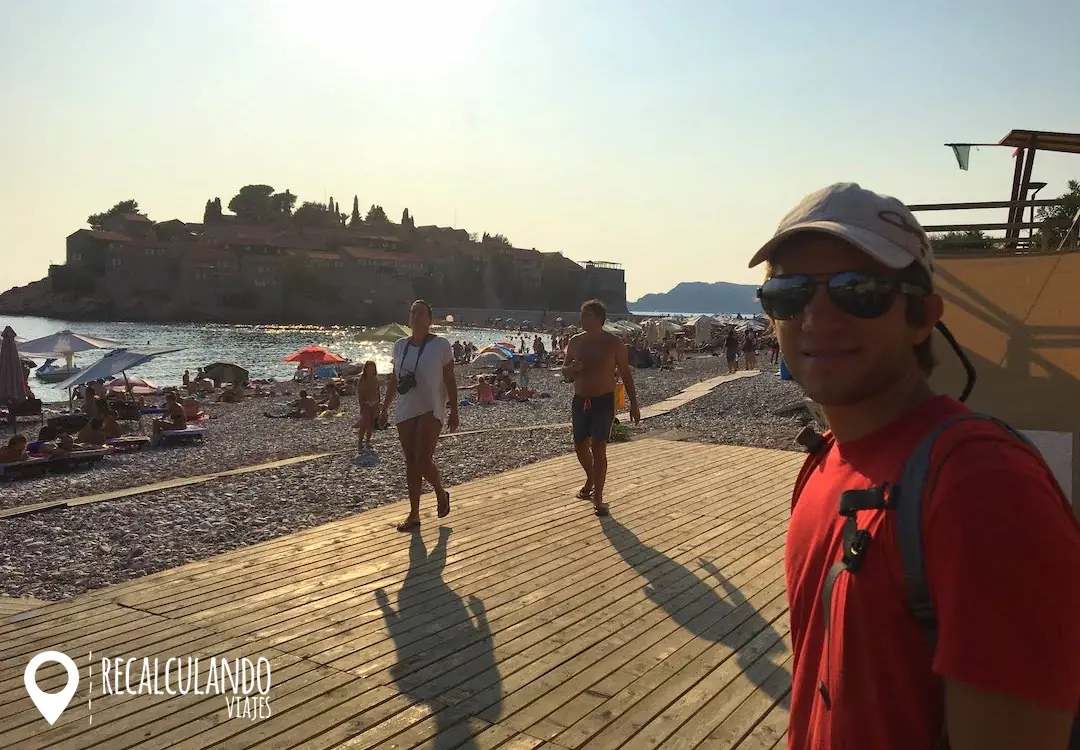
We arrived near five in the afternoon, and it was a hit. With the sun going down, the stone turns golden and the water becomes a turquoise that doesn’t seem real. Early in the morning also works very well, especially if you want the photo without people.
TIP: walk down to the very edge of the isthmus on the east side. From there, you can see the entire island with the mountains in the background. It’s free and is the best sea-level photo in the entire area.
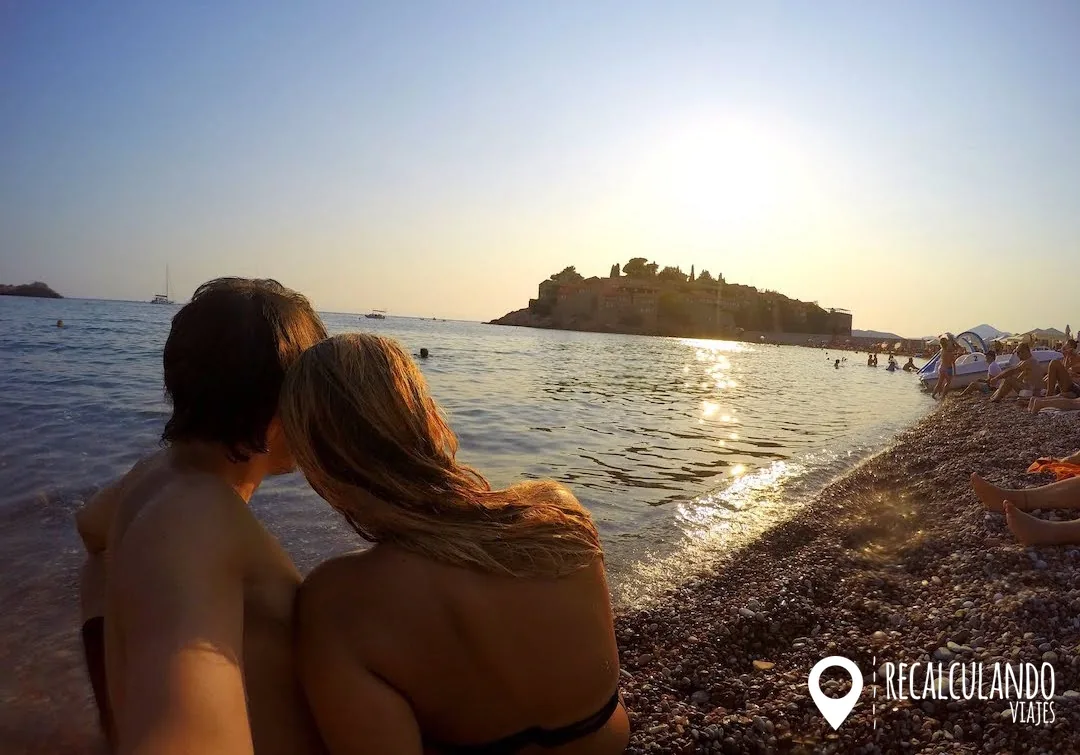
3. The public beach of Sveti Stefan, one of the must-do things
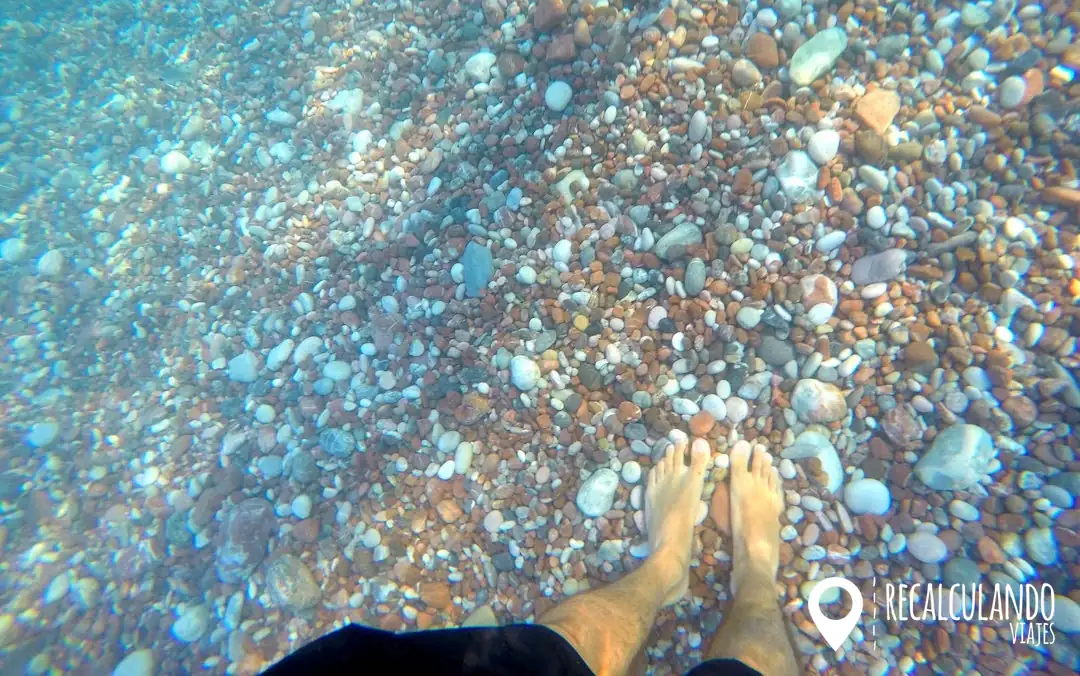
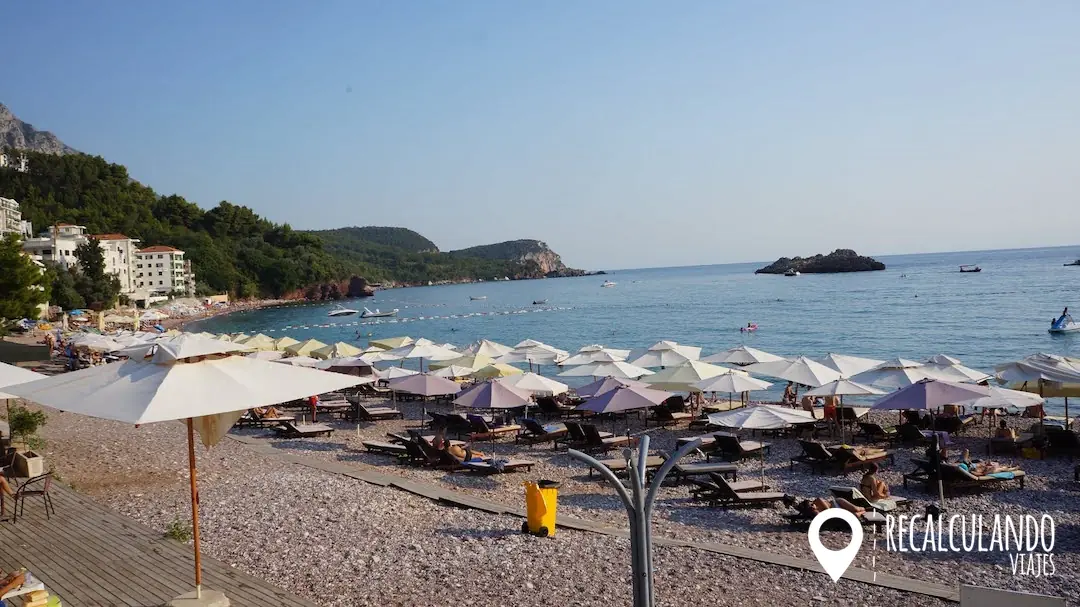
To the left of the isthmus, looking towards the island, is the public beach, and it’s where we spent our afternoon. It’s fine pebbles with a very characteristic pinkish tone, and the water is impressively transparent: you walk in and see the bottom several meters away.
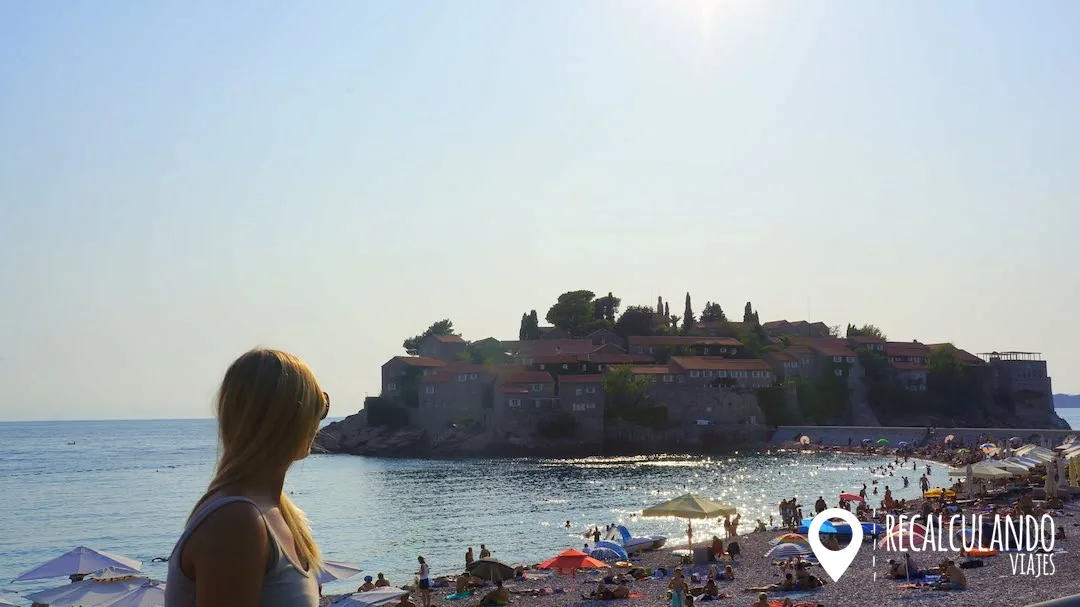
Access is free: if you bring your own towel, you pay nothing. If you want beach chairs and an umbrella, the concessionaires rent the set for about €30 to €50 depending on the month (last season’s value, it’s worth checking on-site). We just laid out our towel. Specific TIP: the further you get from the isthmus, the more free space you’ll find. The area right by the entrance is occupied by rental chairs; the opposite end is the area where people with towels hang out, and the view of the island is exactly the same.
Two things to keep in mind. First: the pebbles get very hot in the August midday, so bring sandals or water shoes. Second: entering the water on round stones is slippery, take it easy the first few meters.
4. The west beach of Sveti Stefan, if you want to treat yourself
On the other side of the isthmus is the western beach, which is part of the hotel complex. It has finer stones, with chairs perfectly aligned and far fewer people.
The price, however, is from another planet: for the 2026 season, there was talk of a value of about €220 for two chairs and an umbrella, with some of the equipment reserved for local residents by agreement with the State. We didn’t pay, but if you are celebrating something big and want the full experience, there you go. It’s best to confirm prices and availability directly at the beach, as they change depending on the month.
5. The Adriatic highway viewpoint, the classic view of Sveti Stefan
If you are coming by car from Budva, this is your first mandatory stop and probably the photo you already have in your head. On the main road, near Hotel Adrović, there is a pull-off area and a viewpoint where everyone stops.
From there, you see the island in profile, with the entire isthmus and the arc of the two beaches: the classic postcard view. We stopped before going down to the beach and stopped again when leaving, because with different light, it looks like a different place.
Now, let’s be honest: there is no official designated viewpoint. These are just shoulder widening areas on the E80, parking space is minimal, and in summer it is usually occupied. The road is narrow and cars pass quickly, so park properly and cross with care. If you don’t find a spot, keep driving and come back later: it clears out quite a bit after seven.
6. The Saint Sava church viewpoint, the most impressive view
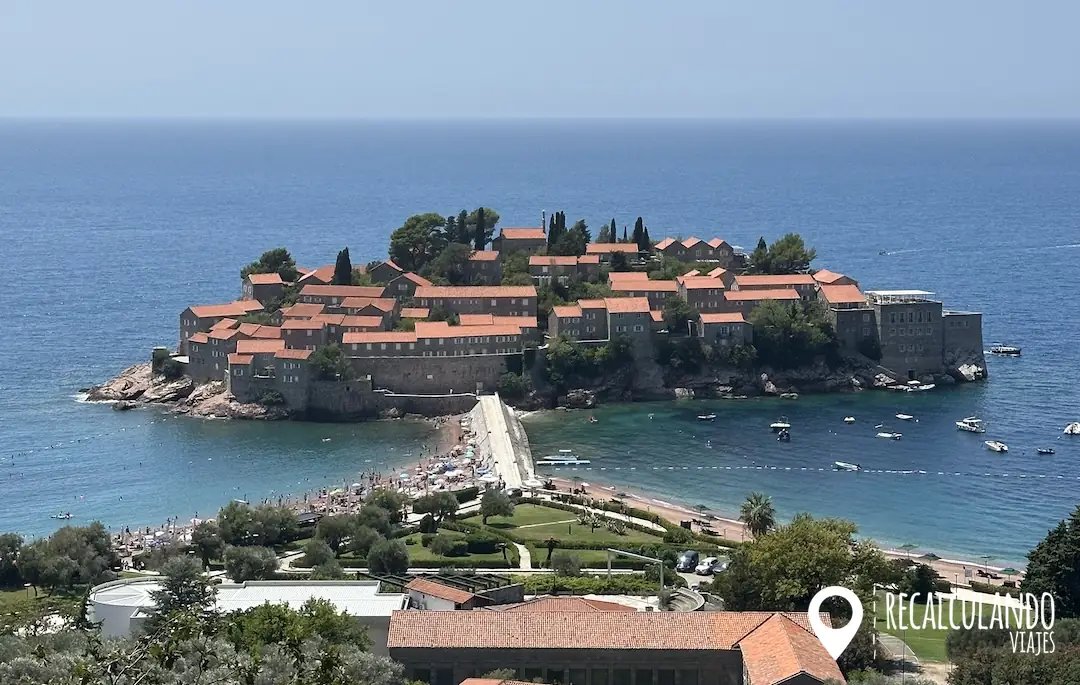
This is the viewpoint that separates nice photos from photos that leave you speechless. The Church of Saint Sava is in the village of Đenaši, on the hill right above the island, and from its stone terrace, you see Sveti Stefan as if you were on a drone: the islet floating, the entire coast, and the mountains behind.
It is impossible to walk there comfortably from the beach because it is on a very steep rocky cliff. You go up by car or taxi on a mountain road in about 10 minutes. Many travelers recommend it as the best sunset spot on the entire Budva Riviera, and seeing the photos that circulate, it’s not hard to believe.
If you go up by taxi, negotiate the ride there, the waiting time, and the return before starting.
👩⚕️👨⚕️ A must-have for stress-free travel! 🌎✈️ ➜ Get a Quote, Compare & Buy
7. Miločer Park, a walk among pines and olive trees
Towards the northwest of the island stretches Miločer Park, the former royal estate of the Karađorđević family: about 16 hectares of pines, olive trees, cypresses, and species brought from half the world, with stone paths that border the sea.
The walk from the isthmus to the park is about a 10-minute walk in the shade, and it’s one of the nicest and cheapest things to do in the area: there are sections where the path hangs over the water and the island remains in the background.
To keep in mind: in the 2026 season, they placed a fence that limits passage through the pedestrian path at the Queen’s Beach between 8 AM and 8 PM, which caused protests and a complaint from the local community. It is an open issue and can change from one month to another, so if you find the path blocked, it’s not your mistake.
8. Villa Miločer, the summer residence of Queen Maria
Inside the park is the white villa that Queen Maria Karađorđević used as a summer residence in the thirties. Today it is part of the Aman complex and operates as a luxury hotel all year round: it reopened on May 22, 2026, with eight suites and a spa.
You cannot enter if you are not a guest, but it can be seen perfectly from the park path, surrounded by century-old olive trees and with the lawn sloping down to the sea. We didn’t reach that far on our visit, but it’s a natural stop if you do the full walk along the coast.
9. Kraljeva plaža or King’s beach, one of the must-sees in Miločer
In front of the villa opens the large Miločer beach, also known as Kraljeva plaža or King’s beach. It’s about 380 meters of very fine pebbles in a bay closed off by the forest, and it always appears on lists of the most beautiful beaches in Montenegro.
Everything changed here too in 2026: it is one of the beaches that were opened to the public within the agreement with the State, with a portion of the equipment reserved for locals. The set of beach chairs with umbrella and service was reported to be around €240 for this season. The reasonable alternative: arrive with your own towel, use the free area, and enjoy the same bay for zero euros.
10. Kraljičina plaža, the Queen’s beach
Following the path towards Pržno, Kraljičina plaža appears, the Queen’s beach, a small cove with emerald green water that was Queen Maria’s favorite. It is probably the most photogenic of the three.
The bad news: since the hotel’s reopening, it has been reserved exclusively for guests between 8 AM and 8 PM, with a spa included in the bay. Outside those hours and out of season, things change, but in the middle of August, don’t count on being able to swim there. We are telling you about it anyway because you will see it from the path and it deserves a look.



11. Pržno, the fishing village on the other side of the park
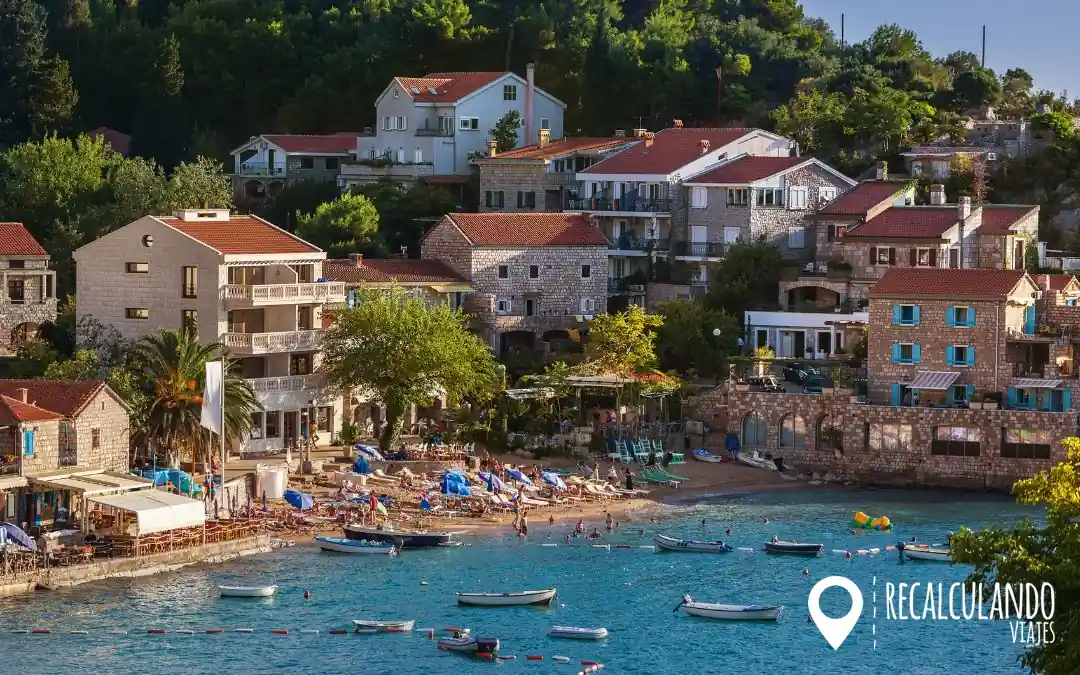
At the other end of Miločer Park, about a 25-minute walk from the isthmus, is Pržno: a small fishing village with a small beach, wooden boats, and several terraces over the water.
It is the perfect counterpoint to the luxury of the island. Here there is nothing exclusive: there are people eating fish, kids jumping into the sea, and normal prices. Many travelers choose it for dinner at sunset and walk back through the forest, and it is one of the things to do in Sveti Stefan that almost no quick guide mentions.
12. Praskvica Monastery, inland
Going up the hillside, among olive groves, is the Praskvica Monastery, the spiritual and historical center of the Paštrovići clan. Tradition dates it back to the 11th century, although documentation places it in 1413. Its name comes from a nearby spring whose water, according to locals, smells like peach (“praska”).
We didn’t visit it, but many travelers recommend it for two reasons: the frescoes in its churches and, above all, the view. Behind the monastery, there are stairs that go up to an elevated point from where you can see Sveti Stefan and the entire bay. It’s best to go with shoulders and knees covered and check the hours, which vary by season.
13. The Jegor trail and the Čelobrdo viewpoint
Starting from Praskvica is one of the most curious paths on the Montenegrin coast: the Jegor trail, three kilometers of stone that a one-armed Russian monk, Jegor Stroganov, built by hand in the early 19th century. It goes up to the village of Čelobrdo.
The reward is a complete panorama of the Budva Riviera with the island below. It is a walk of medium difficulty that takes just under an hour to go up, and those who have done it say it is one of the best things you can do in the area if you like trekking.
If you don’t want to go up on foot, there’s a shortcut: go up by car on the zigzag road that leads to the Rustovo Monastery. It’s just 1.5 kilometers to an open area where the Čelobrdo viewpoint is located, and it is much less known than the other two. Several travelers report having been completely alone up there, something unthinkable at the highway viewpoint in the middle of August.
14. The coves of Crvena Glavica and Kamenovo beach
A few minutes by car towards Budva are the coves of Crvena Glavica, hidden under the cliffs and accessible by stairs and paths. They are small, pebbly, and some are nudist-friendly.
A little further on is Kamenovo, a wider open beach with services, very popular among those staying in Budva or Bečići. If you have a car and half a day to spare, combining these coves with Sveti Stefan is a perfect beach plan.
15. A boat trip around the island
The last way to see the islet, and for many the best, is from the water. Boat trips depart from Budva and Petrovac that border the islet and continue along the coast; prices range between €20 and €50 depending on the duration.
From the sea, you see the complete walls, the private piers, and the southern facade that isn’t visible from land. It is the only way to “get close” to the island without being a hotel guest. They are usually combined with the island of Saint Nicholas in front of Budva or with the blue cave of Luštica.
What Sveti Stefan is like inside and how much it costs to stay there
Since you can’t enter, almost no guide in Spanish tells you what is on the other side of the gate. We weren’t inside either, but it’s worth knowing: if you are looking at the island from the beach, understanding what you are looking at changes the visit.
The three churches on the island
Inside the walls are three Orthodox churches, and they are the most valuable heritage of the place:
- Church of Saint Stephen (Sveti Stefan): the main one, built in 1464 at the highest point of the village. The island’s name came from it, and it preserves old frescoes and icons.
- Church of Alexander Nevsky: near the main entrance, dedicated to the patron saint of the Russian army. It is the second largest.
- Church of the Transfiguration: the smallest of the three, right at the entrance to the village. It is the first religious building seen when crossing the isthmus.
Watch out for a fact circulating incorrectly on the internet: you will read that the Church of Saint Stephen is from the 12th century. That doesn’t fit, because the village was founded in the 15th century; the date handled by local sources and the Orthodox Church is 1464.
The streets, the piazza, and the olive trees
No cars or bicycles circulate inside: they are narrow stone pedestrian streets and thousands of steps, with a perimeter of just two kilometers. The streets have their own names, there are about eight hundred century-old olive trees integrated into the landscape, and on the walls, you can still see the slots from which arrows were shot. In the center is the piazza, the square where neighbors would gather to sell what they produced.
How much does it cost to stay in Sveti Stefan
It’s the question everyone asks while looking at the island from the beach. The island has about 33 cottages and suites within the restored village, plus eight suites in Villa Miločer, on the mainland: about 41 units in total, with three restaurants and several swimming pools. The rates published for the 2026 season start well above €1,000 per night, and the island operates only seasonally (approximately May to October), while Villa Miločer is open all year round.
Can you eat there without being a guest?
It’s the only realistic gateway, and it changes depending on the season. The complex’s restaurants accept reservations in advance, and access goes through the entrance checkpoint, so you have to arrange it directly with the hotel and confirm if they are taking outside reservations. In the 2026 season, two international brands also opened in front of the island, on the mainland, which do not require you to be a guest. We didn’t eat at any of them, so we’re not going to sell you an experience we didn’t have: we’re just letting you know that the option exists.
Itinerary for visiting Sveti Stefan
Half a day (what we did)
You arrive in the mid-afternoon, stop at the highway viewpoint for the classic photo, go down to the isthmus, get into the public beach for a couple of hours, and stay until the sun goes down and the stone turns golden. Simple and perfect.
A full day
Start early at the public beach, when it’s still quiet. In the mid-morning, walk through Miločer Park to the King’s Beach and continue to Pržno. Have lunch there, return through the forest, rest on the beach, and, if you have a car, go up to the Saint Sava church viewpoint for the sunset. If you have energy left, add the Praskvica Monastery before going down.
If you are building the full route through the Balkans, here is our guide to planning your trip step by step.
June and September (warm sea, fewer people). July and August are the most crowded months.
Half a day is enough for the island and beaches. A full day if you add Miločer, Pržno, and the monastery.
From €10 per person (public beach + bus) to €250 if you want beach chairs at the hotel beaches.
Montenegrin; the euro is the official currency even though the country is not in the EU.
Local bus from Budva (about 15-20 minutes) or by car along the Adriatic highway.
Where to stay in Sveti Stefan
The village is small and expensive, but it has options beyond the island hotel. These are the areas worth checking:
- The village (upper part): apartments and family homes on the hillside, many with a direct view of the island from the terrace. It’s the best view-to-price ratio on the entire Riviera and you are 10 minutes walk from the beach.
- Pržno: our favorite for those looking for tranquility. Fishing village, its own beach, good restaurants, and Miločer Park next door.
- Bečići and Rafailovići: 10 minutes by car, with large hotels, long beaches, and much softer prices. Ideal if you travel as a family.
- Budva: the most practical base if you don’t have a car, because of the bus and nightlife. Mind you, in August it is a hotspot.
- Petrovac: 12 kilometers to the south, quieter and cheaper, with a very pleasant promenade.
➪ VIEW ACCOMMODATIONS IN SVETI STEFAN (CLICK HERE)
TIP of the season: July and August fill up months in advance and prices skyrocket. If you travel on those dates, book as soon as you have the flights and choose free cancellation. In June or September, you will find the same accommodations for much less.
Sveti Stefan map: Accommodation and Prices
On the map below you can move, zoom, and filter by your dates to see prices for accommodation in Sveti Stefan:
How to get to Sveti Stefan
The village is about 8 kilometers southeast of Budva, on the Adriatic highway. These are the options:
- By bus from Budva: the most practical and cheapest way. Local lines going towards Petrovac and Bar stop at Sveti Stefan; the trip is 15-20 minutes and the fare is around €2-2.50 each way. The stop is on the main road, right at the viewpoint.
- By car: what we did. From Budva, it’s 15 minutes along a road with curves but in good condition. From Kotor, calculate about 40 minutes.
- By taxi: from Budva, it costs around €15-25. Agree on the price before getting in or ask them to turn on the meter.
- From airports: Tivat is about 25 kilometers away (the closest) and Podgorica about 65. From Croatia it is also easy to reach: we were driving from Dubrovnik and, counting the border, it is a long two and a half hours. Mind you, the border is the great wildcard: a Saturday in July or August can turn into a multi-hour wait. Cross early, avoid weekends, and carry water in the car.
- On foot from Budva: there is a coastal path of about 8 kilometers. Very nice, but in the middle of summer and with heat, it is demanding.
How to get around Sveti Stefan and the parking issue
Everything close to the island is done on foot: the two beaches, the isthmus, Miločer Park, and Pržno are connected by paths. For the high viewpoints, the monastery, and the coves, you do need a vehicle.
Parking is the weak point. There are paid parking lots near the isthmus and another in the olive grove behind the beach; the reported values range from €2 to €4 per hour, although in peak season some rise quite a bit more. To avoid paying, the only alternative is to find a spot on one of the streets that go down from the main road to the coast: it is free, but in August finding a spot is a lottery and it is advisable to arrive before ten in the morning. What you shouldn’t do is leave the car on the shoulder of the E80: the tow truck works fast and seriously.
If you are going to tour Montenegro beyond the coast (Kotor, Lovćen, Lake Skadar, Durmitor), a car is almost mandatory and it is advisable to book it in advance. You can Compare Rental Prices Here.
Another practical detail: Montenegro is not part of the European Union, so check if your data plan covers roaming in the country. We found it simpler to travel with an eSIM from Holafly and stop worrying (with the code RECALCULANDOVIAJES you get a discount).
What to eat in Sveti Stefan and where to eat with a view of the island
The cuisine of this part of the coast is Mediterranean with a Balkan accent. What you cannot miss:
- Grilled fresh fish: sea bream, sea bass, or snapper with chard and potatoes (blitva). It is charged by weight.
- Crni rižot: black squid risotto, a classic of the entire Adriatic.
- Njeguški pršut and Njeguši cheese: the smoked ham and cured cheese from the mountain village behind Kotor. Unmissable.
- Vranac and Krstač wine: the autochthonous red and white wines of Montenegro, very good and cheap.
Where to eat: the terraces facing the isthmus have the best view and work very well for a sunset coffee, although you pay for the location. If you are looking for normal prices, go down to Pržno or up to the village. We didn’t have dinner there that afternoon, so we’re not going to recommend a specific restaurant we didn’t try.
Travel insurance for Montenegro
Montenegro is not in the European Union, so the European health insurance card does not cover you: here medical care for foreigners is private and must be paid for. Add to that the typical area plan includes slippery pebbly beaches, mountain paths, and roads with sharp curves. We never leave without insurance, and certainly not driving through the Balkans.
We have used IATI Seguros for years because it covers medical assistance well and doesn’t complicate paperwork when you have to use it. Booking from our link, you get a permanent 5% discount with the code RECALCULANDO, and IATI assistance works in Spanish 24 hours a day, which is exactly what you want when the problem hits you far from home.

Excursions from Sveti Stefan
The location is unbeatable for moving along the coast and inland. The most popular getaways:
- Kotor and the Bay of Kotor: 40 minutes away. The walled city, the climb to the Saint John fortress, and the entire fjord. We did it in a day and it was one of the best parts of the trip.
- Budva: 15 minutes away. Venetian old town, walls over the sea, and plenty of nightlife.
- Petrovac and the southern beaches: Drobni Pijesak and the Reževići coves, much quieter.
- Lovćen National Park and Cetinje: the former capital and the Njegoš mausoleum, with a view that covers half the country.
- Lake Skadar: boat trips among water lilies, a long hour away.
You can see tours with a Spanish-speaking guide in Montenegro here, which is the most comfortable thing if you didn’t rent a car. And if you continue on the road through the Balkans, here is our guide on things to do in Ohrid, in North Macedonia.
Sveti Stefan map with the 15 places
We put together a map with the 15 places in this guide so you can get oriented quickly: the island, the two viewpoints, the beaches, Miločer Park, Pržno, and the monastery. Everything is very concentrated, so it can be toured on foot except for the high viewpoints and the coves.
Frequently Asked Questions about Sveti Stefan
Can you enter the island of Sveti Stefan?
No, unless you are a hotel guest or have a confirmed reservation at one of its restaurants. The island reopened on July 1, 2026, after five years of being closed, but it remains a private hotel complex and not an old town with free access. There is the possibility of organized visits at controlled times, although it is advisable to consult directly with the hotel.
How much does the beach at Sveti Stefan cost?
The public beach, east of the isthmus, is free if you bring your own towel; renting beach chairs costs around €30 to €50. The hotel complex beaches are much more expensive: for the 2026 season, values of about €220 on the western beach and €240 on the King’s beach were reported for the set of two chairs with an umbrella.
How to get to Sveti Stefan from Budva?
By local bus, which leaves frequently from the center of Budva, it takes between 15 and 20 minutes and costs around €2 to €2.50 each way. By car, it is 8 kilometers along the Adriatic highway, about 15 minutes, and by taxi, the trip is around €15 to €25.
How many hours are needed to visit Sveti Stefan?
Half a day is more than enough for the viewpoints, the isthmus, and a good amount of beach time. If you want to add Miločer Park, the walk to Pržno, and the Praskvica Monastery, reserve a full day.
What is the best viewpoint to photograph Sveti Stefan?
The best point is the esplanade of the Church of Saint Sava, in the village of Đenaši, on the hill that dominates the island: you can get there by car or taxi in about 10 minutes. The other classic view is the Adriatic highway viewpoint, near Hotel Adrović, which is free and is next to the bus stop.
What is the best time to visit Sveti Stefan?
June and September are the best months: the sea is warm, there is sun, and the area is much less crowded than in the middle of summer. July and August are the months of maximum occupancy and high prices, although they are still perfectly enjoyable if you arrive at the beach early.
Is it worth visiting Sveti Stefan if you don’t stay at the hotel?
Yes, totally. What makes this place unique is its silhouette seen from the outside, and you enjoy that just as much from the viewpoints, the isthmus, and the public beach without spending practically anything. What you shouldn’t do is travel there expecting to walk through the streets of the island.
How much does it cost to sleep in Sveti Stefan?
Staying on the island is one of the most expensive experiences in the Adriatic: published rates for the 2026 season start well above €1,000 per night. In the town on the mainland, in Pržno, or in Bečići, you will find apartments and hotels with a view of the island for a fraction of that price.
Why did Sveti Stefan stop being an island?
Because its own inhabitants connected it to the mainland. In the 15th century, they widened the strip of sand that separated it from the coast so they could pass with a horse-drawn cart and supply themselves with food and materials. That artificial isthmus remains today the only access to the fortified village.
Do I need travel insurance for Montenegro?
It is not mandatory to enter in most cases, but it is highly recommended: Montenegro does not belong to the European Union and the European health insurance card is not valid, so any medical care is paid for privately. You can see options and coverage in our guide to the best travel insurance for Europe.
Conclusion: is it worth visiting Sveti Stefan, Montenegro?
Yes, and a lot, as long as you know what you are going for. It is not a village to tour, it is an image to contemplate, and in that, it has no competition in the entire Adriatic. We went one afternoon, without expectations of entering the island, and we stayed until the sun set on the pink stones of the beach.
Our advice after that afternoon: don’t dedicate only twenty minutes and a photo from the highway to it. Go down, get into the water, walk Miločer Park, and wait for the afternoon light. The best of Sveti Stefan is free and is enjoyed without a rush.
And if you have time left, combine it with Kotor and Budva on the same day. Montenegro is small, the coast is covered quickly, and in a few hours, you go from a fjord to a fortified village on the sea. We loved it, and we would return without hesitation. More destination ideas in our Europe section.
ℹ️ **Full Transparency**
This article contains affiliate links. If you book through these links, we may receive a small commission at no extra cost to you. We only recommend services we use on our trips and trust. This helps us keep this blog free and continue creating useful content for you. Thanks for your support!
🔗 Resources & Useful Links for your trip to Sveti Stefan
Do you have questions or want to add your own recommendations on things to do in Sveti Stefan?
💬 Leave your comment or write to us, we love reading about the experiences of other travelers.
Thank you very much for being part of this adventure!— Nanu & Facu 🌎 | Recalculando Viajes 💜