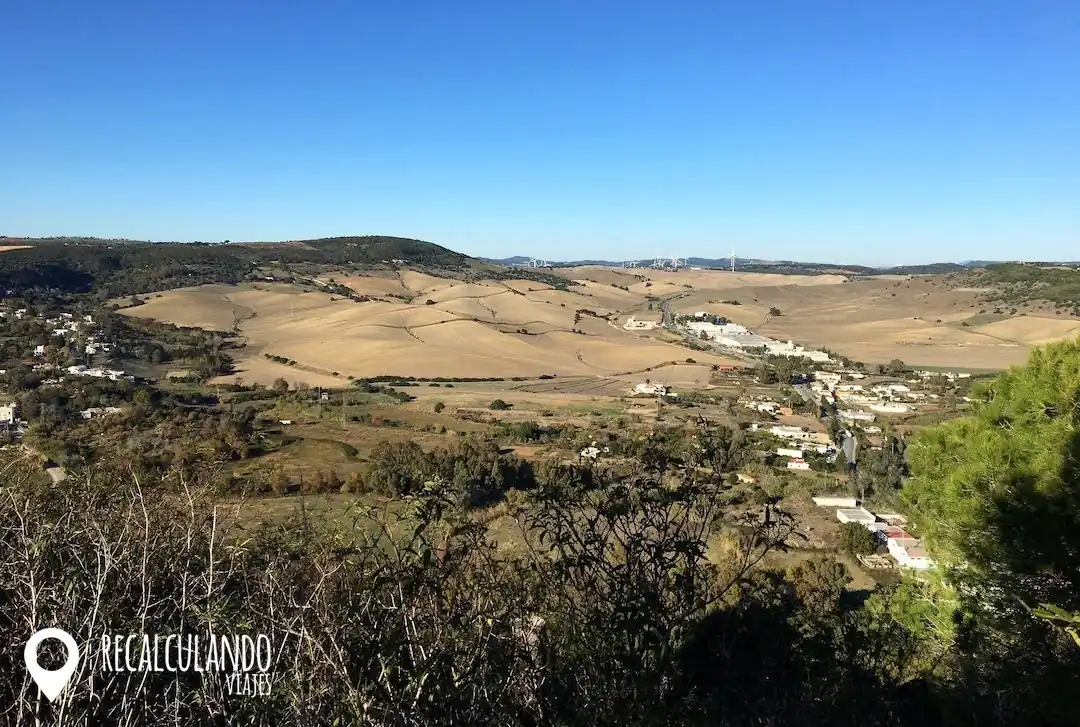
The things to do in Vejer de la Frontera are best explored on foot, uphill and without rushing: it is a white village perched on a hill, with walls, a castle, and streets that look like they were hand-drawn. We arrived at noon in late November with the car we had rented to explore the area, and we left with the feeling that it hadn’t been enough time. In this guide, we tell you what to visit in Vejer, in what order, with updated opening hours and prices, where to park the car, where to stay, and a map with everything marked.
🌍 Travel Insurance: 5% Off with IATI Seguros! 🌟
Take advantage of this offer and travel safe.
Spring (April-May) and autumn (September-November). Summer is hot and the town gets crowded.
Half a day is enough for the historic center. A full day if you want to include the beach, Santa Lucía, or Conil.
Very cheap: almost everything is free and the two museums cost €1 and €2. Dining costs between €20 and €35 per person.
On foot. The old town is pedestrianized and the hills are real: comfortable shoes are a must.
Vejer de la Frontera in two minutes: the history that explains the town
Understanding a few basics before exploring the things to do in Vejer de la Frontera makes the visit much more meaningful. Vejer has traces of occupation since ancient times—Phoenicians, Carthaginians, Romans, and Visigoths passed through here—but the town you see today is a product of a different era.
In 711, North African troops took control of the area, and five and a half centuries of Al-Andalus rule followed. That period defined everything that makes Vejer beautiful: the walled enclosure, the twisted layout of narrow streets, and the interior courtyards. The Castilian reconquest only arrived in the 13th century, and not all at once.
The suffix comes from that moment. Vejer, along with Arcos, Jerez, Conil, or Chiclana, marked the border line between kingdoms, which is why they all carry “de la Frontera” (of the Frontier) to this day. Fun fact: Vejer is twinned with Chefchaouen, the blue city of Morocco, due to the evident resemblance between the two. Inside the castle, there is a plaque that commemorates this.
Before you begin: how we organized our visit
We stayed for almost a week in Arcos de la Frontera and rented a car to travel around the province of Cádiz. We did Vejer in one day, and in the afternoon we continued to Conil de la Frontera. It is a combination that works very well: white village in the morning, sea at sunset.
The first and most important piece of advice: do not try to drive into the historic center. The streets in the center are narrow, cobbled, and largely pedestrianized or restricted to residents. Leave the car at the bottom and walk up. The reference parking lot is Los Remedios, next to the park and the tourist office; it is free and a 3-5 minute walk from the center. There are other free ones scattered around the town (behind the health center, in the Paseo de las Cobijadas area) and a paid underground parking lot near Plaza de España for rainy days.
In November, we found a spot without any trouble, but in summer and during Easter week, the story changes: it gets quite complicated after noon. If you are going in high season, get an early start.
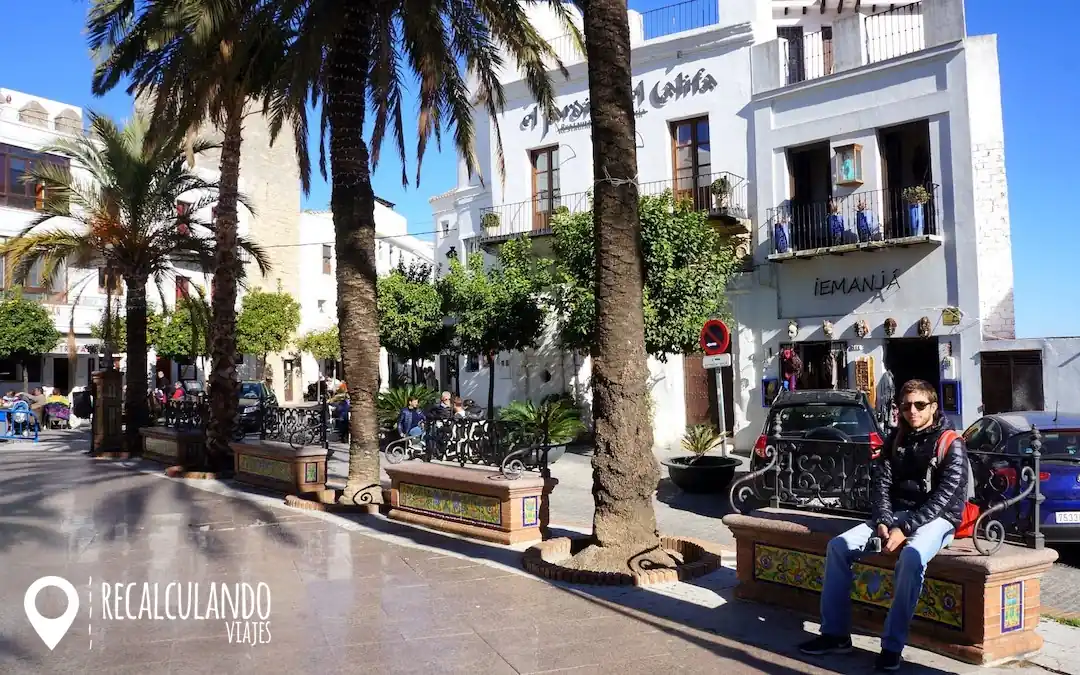
1. Plaza de España, the heart of the town
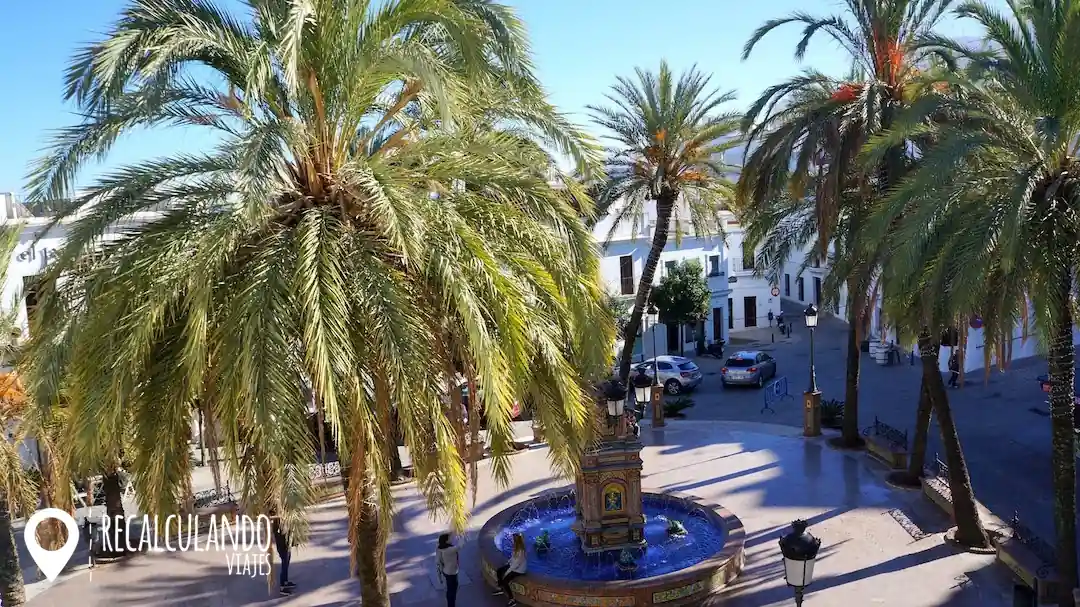
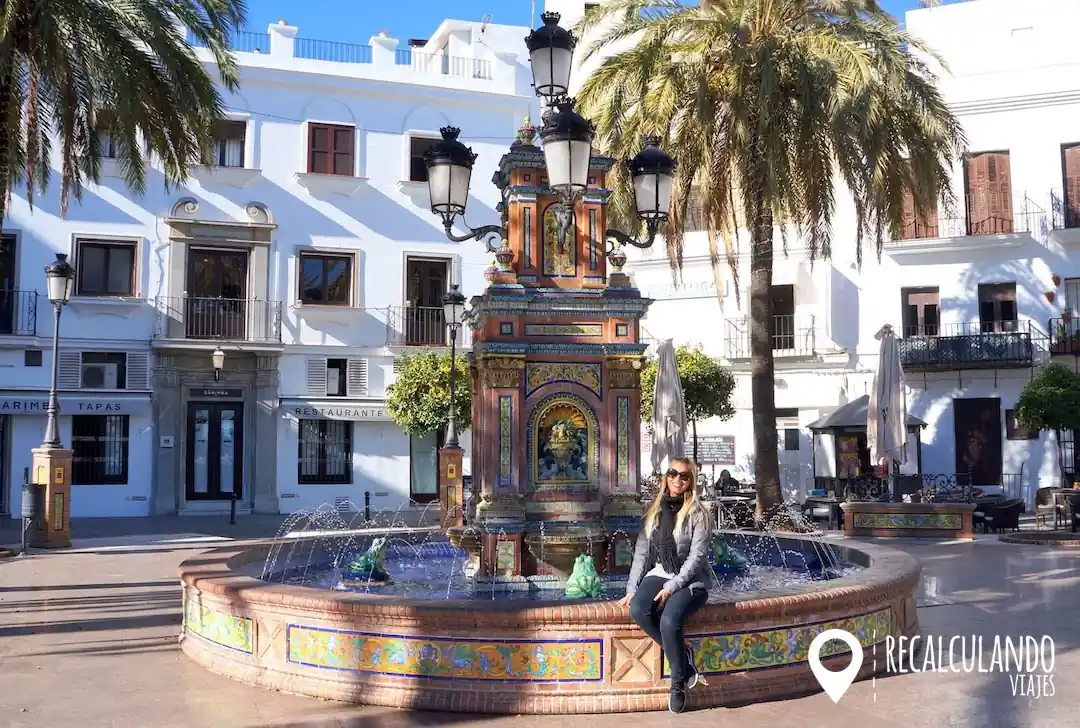
Almost every tour of Vejer starts here, and for good reason. Plaza de España is a white rectangle surrounded by palm trees, with the Town Hall on one side and bars with terraces on the other. In the center is the Sevillian tile fountain that gave it the popular nickname by which everyone knows it: the Plaza de los Pescaítos (Square of the Little Fish), due to the ceramic fish that decorate the basin. The fountain was built in 1955, and since then, no one calls it by its official name.
A detail that almost no one mentions: the square is not inside the city wall. It was born in the 16th century, just as the town began to grow outside the walled enclosure, and during the 16th and 17th centuries, it was used for bullfighting festivals organized by the nobles and knights of Vejer.
What surprised us most was the contrast: you come from a winding road and suddenly you are in a square that looks like a giant Andalusian courtyard. We sat for a while watching the locals pass by, who in November are practically the only people there.
TIP: it is the best reference point for getting oriented. Almost everything else on this list is less than a ten-minute walk from here.
2. The Arco de la Villa and the medieval wall
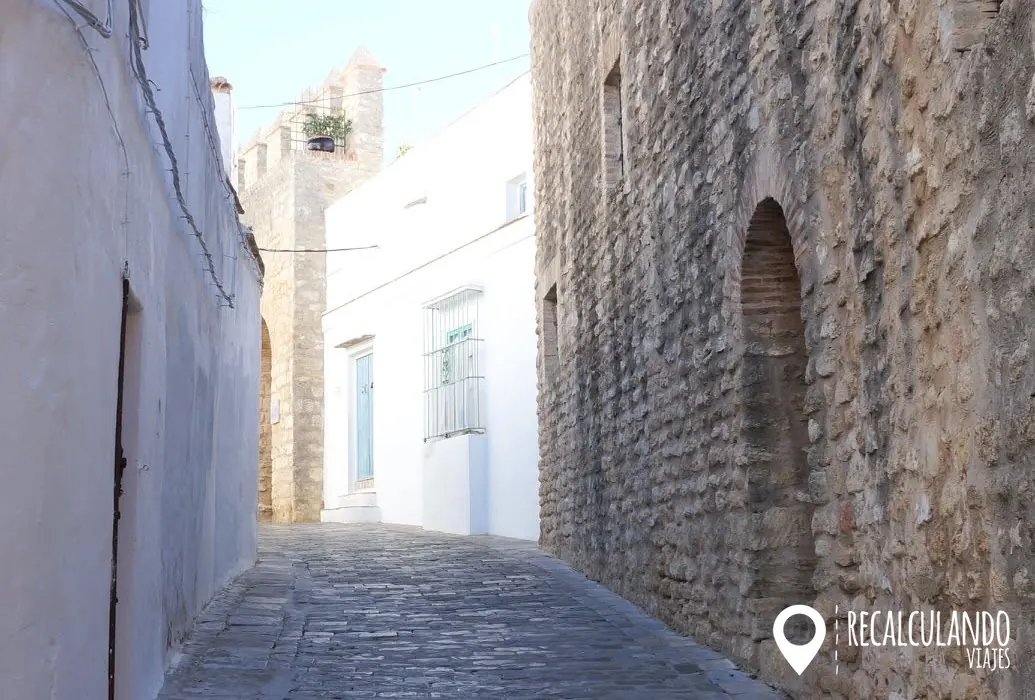
Walking up from the square, you reach the Arco de la Villa, one of the four gates of the walled enclosure and the most photographed along with the stairs that accompany it. Crossing it literally means entering the old part of the town.
Here are the concrete figures that no guide usually gives: the current wall dates from the 15th century, has an irregular layout because it adapts to the terrain, encloses a little over 4 hectares, and its perimeter is about 2 kilometers long. The thickness ranges from 1.5 to 2 meters and increases significantly near the gates.
Four gates are preserved—Arco de la Villa, Arco de la Segur, Arco de Sancho IV, and Arco de la Puerta Cerrada—and two main towers: Torre de la Corredera and Torre del Mayorazgo. A nice fact: the Arco de la Villa was the most important entrance because it connected to the Cuesta de la Barca and the Fuente del Concejo, but it is precisely the only gate that does not preserve its original state.
You can walk a good part of the perimeter, and it is one of those things to do in Vejer de la Frontera that costs nothing and gives you the best views of the Barbate river valley. We did it with the Levante wind in our faces, which blows quite hard in this area. It’s worth it anyway.
3. The Castle of Vejer, at the highest point
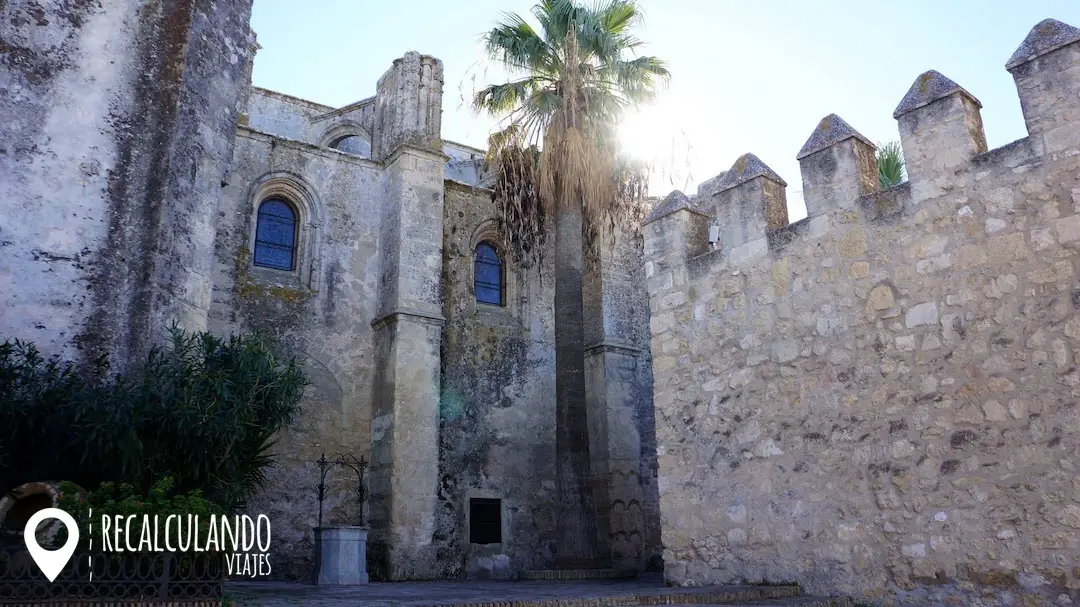
One of the essentials of Vejer de la Frontera and, on top of that, free. The castle stands in the highest area of the enclosure, on remains of an Andalusian fortress from the 10th-11th centuries. It was declared a National Monument in 1931, and its most valuable preserved feature is the main gate: a horseshoe arch framed by an alfiz, the most important Arab vestige still standing.
What to see inside
Inside, there are two courtyards. In the main one is the old cistern, which collected rainwater through a canal. From the parade ground, you can access the battlements, and there it is: the whole town spread out downhill.
The detail that blew our minds and that we didn’t see in any other guide: the floor of the castle is paved in a herringbone pattern, and it is not just for decoration. It was done this way so that the animals in the stables wouldn’t slip. It is classified as a “minor castle” because it has a single entrance and exit gate, placed at the most accessible and easiest point to defend. In the 14th century, it was the residence of the Dukes of Medina Sidonia, lords of Vejer.
Opening hours and important warning
It is worth being clear here, because there is a lot of outdated information circulating. You will find guides (some in English, quite well-positioned) that say the castle is under construction and that it only opens on weekends. That is no longer the case: the restoration work is finished, and the building has added new rooms, restrooms, and exhibition areas.
The current schedule published by the tourist office is Monday to Saturday, from 11:00 AM to 2:00 PM and 6:00 PM to 9:00 PM, closed on Sundays. Admission is free. If you go on a Sunday, you won’t see the inside of the castle: it is probably the most common planning mistake in Vejer.
4. Parish Church of the Divino Salvador
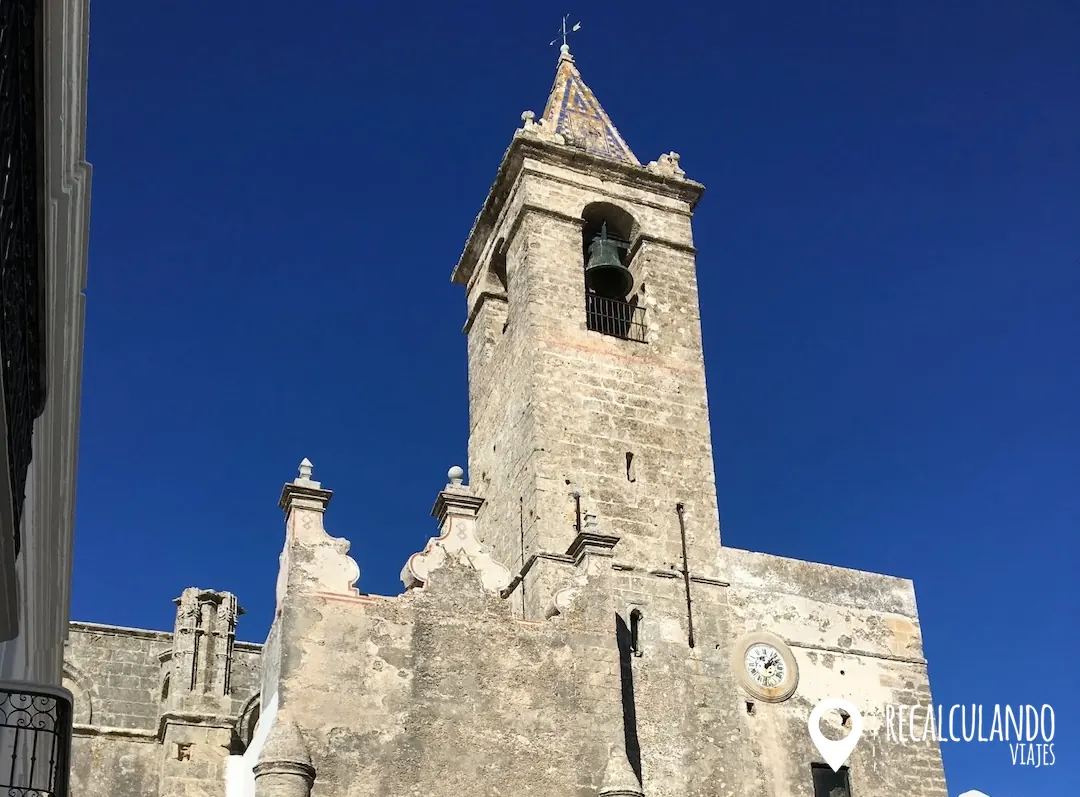
A few meters from the castle appears the town’s main church, built possibly over an old mosque. From the outside, you immediately notice that they are two attached buildings from different eras, and it is not an impression: the header is Mudejar-Gothic from the 14th century, and the expansion is late Gothic from the end of the 15th and beginning of the 16th century.
Inside, it has a basilica plan with three naves, the central one higher than the side ones, and three chapels that open to the sides. The most outstanding piece is the altarpiece of the main altar, the work of master Francisco de Villegas in the 17th century, carved in cedar and borne wood.
We went in for a while and what struck us most was precisely that: the unevenness of the complex; naves at different heights, as if the building had been growing in fits and starts for centuries. It is a village church, without pretensions, and that makes it feel more real than many cathedrals.
TIP: visiting hours depend on religious services and there is no fixed schedule published, so it is best to check on the same day. If you find it closed, walk around the exterior: the apse and the bell tower from the street behind are just as beautiful.
5. The Arco de las Monjas street, the postcard of Vejer
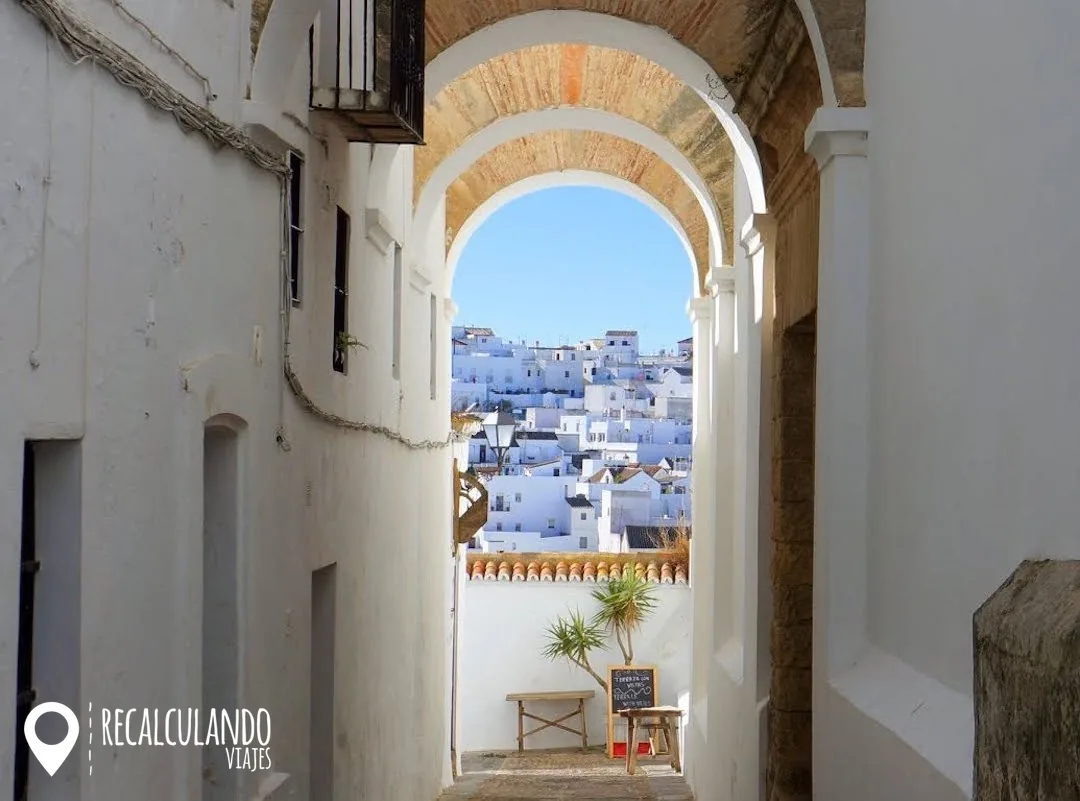
If you are looking for a single image of Vejer, this is it. A narrow street crossed by a succession of semicircular arches, with the white town framed in the background by the last one. It is the most photographed spot and, in high season, there is a line to take the photo.
Here is the fact that almost no one tells and that we loved: those arches were not built for aesthetics. They are buttresses. They were built to reinforce the side wall of the neighboring convent after the 18th-century earthquake, the 1755 Lisbon earthquake, which was felt strongly throughout the Cádiz coast. In other words, the most beautiful postcard of the town was born from a seismic scare.
In November, in the mid-afternoon, we had it all to ourselves. One of those moments where traveling in the off-season pays for itself.
6. The Judería neighborhood and Judería street
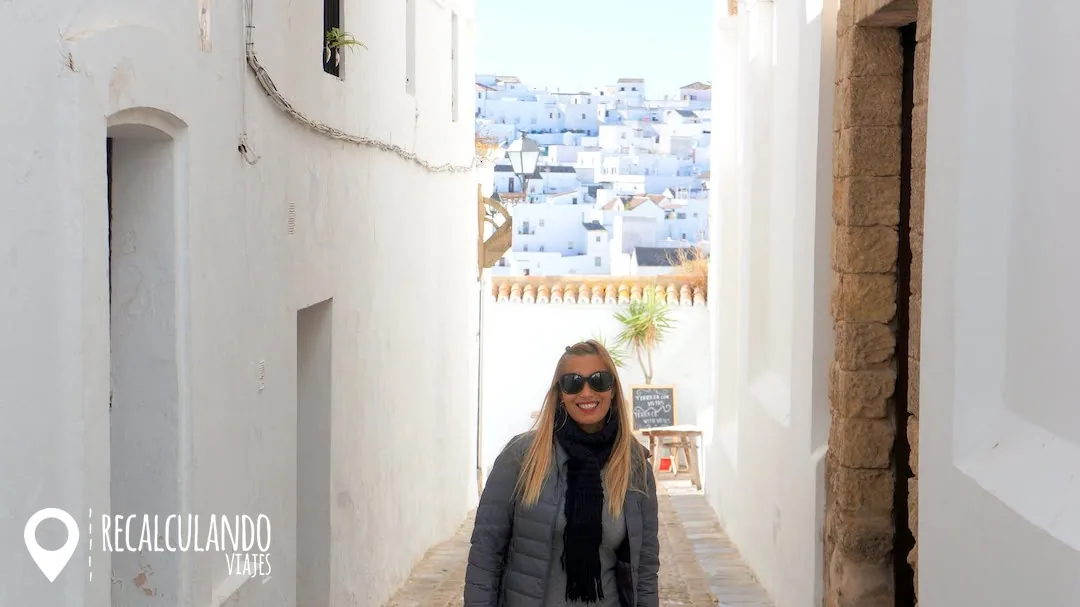
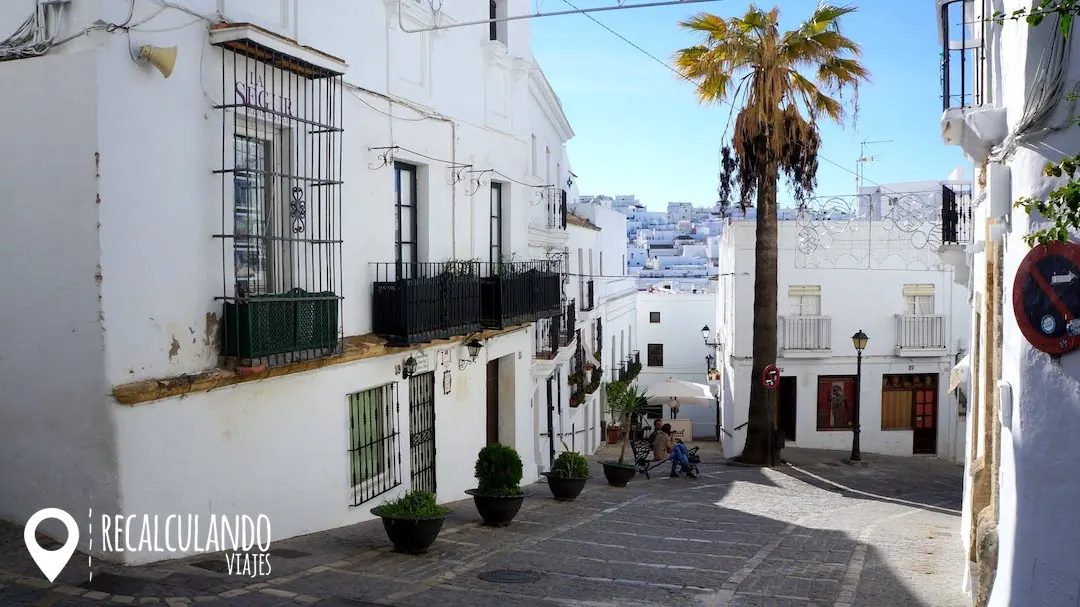
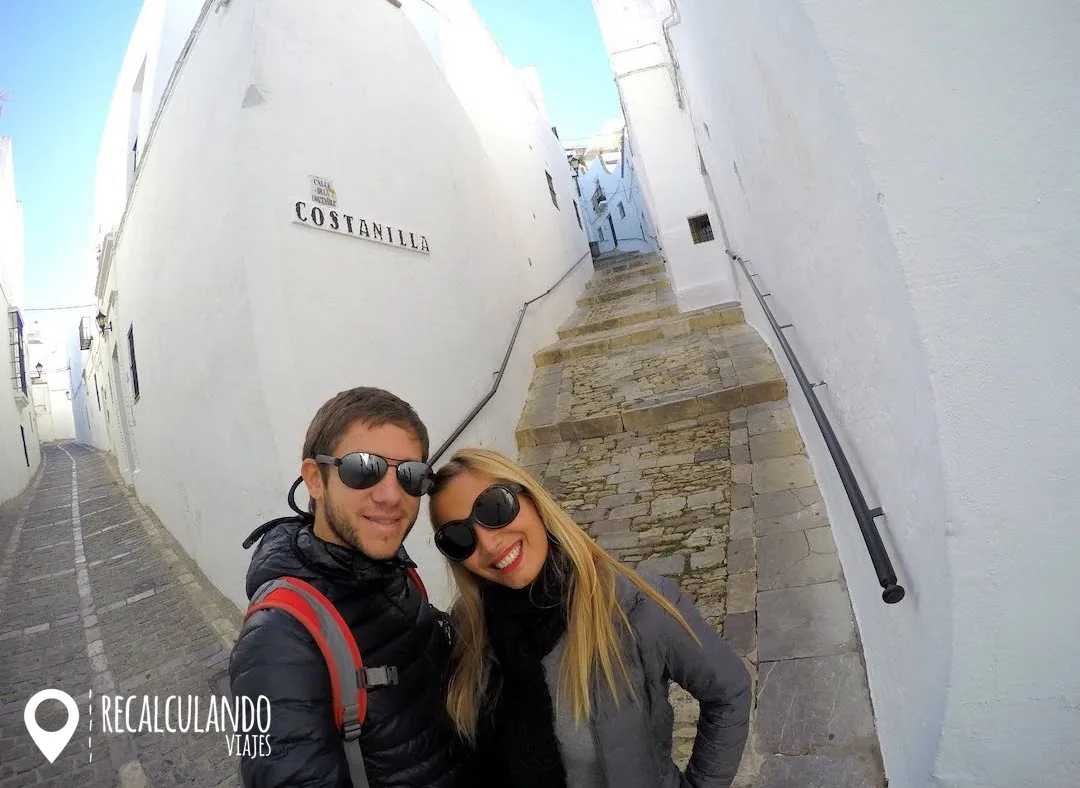
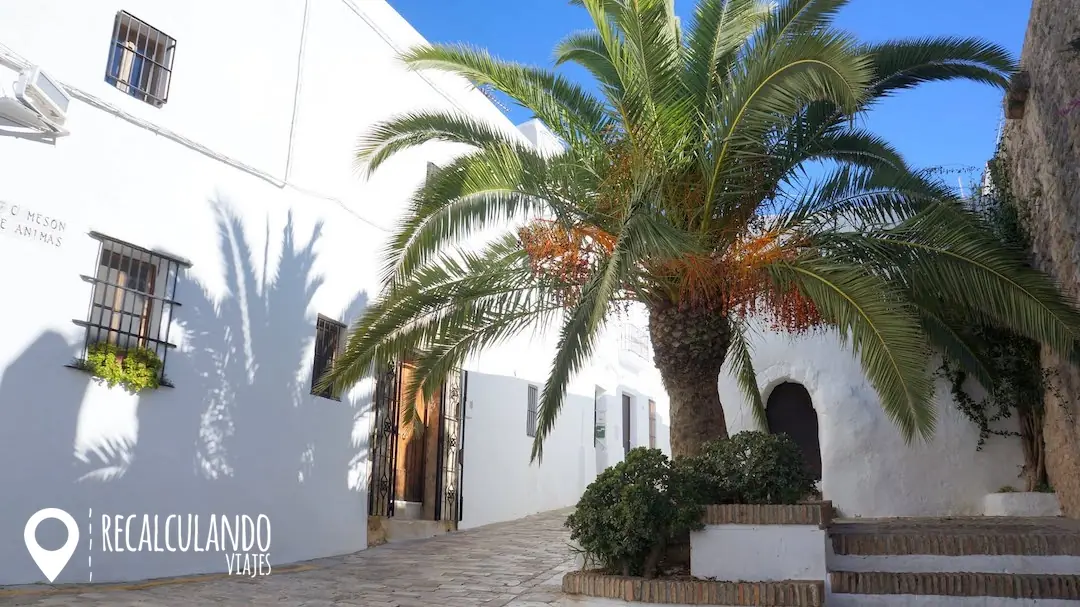
Crossing the arch, you enter the Judería neighborhood, which is where Vejer gets truly labyrinthine. Whitewashed narrow streets, flowerpots with geraniums and bougainvillea, patios peeking out through half-open doors, craft workshops, and an occasional art gallery.
Judería street itself runs along a section of the wall and is one of the most beautiful in the town. Our advice is simple: don’t use the map here. Get lost for ten or fifteen minutes, turn where it catches your eye, and let the town carry you. It’s small; you won’t get lost for real.
The famous Vejer courtyards, a legacy of the Andalusian past, are also from this neighborhood. Some are private and others are communal courtyards: if you see an open door, you can peek from the threshold, but without trespassing. It is someone’s home.
7. Convent of the Concepcionista Nuns and the Museum of Customs and Traditions
Right next to the Arco de las Monjas is the convent that gives it its name. It is the only vestige remaining of the original convent of Nuestra Señora de la Concepción, founded by Don Juan de Amaya in 1552 as a burial place for him and his wife. Highlights: the Renaissance façade, the spherical dome over the main chapel, and the vaulted crypts of the founders.
Today, the Municipal Museum of Customs and Traditions of Vejer operates there. We didn’t go in, but many travelers recommend it mainly for the crypts and the room dedicated to the cobijada. If you are interested in local history, it seems to be the best stop to understand it.
Practical info: general admission is €1 and for groups, €0.50. It is open from Tuesday to Saturday, from 11:00 AM to 2:00 PM and 6:00 PM to 9:00 PM. It is closed on Mondays, Sundays, and public holidays.
👩⚕️👨⚕️ A must-have for stress-free travel! 🌎✈️ ➜ Get a Quote, Compare & Buy
8. The Mirador de la Cobijada and the Arco de la Puerta Cerrada
This was our favorite corner of all the things to do in Vejer de la Frontera. You reach it by crossing the Arco de la Puerta Cerrada, which was called so because it was closed for centuries: from there, the direct path to the sea went out, and through that path, pirates could arrive.
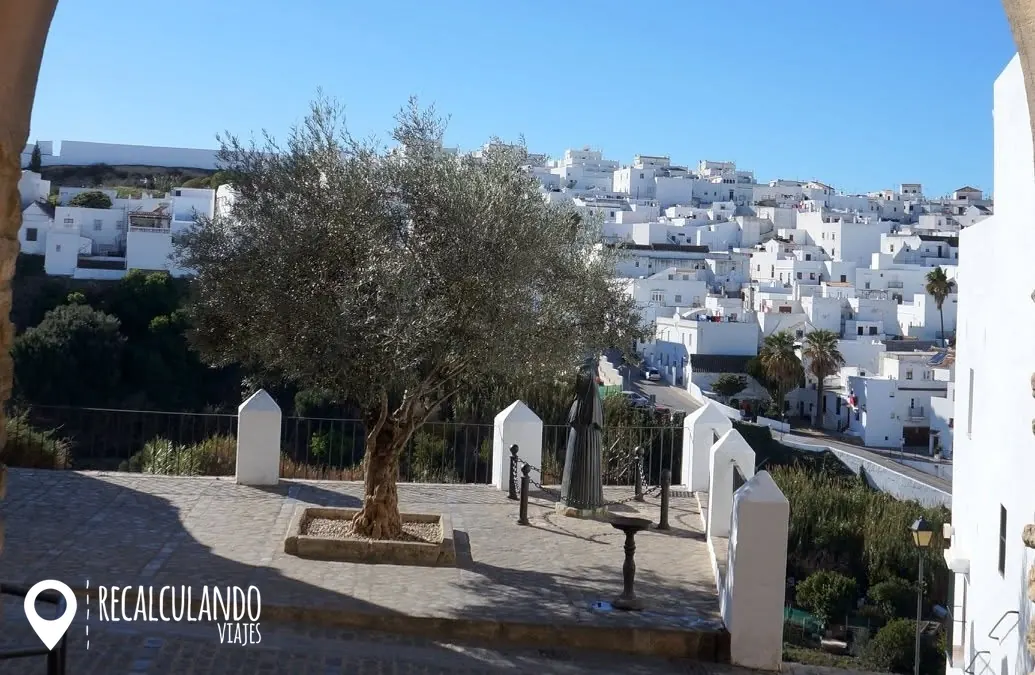
At the viewpoint is the sculpture that gives it its name: a woman wrapped in the cobijada, the traditional black cloak of Vejer that covered the entire body leaving only one eye visible, the right one. Seeing her there, under an olive tree, with her back to the valley, with the wind moving everything except her, is impressive. It is still used in some traditional festivals of the town.
The views towards the countryside and the coast are the best in the old town. If you can, come at sunset.
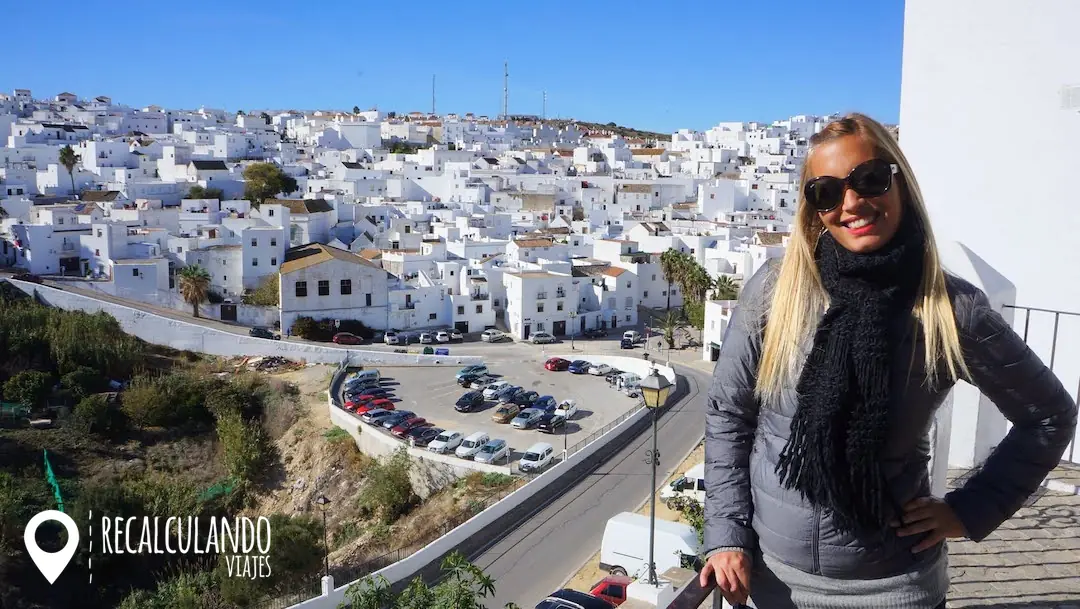
9. The Casa del Mayorazgo and the Torre del Mayorazgo
One of the most curious visits to make in Vejer de la Frontera. It is an 18th-century Baroque mansion, built directly against the wall, with two courtyards that connect to the Torre del Mayorazgo and a stretch of the wall. The main courtyard has a deserved reputation: there are about 450 flowerpots distributed among columns, arches, and galleries.
The tower, also called the Torre del Homenaje, preserves remains of the belfry of a chapel that no longer exists. From the top, you can see the mouth of the Barbate River, the coast of Zahara de los Atunes, and part of the La Breña y Marismas del Barbate Natural Park.
Watch out for this, as it is important: you will read in almost all guides (including our own until recently) that you can enter by asking permission from the neighbors and leaving a tip in the mailbox in the courtyard. The tourist office has it marked as temporarily closed, so you might find the door locked. Don’t insist or knock: people live there. If it’s open, enjoy it; if not, the façade and the tower from the street are already worth the detour.
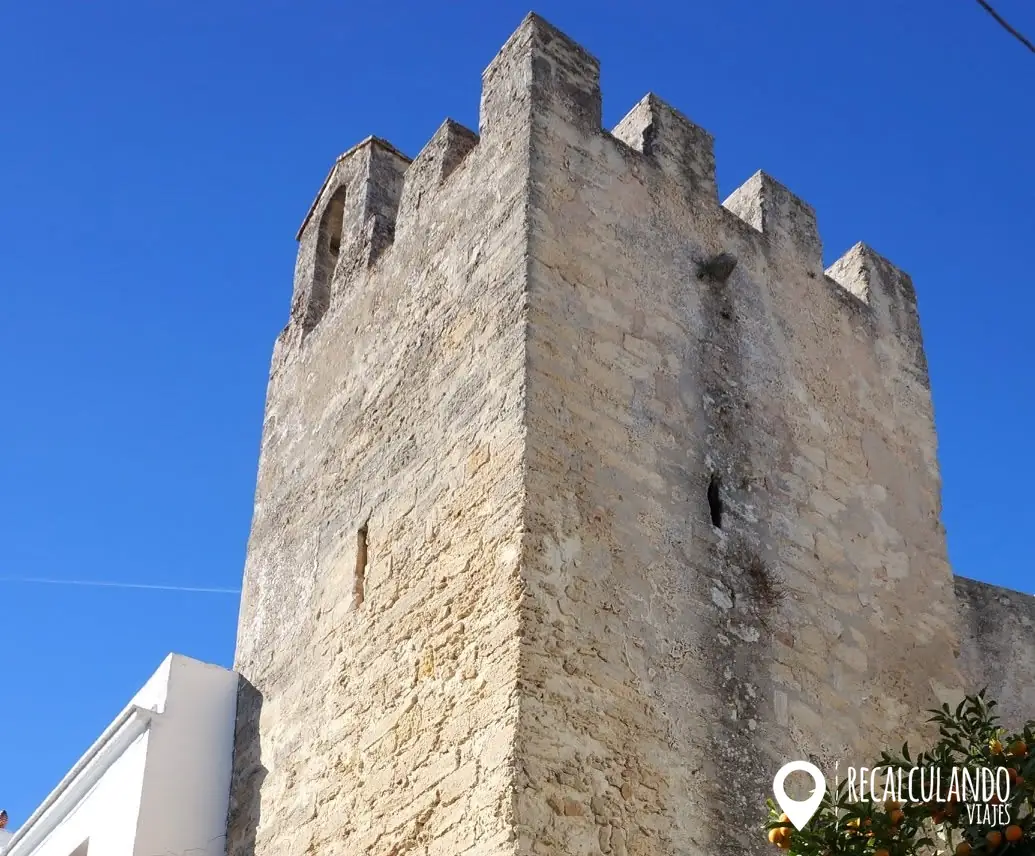
10. The Arco de Sancho IV and the story of Juan Relinque
On the north side of the wall, looking towards Medina Sidonia, is the Arco de Sancho IV. It is a semicircular arch with molded imposts, and above it has a Baroque noble coat of arms. Look at the floor: it was lowered almost two meters to overcome the slope of the Calle Corredera, and that exposed the foundations resting on the bedrock. It is the best place in the town to understand how the wall is built.
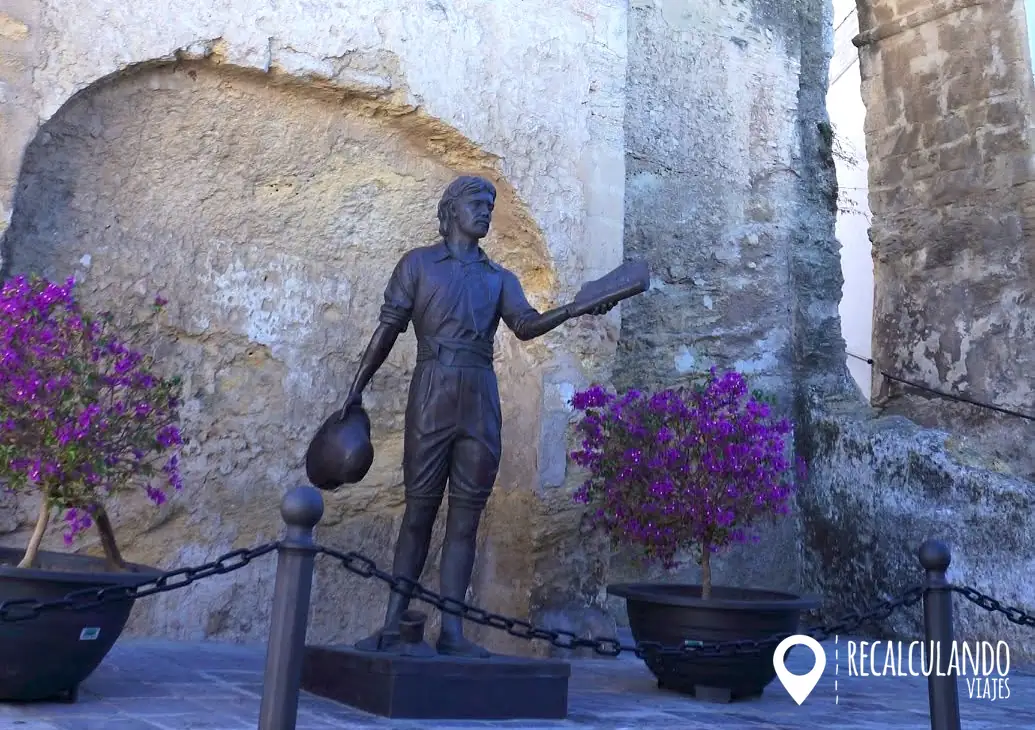
At its feet, there is a small sculpture that most people walk by without looking, and that is where the best story of Vejer is hidden.
The honoree is Juan Relinque, a local farmer. In the 13th century, after the Castilian repopulation, King Sancho IV gave some communal lands to the residents. Centuries later, the Duke of Medina Sidonia wanted to keep them. Relinque led the revolt, the lawsuit went far, and in 1566 a sentence returned the lands to the town.
What is incredible is that this distribution remains in force: the so-called “Hazas de Suerte” are still raffled today among registered residents, every four years, in leap years. In the town, they experience it like a year-end raffle. And there is more: the tradition is a candidate for UNESCO Intangible Cultural Heritage.
Your content goes here. Edit or remove this text inline or in the module Content settings. You can also style every aspect of this content in the module Design settings and even apply custom CSS to this text in the module Advanced settings.
11. The Paseo de la Corredera and its tower
One of the most underrated points of interest in Vejer de la Frontera. The Corredera is an open promenade, with wide views of the countryside and the lower part of the town, lined with shops, cafes, and a restaurant. It ends at the church of the old convent of La Merced.
On the promenade is the Torre de la Corredera, from the 15th century. Its function was defensive and, above all, communicative: from there, smoke signals were made to warn Medina Sidonia. When you are standing at that point and looking at the horizon, it is perfectly understood why.
TIP: if you are sleeping in Vejer, this is the place for sunrise. The morning light enters directly over the valley and the town is still asleep.
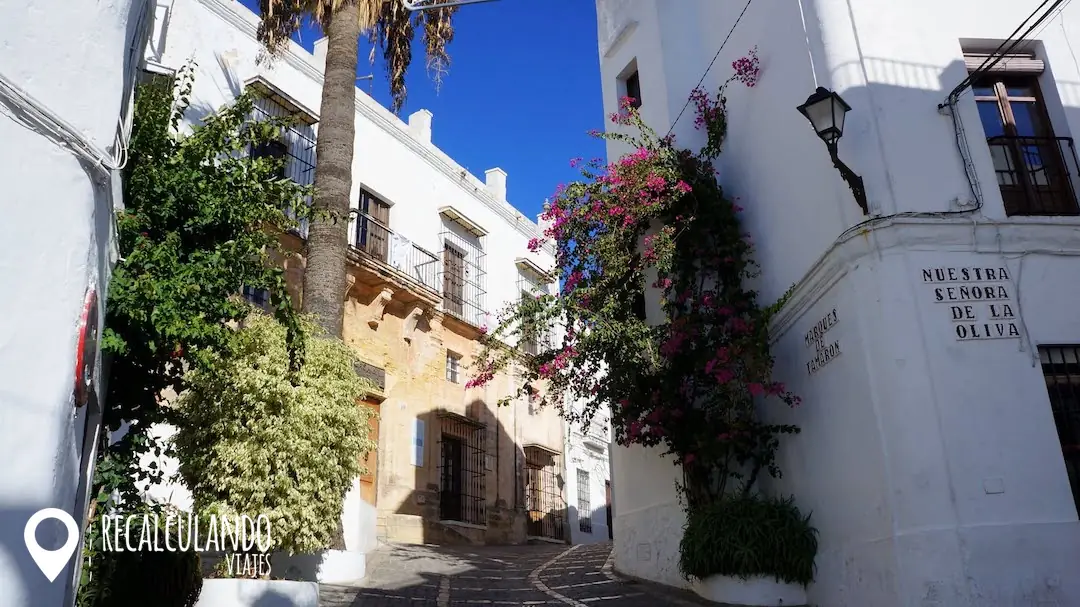
12. Calle Nuestra Señora de la Oliva
It is one of the main streets and one of the nicest to walk up calmly, with whitewashed houses, railings, and balconies with flowers. We used it as an uphill route from the lower part towards the castle, stopping every two steps.
It is one of those streets where the town is revealed to you little by little: you turn your head and a courtyard appears, a tile, a cat sleeping in the sun. If you arrive by bus, furthermore, the bus stop at the top is right on this street, so it will probably be your first contact with Vejer.
13. The Arco de la Segur and its bastion
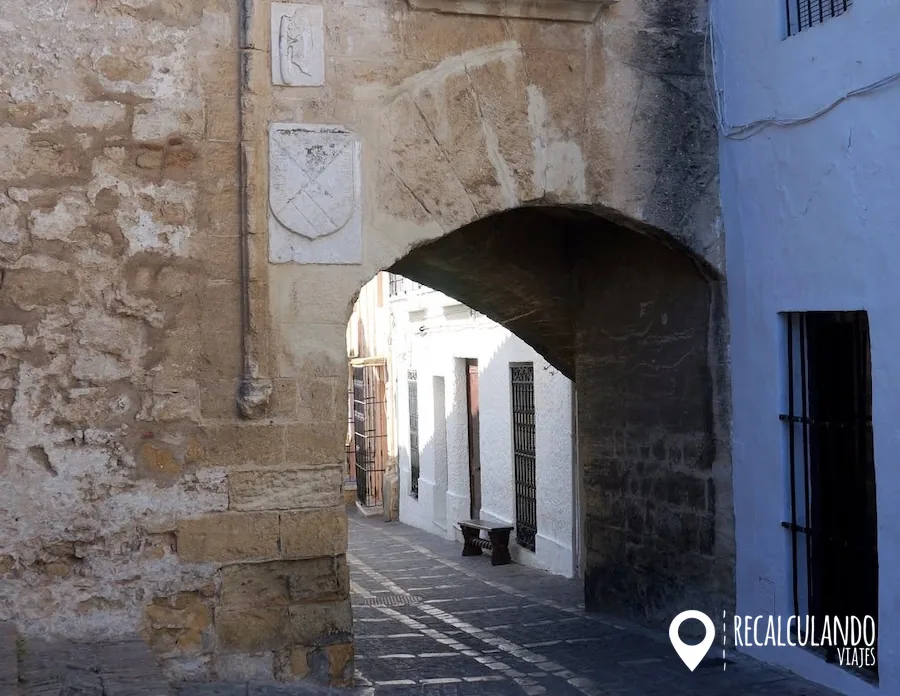
The fourth gate of the wall, on the west side, and the one with the fewest tourists. It was built at the end of the 15th century, in the time of the Catholic Monarchs.
The name has a beautiful explanation that we discovered right there: on the inside of the arch, there is a marble relief in the shape of an axe, the segur, which was the symbol of judicial power in Rome. Look for it, because it is in plain sight and almost no one looks at it.
Next to it is the Baluarte de la Segur. This was the easiest access to the enclosure—troops, goods, livestock, and agricultural products passed through here, and it was the gate towards Cádiz and Gibraltar—so a bastion was built with an interior double-gate enclosure to control everything. It also served to prevent the entry of contagious patients and to control goods for taxes. The battlements were restored in 1977 and the interior was rehabilitated in the nineties.
We liked it precisely because of how little scenographic it is: it is not prepared for a photo; it simply remains there.
14. The Palace of the Marquis of Tamarón and the Museum of Vejer
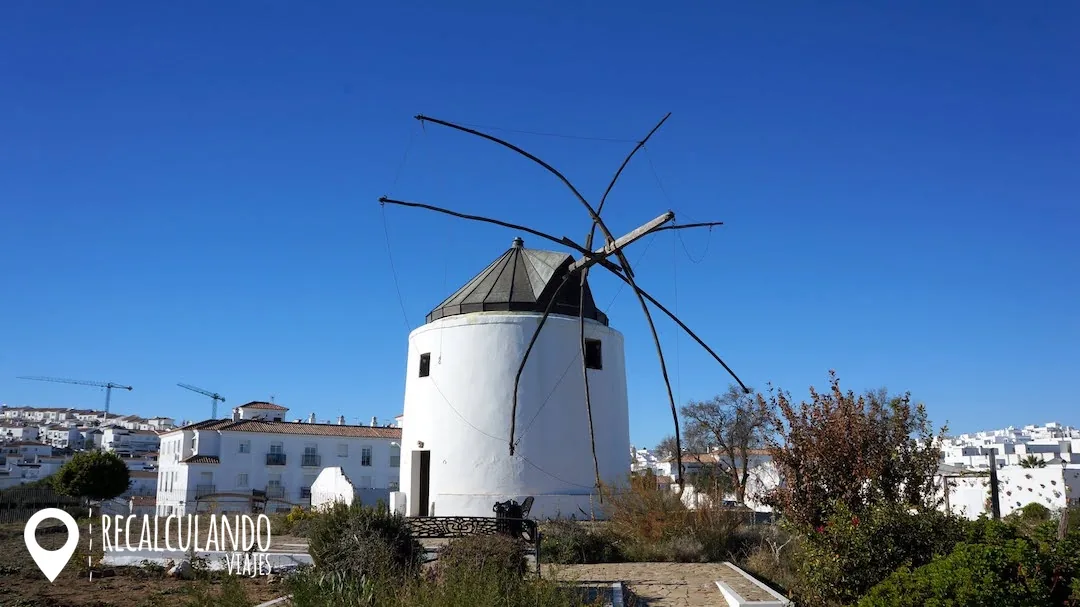
On the Calle Marqués de Tamarón, next to the Arco de la Segur, and already outside the walled enclosure, is this stately manor from the early 18th century. Today, the Museum Collection of History and Archaeology of Vejer operates inside, which the locals call the Museum of Vejer.
We didn’t get to go inside, but according to the tourist office, it has 13 rooms: 8 dedicated to archaeology, with remains of all the cultures that passed through here, 3 of fine arts, and 1 of temporary exhibitions. If you are traveling with children or like the historical context before walking the town, many travelers recommend it as a first stop.
Practical info: admission costs €2 per person, and it is free for children under 12 and senior citizens. The published schedule corresponds to the season from June 15 to September 15, Monday to Saturday from 10:30 AM to 2:00 PM and 6:00 PM to 9:00 PM. Outside those dates, it is best to confirm by phone before going.
15. The San Francisco Food Market
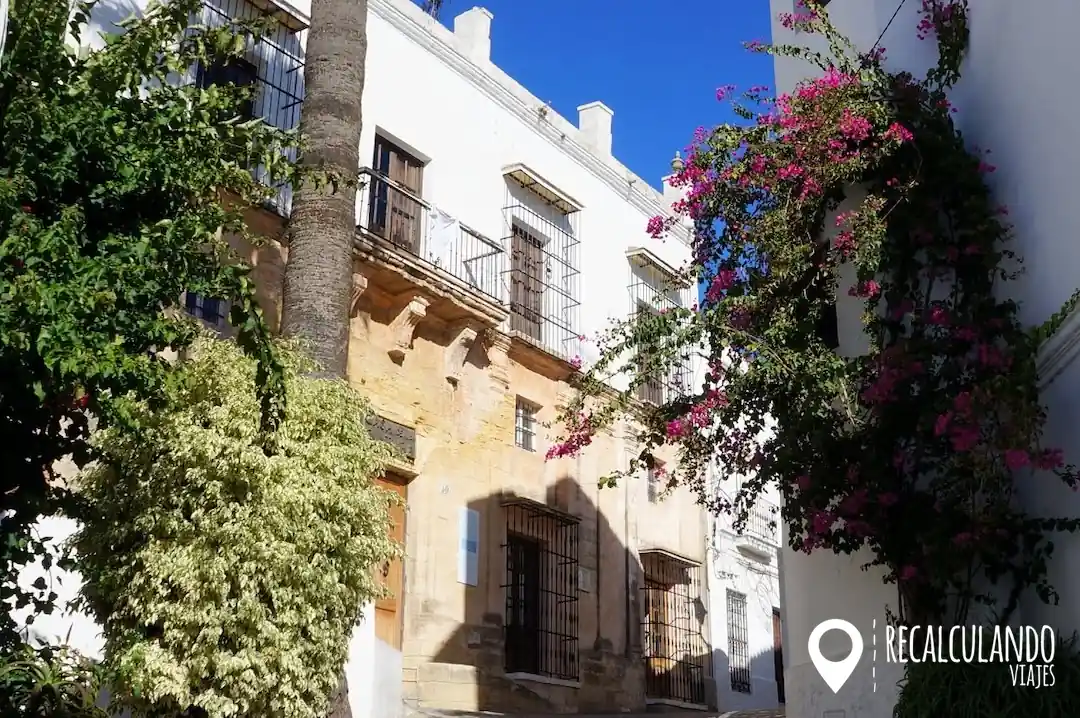
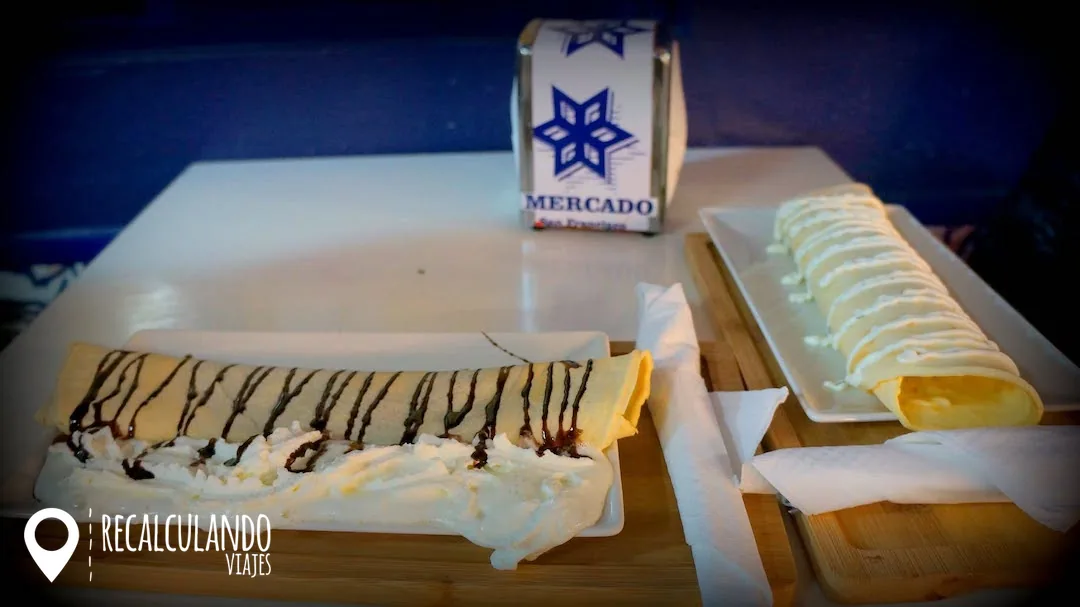
One of the corners that does not appear in the classic guides and yet shows you the real town. It is a small and charming market, the old food market, which operates in the morning as a traditional neighborhood market and at noon and at night, it transforms into a gastronomic market, with a dozen stalls and tables to share.
It is the best place to try local products without spending a fortune, and the offer ranges from the usual fried fish to more international things. We grabbed something here before continuing our trip to Conil and left happy.
TIP: the town’s street market, which is something else, is set up on Thursday mornings, from 9:00 AM to 2:00 PM.
16. The windmills of the Hazas de Suerte Park
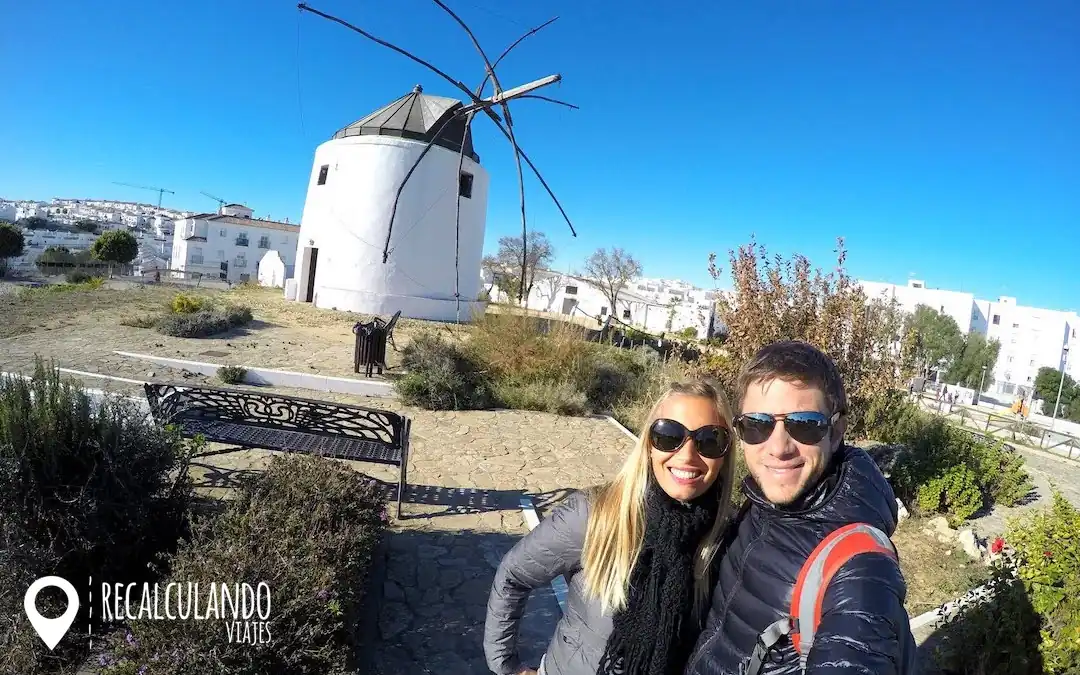
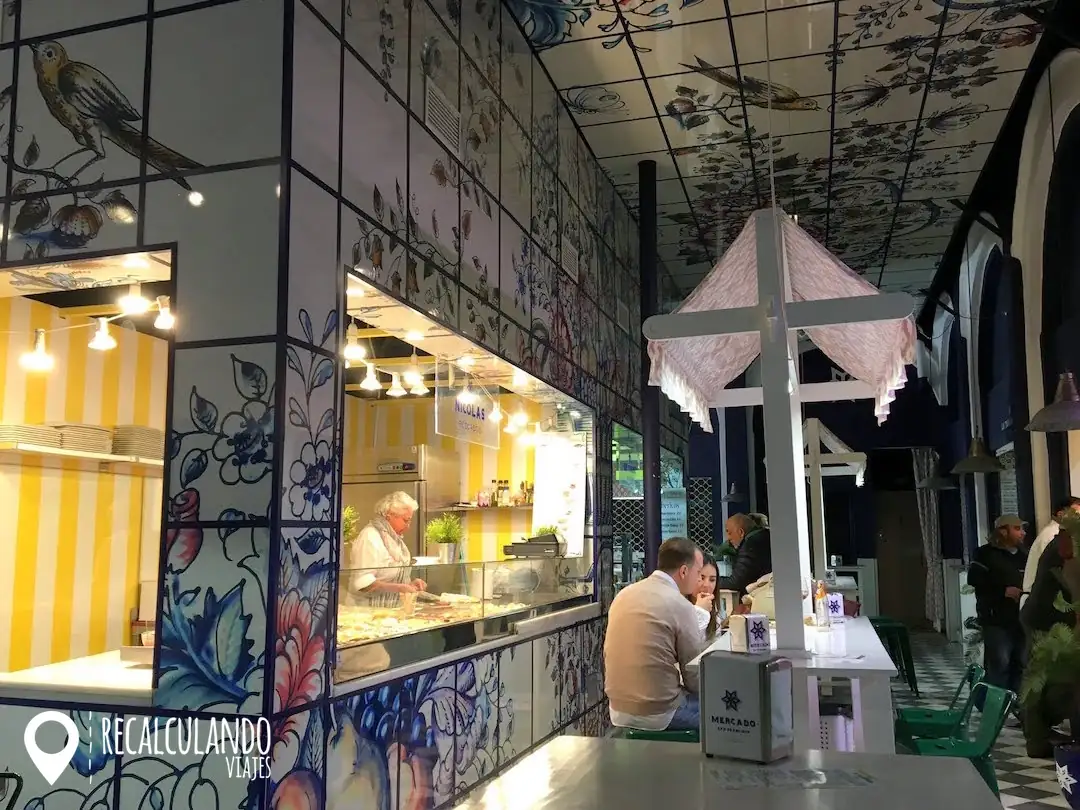
If there is one image that summarizes what to see in Vejer de la Frontera from afar, it is the silhouette of its flour windmills. They are grouped in the Hazas de Suerte Municipal Park—also called the Wind Park—, in the San Miguel neighborhood, a short walk from the old town. The complex is known as “the three Hail Marys”: the San José, San Francisco, and San Antonio mills.
In the 16th century, all the flour mills in Vejer were water mills. The first windmills arrived only in the 19th century, and here is the interesting part: they are not of the La Mancha model that one imagines, but of the Cartagena type, lower and wider, because the tall and slender ones couldn’t withstand the gusts of Levante wind on this coast. Beautiful detail: the roof was rotating, to take advantage of the wind no matter where it came from. In the 1860s, five were built in the San Miguel neighborhood, and three have been preserved and restored.
Keep in mind: the interior that can be visited is that of the San Francisco Mill, and it must be done by prior appointment through the cultural association that manages it (the tourist office will give you the contact via WhatsApp). We stayed outside, walking through the park, but many travelers recommend going inside to see the old machinery.
17. The Sanctuary of the Virgen de la Oliva
It is 5 kilometers from the town, on the road to Barbate, and it is one of those sites that no list of what to see in Vejer de la Frontera usually includes. It seems like a mistake to us, because it is the oldest place in the municipality.
There was first a Roman villa here and later, in Visigothic times, a basilica that epigraphic sources date to the year 674. The current hermitage is built on that site. Inside there is a funerary monument with a pagan inscription that contains remains of the protomartyr Stephen and several holy martyrs. The carving of the Virgin is by the Sevillian sculptor Martín Alonso de Mesa, from 1596, in gilded and polychrome pine wood, with the child on one side and an olive branch in her arm.
On May 7, the pilgrimage is celebrated, which is when the entire town comes down here. The rest of the year, it opens every day, with morning and afternoon hours that change between winter and summer.



18. The aqueduct and the rural center of Santa Lucía
Another less touristy visit is Santa Lucía, a rural neighborhood a few minutes from Vejer, on the slope of the Meseta de la Muela, and it is declared a Natural Monument due to the richness of its landscape: there is a lot of water and vegetation that you wouldn’t expect to find in this part of Cádiz.
There is the 16th-century aqueduct, a water conduction system built probably by reusing materials from an earlier one. Nearby, remains of seven water mills from the same period are preserved, with their canals, vaults, and some millstones. They were the property of the Dukes of Medina Sidonia, who charged rent to use them.
The fact we liked best: at the beginning of the 20th century, the Count of Villariezo created an electric company here that brought light and water to Vejer, and that made the town one of the first in Spain with those services inside private homes. Not bad for a white village of 12,000 inhabitants.
19. El Palmar beach and the Torrenueva
Vejer is not just a white village: the municipality reaches the sea. El Palmar beach is about 10 kilometers away, has nearly 8 kilometers of golden sand, waves for surfing—there are several schools—and beach bars right on the sand. It is one of the most famous beaches on the Costa de la Luz.
On the sand stands the Torrenueva, a coastal watchtower from the 17th and 18th centuries. It was part of a network that ran along the entire Cádiz coast and communicated with neighboring towers using smoke signals by day and fire by night, in an era when pirate attacks were serious business. It is the visual landmark of the beach.
We didn’t get down to El Palmar that day because the plan was to continue towards Conil, but it is one of those places everyone speaks well of and that we left pending to return to.
TIP: if you go outside of summer, the beach is deserted and many beach bars close. We went in late November and the Cádiz coast was empty, with spectacular sun. For walking and taking pictures, wonderful; for swimming, better from June to September.
20. The Rincón del Beso and the photo streets
We close the list with something much lighter. On Calle Viña there is a bench under a sign that says “Rincón del Beso” (Kiss Corner), with the town in the background, and it has become one of the fixed photo stops in Vejer.
It’s pure Instagram, we won’t lie to you, but it’s well done and in the process, it takes you through a street you might not have walked down. The same happens with the blue-painted doors that you will find throughout the old town, a visual legacy of that resemblance to Chefchaouen that we talked about at the beginning.
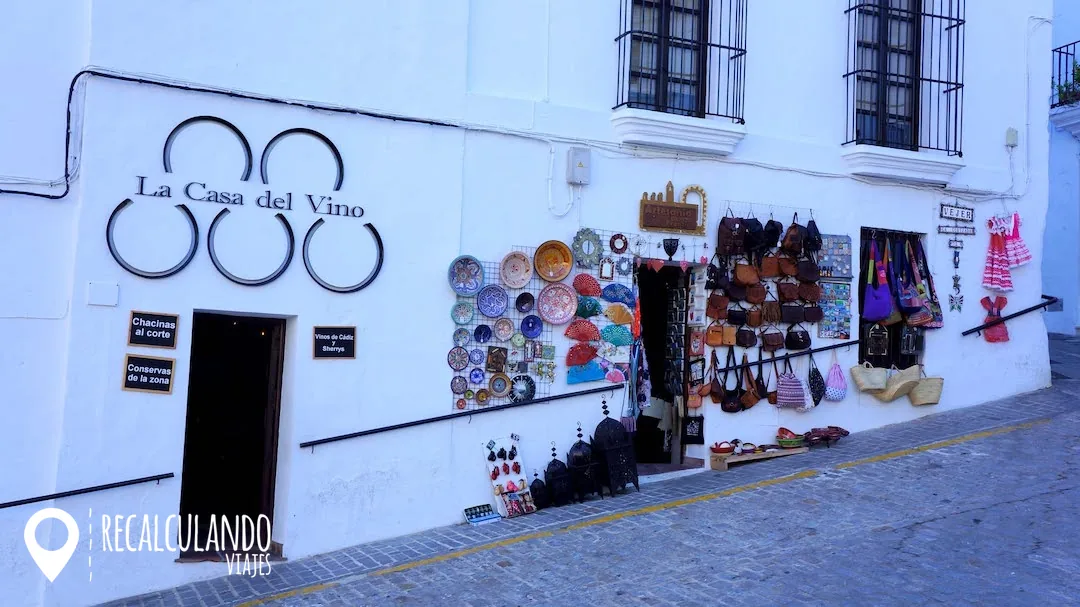
Take the opportunity to enter some of the craft shops: Vejer has been a refuge for artists for decades and there are pottery, leather, and decoration workshops that mix Arab influence with things brought from halfway around the world. It is one of the few towns where the shops add to the charm instead of ruining it.
One-day itinerary: things to do in Vejer de la Frontera on foot
If you have only one day, this is the order we would have liked to have written down before going. It’s about a 4-5 hour quiet route, all walking and without repeating streets.
- Morning (10:00 AM): leave the car in the Los Remedios parking lot and walk up Calle Nuestra Señora de la Oliva to Plaza de España. Coffee with a view on a terrace.
- 10:45 AM: cross the Arco de la Villa and start the ascent through the walled enclosure to the Iglesia del Divino Salvador.
- 11:15 AM: the Castle, which opens at 11:00 AM. Parade ground, cistern, and battlements.
- 12:00 PM: walk down to the Calle Arco de las Monjas, the convent, and the Judería neighborhood. Time flies here without you realizing it.
- 1:00 PM: Arco de la Puerta Cerrada and Mirador de la Cobijada.
- 1:30 PM: lunch at the San Francisco Market or in the Plaza de España area.
- 3:30 PM: Arco de Sancho IV, the sculpture of Juan Relinque, and the Paseo de la Corredera.
- 4:30 PM: Arco de la Segur, the bastion, and, if you are interested, the Museum of Vejer.
- 5:30 PM: walk to the windmills of the Hazas de Suerte Park.
- Sunset: return to the Mirador de la Cobijada, or get in the car and go watch the sunset at El Palmar or the Faro de Trafalgar.
Keep in mind: the castle is closed on Sundays and the convent museum is closed on Mondays and Sundays. If your only free day is the weekend, adapt the itinerary or you will arrive at closed doors.
Opening hours and prices of things to do in Vejer de la Frontera
This is the information that changes the most and is the worst on the internet, so we have summarized it in a table. These are the data published by the municipal tourist office. Even so, always confirm before you go: in a small town, a holiday or a local event changes everything.
| Place | Price | Hours | Keep in mind |
|---|---|---|---|
| Castle of Vejer | Free | Monday to Saturday, 11:00-14:00 and 18:00-21:00 | Closed on Sundays |
| Museum of Customs and Traditions (Convent) | €1 general / €0.50 groups | Tuesday to Saturday, 11:00-14:00 and 18:00-21:00 | Closed Mondays, Sundays, and holidays |
| Museum of Vejer (Palace of the Marquis of Tamarón) | €2 (free for under 12s and senior citizens) | Monday to Saturday, 10:30-14:00 and 18:00-21:00 | Published schedule for 06/15 to 09/15 |
| Iglesia del Divino Salvador | Free | No fixed hours published | Depends on religious services; check on the day |
| Casa del Mayorazgo | Free (voluntary tip) | No fixed hours | Temporarily closed when we went |
| San Francisco Mill | By agreement | By appointment only | Managed by the local cultural association |
| Sanctuary of the Virgen de la Oliva | Free | Morning and afternoon, every day | Different hours in winter and summer |
| Walls, arches, and viewpoints | Free | Always open | No time restrictions |
Where to stay in Vejer de la Frontera
If you can extend your visit, staying near the things to do in Vejer de la Frontera is a very good idea. The town changes when day-trippers leave: the streets are empty, the façades are lit up, and the silence is absolute. We did it as an excursion from Arcos, and if we return, we are staying overnight.
Three areas to choose from:
- Historic center: the nicest and most convenient for walking, with boutique hotels and restored houses. Downside: no accommodation in the center has its own garage, because they are centuries-old buildings, so you will leave the car at the bottom anyway.
- Lower area of the town: more practical for the car and somewhat cheaper, but you have to walk up the hill every time.
- El Palmar / Los Caños de Meca: ideal if you go in summer and want the beach. Vejer is 15-20 minutes away by car.
Seasonal tip: in July and August, prices soar and the town gets crowded, so it is best to book several months in advance. In spring and autumn, you find very good options at half price, and the weather is still ideal for walking. If you are traveling for the Spring Fair or the Night of the Candles (Noche de las Velas), book even earlier.
See available accommodation in Vejer
On this map, you can compare prices and locations of hotels, apartments, and rural houses in the area:
What to eat in Vejer de la Frontera
We are in Cádiz, so the food is good and you don’t need to look much. These are the dishes worth asking for, more than specific venues:
- Lomo en manteca colorá: the most Vejer-style dish of all. It has so much identity here that they even named a street after it.
- Retinto meat: the native breed of cow of the region. If you see “retinto” on the menu, order it.
- Almadraba tuna: peak season from April to June, when it passes through the coast of Barbate and Zahara. Tartare, tataki, or grilled.
- Shrimp fritters and fried fish: the classic from Cádiz, unbeatable.
- Payoyo cheese: from the Sierra de Cádiz, for snacking before everything else.
We don’t give you restaurant names on purpose: in small towns, they open and close with a lot of rotation and we prefer not to send you to a place that no longer exists. What always works is the San Francisco Market at noon and the terraces of Plaza de España in the afternoon.
Festivals and events in Vejer: when it is worth (or not) to go
In Vejer, something is celebrated almost every month. We like to visit towns at their normal pace, but if you are interested in festivals, these are the peak dates:
- Carnival (February or March): with all the Cádiz carnival power.
- Easter Week (March or April): experienced with great intensity.
- Toro Embolao (Easter Sunday): the most debated tradition of the town, in a fenced circuit.
- Spring Fair (two weeks after Easter): it is known as the first fair of Spain.
- Pilgrimage of the Virgen de la Oliva (May 7): the entire town goes down to the sanctuary.
- Week of the Vejer Patios (mid-May): patios that are not seen the rest of the year are opened to the public. If you are interested in patios, this is THE week.
- Night of the Candles (Noche de las Velas) (summer): the old town illuminated only with candles. The most beautiful, without discussion.
- Evening of the Virgen de la Oliva (week of August 15): the big festival.
Our honest opinion: if you are going for the first time and want to walk quietly and take photos, avoid Easter Week and August. If you are looking for atmosphere, the Noche de las Velas and the Week of the Patios are the two that really change the experience.
How to get to Vejer de la Frontera
Vejer is right on the Costa de la Luz, in the province of Cádiz, very well connected by the N-340 and the A-48.
| From | By car | By bus |
|---|---|---|
| Cádiz | ~45 min (50 km) | ~1 hr with Comes, several daily frequencies |
| Jerez de la Frontera | ~55 min | With transfer, check schedules |
| Seville | ~1 hr 45 min | ~3 hr direct |
| Málaga | ~2 hr 30 min | With transfer in Cádiz or Algeciras |
| Arcos de la Frontera | ~1 hr 20 min | Difficult without a car |
| Conil de la Frontera | ~20 min | Local bus, short trip |
By car is, by far, the best option. The area is enjoyed much more by being able to link white villages, beaches, and viewpoints on the same day, which is exactly what we did.
By bus you can reach it perfectly from Cádiz with the company Comes. Watch out for a detail that ruins visits: there are two stops. One is at the top, in the town, on Calle Nuestra Señora de la Oliva, and another at the bottom, in La Barca de Vejer, on the N-340. If you get off at La Barca, you are in for a 20-minute uphill walk with quite a slope, so confirm which one is yours before buying the ticket.
By plane: the nearest airports are Jerez (about 70 km away), Seville, and Málaga. From any of the three, you can rent a car or combine train and bus.
Travel insurance to visit Vejer de la Frontera
If you are coming from Latin America, travel insurance is not optional: it is a requirement to enter the Schengen area and, furthermore, it is what saves you from an expensive scare. If you are a resident in Spain, your health card is enough, although for long trips around Europe, many still take out extra coverage.
We always travel insured and we use IATI Seguros, which has specific coverage for Europe and provides service in Spanish. Entering from our link, you get a 5% discount with the code RECALCULANDO. Another advantage of IATI for short getaways like this is that it can be hired until the day before departure.
If you want to compare options before deciding, we leave you our guide with the best travel insurance for Europe and all our current discounts for travelers.

Excursions from Vejer de la Frontera
The things to do in Vejer de la Frontera are great to explore on your own, but the town’s stories (about the Hazas de Suerte, the cobijada, the legends of the wall) are enjoyed much more with someone local telling them. And if you have a car, there is enough for several days around.
Tours inside the town
- Free tour of Vejer: walking tour through the historic center, wall, and monuments. You pay what you want at the end.
- Free Tour of mysteries and legends: sunset/night version, with the least touristy stories of the town.
- Organized excursion from other cities: there are departures from Cádiz, Jerez, Chiclana, San Fernando, and El Puerto de Santa María, often combined with Medina Sidonia. It is the best option if you don’t have a car.
Check information for Tours and excursions in Vejer de la Frontera in Spanish HERE
One-day getaways from Vejer
- Conil de la Frontera (20 min): seaside town, wide beaches, and white old town. It is what we did and it fits perfectly.
- Cabo de Trafalgar and Los Caños de Meca (25 min): the lighthouse on the isthmus and one of the best sunsets on the Cádiz coast.
- Zahora Beach: quieter and wilder than El Palmar, for those looking for fewer people.
- Zahara de los Atunes and Barbate (30 min): territory of the almadraba tuna.
- Bolonia and Baelo Claudia (45 min): Roman city right on the beach, with a huge dune next to it.
- Medina Sidonia (30 min): another white village, much less touristy and with very good views.
- La Breña y Marismas del Barbate Natural Park: cliffs, pine forest, and signposted trails.
Practical tips for your visit
- Comfortable footwear, without exception. Vejer is built on a hill and the cobblestones are irregular. This is not a town for party sandals.
- Check which day you go. Sunday: castle closed. Monday: convent museum closed. It is the most expensive mistake of the visit.
- Bring water and sunscreen even in autumn. The Cádiz sun beats down, and in the old town, there is little shade at noon.
- Beware of the wind. The Levante wind blows hard on this coast. A light windbreaker in your backpack will save your day.
- Andalusian hours. Many monuments and shops close from noon to mid-afternoon and reopen at 6:00 PM. Organize the morning for what is actually open.
- Accessibility: the old town has hills and cobblestones, so if using a wheelchair or stroller, plan ahead. The Plaza de España and Corredera areas are the flattest.
- Internet and data: if you are coming from outside the European Union, an eSIM saves you roaming. We use Holafly with the code RECALCULANDOVIAJES.
- Payments: cards are accepted almost everywhere, but carry some cash for market stalls and the €1 museum entry.
If you are putting together a longer route through the south of Spain, our guide on what to visit in Granada and everything we have been publishing about Spain might be useful. And if you are just starting to organize your trip, look at how we plan every trip and our luggage checklist so you don’t forget anything.
Map of the things to do in Vejer de la Frontera
We created a map with the 20 things to do in Vejer de la Frontera that we told you about here, plus the parking lots, Santa Lucía, and El Palmar beach. You can open it on your phone and use it on the day of the visit.
Frequently asked questions about Vejer de la Frontera
How many days are needed to see Vejer de la Frontera?
Half a day is enough to walk through the entire historic center, which is what we did. If you want to add El Palmar beach, the windmills, or a getaway to Conil, reserve the whole day. Sleeping one night in the town is the best option if you have time.
Can you visit Vejer de la Frontera in one day?
Yes, and it is the way most people visit it. Vejer works perfectly as a day trip from Cádiz, Conil, Chiclana, or even Seville. We did it from Arcos de la Frontera and in the afternoon we continued to Conil without any problem.
What are the opening hours for the Vejer castle and how much does it cost?
Admission to the Vejer castle is free, and the hours published by the tourist office are Monday to Saturday, from 11:00 AM to 2:00 PM and 6:00 PM to 9:00 PM; it is closed on Sundays. The restoration work is finished, so there is no need to pay attention to guides that still say it only opens on weekends.
Where can you park in Vejer de la Frontera?
The most practical parking is Los Remedios, free and a few minutes’ walk from the old town. There are other free ones behind the health center and in the Paseo de las Cobijadas area, and a paid underground parking lot near Plaza de España. Do not try to enter the old town by car.
What is the best time to visit Vejer de la Frontera?
Spring and autumn are the best times: good weather, quiet town, and lower prices. We went in late November and enjoyed it a lot, almost without tourists. In July and August, it is very hot and the old town gets quite full.
What is near Vejer de la Frontera?
Very close are Conil de la Frontera about 20 minutes away, Barbate and Zahara de los Atunes, Cape Trafalgar, Los Caños de Meca, Bolonia with the Roman city of Baelo Claudia, and Medina Sidonia. El Palmar beach, which belongs to the same municipality, is about 10 kilometers from the town.
What is the cobijada of Vejer?
The cobijada is the traditional costume of the women of Vejer: a black cloak that covered the entire body leaving only one eye visible. Today it is still used in some town festivals and has its own sculpture at the viewpoint that bears its name, one of the most beautiful corners of the old town.
What are the Hazas de Suerte of Vejer?
They are communal lands that King Sancho IV gave to the residents in the 13th century and which the town defended in court, with Juan Relinque at the lead, until winning the lawsuit in 1566. Even today, they are raffled every four years among registered residents, and the tradition is a candidate for UNESCO Intangible Cultural Heritage.
Is Vejer de la Frontera one of the most beautiful villages in Spain?
It is considered one of the most beautiful white villages in Andalusia and its old town was declared a Historic-Artistic Site in 1976. After traveling quite a bit through the south of Spain, for us, it competes comfortably with the most famous ones on the list.
Conclusion: why we would return to Vejer
Of all the things to do in Vejer de la Frontera, what stuck with us most were not the big monuments, but the details: the arches that are actually buttresses from an earthquake, the castle floor paved in a herringbone pattern so the animals wouldn’t slip, the Roman axe carved into the Arco de la Segur, the sculpture of the cobijada looking at the valley, and the story of Juan Relinque and lands that are still raffled among neighbors five centuries later.
It is a small town that can be toured in half a day and still leaves you wanting more. We visited it in passing, in the middle of a road trip through the province of Cádiz, and left convinced that next time we will stay overnight to see it lit up, go up to the Corredera at sunrise, and treat ourselves to a slow trip down to Santa Lucía.
If you are putting together your route along the Costa de la Luz, add it without fail. And if you have already been, tell us in the comments what your favorite corner was. We love reading your input!
ℹ️ **Total Transparency**
This article contains affiliate links. If you book through these links, we may receive a small commission at no additional cost to you. We only recommend services we use on our trips and trust. This helps us keep this blog free and continue creating useful content for you. Thank you for your support!
🔗 Resources & Useful Links for your trip to Vejer de la Frontera
Do you have questions or want to add your own recommendations about things to do in Vejer de la Frontera?
💬 Leave your comment or write to us; we love reading about other travelers’ experiences.
Thank you for being part of this adventure!— Nanu & Facu 🌎 | Recalculando Viajes 💜