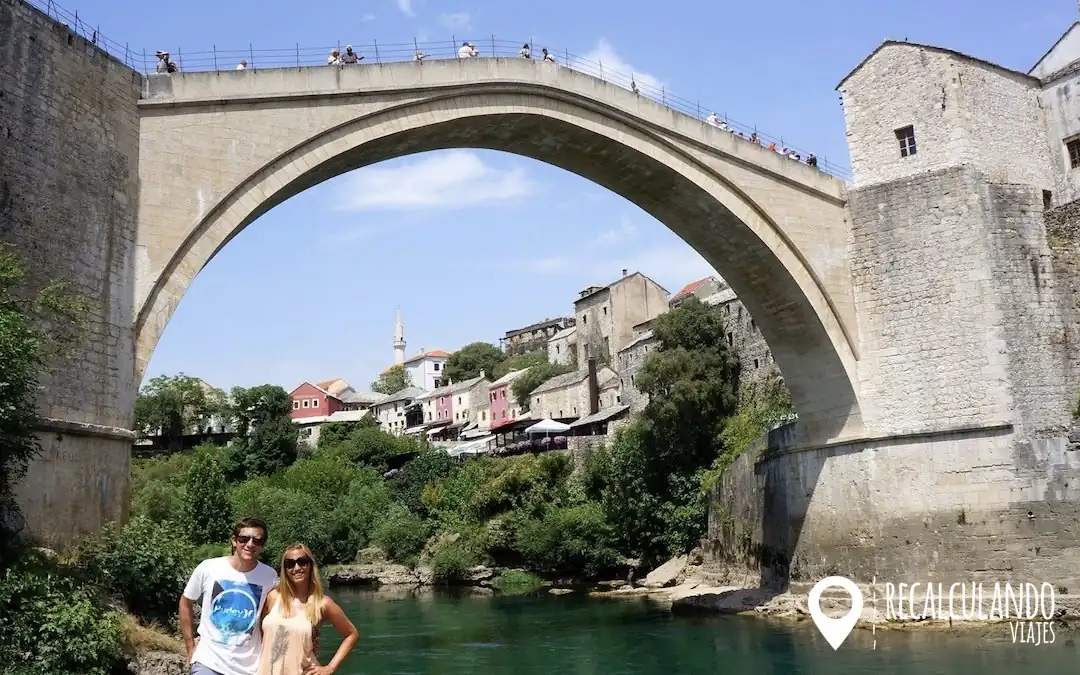
Mostar, in Bosnia and Herzegovina, was one of the loveliest surprises of our route through the Balkans: we visited as a day trip from Trogir by car and returned wishing we had stayed the night. In this guide, we tell you about the 20 things to do in Mostar that we liked the most, with a map, a one-day itinerary, what to eat, where to sleep, how to get there from Croatia, and the practical tips we would have loved to have had before crossing the border.
It’s not a large city, and it won’t take you a week. But it has an intensity that few places in Europe possess: a 16th-century Ottoman bridge, an impossibly green river, minarets and church bells ringing at the same time, and facades still bearing bullet holes that remind you of what happened three decades ago.
FREE🚶♀️➡️Free walking tour of Mostar with a Spanish-speaking guide ➜ Click Here🚶 — free of charge, just the tip you wish to leave.
🌍 Travel Insurance: 5% Off with IATI Seguros! 🌟
Take advantage of this offer and travel safe.
Mostar Bosnia Summary
| Category | Key details |
|---|---|
| Best time to visit | May, June, and September (pleasant weather and fewer crowds). |
| Recommended duration | 1 day for the city; 2 days if you want to include Blagaj, Počitelj, and Kravice. |
| Daily budget | 40-50 € per person (meals, entrance fees, and comfortable accommodation). |
| Language and currency | Bosnian, Croatian, and Serbian. Convertible Mark (KM); the euro is widely accepted. |
| Must-do | Visit the Stari Most early in the morning to avoid crowds. |
| Travel requirement | Passport required (outside the EU) and Green Card if you rent a car in Croatia. |
| Gastronomy | Ćevapi, burek, klepe, and Bosnian coffee in local spots away from the bridge to save money. |
| Safety | Safe city; it is recommended to avoid unmarked trails in hills due to old mines. |
Mostar, Bosnia: where it is and why it’s worth visiting
Let’s start with the basics, because there is a lot of confusion about this: Mostar is in Bosnia and Herzegovina, not Croatia. It is the most important city in the Herzegovina region, the fifth largest in the country, and lies on the banks of the Neretva River, about 140 km from Split and 140 from Dubrovnik. The fact that most travelers arrive from the Croatian coast explains the misunderstanding, but you cross an international border to get there (keep in mind that border crossings can take quite a while in the summer).
The name comes from “mostari”, which means something like the bridge guards: those who guarded the wooden suspension bridge that existed before the current one. So this city is literally named after the people who looked after its bridge. It’s hard to find a more appropriate name.
And why is it worth it? Because all the things to do in Mostar fit into a few blocks where everything coexists: the Ottoman bazaar, 16th-century mosques, Austro-Hungarian architecture in the expansion area, and the scars of a war that ended just thirty years ago. It’s one of those places where you hear the call to prayer and church bells at the same time, and suddenly you understand why Mostar is called a bridge city in more ways than one.
1. Stari Most, the Old Bridge and symbol of Mostar
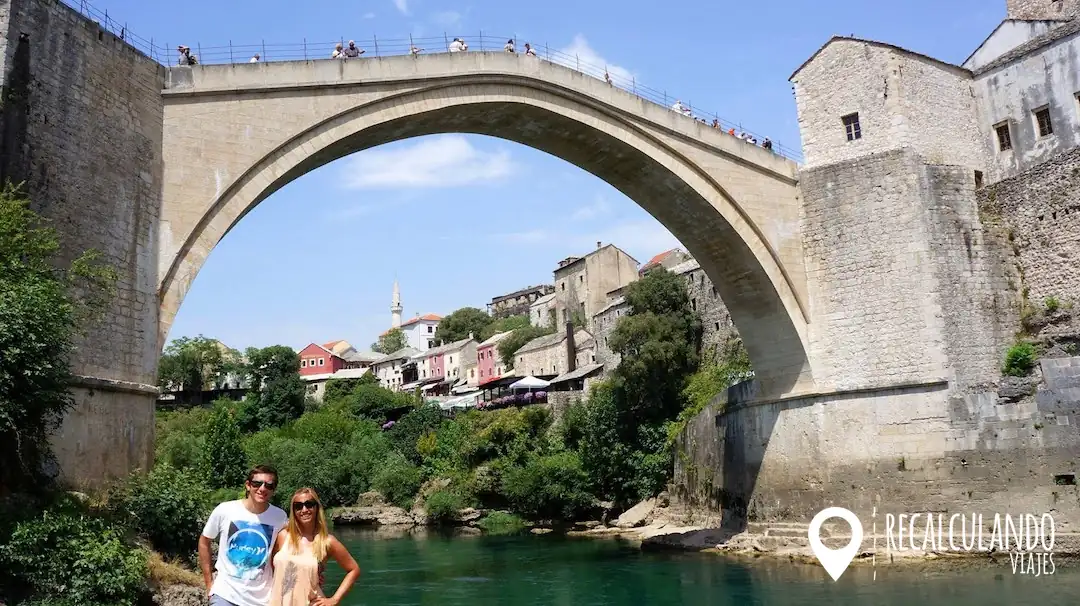
If there is one place in the city that we loved, this is it. The Stari Most is the reason almost everyone comes here, and we can assure you that it does not disappoint.
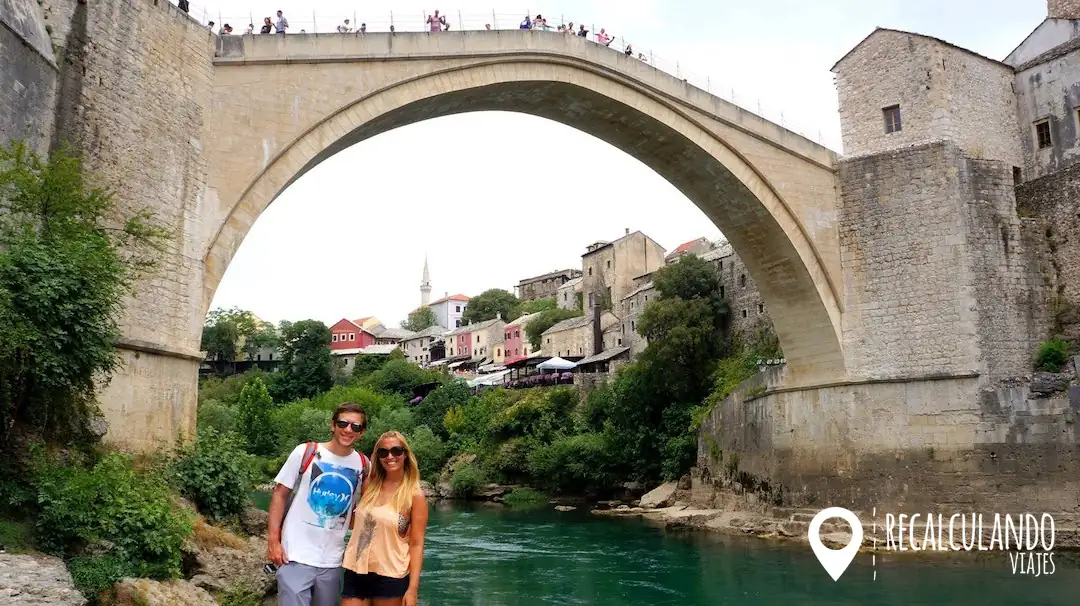
The original bridge was commissioned by Sultan Suleiman the Magnificent and was completed in 1566, the work of Ottoman architect Mimar Hayruddin. A light stone arch about 29 meters long that rises more than 20 meters above the Neretva River, without a single pillar in the middle. It stood for 427 years. On November 9, 1993, during the war, it was destroyed. The reconstruction was inaugurated on July 23, 2004, and since 2005, the complex has been a UNESCO World Heritage Site.
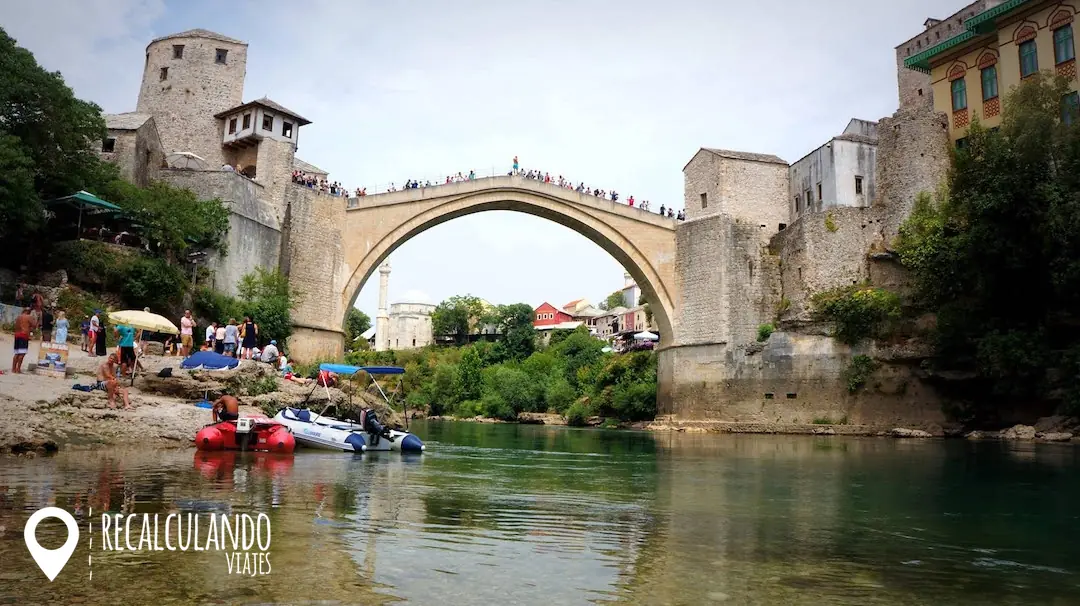
A detail we found very interesting: to rebuild it, original stones were rescued from the bottom of the Neretva, and the same local limestone with which it had been built in the 16th century was used, the “tenelija,” extracted from the same quarries.
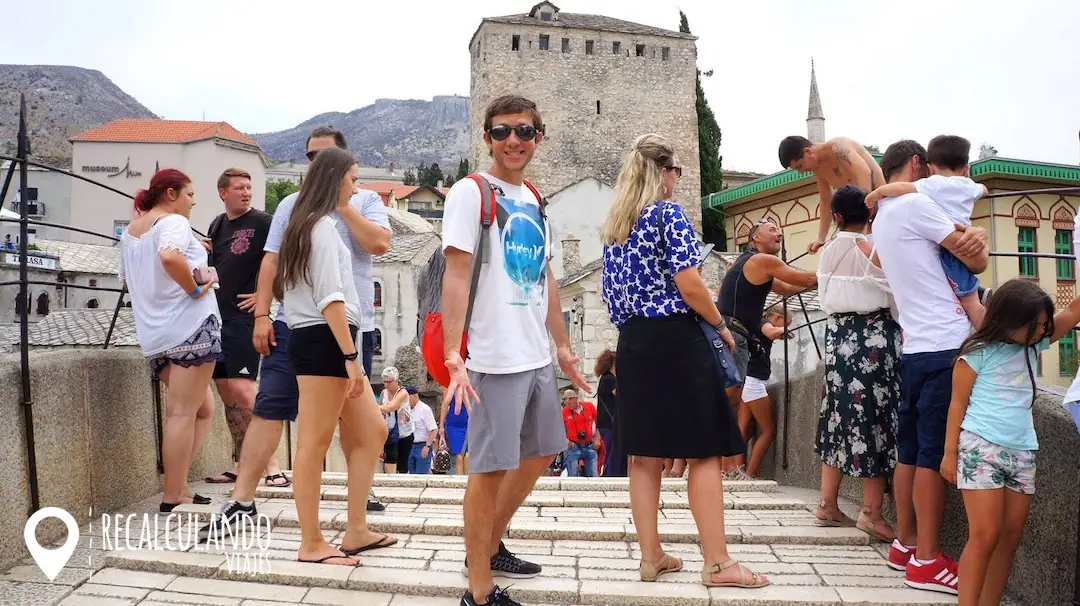
Crossing it is free and possible at any time. Two tips that will be useful: first, the stones of the bridge and the streets of the old town are truly slippery, especially with humidity, so wear footwear with good soles. And second, there are transverse stone strips that function as improvised steps: use them.
In our case, we arrived around eleven in the morning and there were already a lot of people. If you can, come very early or stay until sunset, when the day-trip buses have already left and the illuminated bridge looks like another place. Very close to the bridge, on the east bank, there is a stone with the inscription “Don’t Forget ’93”. Don’t miss it: it’s brief, it’s simple, and it says everything.
2. Watch the divers jump: one of the things to do in Mostar
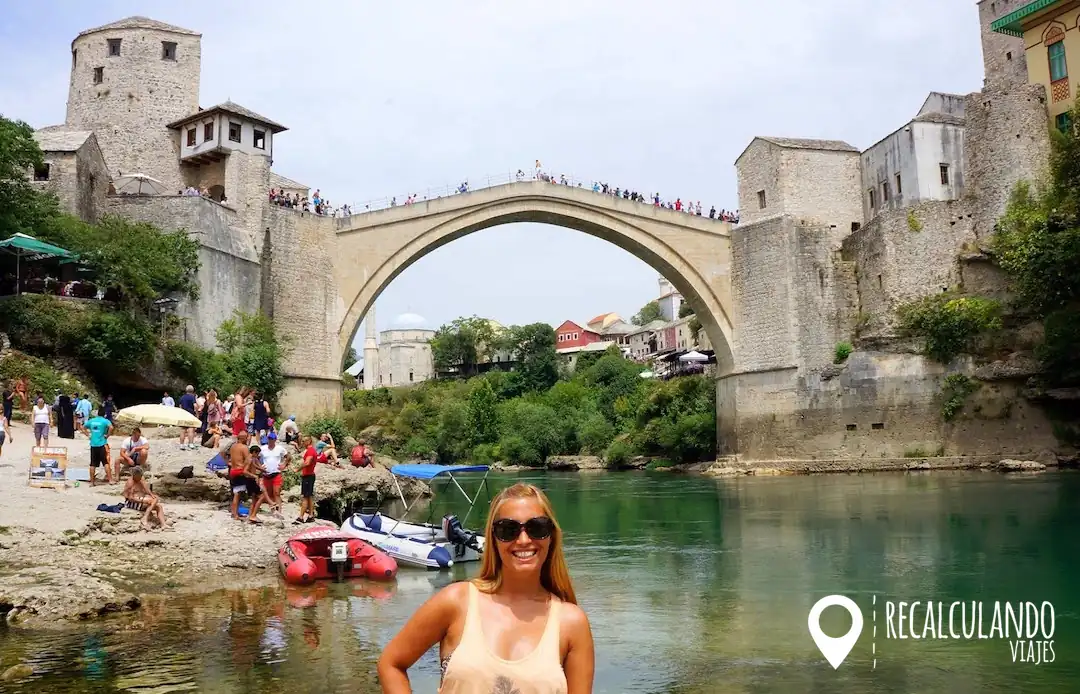
It is impossible to pass by the Stari Most without seeing someone preparing to jump. The divers of Mostar have been part of the city’s identity for more than four centuries, and the local club organizes jumps throughout the high season.
The jump is between 20 and 24 meters, depending on the level of the Neretva, and the water is freezing even in mid-summer. It is not a show with a fixed schedule: the diver climbs onto the railing, takes his time, warms up, and collects money from the people who crowd around to watch. When they collect enough, they jump. That’s the whole mechanism. There is usually a hat or an assistant going around collecting: count on leaving about 20-30 KM among everyone if you stay to watch.
We waited for a good while and it was worth it, although I warn you that the wait can be very long. One thing though: don’t even think about jumping on your own. To dive, you have to be trained and be part of the city’s diver club; there have been serious accidents involving tourists who tried it. Watch, clap, leave your contribution, and that’s it.
3. Lučki Most, the best view of the Old Bridge
This is the worst-kept secret among photographers and one of the things to do in Mostar that most people miss because they don’t know it exists.
The Lučki Most is a modern, functional bridge without any architectural grace, about 300 meters downstream from the Stari Most. And precisely because of that, it is perfect: from the middle of the Lučki Most, you have the full frontal view of the Old Bridge, with the entire arch, the two towers, the old town climbing up the hillside, and the Neretva in the background. It is the perfect postcard frame, and it costs nothing.
Our advice is to start your tour right here, before heading into the old town. You see the complex from the outside, understand the city’s geography in two minutes, and then go down to walk through it. On the way back, if you return at sunset, the light falls directly onto the stone and the bridge turns golden.
If you come by car, this area is also practical: the parking lots on the edge of the pedestrian old town are nearby, and from there, you just walk.
4. Kriva Ćuprija, the Crooked Bridge
About 200 meters from the Stari Most, over the Radobolja stream, there is a much smaller and much quieter bridge. It is called Kriva Ćuprija and predates the famous one: it was built around 1558, and some say it served as a test before undertaking the big work over the Neretva.
We really liked this area, and it is where we found the respite that was not in the bazaar. There are terraced platforms over the stream, old water mills, and plenty of shade. You get there by going down an alley from the main street of the old town, and since most people don’t deviate, there is always less movement.
A curiosity: the current bridge is not exactly the original. A flood of the stream destroyed it in the late nineties, and it was rebuilt with the recovered stones. Another scar of a city that has many.
5. Onešćukova Street, the prettiest in the old town
Leaving the Crooked Bridge and going up a short ramp, you reach Onešćukova, which for us is the most beautiful street in Mostar and one of the things to do in Mostar that doesn’t appear on quick lists.
It is the axis that connects the area of Kriva Ćuprija with the Stari Most, cobblestoned, with low stone houses, workshops, some open courtyard, and the silhouette of a minaret peeking out among the roofs. It has much less commercial movement than the Kujundžiluk on the other side of the bridge and much more of a neighborhood feel.
It’s a five-minute walk that most people do in a rush to reach the bridge. We recommend the opposite: do it slowly, look up, and step into the side alleys that lead down to the stream. There lies the Mostar that doesn’t appear on Instagram.
6. Kujundžiluk, the old town bazaar
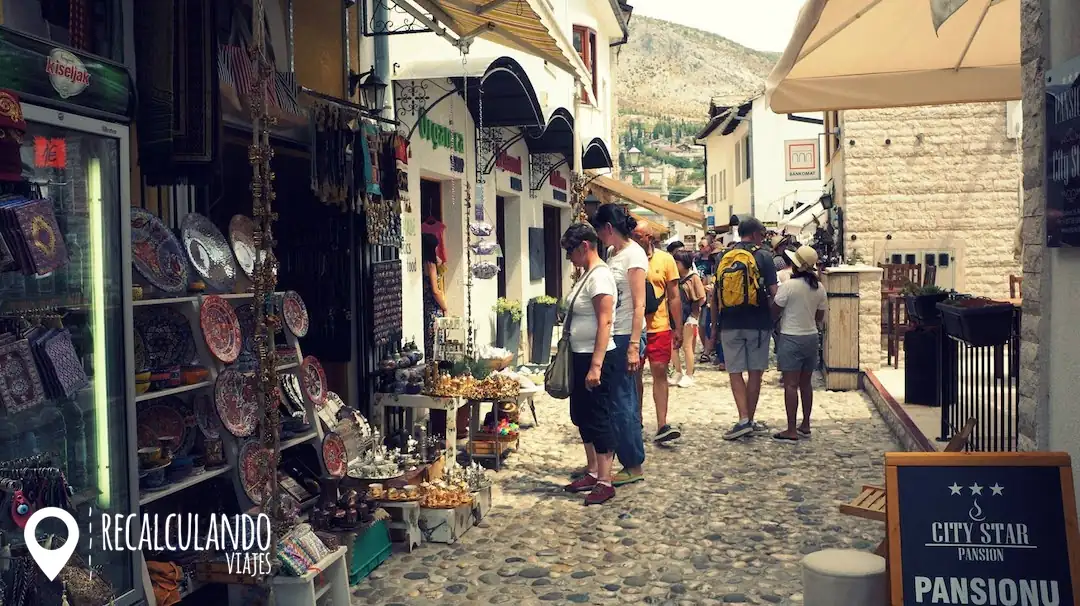
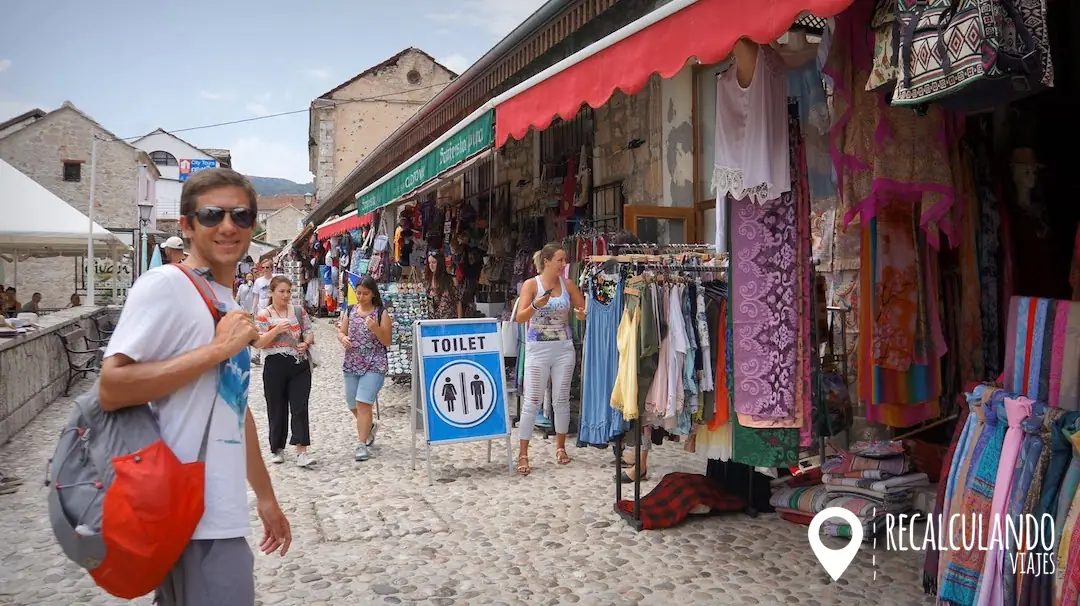
Kujundžiluk Street starts at the bridge itself and goes down towards the east between stalls of copper, rugs, Turkish coffee sets, grinders, magnets, and bags. It is the commercial heart of the old town and one of the most recognizable postcards of Mostar.
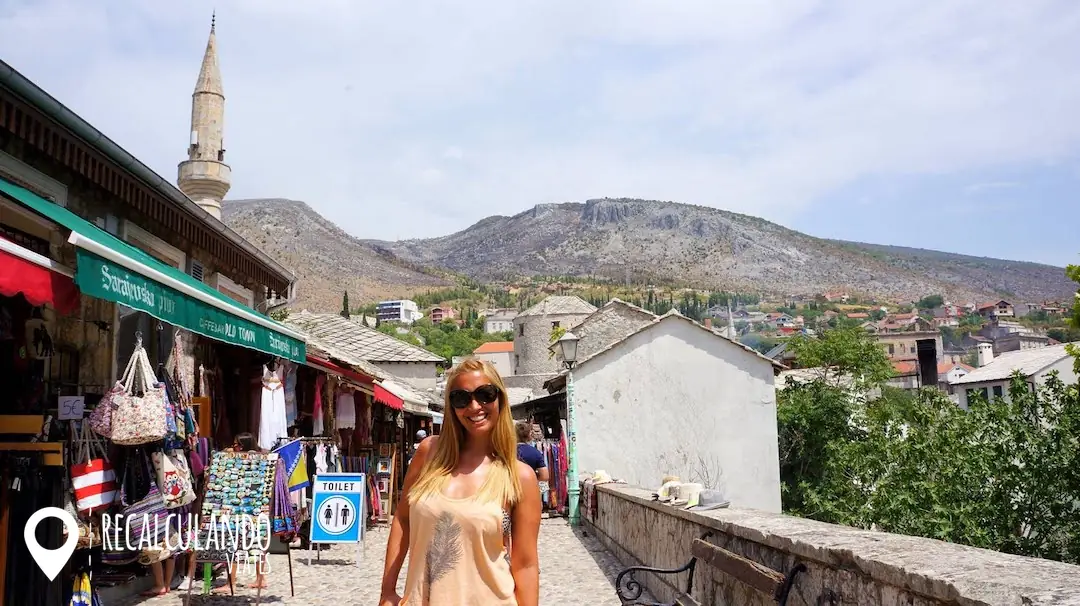
The name comes from the “kujundžije,” the goldsmiths who worked here in Ottoman times. There are still real workshops where copper is hammered by hand, mixed with stalls clearly designed for tourism. You can tell pretty quickly: if you see someone working the metal in the back of the shop, the stuff there is genuine.
We loved wandering through it without rushing, although at noon in the summer there were many more people and the heat among the stones was noticeable. A detail that caught our attention: many stalls sell engraved bullet casings converted into pens or ornaments. It is a controversial souvenir, and some travelers are uncomfortable with it, but it is part of the current commercial landscape of the city.
Tip: haggling is accepted and is part of the game, especially if you buy more than one thing. Without being aggressive, but asking never hurts.
7. Eat Bosnian food, one of the best things to do in Mostar
Here is one of the big reasons not to do Mostar in three hours: you eat very well and very cheaply. After Croatia, where prices on the coast are through the roof, sitting down to eat in Mostar is a relief for your wallet.
Eating well is one of the things to do in Mostar that surprised us the most. These are the dishes you absolutely must try:
- Ćevapi: the national dish. Small grilled minced meat sausages, served inside a pita-style bread called somun, with raw onion and kajmak, a dairy cream similar to sour butter. It is ordered by the piece (10 or 5).
- Burek: puff pastry rolled in a spiral filled with meat. Be careful with the name: if the filling is cheese, it’s called sirnica, and if it’s spinach, zeljanica. It is the quintessential street breakfast.
- Japrak and sogan-dolma: vine leaves or whole onions stuffed with meat and rice, slow-cooked. Homemade food, of the kind we like most.
- Klepe: small ravioli with garlic and yogurt, very similar to Turkish manti.
- Baklava and tufahija: the sweets. The latter is a peeled and boiled apple stuffed with walnuts and cream, and it is much less cloying than it sounds.
- Bosnian coffee: served in a small copper pot (džezva) with a tiny cup, a sugar cube, and a Turkish delight on the side. It is not a coffee to drink in a hurry.
Regarding where to eat, we prefer not to give names: the establishments in the old town change owners and quality all the time, and we are not going to recommend something we haven’t tried ourselves. What we can tell you is how to choose: get a block or two away from the direct view of the bridge. The terraces with a view are spectacular for having a drink, but you pay for the scenery. The places where the Bosnians eat are on Braće Fejića street, the pedestrian street on the east side, and the price difference is noticeable.
8. Tara Tower and the Old Bridge Museum, one of the places to see in Mostar
The two towers that guard the Stari Most have their own names: Tara, on the east side, and Halebija, on the west. During the Ottoman era, Tara functioned as a powder magazine and ammunition depot. Today, it is the headquarters of the Old Bridge Museum (Muzej Stari Most), created in 2006 after the reconstruction.
The tour is organized into three parts: the history of the bridge, archaeological remains, and the rehabilitation process after the war, with audiovisual material about the destruction of 1993 and the rescue of the original stones from the bottom of the river. Many travelers recommend it precisely for that last section, which is the one that gives you the most context.
We didn’t go in because we were on a fairly tight schedule from Croatia, so we tell you this with the information we were able to gather. The entrance fee is around 8-10 KM (about 4-5 €) and the hours vary by season: in summer it usually opens from 10 am to 6 pm, and in shoulder months it closes earlier. It is best to confirm it at the ticket office on the same day, because the hours change quite a bit.
9. Koski Mehmed Pasha Mosque, one of the must-sees in Mostar
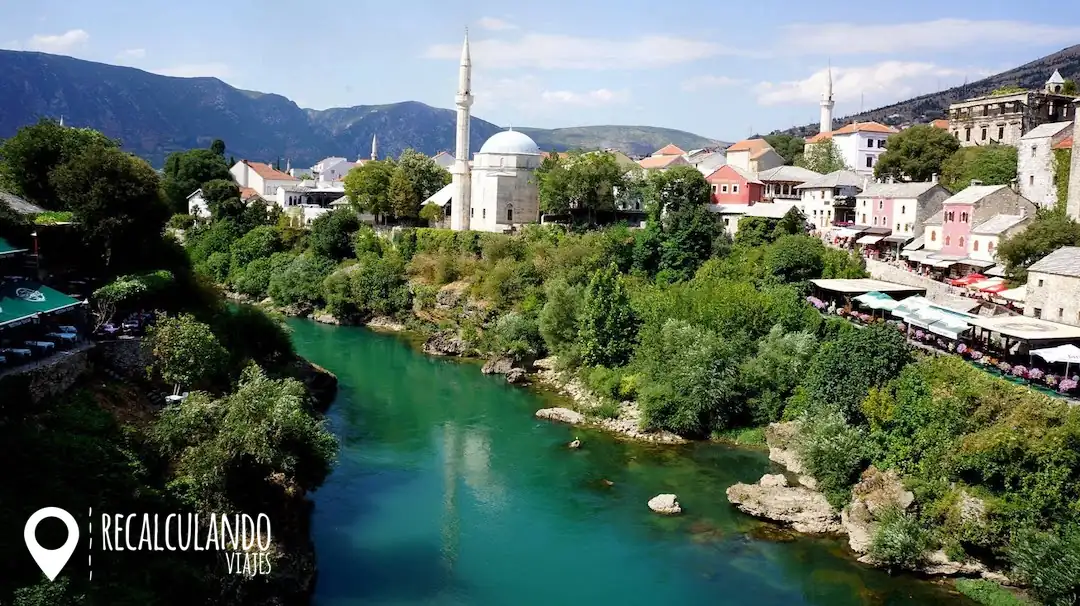
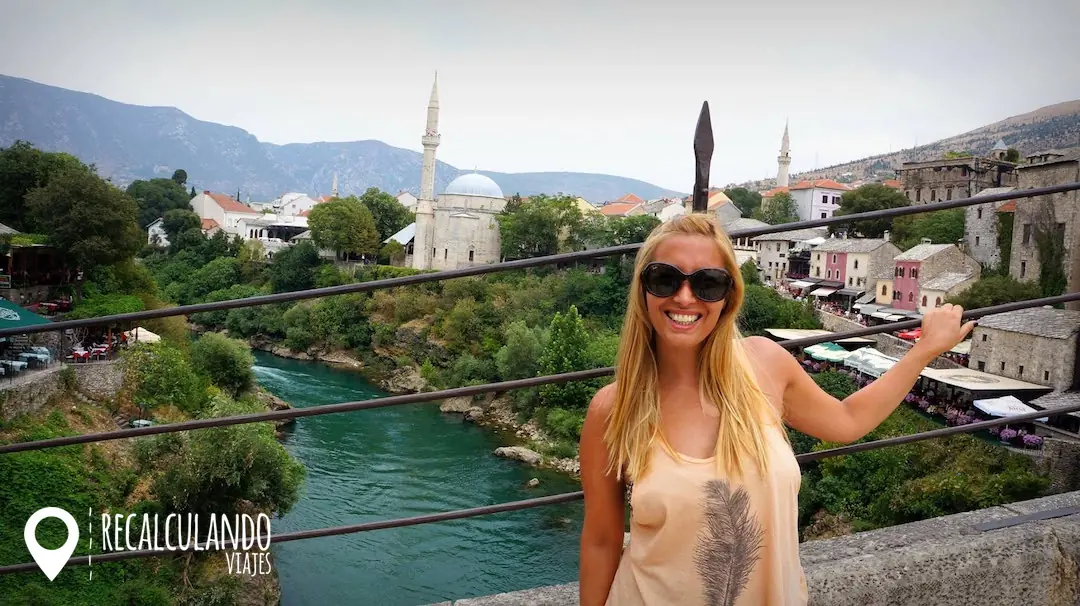
That photo you’ve seen a thousand times of the Stari Most from above, with the green river in the background and the whole old town fitting into the frame, is almost certainly taken from the minaret of this mosque.
The Koski Mehmed Pasha was built in 1618 and is one of the best examples of Ottoman architecture in all of Herzegovina: a single dome, a slender minaret about 30 meters high, and an interior with floral decoration and calligraphy. The courtyard can be toured without paying, but to go inside and climb the minaret, an entrance ticket is required.
Here comes the important piece of information: the prices you will find published vary greatly, from 8 to 15 KM (between 4 and 8 €) depending on the season, so take it as an estimate and confirm on the spot. The climb consists of about 90 very narrow and steep spiral stairs, with room for only one person: when someone is going down, you have to press against the wall. It is not suitable if you have mobility problems or claustrophobia.
A practical detail that almost no one mentions: in the courtyard there are fountains with cold drinking water, very useful in summer. And for women, they lend scarves at the entrance, so you don’t need to bring your own.
We didn’t climb, but it is one of those places where almost all travelers agree that the view compensates for the entrance fee and the stairs. If you are going to pay for only one thing in Mostar, many say it should be this one.



10. The banks of the Neretva: where to take the best photos of the bridge
One of the things to do in Mostar is not a building: it’s the two banks of the river. And if it matters to you to return with good photos, this will serve you better than anything else.
The best point at water level is on the west bank, going down the stairs that come out near the Halebija tower. From there, on the riverbank stones, the bridge fits completely into the frame with the arch reflecting. It is the classic angle and it costs nothing. Watch out for the stones: they are wet and quite treacherous.
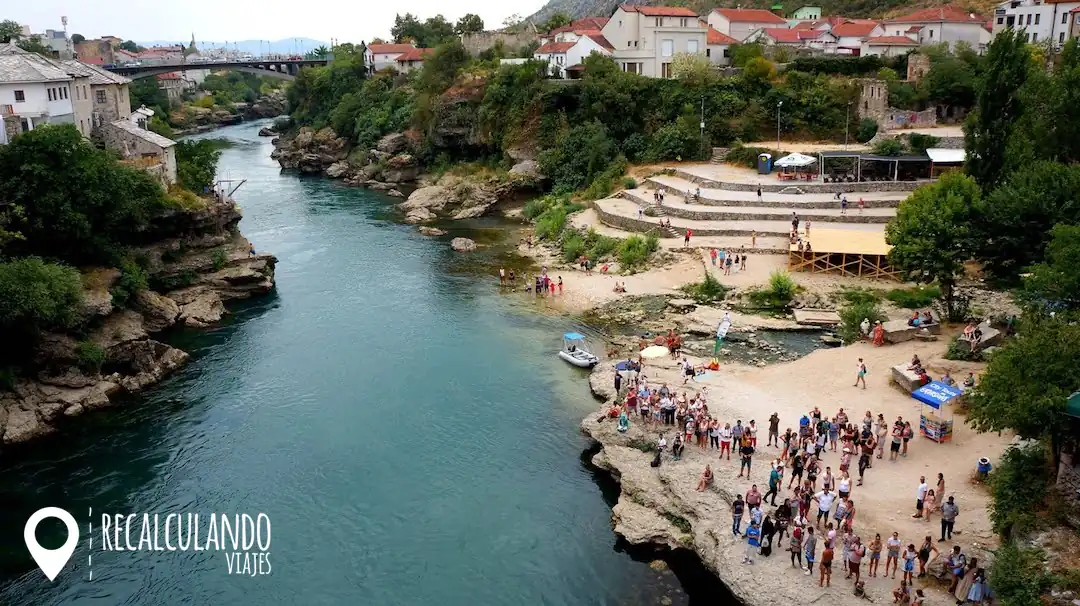
On the east side, from the terraces of the restaurants facing the river, you have the most elevated view. You don’t need to consume to lean out in most public viewpoints, although having a drink while looking at the bridge is one of those things one does anyway.
The color of the Neretva deserves a separate paragraph. It is a turquoise green that looks retouched, but it isn’t: it comes from meltwater loaded with minerals that flows down from the mountains. In spring, it is at its most intense. There are also short 15-minute boat trips that depart from under the bridge for 5-10 € per person, without prior reservation.
11. War Victims and Genocide Museum 1992-1995, the toughest thing to visit in Mostar
This is probably the toughest place on the list and, at the same time, the one that will most change the way you look at everything else.
The museum is in the heart of the old town, meters from the bridge, and focuses on the suffering of the civilian population during the Bosnian War: first-person testimonies, photographs, personal objects, documents, and reconstructions of detention camps. It is not a military museum or a story of battles; it is the war told by those who suffered it. The entrance fee is around 10-12 KM (about 5-6 €).
Very close by, next to the Old Bridge, is also the War Photo Exhibition, a much smaller and faster exhibition, set up in one of the towers, with photos by New Zealand photojournalist Wade Goddard taken during the conflict. If you are short on time, this is the condensed version.
We didn’t go into either, so we don’t tell you this from our own experience, but it is the point on which all travelers agree the most: it is difficult, but it is what gives meaning to the rest of the visit. An honest warning: there are very graphic images and we wouldn’t recommend it for children.
12. Bišćević House, a Turkish house over the river
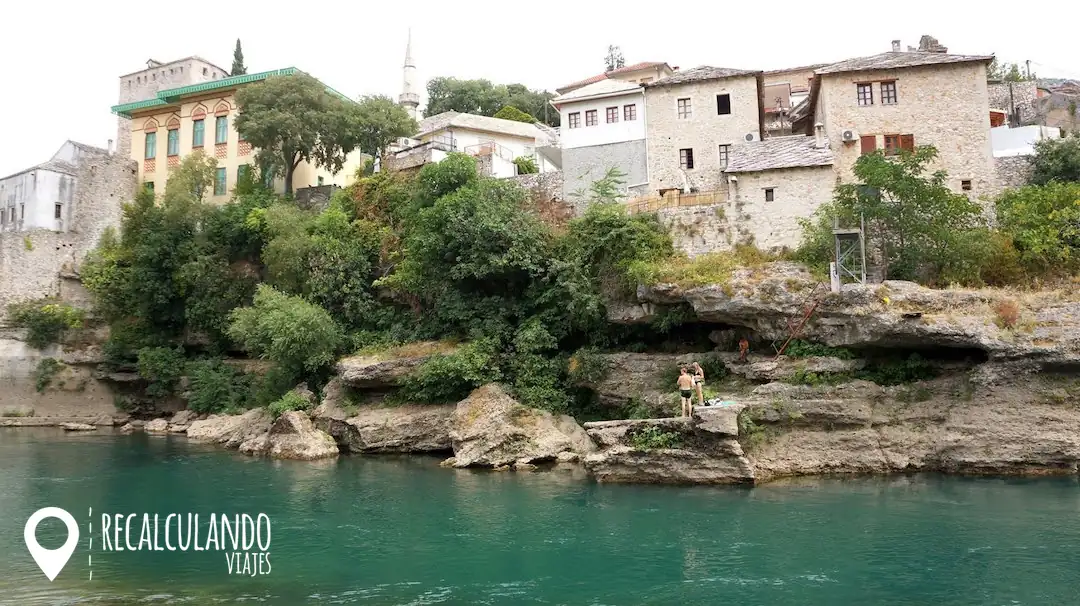
The Bišćevića kuća is a 17th-century Ottoman house built directly over the ravine of the Neretva, supported by nine-meter stone columns that emerge from the water.
What those who visit it highlight the most is the “divanhana,” the open living room on the upper floor, with cushions, rugs, and windows that look directly onto the river. It is the best way to understand how a wealthy family lived in Ottoman Mostar, with the traditional separation between reception and private areas.
The entrance usually costs around 4-6 KM (about 2-3 €) and the visit takes no more than twenty minutes. We are not into entering house museums unless they are essential, so we tell you this from what we collected and not from our experience. But if you are interested in Ottoman domestic architecture, many travelers rank it above the larger museums in the city.
👩⚕️👨⚕️ A must-have for stress-free travel! 🌎✈️ ➜ Get a Quote, Compare & Buy
13. Muslibegović House, between a museum and a hotel
The other famous Ottoman house in Mostar is the Muslibegović, a little further north, already outside the most touristy core. It is a National Monument of Bosnia and Herzegovina and has a lovely quirk: it functions both as a house museum and as a boutique hotel.
In other words, you can visit it by paying an entrance fee of about 4-8 KM, or stay there directly. The rooms are decorated in the traditional Bosnian-Ottoman style, with antiques, and the prices we saw published start around 75 € per night for a double room. If you are looking for accommodation with character instead of a generic hotel, it is an option that is mentioned a lot among travelers who stay the night in Mostar.
The complex combines two courtyards, the winter and summer areas, and a collection of household objects, textiles, and books. It is about a ten-minute walk from the Stari Most, uphill.
If you were left wanting more Ottoman houses, there is a third less known one: the Kajtaz House, which was the harem of a 16th-century dwelling and which many travelers describe as the most authentic of the three, precisely because it remains a house inhabited by descendants of the family.
14. Karađoz Bey Mosque, the largest in Herzegovina
Built in 1557, the Karađoz Bey is the largest and most important mosque in the entire region and one of the Ottoman masterpieces of Bosnia. It is on Braće Fejića street, the main pedestrian street on the east side, about ten minutes from the bridge.
It was severely damaged during the war and restored later, and today it remains a functioning mosque, not a museum. This implies the obvious: if you enter, respect prayer times, take off your shoes, and keep your shoulders and knees covered. At the entrance, they usually lend scarves and sarongs.
It receives many fewer visits than the Koski Mehmed Pasha, which is meters from the bridge, and that is precisely what makes it interesting. The courtyard with the ablution fountain and the cemetery with the leaning Ottoman tombstones is one of those corners where suddenly you are almost alone in a city full of people. The entrance, when charged, is symbolic.
15. The Turkish Hamam
The old Mostar hamam is a 16th-century Turkish bath that today functions as a museum space and exhibition hall. It is not an operational hamam: you won’t bathe there, you’ll see what it was like.
What is interesting is the architecture: the domes with the characteristic glass holes that let in beams of light, the rooms of different temperatures, and the underfloor heating system. The entrance costs about 5 KM (about 2.50 €) and the visit is short, half an hour at most.
Many travelers recommend it especially if you are hot: the stone interior stays cool and is a good refuge in the central hours of the day in summer.
16. The Boulevard and the old front line, one of the most striking places to see in Mostar
This is the part of Mostar that doesn’t appear on postcards and which, for us, is as essential as the bridge.
The Boulevard (Bulevar narodne revolucije) and Aleksa Šantić street were the front line during the conflict of the nineties, when the city was split in two. Just walk a few blocks to the west, moving away from the old town, to start seeing facades literally perforated by bullets and empty buildings that were never rebuilt.
The best-known one is the so-called Sniper Tower, a former nine-story bank building that during the war was a sniper position and later remained abandoned, covered in graffiti. It was for years a magnet for travelers and photographers, although recently access has been restricted and the building is closed and boarded up, so don’t count on being able to go up. It can be seen perfectly from the outside, from Zrinjevac Park.
Another building that is striking is the old Neretva Hotel, on the banks of the river, of which barely the structure remains. And throughout the neighborhood, you will find murals and graffiti that are, to a large extent, the way the city’s young generation has found to talk about all this.
We were very struck by walking through here after having been among the copper stalls of the bazaar. It is the same city, ten minutes away, and they are two worlds. If you want to really understand Mostar, don’t just stay on the pretty side.
17. Plaza de España and the Gimnazija
The Španjolski trg, or Plaza de España (Spanish Square), is the point where everything we were talking about meets. It is named in honor of the Spanish soldiers of the peacekeeping forces who died in the area during the conflict.
The building that dominates the square is the Gimnazija Mostar, which is not a gym but the city’s high school, in the Austro-Hungarian pseudo-Moorish style, with its striped colors and its arches. It was destroyed during the war and rebuilt later. Today it is probably the most beautiful building in the modern part of Mostar and has an enormous symbolic weight: for years it operated with two separate educational programs inside the same building, one for Bosniak students and one for Croats, a system known as “two schools under one roof.”
It is also a good reference point for orienting yourself: from here starts the trail that climbs Hum Hill, and you are ten minutes walking from both the old town and Zrinjevac Park.
18. The Franciscan bell tower, the highest viewpoint in Mostar
The tower of the Franciscan Church of St. Peter and St. Paul can be seen from all over the city: more than 100 meters of bell tower that make it the tallest structure in Mostar. It is relatively new, built after the war, and is known as the peace tower.
You can go up, and it is one of the things most recommended by travelers who have little time. An elevator takes you almost to the top and the last floors are done on foot. The entrance costs about 3 € and from the terrace, you have a 360-degree panorama: the Neretva splitting the city in two, the old town, the minarets, the Millennium Cross on Hum Hill, and the mountains of Herzegovina in the background.
It is the best way to understand something that you don’t perceive by walking: the touristy old town is just a very small portion of a city that is much larger and quite a bit more normal than one imagines.
19. Zrinjevac Park and the Bruce Lee pedestal
This is the strangest story you will take away from Mostar, and it must be told with updated data.
In 2005, a life-size bronze statue of Bruce Lee was inaugurated in Zrinjevac Park. It was the first statue of the actor in the world, the work of Croatian sculptor Ivan Fijolić, and the idea came from a local youth association that was looking for a symbol that all three communities of the city could identify with equally. Several names were voted on, including Tito and the Pope, and the martial arts master won because he didn’t belong to any side. It was inaugurated one day before the one in Hong Kong.
The important detail: the statue was stolen in March 2024 and was later found cut into pieces. In 2026 the statue is here, just in case, it is advisable to confirm the status before going, because it may change.
The park is still worth it on its own: it is large, has shade, playgrounds for children, and is the best place to see the Sniper Tower up close.
20. Fortica Sky Walk, one of the newest must-sees in Mostar
And we close the list of the 20 things to do in Mostar with the city’s newest must-see, one that almost no guide in Spanish includes yet. On Fortica Hill, atop an 1880 Austro-Hungarian fortress east of the old town, there is a walkway of about 35 meters with a glass floor suspended over the hillside.
From there, you have the entire city, the Neretva valley, and the Stari Most below, tiny. You can get there in about 15 minutes by car along an asphalt road with sharp curves, and there is free parking at the top. You can also walk up, but it is a good uphill hike, and in the heat, it’s not a great plan.
There is also contradictory information floating around here: some sources say the platform is free, and others talk about an entrance fee of about 10 KM (about 5 €). What is definitely paid for sure are the adventure park activities: the 570-meter zip line, the via ferrata, and the rock climbing. It is best to confirm on the spot.
As an alternative, there is the Millennium Cross on Hum Hill, on the other side of the valley, which you can hike to in about an hour from Plaza de España. We must be clear here: the trail passes close to areas that still have mine warning signs from the nineties. If you do it, do not stray from the marked path under any circumstances, and if you are not sure, it is better to go with a guide or stick with Fortica.
What to do in Mostar in 1 day: recommended itinerary
If you are wondering what to do in Mostar in one day and are coming from Split, Trogir, or Dubrovnik, which is what most people do, this is the order we would do it in based on the experience of having done it:
| 9:00-9:30 | Arrival, park on the edge of the old town, and walk down to the Lučki Most for the frontal view of the Old Bridge |
| 9:30-11:00 | Kriva Ćuprija, Onešćukova Street, and arrival at the Stari Most while it’s still uncrowded |
| 11:00-12:30 | Kujundžiluk Bazaar, minaret of the Koski Mehmed Pasha, and descent to the banks of the Neretva for photos |
| 12:30-14:00 | Bosnian lunch on Braće Fejića street, cheaper and less touristy |
| 14:00-15:30 | Karađoz Bey Mosque, Ottoman houses, and Museum of War Victims |
| 15:30-17:00 | The Boulevard, the Sniper Tower, Plaza de España, and Zrinjevac Park |
| 17:00-19:00 | Climb to Fortica or the Franciscan bell tower, and return to the bridge at sunset |
If you stay the night, move everything an hour earlier and add Blagaj in the mid-afternoon, which is the best way to see Mostar and the surroundings without rushing. And if you come on an organized excursion, you will have between 3 and 4 hours free: in that case, stick to points 1 to 10 and forget the rest.
Where to sleep in Mostar
Now you know what to do in Mostar, now for the practical part. Our recommendation after having gone for the day: if you can, sleep one night. Mostar changes completely when the excursion buses leave, and the illuminated bridge at night with the old town almost empty is another experience. In addition, accommodation prices are notably lower than on the Croatian coast.
The ideal area is the old town and its immediate surroundings, on the east side of the river: you can walk everywhere and have life at night. Most options are family guesthouses and small hotels, many with terraces over the river. If you come by car, check the parking situation carefully, because it is complicated in the old town and many accommodations in the center do not have their own space. The DUM area, about 600 meters west of the bridge, is usually a good balance: you are within walking distance, it is quieter, and there are more options with parking included.
On this map, you can see the accommodation available in Mostar with real prices for each date, comparing between different platforms:
Season tip: in July and August it is advisable to book well in advance, because Mostar’s hotel stock is small and fills up with travelers doing the Split-Mostar-Dubrovnik route. In May, June, or September, you will find much more availability and better prices.
How to get to Mostar
Mostar is very well connected with the Croatian coast, Sarajevo, and Montenegro, and all the things to do in Mostar in this guide can be done as a day trip, which is what we did.
By car from Croatia
It is the option that gives you the most freedom and the one we chose. We went from Trogir, and it is a long 2.5-hour journey. From Split, it is about 135 km and about 2 hours and 15 minutes without counting the border; from Dubrovnik, about 2 hours and 30 minutes inland via Imotski.
Here is the most important piece of information in this entire section: Bosnia and Herzegovina is not in the European Union, so there is real border control. If you go with a rental car taken in Croatia, you absolutely need two things: the Green Card (the international vehicle insurance certificate) and your rental agreement must expressly allow crossing into Bosnia. Many companies charge a supplement for crossing the border that can range from 10 to 50 €, and others include it for free on multi-day rentals. Ask when booking, not at the counter.
Waiting times at the border are variable: we got through quite quickly, but in high season and on weekends, it can take quite a bit longer. Keep your passports handy and count on that extra margin when planning your day.
Where to park in Mostar
This question is answered by almost no one, and it is one of the first ones that comes up if you are driving. The old town is pedestrianized, so you have to leave the car on the edge. There are several paid parking lots around the perimeter, especially in the Boulevard area and near Lučki Most, with low hourly rates compared to Croatia (count on about 2-3 KM per hour, about 1-1.50 €). In high season they fill up early, so arriving before 10 am is doubly beneficial. If your accommodation has its own parking, use it and walk around: it’s not worth driving into the center.
By bus
There are direct buses between Split and Mostar, with a travel time of about 3 hours and 30 minutes to 4 hours and prices starting at about 20-25 € each way. From Dubrovnik, it is about 3 to 4 hours for about 15 €, and from Sarajevo about 2 hours and 30 minutes for about 10 €. There are also connections from Kotor and Podgorica, in Montenegro, including night buses. Frequency in all cases is low, so if you want to do it in one day, you have to look closely at the departure and return times before buying.
Useful tip: the main bus station in Mostar has a luggage storage service, with approximate hours from 6 am to 7:30 pm. If you arrive early and leave at night, it saves your day.
By train from Sarajevo
This is the option we would most like to do if we return. The Sarajevo-Mostar train takes about 2 hours, costs about 6 €, and is considered one of the most beautiful rail journeys in Europe: it follows the Neretva canyon between mountains, tunnels, and emerald lakes for almost the entire route. There are few daily frequencies, so you have to plan it, but for price and scenery, it is unbeatable.
By organized excursion
If you don’t want to drive or deal with the paperwork of the border crossing, day trips from Split, Trogir, or Dubrovnik are a very popular alternative. They last between 9 and 11 hours and most combine Mostar with Kravice, Počitelj, or Medjugorje. You have many options in excursions to Mostar from the Croatian coast.
And while in the city, if you want historical context from a local, there are free tours of Mostar lasting about an hour and a half that leave from the old town. For a city with such complex recent history, hearing it told by someone who lived through it changes the visit quite a bit.
FREE🚶♀️➡️Free walking tour of Mostar with a Spanish-speaking guide ➜ Click Here🚶 — free of charge, just the tip you wish to leave.
Travel insurance for Bosnia and Herzegovina
This point is more relevant here than in other European destinations, and for a concrete reason: Bosnia and Herzegovina is not part of the European Union, so the European Health Insurance Card does not cover you. If you come from Spain or any EU country and assume you are covered because you are “in Europe,” you could be in for a expensive surprise.
➜ Calculate your IATI insurance with a 5% discount (Click HERE)
We always travel with insurance and in these years we have already used it several times, especially on road trips where there are more chances of an unforeseen event. We book with IATI, which covers medical expenses, repatriation, theft, and cancellations, and has 24-hour assistance in Spanish.

Things to do in Mostar and surroundings: half-day excursions
If you have already covered the 20 things to do in Mostar and you have room left, these four destinations are all less than an hour away and are some of the best of Herzegovina.
Blagaj and the source of the Buna River
12 km from Mostar, it is the most photographed image of the region after the Stari Most: a white 16th-century dervish monastery built at the foot of a 200-meter cliff, right where the Buna River springs from inside the mountain. Entrance to the tekija is about 10 KM (about 5 €) and you must take off your shoes and cover up. You can also take a short boat trip to the cave for about 10 KM. The water is between 8 and 11 degrees all year round, so if you’re tempted to take a dip, you know what awaits you.
Kravice Waterfalls
About 40 km to the south, on the Trebižat River, there is an amphitheater of waterfalls about 25 meters high that falls into an emerald green pool where swimming is allowed. Entrance in high season is about 20 KM (about 10 €), with long hours from May to September, and off-season there are times when access is free. The best time of the year is spring, when the flow is at its maximum. You go down a long staircase: keep that in mind on the way back.
Počitelj
An Ottoman stone village perched on the hillside above the Neretva, halfway between Mostar and Kravice. It is one of those places where the visit is resolved in an hour and you take away one of the best views of the trip if you climb up to the fortress tower. It is free and usually much less crowded than Mostar.
Medjugorje
25 km away, it is one of the most visited Catholic pilgrimage centers in Europe since the alleged Marian apparitions of 1981. If you are not interested in religious matters, you can probably skip it, but many organized excursions include it.
➜ See excursions from Mostar to Blagaj, Počitelj, and Kravice
Practical tips for your visit to Mostar
The currency. The official one is the convertible mark (KM or BAM), with a fixed exchange rate regarding the euro established by the Central Bank of Bosnia and Herzegovina: 1 euro equals 1.95583 marks.
In the old town of Mostar, the euro is accepted almost everywhere and many businesses set prices directly in euros, but the exchange rate they apply is rarely favorable. If you are only going for the day, you don’t need to exchange: pay in euros or with a card and that’s it. If you stay longer, withdraw marks from the ATM and use a card without a commission for currency exchange, because the difference is noticeable.
Internet: Bosnia is not in the European Union, so your European roaming rate does not work here and you can run up a significant charge without realizing it. We use eSIMs so we don’t depend on bar Wi-Fi: if you want, you can get your Holafly eSIM with a 5% discount using the code RECALCULANDOVIAJES.
Footwear. We repeat it because it is the number one mistake: the rounded stones of the old town and the bridge are very slippery. No smooth soles.
Hours. The old town fills up between 10 am and 4 pm with excursion buses arriving from Split and Dubrovnik. Before 9 am or after 6 pm, the city is a different place.
Respect. Mostar is still a city marked by war and with open wounds. It is a topic that many locals talk about naturally if you ask with respect. And in active mosques, keep shoulders and knees covered.
If you are building a longer route through the area, our guide to things to do in Croatia might be useful, particularly the guide to Brela, which is on the way on the Makarska Riviera, and the Krka Waterfalls, if you want to compare with those of Kravice.
Curiosities about Mostar that almost no one tells
- The city’s name comes from “mostari,” the guards of the wooden suspension bridge that existed before the Stari Most.
- The tradition of jumping from the bridge dates back more than 400 years and served as a rite of passage for the city’s youth.
- To rebuild the bridge, original stones were recovered from the bottom of the Neretva and the historic tenelija quarries, the local limestone, were reopened.
- The Bruce Lee statue in Zrinjevac Park was the first of the actor in the world: it was inaugurated one day before the one in Hong Kong.
- The Gimnazija institute operated for years under the system of “two schools under one roof,” with separate programs for Croat and Bosniak students in the same building.
- The water of the Buna spring, in Blagaj, stays between 8 and 11 degrees all year round.
Map with the 20 things to do in Mostar
So you can organize the tour without wasting time, we made a map with the 20 things to do in Mostar from this guide, plus the surroundings that we tell you about below. Almost the entire old town can be walked in a 15-minute radius; the only thing that requires a vehicle or taxi is Fortica.
Frequently asked questions about Mostar
How many days are needed to see Mostar?
One full day is enough to explore the old town, cross the Stari Most, see the bazaar, and walk through the Boulevard area. If you want to add Blagaj, Počitelj, and the Kravice waterfalls, you need two days. We went on a day trip from Trogir and were left wanting more.
Can you visit Mostar in one day from Split or Dubrovnik?
Yes, and that is what most travelers do. From Split, it is about 2 hours and 15 minutes by car and from Dubrovnik about 2 hours and 30 minutes, without counting the border. By bus, the trip is around 3 hours and 30 minutes to 4 hours, with few daily frequencies, so you have to check the return times well.
What currency is used in Mostar and is the euro accepted?
The official currency is the convertible mark (KM or BAM), with a fixed exchange rate of 1 euro per 1.95583 marks. In the old town of Mostar, the euro is accepted in most shops and many set prices directly in euros, although the exchange rate they apply is usually not favorable. If you go only for the day, you don’t need to exchange money.
What to eat in Mostar?
The essential dishes are ćevapi, grilled meat sausages served in somun bread with onion and kajmak; burek, a rolled puff pastry filled with meat; japrak and sogan-dolma, stuffed vine leaves or onions; and for dessert, baklava or tufahija. Everything accompanied by Bosnian coffee served in a small copper pot. Eating in Mostar is notably cheaper than on the Croatian coast.
Where can you park in Mostar?
The old town is pedestrianized, so you have to leave the car in the paid parking lots on the perimeter, especially in the Boulevard area and near Lučki Most. Rates are around 2-3 KM per hour, about 1 to 1.50 euros. In high season they fill up early, so it is advisable to arrive before 10 in the morning.
Is it safe to travel to Mostar?
Yes, Mostar is a safe city for travelers and crime against tourists is low. The two real precautions are the slippery stones of the old town and not straying from marked trails in the surrounding hills, where there are still mine warning signs from the nineties.
Is travel insurance necessary to go to Bosnia and Herzegovina?
It is highly recommended, because Bosnia and Herzegovina is not part of the European Union and the European Health Insurance Card is not valid there. Any medical attention is private and paid for, so it is advisable to enter the country with travel insurance.
Can you cross into Bosnia with a Croatian rental car?
Yes, but you have to notify the rental company when booking. You need the Green Card, which is the international vehicle insurance certificate, and the contract must expressly authorize the crossing into Bosnia. Some companies charge a supplement of between 10 and 50 euros and others include it for free on multi-day rentals.
What is the best time to visit Mostar?
May, June, and September are the best months: good weather, fewer people, and lower prices. In July and August the city gets crowded and temperatures can exceed 35 degrees, which is difficult for walking among the stones of the old town. Spring is also when the Neretva and the Kravice waterfalls are at their most voluminous.
Conclusion: is it worth going to Mostar?
Resoundingly yes. Of all the things to do in Mostar, the Stari Most draws all the attention, but what stays with you is something else: the mix. Minarets and bell towers in the same frame, an Ottoman bazaar ten minutes from buildings still perforated by bullets, an impossibly green river, and a city that rebuilt itself and continues to rebuild itself.
Our advice, if we have to leave you just one: don’t just pass through. We went on a day trip from Trogir and it was very good, but if you can stay the night, even for one night, you will see the version of Mostar that excursion buses miss. The illuminated bridge, empty streets, and that silence that is unthinkable at three in the afternoon.
If you go, tell us how it went. And if you have any questions about what to do in Mostar, Bosnia, write to us in the comments and we will answer you. Have a great trip!
ℹ️ **Total Transparency**
This article contains affiliate links. If you book through these links, we may receive a small commission at no additional cost to you. We only recommend services we use on our travels and trust. This helps us keep this blog free and continue creating useful content for you. Thank you for your support!
🔗 Resources & Useful Links for your trip to Mostar
Do you have questions or want to add your own recommendations on what to do in Mostar?
💬 Leave your comment or write to us, we love reading other travelers’ experiences.
Thank you very much for being part of this adventure!— Nanu & Facu 🌎 | Recalculando Viajes 💜