Christmas in Budapest is one of those things you’ve had on your bucket list for years, and when you finally experience it, you understand the hype. In this guide, we leave you with the 22 things to do in Budapest at Christmas that are truly worth it. Including dates, updated prices, a map with everything marked, a three-day itinerary, where to stay, and how to get there. We stayed in Budapest for two weeks in November, just as the city began setting up wooden stalls and hanging lights, so we’ll share what to expect and what not from our experience.
FREE🚶♀️➡️Free walking tour of Budapest ➜ Click Here🚶 — no cost, just the tip you want to leave.
🌍 Travel Insurance: 5% Off with IATI Seguros! 🌟
Take advantage of this offer and travel safe.
Budapest at Christmas: Summary
| Category | Key Information |
|---|---|
| Recommended dates | November 14th to January 1st (Advent Season). |
| Ideal duration | 3 to 4 full days to see the main sights. |
| Daily budget | €60-90 per person (excluding accommodation). |
| Currency | Hungarian Forint (HUF). Paying by card is always recommended. |
| Best free plan | Light show on the façade of St. Stephen’s Basilica. |
| Must-do (paid) | Bath in the Széchenyi Thermal Baths (go early to avoid queues). |
| Star transport | Tram 2 (fényvillamos) to see the illuminated Parliament. |
| Typical cuisine | Kürtőskalács, Lángos, Gulyás, and mulled wine (Forralt bor). |
| TIP | Book accommodation 2-3 months in advance. |
Is it worth visiting Budapest at Christmas?
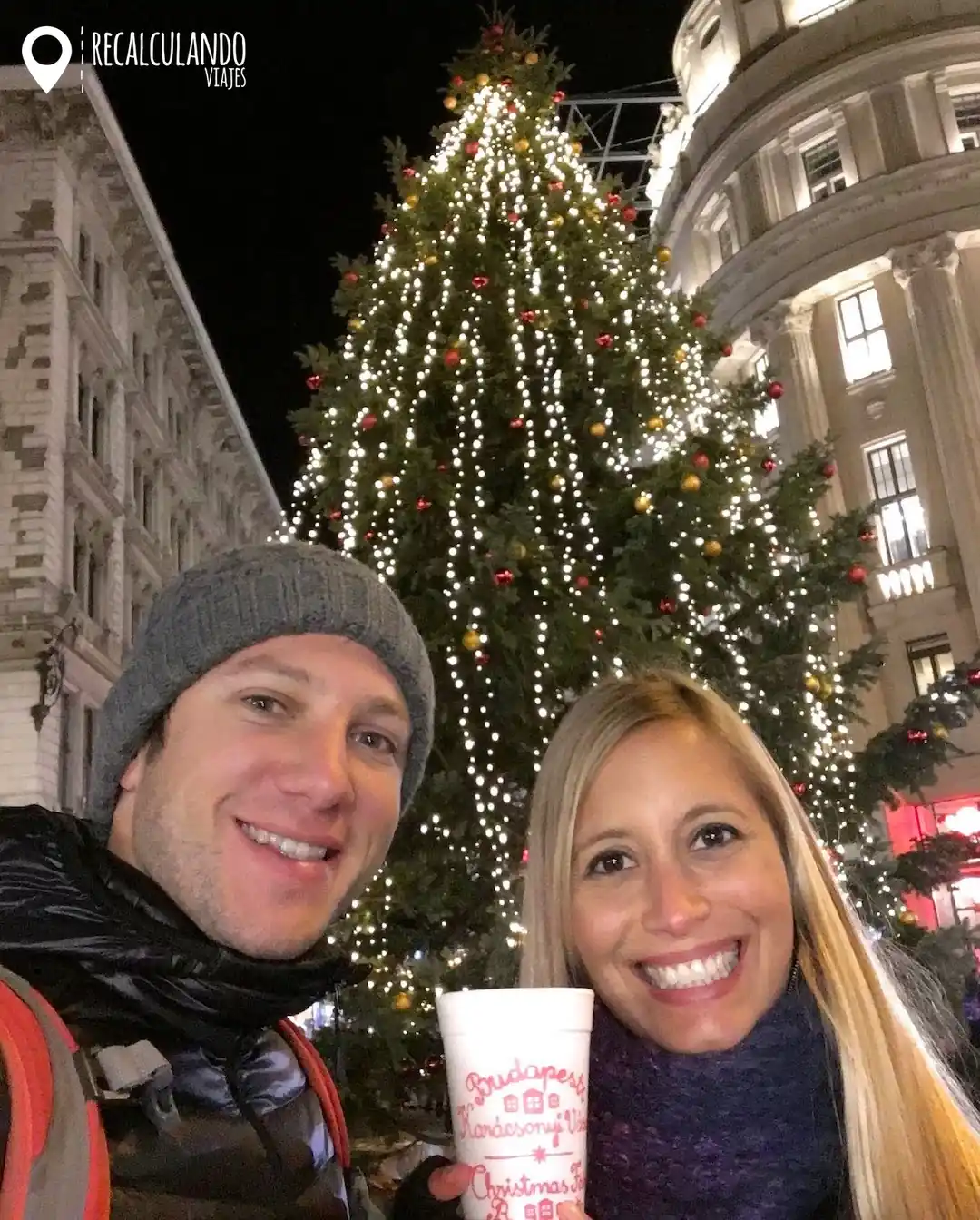
Yes, and we’ll tell you exactly why, without any fluff. Budapest has three things that almost no other European capital combines in December: two world-class Christmas markets (the one at the Basilica has been voted the best in Europe for several years in a row), outdoor hot spring baths to soak in when you can no longer feel your fingers, and a river with the Parliament and castle illuminated that you can see for free from any bridge.
The downsides? Prices inside the markets aren’t Hungarian, they’re German or worse. During Advent weekends, the center becomes uncomfortably crowded. And it almost never snows: the white winter postcard you have in your head will likely be gray and drizzly. Knowing that, the answer is still yes.
If you come to Budapest at Christmas expecting the giant, orderly German market model, you’ll find something different: smaller, more artisanal, and with much more to do outside of the Christmas markets.
1. Vörösmarty Square market, the Budapest Christmas classic
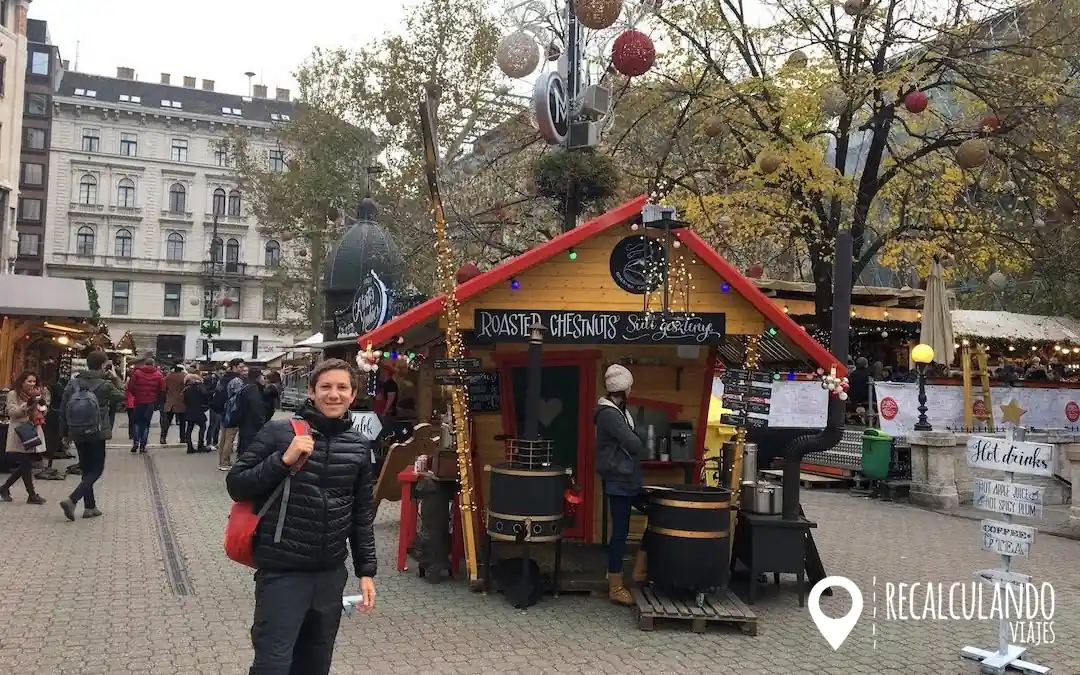
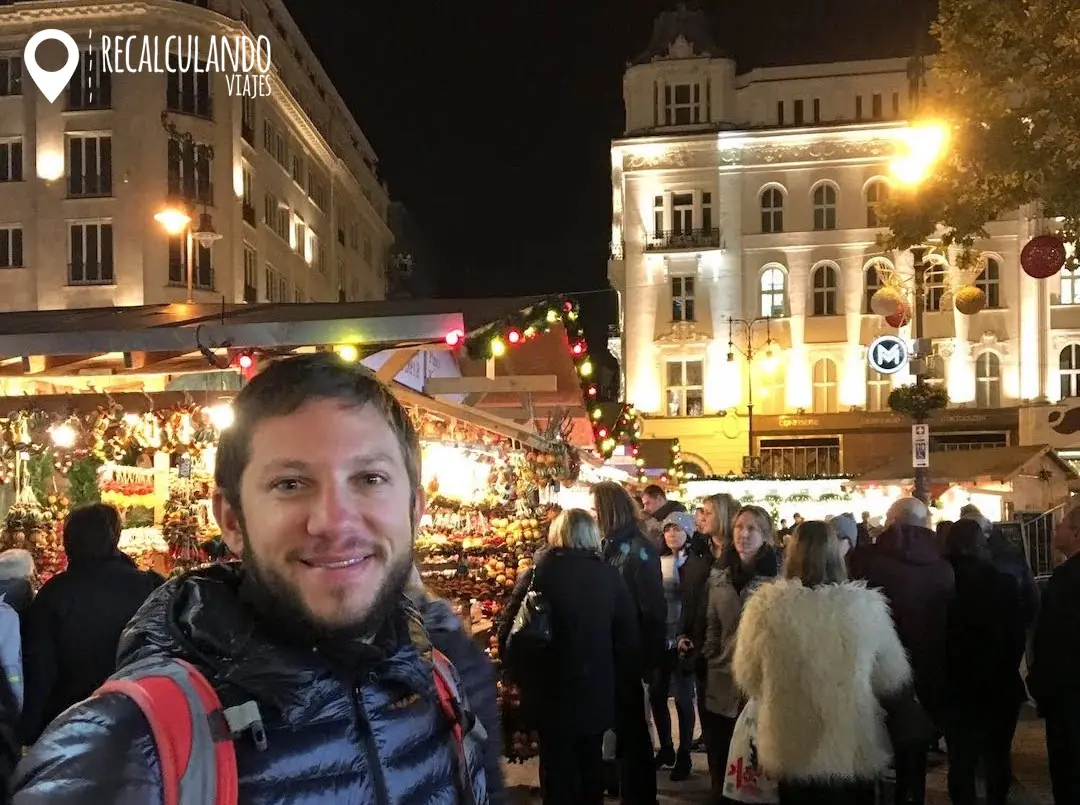
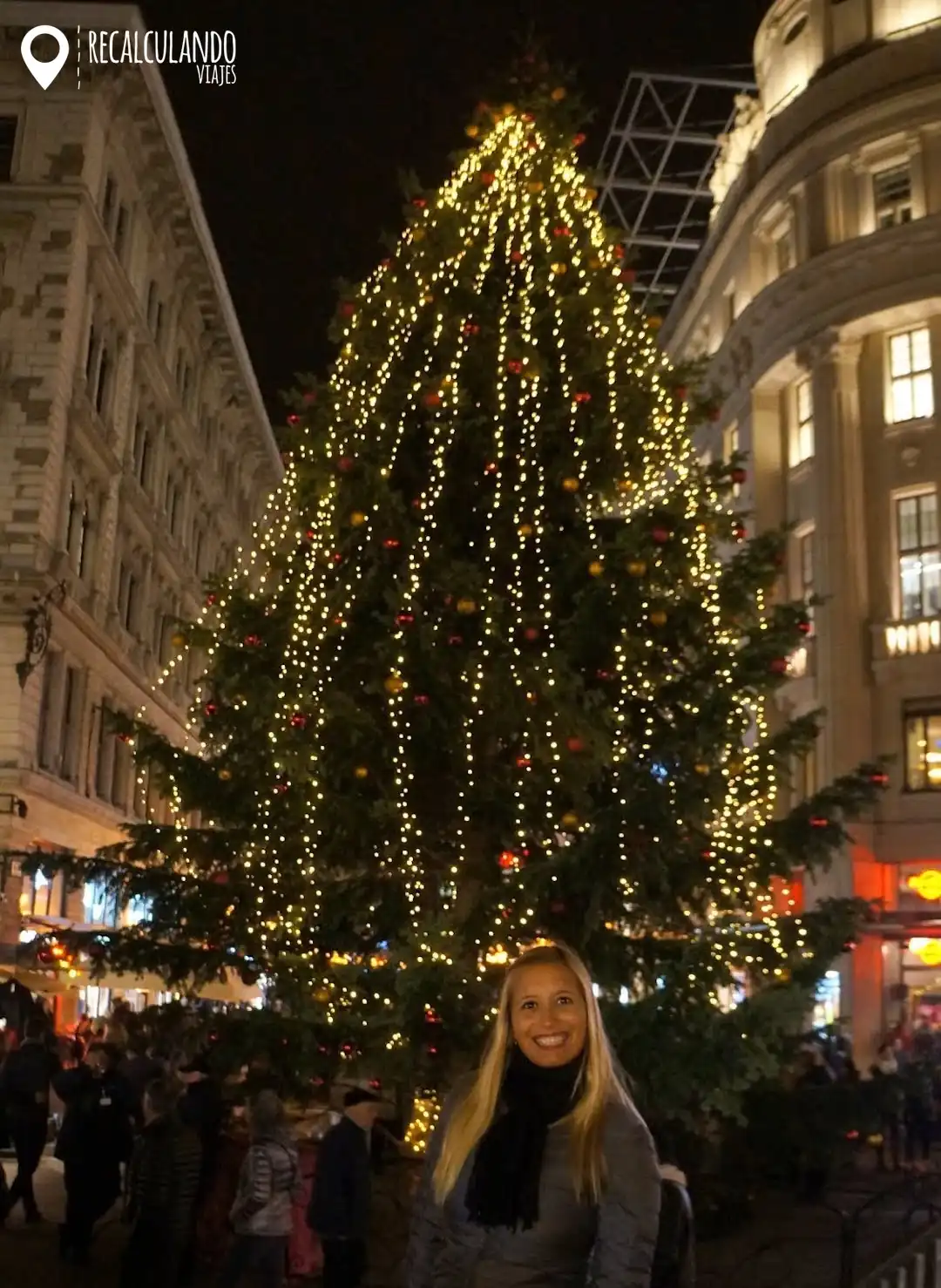
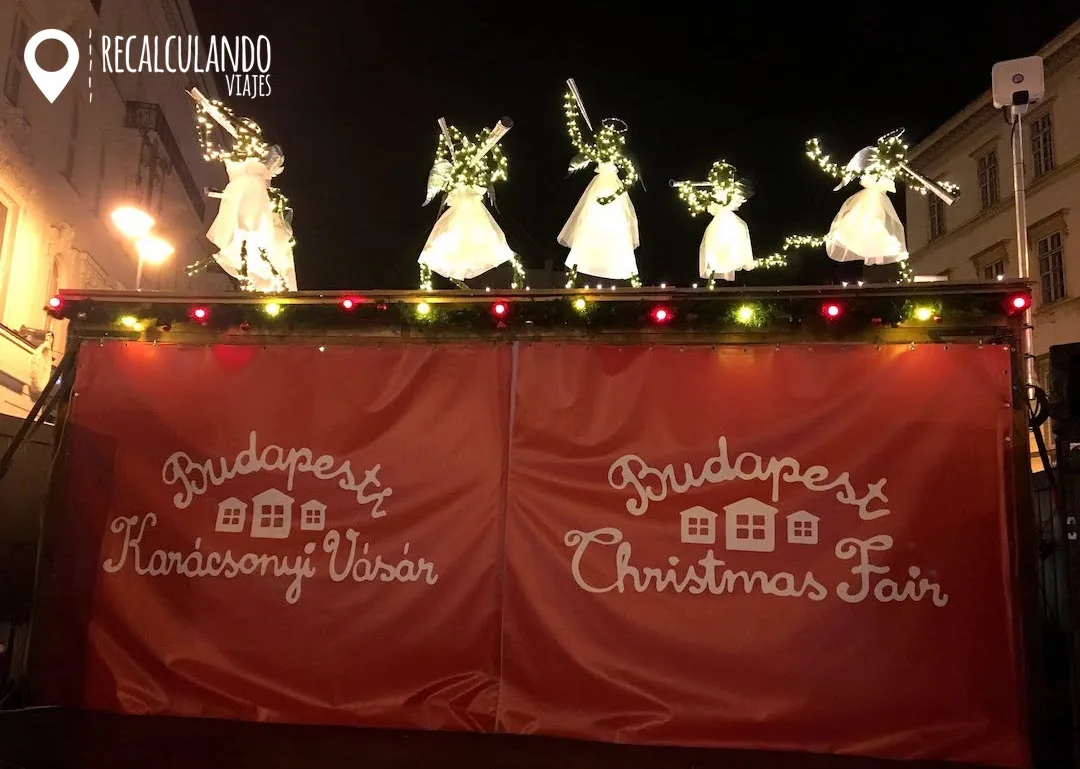
It’s the oldest market in the city and an mandatory starting point for any Christmas in Budapest: it has been operating since 1998 and is organized by the tourism office itself. It’s located in the heart of Pest, at the end of the Váci shopping street, and it’s the one you see in all the photos: beautiful wooden houses in a circle, a huge tree in the middle, and a small train for the little ones.
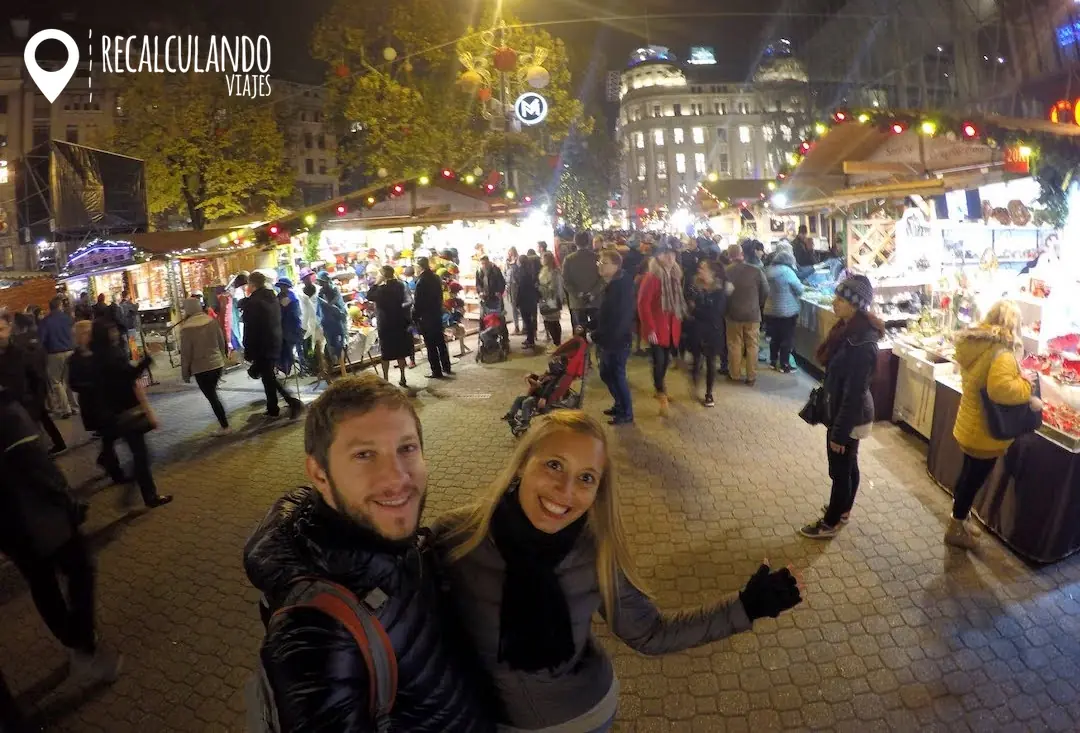
What we liked most about this square when we visited in November is that even without the market, it has a life of its own. With the Christmas stalls set up, many travelers point to it as the best starting point for a first evening. The stalls mix Hungarian crafts—ceramics, embroidery, wooden ornaments—with food huts where you eat standing up, gloves on.
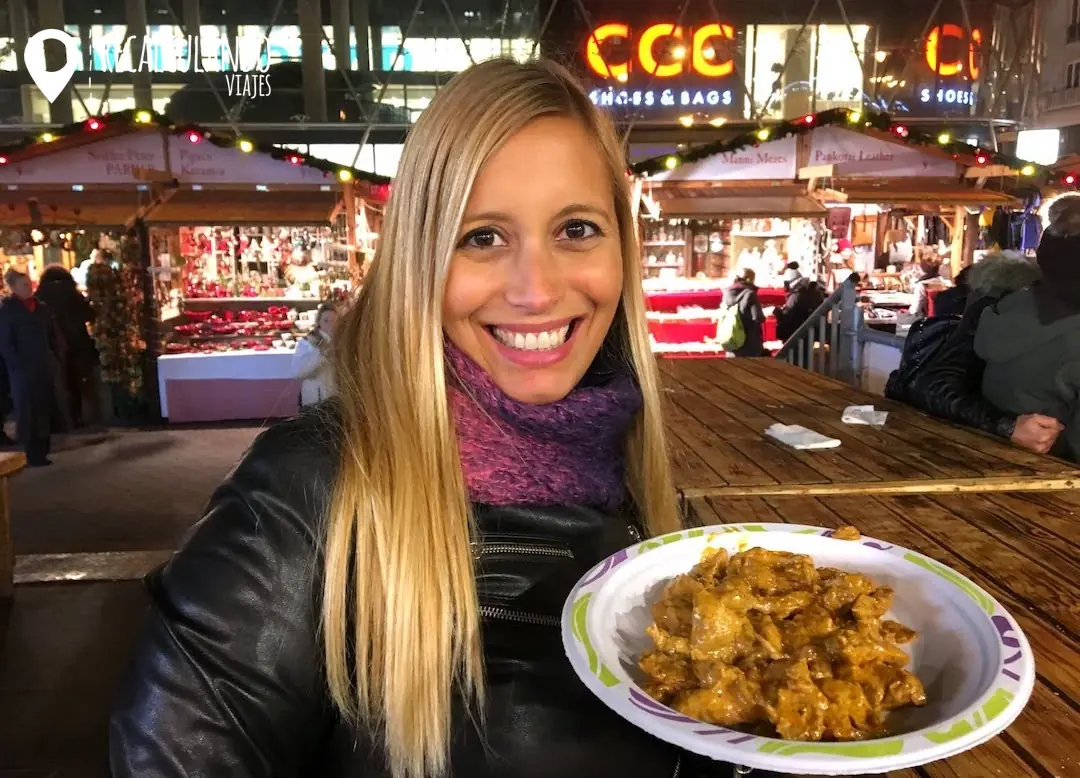
Regular hours: Sunday to Thursday from 11:00 AM to 9:00 PM and Friday and Saturday from 11:00 AM to 10:00 PM. On December 24th it closes early (around 2:00 PM – 3:00 PM), on the 25th and 26th it opens for reduced hours, and on the 31st it stays open until the early morning.
Keep in mind: in this market, several stalls only accept cards. It’s not a minor detail if you come with the idea of exchanging forints in cash for everything. Always carry a card with no foreign exchange commissions.
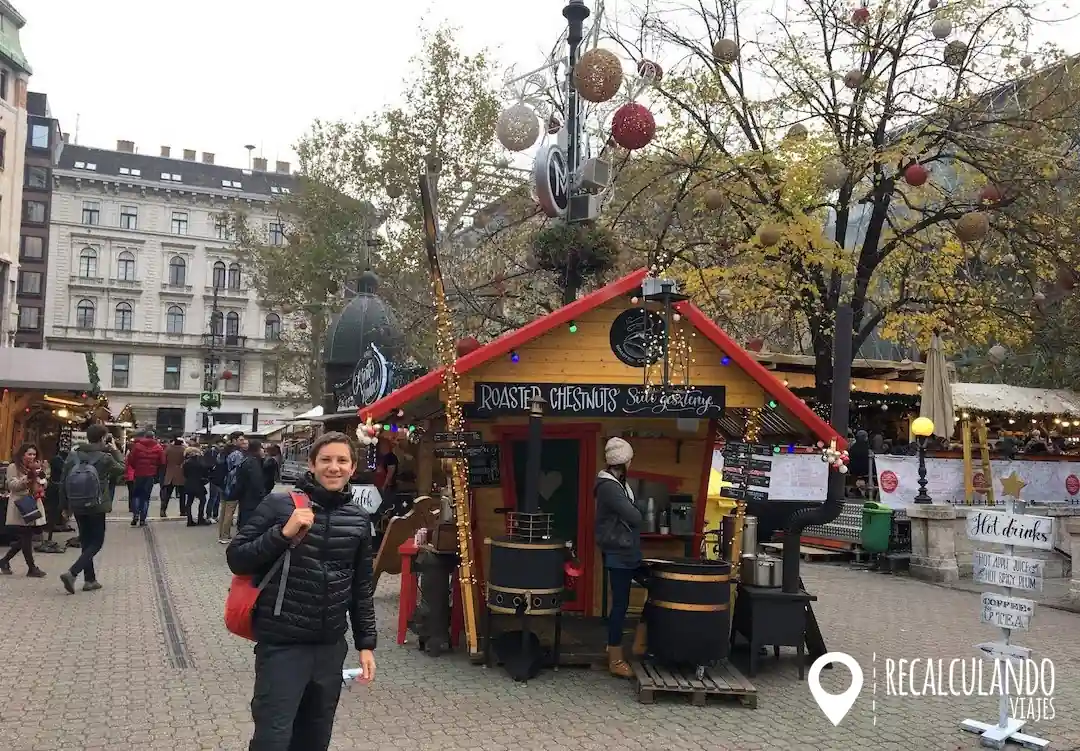
2. Advent at the Basilica, the award-winning market
If we had to choose just one place for Christmas in Budapest for someone visiting for a short weekend, this would be it. The market at St. Stephen’s Square, known as Advent Bazilika, started in 2011 and has since become the absolute favorite: it has been voted the best Christmas market in Europe for several years in a row.
The scenery helps a lot. St. Stephen’s Basilica is 96 meters high—the exact same height as the Parliament, a nod to the year 896 of Hungary’s founding—and serves as a backdrop for nearly a hundred artisan stalls, a twelve-meter tree, and an ice rink set up in the center of the square.
Reference dates: the last edition was from November 14th to January 1st. Official dates for the upcoming season are confirmed between September and October on the official Advent Bazilika website.
Regular hours: Sunday to Thursday from 11:00 AM to 10:00 PM, Friday and Saturday until 11:00 PM. December 24th closes at 3:00 PM and December 25th and 26th open from 11:00 AM to 8:00 PM.
The organizers insist each year on keeping food prices reasonable, which is appreciated, because the other Christmas markets in Budapest aren’t exactly cheap. Food and drink prices at the Christmas markets are on par with Germany or Austria. Although Hungary is usually a more economical destination, that doesn’t apply inside a Christmas market.
3. The light show on the façade of the Basilica
For us, this is the most impressive free activity in all of Budapest at Christmas. Every evening, starting at 5:30 PM, the façade of St. Stephen’s Basilica turns into a giant screen: animated Christmas-themed projections that repeat every half hour until approximately 10:00 PM.
There’s no need to book, no need to pay, no need to queue. You simply arrive at the square, find a spot with a good view, and wait. Our advice is to position yourself a bit further back, towards the entrance of Zrínyi street, to get the entire building in the frame without heads blocking the bottom part.
If you’re coming with a camera or want a great photo, this is one of the things to do in Budapest that yields the best results. And since it repeats every half hour, you can watch it, head into the market to grab some mulled wine, and return to see it with different lighting.
4. Ice skating in front of Vajdahunyad Castle
The Városligeti Műjégpálya rink has been operating since 1870 and is one of the largest in Europe: 180 by 67 meters of ice set on the lake of Városliget Park. The background is the illuminated Vajdahunyad Castle. It sounds like a staged postcard, yet it’s real.
We walked through the park several times in November, when they were still preparing the surface, and just the size of the area is impressive. It usually opens in the last week of November—the exact date depends on the weather—and stays open until February.
Reference prices from the last season: around 3,500 HUF for an adult ticket on weekdays and 4,500 HUF on weekends; students and seniors around 2,500 and 3,500 HUF. There are family tickets and ten-use passes. Skate rental is paid separately and usually requires a deposit.
An honest piece of advice: towards the end of each three or four-hour session, the ice gets very chewed up and has puddles because thousands of skates have passed over it. If you’re going for the experience and the photos, it’s perfect. If you’re going to skate seriously, there are smaller rinks with better ice, such as the one set up in the Basilica square.
Our luggage checklist will come in handy here: thin gloves to use your phone, a hat, and a good pair of thermal socks completely change the experience of an afternoon outdoors.
5. Városháza Park, the most peaceful Christmas market in Budapest
A few minutes’ walk from Vörösmarty is an inner park, Városháza Park, which fills with wooden huts, hanging lights, and a smaller ice rink during the season. It’s one of the places to see in Budapest that most guides overlook, which is precisely why it works so well.
The atmosphere is more local and less crowded. There are benches, space to sit down, and the value for money is much better compared to the two large markets. If you’re traveling with kids or just can’t stand crowds, add it to your itinerary in the mid-afternoon, before the sun sets.
This park is also a good mental shortcut to understand the city: you are five minutes from the most famous market in Hungary and suddenly the volume turns down. Budapest has a lot of that.
6. Ride the fényvillamos, the light tram
One of the must-dos of Budapest at Christmas, and it costs the same as a regular transport ticket. During the Advent season, the transport company covers several trams with thousands of LED lights and puts them into service on regular lines. They are called fényvillamos and are usually seen on lines 2, 47, and 49, among others.
Line 2 is the one to look for. It runs along the Danube on the Pest side, passing in front of the Parliament, the Chain Bridge, and with views of Buda Castle on the other side of the river. At night, with the illuminated tram and the city reflected in the water, it’s one of the best cheap tours we’ve done in Europe.
How to take advantage: the schedules when the illuminated tram runs are published each season and it’s not a continuous service, so you might have to wait. In the meantime, the regular line 2 is already worth it for the route. We used it daily during our two and a half weeks in the city and it never got boring.
Price: a single ticket costs 500 HUF (700 HUF if purchased from the driver), the 90-minute ticket 850 HUF, and the 24-hour pass 2,750 HUF. They can be bought at the yellow machines at the stations or from the official BudapestGO app. Always validate: the fine is high and inspectors really check.
👩⚕️👨⚕️ A must-have for stress-free travel! 🌎✈️ ➜ Get a Quote, Compare & Buy
7. The Széchenyi Thermal Baths with the air at zero degrees
Soaking in 38-degree water while steam covers everything and it’s cold outside is, for us, the best Christmas plan in Budapest that has nothing to do with Christmas markets. The Széchenyi are inside Városliget Park, in a huge yellow neo-baroque building, and have outdoor pools open all year round.
We went early on a weekday morning and it was the right decision: practically no queue and the large pools almost empty during the first hour. From noon onwards, everything changes.
2026 prices: a full-day ticket with a locker costs around 13,200 HUF on weekdays and 14,800 HUF on weekends. With a private cabin, you add about 1,000 HUF more. There are early-bird access tickets that are quite a bit cheaper if you wake up motivated.
Two important and updated warnings: as of August 2025, children under 14 are not allowed to enter Budapest’s thermal pools, and the Gellért baths are closed for renovations until 2028. If you read in an old blog that Gellért is unmissable, it’s no longer an option. The alternatives are Széchenyi, Rudas, and Lukács.
What to bring: swimsuit, flip-flops, and a towel. They are rented there, but you pay quite a bit more than what they’re worth.
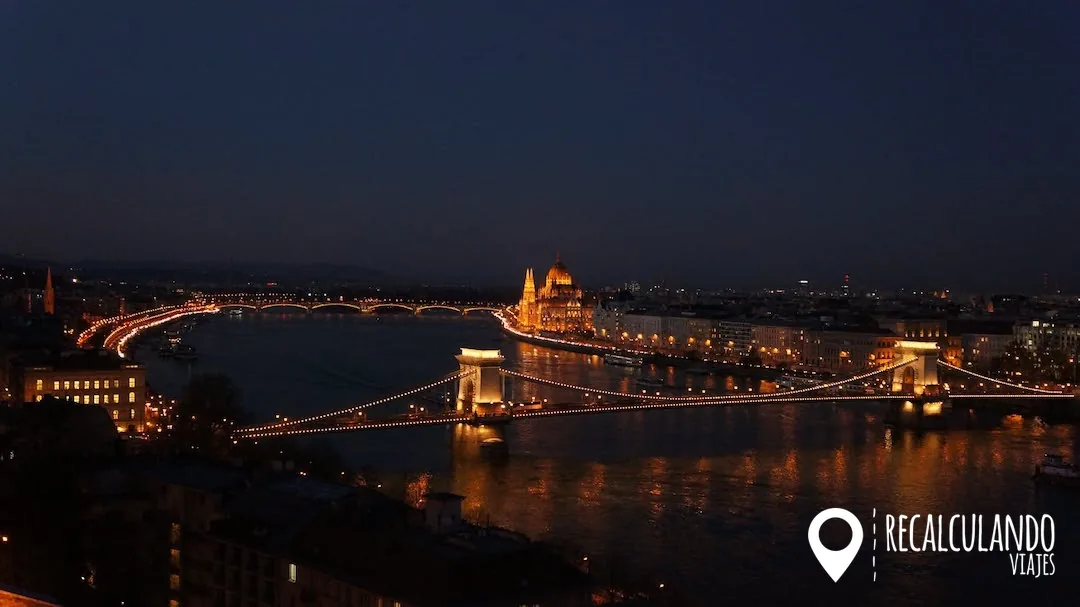
8. The illuminated Parliament from the Buda shore
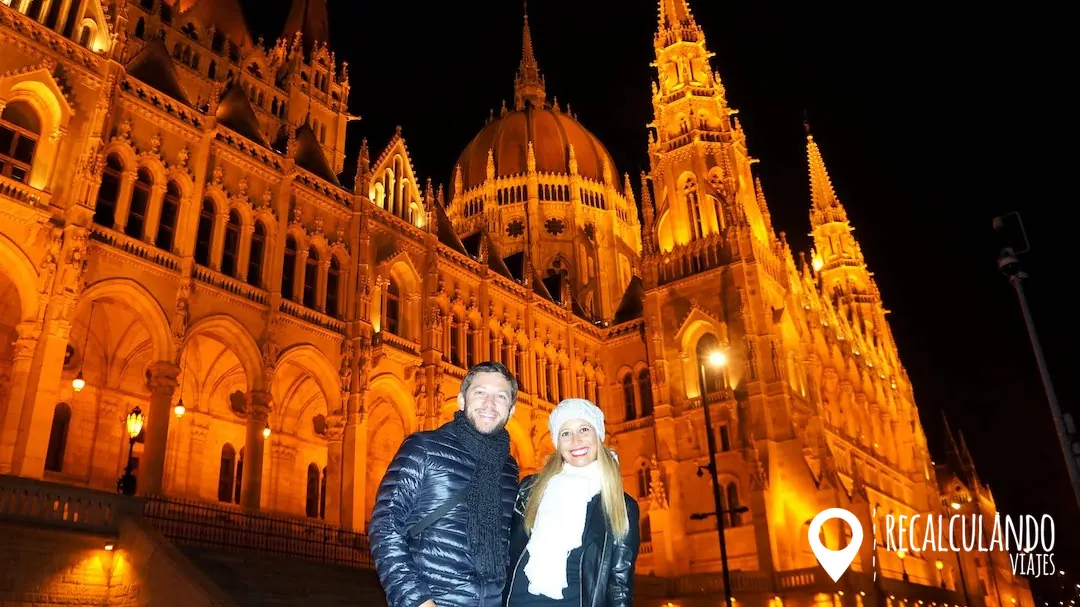
The Hungarian Parliament is the building that defines the postcard of Christmas in Budapest, and in winter it has an advantage: it gets dark around 4:00 PM, so the lights turn on early and you have many hours of “blue hour” to see it.
The trick that worked for us was crossing to the Buda shore, to Batthyány tér (stop for the M2 metro line). From there you have the entire building in front, symmetrical, reflected in the Danube. Arrive about twenty minutes before sunset and stay until it’s completely dark: they are two completely different photos.
To go inside, you must book an official guided tour, with tickets reserved in advance on the Parliament’s own website. In December spots fly, so if you’re interested, book weeks in advance. We stuck with the exterior view and didn’t regret it one bit: it’s one of those buildings that impresses more from a distance.
9. Advent Budán: the market at Buda Castle and Fisherman’s Bastion
Crossing to the castle hill is the Fisherman’s Bastion, with its fairytale white towers and Matthias Church next to it. In Szentháromság Square, in front of the church, the Advent Budán market is set up: smaller than those in the center, with local artisans, free concerts on weekends, and candle-lighting ceremonies. Last season it ran from November 29th to December 24th, every day from 9:00 AM to 7:00 PM, and some sources extend it until the first days of January. It is clearly the most romantic and the one with the fewest people.
It’s one of the things to do in Budapest that changes completely depending on the time. By day you have the panoramic view over the Danube and all of Pest; at night, with the warm lights and fewer people, the area becomes silent and quite magical. We went up several times and always preferred sunset.
How to get up: you can walk from the Chain Bridge (a short but real climb), take the funicular, or take buses 16, 16A, and 116 from Deák Ferenc tér. In winter, with ice on the cobblestones, the bus is a very reasonable option. And if you go on foot, go up the stairs on the bridge side instead of paying for the funicular: it’s a five-minute climb and you save yourself the queue.
The high terraces of the Bastion have a paid entrance in some sections and hours, but much of the route and the best views are free. Don’t let yourself be sold the opposite.
10. Erzsébet Square, its market and the Ferris wheel
Erzsébet Square is a step away from Deák Ferenc tér, the hub where three metro lines cross, and in season it adds a smaller Christmas market next to the city’s giant Ferris wheel.
The Ferris wheel runs all year round and climbs about 65 meters, enough to see the center of Pest illuminated from above. It’s not the most spectacular view of Budapest—for that, there’s the castle hill—but at night, with the Christmas lights on and the wooden stalls below, it has its charm.
Between this market and Vörösmarty there is a five-minute walk along Deák Ferenc street, which is decorated entirely with light installations at this time. It’s the pedestrian stretch we liked most to walk aimlessly on any given night.



11. The Great Market Hall, perfect shelter for a rainy day
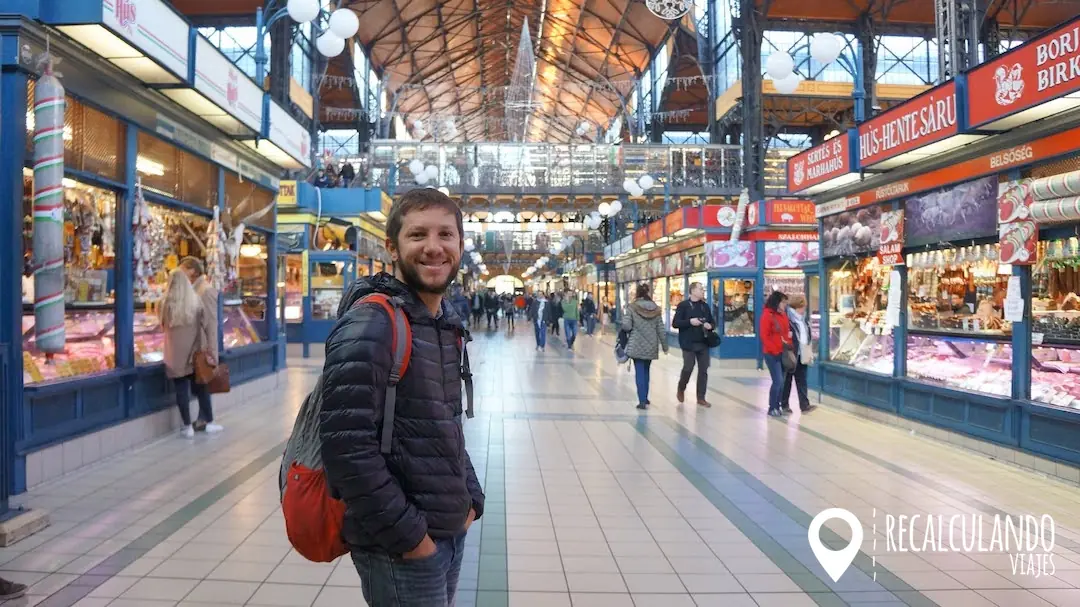
The Nagyvásárcsarnok is an 1897 building with a colorful tiled roof and three floors of stalls. In December it is decorated, gets crowded, and becomes one of the most useful places of interest in Budapest for the whole season: you are indoors, in the warmth, and you can buy gifts and food all in one place.
On the ground floor is the real deal: canned Hungarian paprika (sweet and spicy), sausages, cheeses, jars of preserves. It’s the best place to buy edible souvenirs at a decent price, well below what the same thing costs at the Christmas markets.
The top floor is for embroidery, tablecloths, and souvenirs, more oriented towards tourism, and also has fast-food Hungarian stalls. We often stopped by to buy fruit and vegetables to cook in the apartment, which is one of the advantages of staying many days in one place.
Watch out for the hours: it is closed on Sundays and closes mid-afternoon on Saturdays. It’s a classic mistake to leave it for the last day of the trip and find it with the shutters down.
12. Andrássy Avenue and the Opera with lights
Andrássy Avenue is a World Heritage Site and connects the center with Heroes’ Square in a straight line. In December it is fully illuminated and walking it from end to end is a plan in itself, although it is about two and a half kilometers and with the cold it can be tiring.
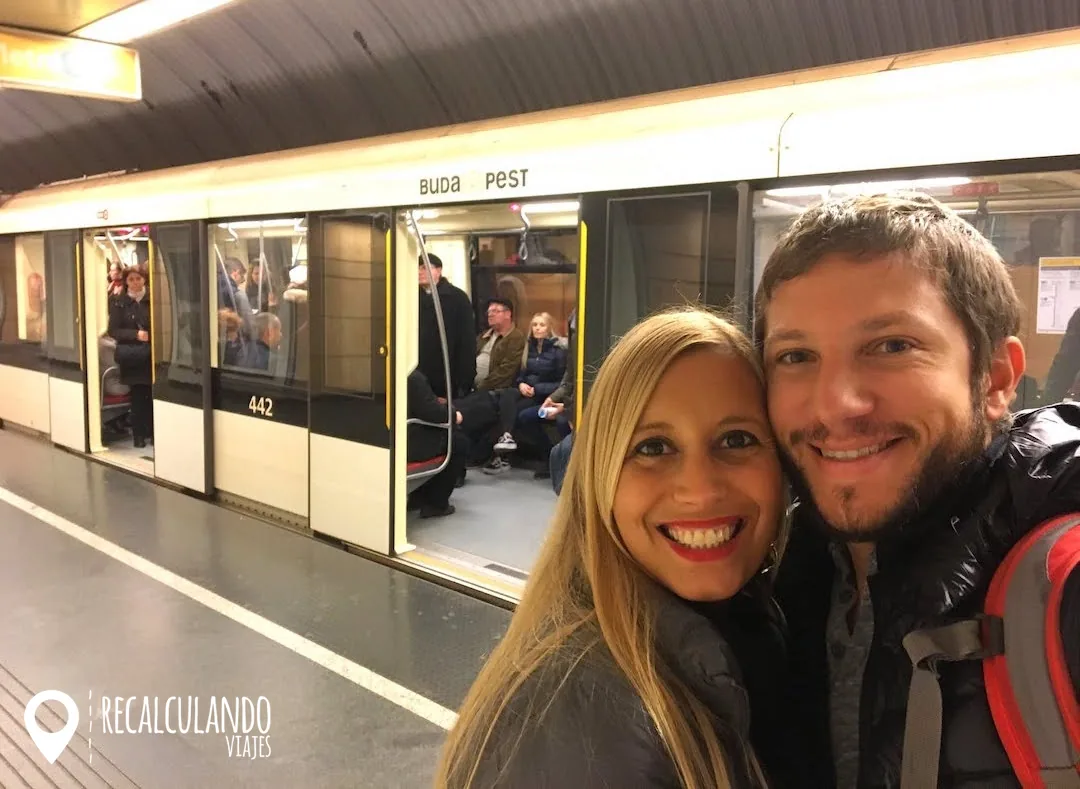
Our recommendation is to do it in sections and use the M1 metro line, the Millennium, which runs just below. It is the oldest metro line in continental Europe (1896), with small stations with tiles and wooden structures that look like a museum. It’s worth riding even if you don’t need to go anywhere.
Halfway through is the State Opera, renovated a few years ago and one of the most beautiful on the continent. During the Christmas season, there is a special concert schedule, and tickets for popular performances are surprisingly accessible compared to Vienna or Milan.
13. Eat and drink at the markets: kürtőskalács, lángos, and mulled wine
No guide to Budapest at Christmas is complete without talking about what to eat, so let’s get down to business. These are the four things you definitely have to try:
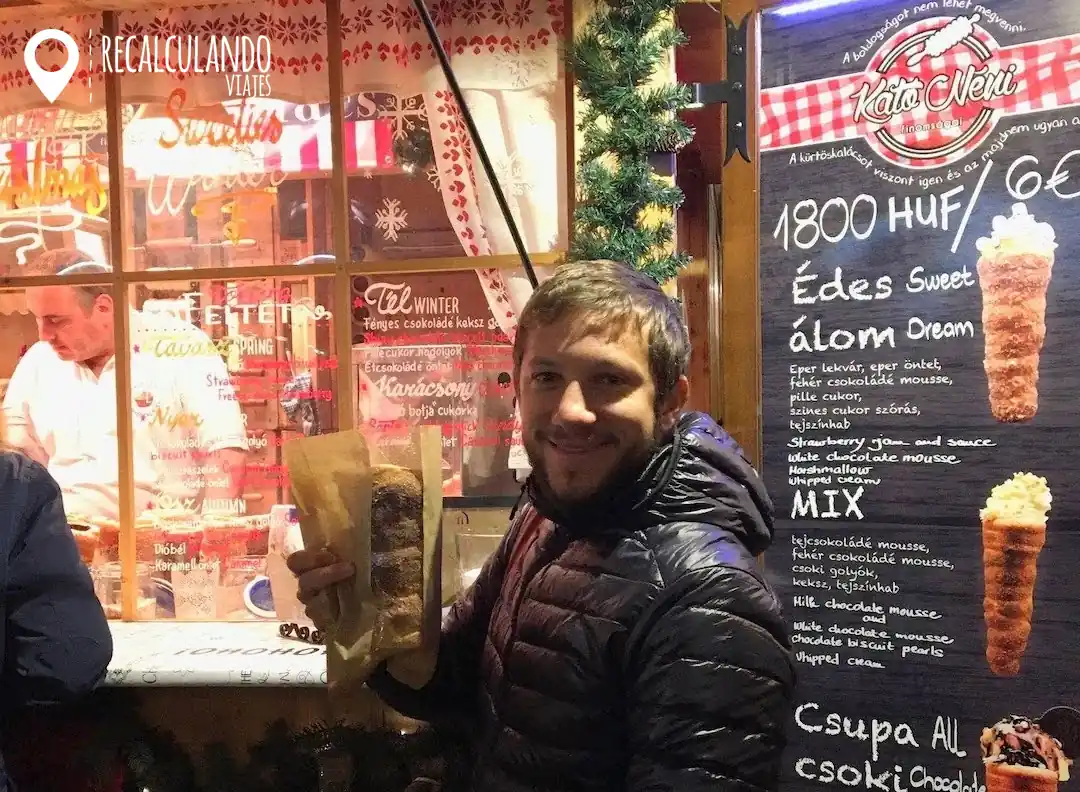
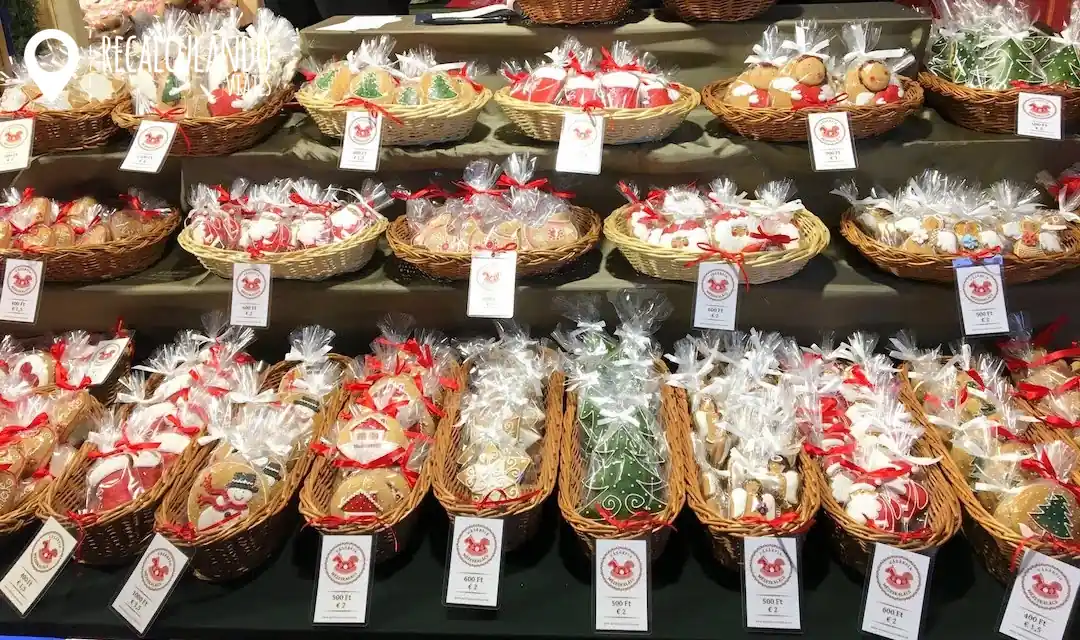
- Kürtőskalács: the famous “chimney cake”. Dough wrapped around a cylinder, cooked over coals and rolled in sugar, cinnamon, walnuts, or cocoa. Eat it fresh, still hot, it’s a delight! Cold, it loses all its charm.
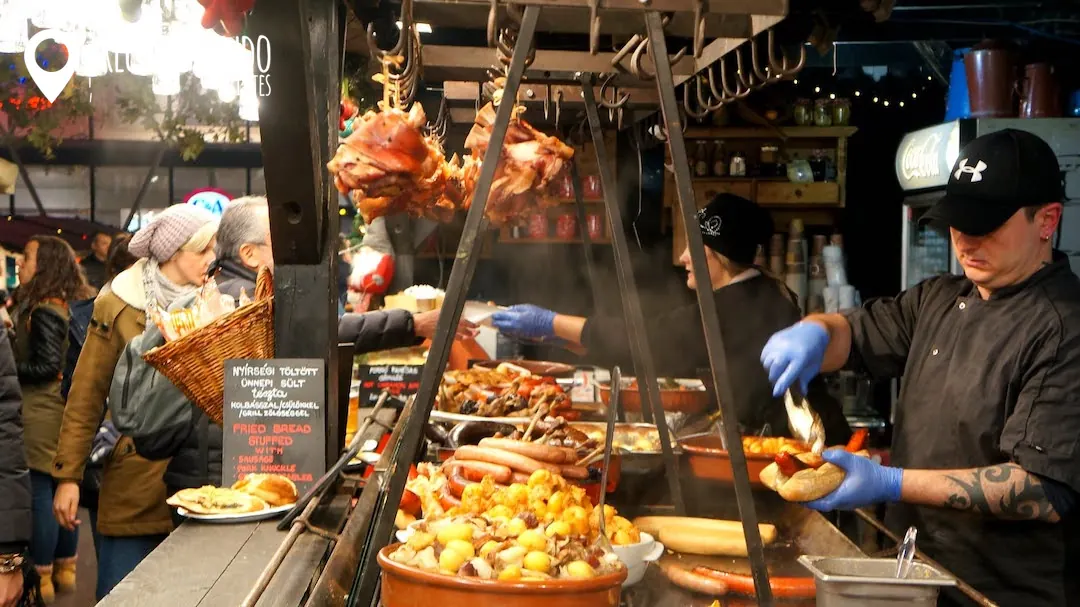
- Lángos: deep-fried dough, generous and substantial, with sour cream and grated cheese on top. It’s the Hungarian version of a caloric hug.

- Forralt bor: local mulled wine, with cinnamon and citrus. Served in a mug, and you almost always pay a deposit for the container that is returned to you upon returning it.
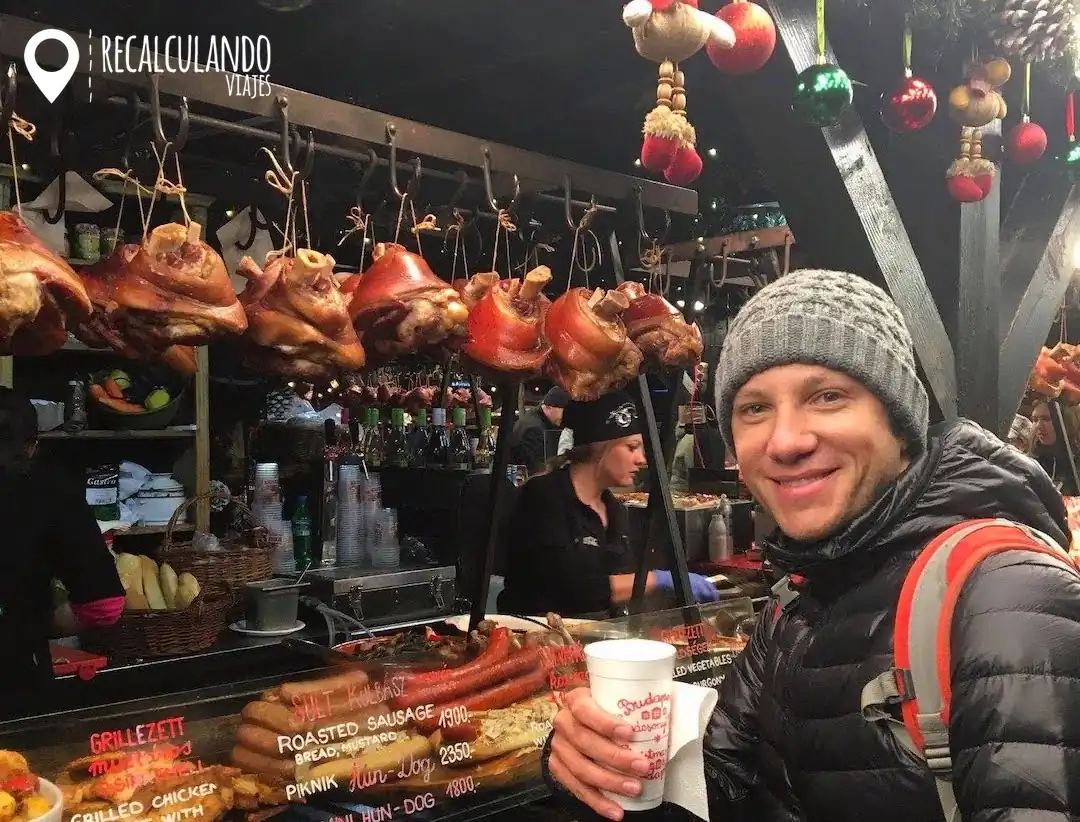
- Gulyás: more soup than stew, with meat, potatoes, and plenty of paprika. In a market at five degrees, it’s excellent!
As you know if you’ve been reading us, we don’t recommend restaurants by name unless we’ve tested them ourselves and they remain open and good. We prefer to tell you what to order and let you choose the stall that looks best that night.
The tip that saves you money: prices inside Christmas markets are clearly higher than at any bar in the center. If you’re going to be there for several days, alternate. One night you dine at the market for the atmosphere and the rest you eat in the neighborhood.
14. Óbuda, Christmas in Budapest far from the tourist circuit
To the north of the city, the main square of Óbuda sets up a much more family-friendly and local Christmas market every December. It doesn’t have the scale or production of those in the center, and that’s exactly the point.
It’s the option for those who have already seen the two big ones and want to understand how people who actually live in the city experience Christmas. It usually runs for a shorter period, approximately from late November to December 22nd or 23rd, so it’s worth checking dates before taking the HÉV or tram there.
Óbuda is also the oldest part of Budapest, with low houses, cobblestones, and a completely different pace. Even if the market weren’t there, the walk is worth it.
15. New Year’s Eve on the Danube and a sunset cruise
If your trip extends until the 31st, know that Christmas in Budapest ends with a bang. The markets extend hours until dawn, there is music in the streets, and the center gets packed. It also means higher accommodation prices and crowds, so it’s a conscious decision.
The plan we liked most to see the illuminated city was the river. A Danube cruise at sunset gives you the Parliament, the Chain Bridge, Buda Castle, and Fisherman’s Bastion all lit up and in motion, all in an hour. With the cold outside, boats with covered decks and heating are a success.
You can book the Danube cruise and other guided tours in Spanish at Civitatis, which usually has the best options for these dates.
Another cheaper alternative: walk up to Fisherman’s Bastion or cross the Chain Bridge at night. Free, and with views that compete on equal terms.
16. Varázsliget, the magical park of Vajdahunyad
Next to the ice rink, in the same Városliget Park, the Varázsliget or “magic forest” is set up every season: a small winter amusement park with the illuminated Vajdahunyad Castle in the background. It is the plan most geared towards kids in all of Budapest’s Christmas.
The main attraction is a Ferris wheel decorated with lights. Prices for the last season were 1,500 HUF for those under 14 and 2,000 HUF for those older. There are also carousels, food stalls, and workshops.
TIP: unlike most markets and attractions, the Varázsliget also opens on December 24th, 25th, and 26th. If you travel on those exact days and everything else is closed or has reduced hours, it can be an option.
17. The lights of Fashion Street and the tree in Deák Ferenc utca
Deák Ferenc street, known as Fashion Street, connects Vörösmarty Square with Erzsébet Square and becomes a tunnel of lights in season. It’s short—you can walk it in five minutes—but it’s one of the best-done lighting installations in the city, with a giant tree that lights up the same day the big markets open.
In addition to the lighting, there are some loose Christmas stalls with crafts, jewelry, and ornaments. We walked this street dozens of times in November and even with the structures mounted you could tell it was going to look good.
In Vörösmarty Square itself is the building of the historic Gerbeaud café, which turns its windows into a giant Advent calendar every December: one illuminated window is opened per day until the 24th. We didn’t go in to have anything there—the prices are from another galaxy—but the façade is free to look at and it’s one of the nicest details of the center.
18. Szabadság tér market, the most design-oriented
Liberty Square is five minutes from the Parliament and sets up a much more contemporary Christmas market than the rest: fewer traditional ornaments and more current Hungarian design, natural cosmetics, bags, and items from local studios.
It’s the ideal market if you’re looking for gifts that aren’t the typical magnet or the repeated wooden ornament. It’s also noticeably quieter than Vörösmarty, which by that time of the afternoon is already a sea of people.
The square itself is worth a visit all year round: it has gardens, fountains, and a mix of buildings that tells half the history of the 20th-century Hungary in one place.
19. Lumina Park on Margaret Island
On Margaret Island, next to the Palatinus baths, the Lumina Park is set up every winter: a night route with over two hundred light installations, music, and illuminated scenes representing classic tales.
It’s a paid plan and quite different from the rest: it’s not a market, it’s a themed walk of approximately one hour. It works very well with children and also as a couple’s plan for a night when you’ve already seen all the markets.
Margaret Island itself is one of the places to see in Budapest that we liked most during our stay. In winter it is almost empty and you can get there by tram 4 or 6, getting off at the Margit Bridge stop.
20. The Nutcracker and Advent concerts
The Hungarian State Opera schedules The Nutcracker and other Christmas shows every December. Tickets are significantly cheaper than in Vienna or Prague for a very comparable level, but they sell out very far in advance: if you’re interested, buy as soon as the schedule is released, which is usually published at the end of August or September.
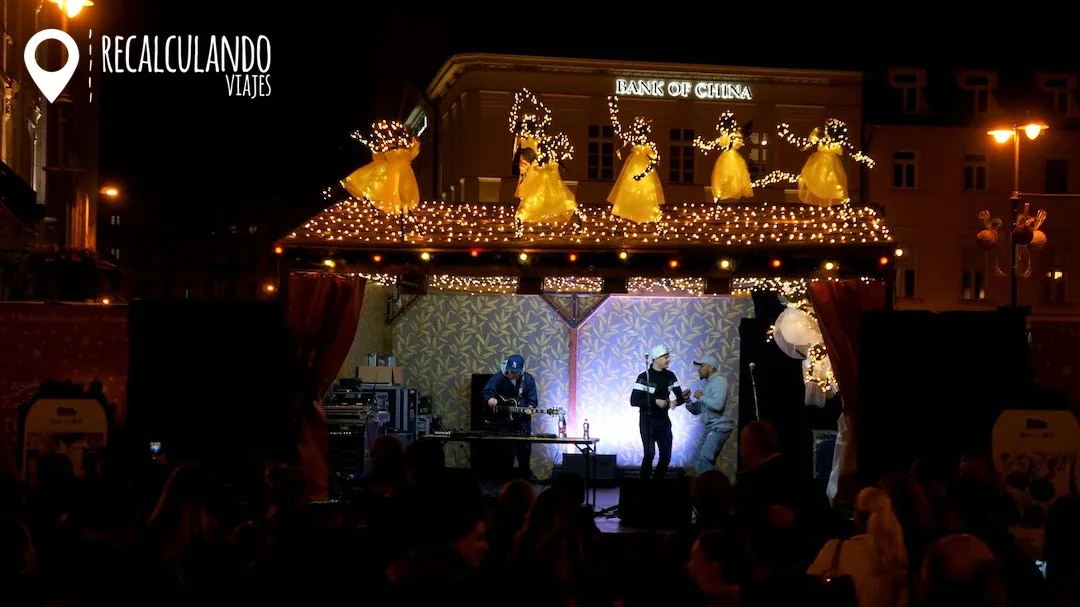
If you don’t get tickets, there’s a pretty good free alternative: the Basilica market has Advent concerts several days of the week, usually Wednesdays, Fridays, Saturdays, and Sundays around 5:00 PM. They are outdoors, free, and have the illuminated façade in the background.
Organ and choir concerts are also organized inside St. Stephen’s Basilica itself, with paid tickets. We didn’t go to any, but many travelers point to them as one of the best plans of the season.
21. Climbing the dome of St. Stephen’s Basilica
From the panoramic terrace of the basilica you have a 360-degree view over the center of Pest, and in December, with the lights on from 4:00 PM, it is a top-tier viewpoint. You go up by elevator or stairs.
Watch out for this, it changed: until recently entry to the temple was a symbolic donation. Since 2026, access is fully ticketed, with turnstiles and a ticket office, and the full pass (church, dome, and treasury) is around 18 euros. Winter hours for the dome are more limited than in summer and, if there is dense fog, they can close the viewpoint for safety.
Our advice: check the schedule the same day on the basilica’s official website before climbing the hill, because weddings on Saturday afternoons and solemn masses alter access.
22. The Christmas tree in Kossuth Square, in front of the Parliament
Every year a huge fir tree is planted in Kossuth Lajos Square, right in front of the Parliament, and it is illuminated throughout the season. It is the country’s official tree and the combination with the illuminated neo-Gothic façade is probably the most striking photo of Christmas in Budapest.
There is no market or stalls here, it’s just the tree and the square, so it’s a ten-minute stop that fits perfectly before or after the visit to the Parliament. It is reached in a minute by the M2 metro line, Kossuth Lajos tér stop.
Combine it with the walk to the Buda shore that we told you about above and you have a whole afternoon sorted without spending a forint.
3-day itinerary for Christmas in Budapest
This is the schedule we would put together if we had a long weekend and wanted to see the essentials without rushing. It’s designed so that sunset, which arrives around 4:00 PM in December, always catches you in the right place.
| Day | Morning | Afternoon and night |
|---|---|---|
| Day 1 | Great Market Hall and walk through the center of Pest | Vörösmarty market, Fashion Street lights, Erzsébet tér Ferris wheel, and Basilica light show at 5:30 PM |
| Day 2 | Széchenyi baths as soon as they open | Ice skating and Varázsliget in Városliget, Heroes’ Square, and walking back along the illuminated Andrássy Avenue |
| Day 3 | Parliament and Kossuth Square tree | Buda Castle, Advent Budán in Szentháromság tér, sunset from the Bastion, and tram 2 at night |
If you add a fourth day, spend the morning in Szentendre and leave the afternoon free for the Szabadság tér market and Lumina Park on Margaret Island.
Currency, payments, and currency exchange in Hungary
Hungary does not use the euro. The currency is the Hungarian forint (HUF) and this is probably the point where people lose the most money without realizing it.
- Pay by card whenever you can. At the Vörösmarty market, several stalls do not accept cash at all. Use a card with no foreign exchange commission.
- Reject dynamic conversion. When the card reader or ATM asks if you want to be charged in euros, always say no and choose forints. That “favor” costs you between 5 and 10%.
- Avoid the exchange offices on Váci Street and ATMs of independent tourist brands, which apply very high commissions. Withdraw from actual Hungarian bank ATMs.
- The mug has a deposit. Mulled wine is served in a ceramic mug with a deposit that is returned to you upon returning it. If you want to keep it as a souvenir, simply don’t return it: you’ve already paid for it.

What to wear and practical tips for the cold
After two and a half weeks in the city with single-digit temperatures, this is what really matters:
- Waterproof footwear with good soles. It doesn’t snow much, but it rains, and the wet cobblestones of the castle are an involuntary skating rink.
- Layers, not one huge coat. You’ll be going in and out of the cold into places with strong heating all day.
- Thin touchscreen-compatible gloves. Between the map and the photos, taking them off twenty times an hour is torture.
- Swimsuit, flip-flops, and towel if you go to the baths. Renting them there is quite a bit more expensive.
- Go to the markets on weekdays and early. On Saturdays from 6:00 PM, the Basilica market is literally a bottleneck.
- Save an afternoon for indoors. If it rains heavily, the Great Market Hall, the Opera, the spas, and the large shopping malls will save your day.

Where to stay in Budapest at Christmas
The ideal area is District V (Belváros-Lipótváros), the center of Pest: you have the two large markets, the Basilica, the Parliament, and the Danube on foot. District VI, around Andrássy Avenue, is a bit cheaper and still well connected. District VII, the Jewish Quarter, is the liveliest at night, with the good and bad that entails.
An important change for 2026: short-term tourist rentals (like Airbnb) have been banned in District VI since January 1, 2026. Hotels and B&Bs are not affected. If you were looking at apartments in that area, check carefully before booking.
In December, prices rise a lot and good places sell out early. We would book two or three months in advance, especially if you travel during Advent weekends or for New Year’s Eve.
Accommodation in Budapest: Map and Prices
On the map below you can move, zoom, and filter by your dates to see accommodation prices in Budapest:
How to get to Budapest and get around the city
Liszt Ferenc Airport (BUD) is about 25 kilometers from the center. There are direct flights from almost all over Europe and it is one of the cheapest destinations on the continent by air, although rates stretch in December.
From the airport to the center:
- Bus 100E: the most direct, to Deák Ferenc tér. Requires a special ticket (about 2,200 HUF) which is not included in any pass or card.
- Bus 200E + M3 metro: the economic option. Works with the regular 500 HUF single ticket, but you have to transfer and it takes longer.
- Taxi or private transfer: most comfortable if you arrive at night or with suitcases. Always use official taxis from the airport counter.
Getting around the city: public transport is excellent and cheap. Metro, tram, trolleybus, and bus share the same ticketing system. If you’re going to make more than three or four trips a day, the 24-hour pass for 2,750 HUF is worth it; for a long weekend, the 72-hour one. Download the BudapestGO app and forget about the machines.
If you’re coming from another city in the region, Budapest is very well connected by train with Vienna and with Bratislava at Christmas, which is just two and a half hours away and can easily be done in a day.
To avoid relying on bar Wi-Fi while looking for schedules or the map, we always travel with an eSIM from Holafly with unlimited data: it activates before leaving home and with the code RECALCULANDOVIAJES you get a discount.
Travel insurance for your Christmas in Budapest
Hungary is in the European Union, so if you’re European, your health card covers the basics. But in winter there are two things the card doesn’t solve and which are quite common in December: ice falls and flights canceled or delayed due to snow.
We’ve traveled for years with IATI Seguros and it’s what we recommend for a winter getaway to Budapest. It covers medical assistance without advancing money, luggage loss, and flight delays, which are not at all rare during the Christmas season.
Booking with IATI from this link gives you a permanent 5% discount, which in specific campaigns reaches up to 15%.
If you’re comparing alternatives before deciding, we have a complete guide on the best travel insurance for Europe with the coverage that actually matters.

Excursions to complete Budapest at Christmas
If you have days to spare, the city works very well as a base. These are the getaways that make the most sense in December:
- Szentendre: a town of colorful houses 40 minutes away by HÉV suburban train. It has its own little Christmas market and can be done in half a day.
- Danube Bend (Esztergom and Visegrád): huge cathedral, castles, and river views. Better with an organized tour in winter because public transport is slow.
- Gödöllő: Empress Sisi’s favorite palace, with its own Christmas schedule.
- Bratislava: two and a half hours by train and another capital with markets. Very easy to combine.
- Vienna: also two and a half hours by direct train. Many travelers set up the classic Central Europe circuit by combining both cities in one trip.
If you prefer to drive and set your own pace, we compare prices on DiscoverCars, although for the city itself, a car is more of a hindrance than a help.
Map of the 22 places to see Christmas in Budapest
Here you have the 22 markets, viewpoints, and plans from this guide marked on a single map, so you can build your route according to where you’re staying. Almost everything is within a walkable radius in the center of Pest, with two or three exceptions that require the metro or tram.
Frequently Asked Questions about Christmas in Budapest
When does Christmas start in Budapest?
The big markets open in mid-November. In the last season, both the Basilica and Vörösmarty markets started on November 14th and continued until January 1st. Official dates for each year are confirmed between September and October.
When do they turn on the Christmas lights in Budapest?
Street lighting turns on along with the opening of the markets, in mid-November. The light show on the façade of St. Stephen’s Basilica starts every evening at 5:30 PM and repeats every half hour until approximately 10:00 PM.
What is the temperature like in Budapest at Christmas?
In December, temperatures are usually 4 to 8 °C during the day and sub-zero in the early morning. Snow is not frequent in November or December, but rain is. Bring proper warm clothing, waterproof footwear with good soles, and gloves.
How many days do you need to see Budapest at Christmas?
With three full days you’ll see the main markets, the baths, and the classic sights without rushing. With four, you can add an excursion to Szentendre or the Danube Bend. We stayed 16 nights and didn’t have time to spare, but that’s a different kind of trip.
Vienna or Budapest at Christmas?
Vienna has more markets, more production, and a more consolidated Christmas tradition, but it’s quite a bit more expensive. Budapest offers two top-level markets, lower accommodation and transport prices, and the huge plus of the thermal baths. If you have to choose only one and budget matters, choose Budapest. If you can, do both: they are two and a half hours apart by train.
Prague or Budapest at Christmas?
Prague is probably more photogenic overall, with the entire historic center acting as a stage. Budapest wins with the highest-rated individual market in Europe, the baths, and the scale of the illuminated river. If you already know Prague at Christmas, Budapest is the logical next step.
Can you pay in euros at the Christmas markets in Budapest?
Not reliably. The currency is the Hungarian forint and even if a stall accepts euros, the exchange rate they give you will be bad. The best thing to do is use a card without commissions or forints withdrawn from bank ATMs. Avoid Váci Street exchange offices and tourist ATMs with sky-high commissions.
Do the markets open on December 25th?
Yes, but with reduced hours. On the 24th they close in the mid-afternoon, the 25th and 26th usually open around noon and close early, and the 31st they stay open until the early morning. Museums and many shops, however, are closed directly on the 24th, 25th, and 26th.
Which is the best Christmas market in Budapest?
The one at St. Stephen’s Basilica square (Advent Bazilika), without argument: it has been voted the best Christmas market in Europe for several years in a row due to the quality of the artisans, the twelve-meter tree, and the light show on the façade. The one at Vörösmarty is the oldest and the most central, and they are a five-minute walk from each other.
Does it snow in Budapest in December?
Rarely. Snow is not common in November or December; you’re more likely to experience damp cold and rain. If you want a real chance of snow, January and February are better bets, although by then the big markets have already closed.
How much does a trip to Budapest at Christmas cost?
Expect to spend between €60 and €90 per person per day excluding accommodation, counting meals, transport, and one or two entrance fees. You can lower this significantly by cooking in the apartment and taking advantage of the fact that many of the best plans—lights, markets, viewpoints, tram 2—are free or nearly so.
Are there Christmas markets outside the tourist circuit?
Yes, and they offer the best value for money. The one in Óbuda, in the main square of the city’s oldest neighborhood, and the one in Szabadság tér, which is more oriented towards contemporary Hungarian design, are the two we would recommend if you’ve already seen the big ones or if the crowds overwhelm you.
Conclusion: why we would return to Christmas in Budapest
After 16 nights living in the city like locals, it was very clear that Budapest has something that many European capitals lost: it remains a city that you can walk around without feeling like you’re paying an entrance fee at every turn. Christmas in Budapest adds a layer of lights, stalls, and mulled wine on top of a foundation that was already great to begin with.
Our honest summary of the 22 plans: the two big markets are absolutely worth it but expensive to eat at; the Basilica light show is the best free plan of the season; the thermal baths in winter are unforgettable and it’s best to go early; and the tram 2 at night, for 500 forints, competes with excursions that cost twenty times more.
If you have to choose a destination for your first Christmas getaway in Central Europe, Christmas in Budapest is a top-tier candidate. We would return, and this time in December indeed.
Have you been to Budapest at Christmas yet? Tell us in the comments which market you liked the most, it helps us a lot to keep updating the guide. And if you want to keep planning your trip, visit our Hungary section.
Other articles for your Christmas trip
- Europe Christmas Markets 2026: The 10 Best and Dates
- Christmas in Graz 2026: markets, map, dates and things to do in 🇦🇹
- Things to do in Montreal at Christmas 2026: Guide + Markets (Map)
- Christmas in Quebec 2026: Things to do in + Market Map 🇨🇦
- Things to do in Bratislava at Christmas 2026: markets, lights, and a complete…
- Things to do in Dublin at Christmas: 2026 Guide with 18 Magical Experiences
- Christmas in Edinburgh 2026 – Christmas markets, lights and complete guide –…
- New York at Christmas 2026: Guide + Photos and locations
- Seville at Christmas 2026: Guide with 24 must-see places (map)
- Things to do in Prague at Christmas 2026: Complete guide, dates and maps
- Things to do in Innsbruck at Christmas 2026: Complete Guide + Christmas Markets…
- Things to do in Copenhagen at Christmas: The Magic Guide with 17 Must-Sees
- Málaga at Christmas: 20 essential things to do in (with map)
- IATI 15% Discount – IATI Travel Days 2026 (July 13–19)
- Travel Discounts 🌍 | Don’t miss these discounts for your trips!
ℹ️ **Total Transparency**
This article contains affiliate links. If you book through these links, we may receive a small commission at no extra cost to you. We only recommend services we use on our travels and trust. This helps us keep this blog free and continue creating useful content for you. Thank you for your support!
🔗 Resources & Useful Links for your trip to Budapest at Christmas
Do you have questions or want to add your own recommendations on things to do in Budapest at Christmas?
💬 Leave your comment or write to us, we love reading other travelers’ experiences.
Thank you so much for being part of this adventure!— Nanu & Facu 🌎 | Recalculando Viajes 💜